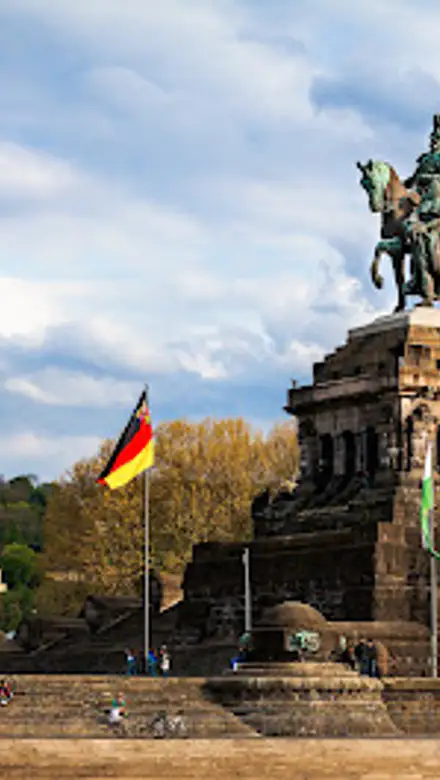
Deutsches Eck Travel Guide
Free Guide: Witness the confluence of the Rhine and Moselle at Deutsches Eck in Koblenz, a symbol of German unity and a UNESCO World Heritage Site.


A brief summary of Deutsches Eck
Witness the confluence of the Rhine and Moselle at Deutsches Eck in Koblenz, a symbol of German unity and a UNESCO World Heritage Site.
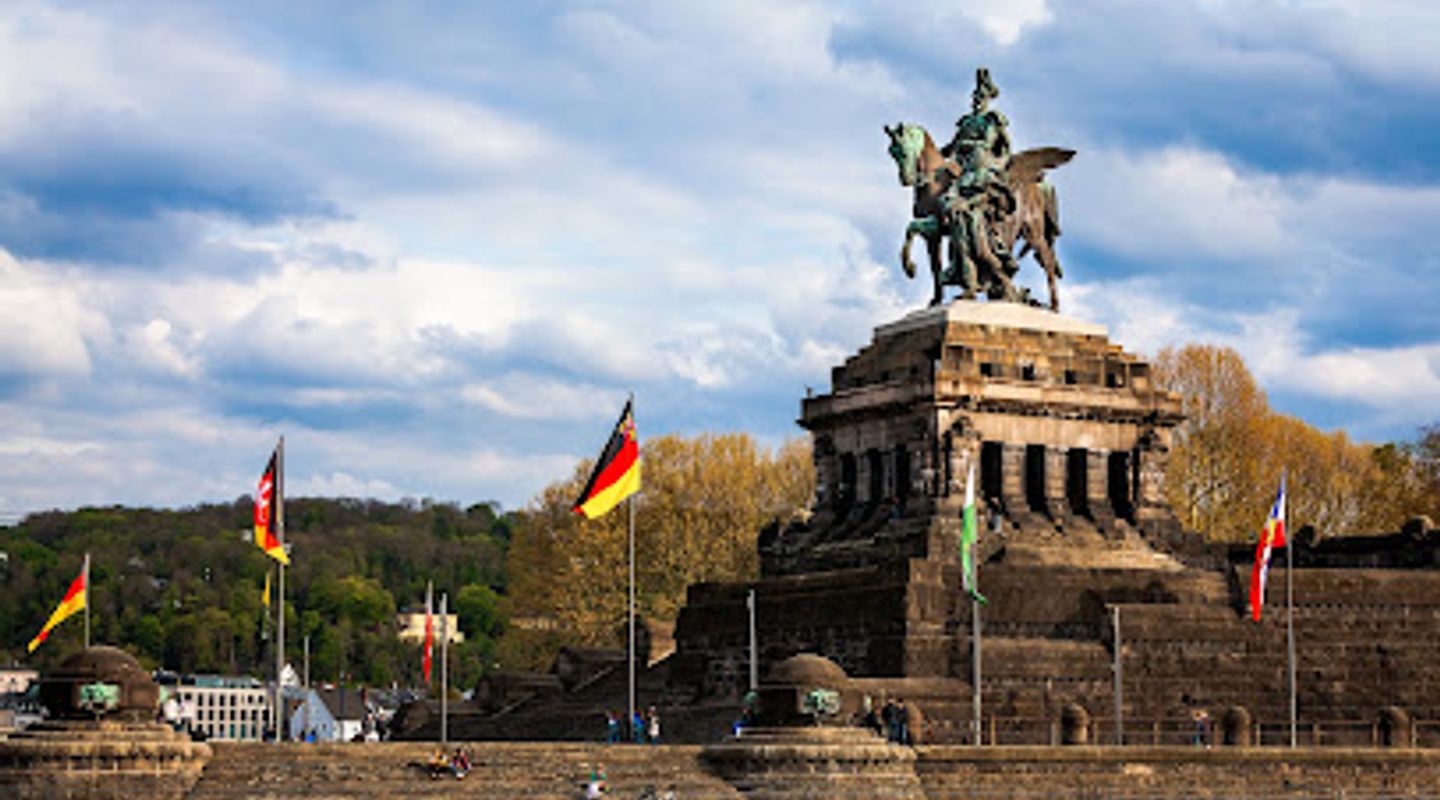
The Deutsches Eck (German Corner) in Koblenz marks the confluence of the Rhine and Moselle rivers, dominated by a monumental equestrian statue of Emperor Wilhelm I. This iconic landmark symbolizes German unity and offers stunning panoramic views. Originally named after a Teutonic Order settlement in the 13th century, the site gained prominence in the late 19th century with the construction of the Kaiser Wilhelm Monument. Destroyed in World War II, it was rededicated as a symbol of German unity in 1953, later reconstructed in 1993. Today, it attracts over 2 million visitors annually and is part of the UNESCO World Heritage Site 'Upper Middle Rhine Valley'. Visitors can explore the area, enjoy riverfront promenades, and take a cable car to Ehrenbreitstein Fortress for a spectacular view.
Opening hours
- Every dayOpen 24 hours
Opening hours as listed on the venue’s Google Business Profile. Hours can change for services and special events, so check with the venue before you go.
- Address
- Konrad-Adenauer-Ufer, 56068 Koblenz
- Phone
- Website
Getting there
Walking
Public Transport
Taxi/Ride-Share
Driving
Discover more about Deutsches Eck
Overview
At the Deutsches Eck, or German Corner, in Koblenz, the mighty Rhine and the winding Moselle rivers converge, creating a historically significant and visually stunning landmark. This promontory, dominated by the imposing equestrian statue of Emperor Wilhelm I, stands as a powerful symbol of German unity and a testament to the region's rich heritage. The name 'Deutsches Eck' originates from the 13th century when Archbishop Theoderich of Wied summoned the Teutonic Order to Koblenz in 1216. He granted them land near the Castor Church, where they established a commandry. This settlement became known as 'Deutscher Ordt,' later evolving into 'Deutsches Eck.' The Teutonic Knights played a crucial role in the area, primarily providing nursing care and establishing an administrative center. Over the centuries, Koblenz itself grew in importance, owing its name to the confluence of the rivers – from the Latin 'Castellum apud Confluentes,' meaning 'fort at the confluence.' The strategic location made it a vital point for trade, defense, and cultural exchange. In the late 19th century, following the death of Emperor Wilhelm I, a movement arose to honor his role in unifying Germany. Kaiser Wilhelm II, his grandson, selected the Deutsches Eck as the site for a grand monument. Completed in 1897, the monument featured a towering bronze equestrian statue of the emperor, symbolizing the newly formed German Empire's power and prestige. The monument quickly became a national symbol, drawing visitors from across the country and beyond. However, the Deutsches Eck's history took a dramatic turn during World War II. The monument was heavily damaged by artillery fire in 1945, leaving only the pedestal standing. In 1953, Theodor Heuss, the President of West Germany, rededicated the site as a memorial to German unity, a poignant gesture in a divided nation. The pedestal was adorned with the flags and emblems of the German states, representing the hope for reunification. Following the fall of the Berlin Wall in 1989 and the subsequent reunification of Germany in 1990, the Deutsches Eck underwent another transformation. A private initiative led to the reconstruction of the Emperor Wilhelm I statue, which was completed in 1993. The restored monument was once again unveiled, symbolizing the renewed unity of Germany. Today, the 37-meter-high monument, with its 14-meter equestrian statue, attracts over 2 million visitors each year. It stands as a reminder of Germany's complex history, its struggles, and its ultimate triumph of unity. A visit to the Deutsches Eck offers more than just a photo opportunity. The area surrounding the monument has been thoughtfully landscaped, providing a pleasant space for strolling and enjoying the views. The Rhine and Moselle promenades offer scenic walks along the riverbanks, lined with cafes, restaurants, and shops. From here, visitors can watch the bustling river traffic, including barges, cruise ships, and smaller pleasure craft. For a unique perspective, take the Koblenz cable car, which connects the Deutsches Eck to the impressive Ehrenbreitstein Fortress on the opposite bank of the Rhine. The cable car ride offers breathtaking views of the confluence of the rivers, the city of Koblenz, and the surrounding landscape. The Ehrenbreitstein Fortress itself is a fascinating historical site, offering museums, exhibitions, and panoramic views. The Deutsches Eck is not only a historical landmark but also a vibrant hub for events and festivals. Throughout the year, the site hosts various cultural events, concerts, and celebrations, adding to the lively atmosphere. Whether you're interested in history, culture, or simply enjoying the scenery, the Deutsches Eck offers a memorable experience for all visitors. Beyond the Deutsches Eck, Koblenz offers a wealth of attractions. Explore the charming Old Town with its narrow streets, historic buildings, and lively squares. Visit the Basilica of St. Castor, a Romanesque church with a rich history dating back to the 9th century. Discover the Electoral Palace, a baroque palace that once served as the residence of the Archbishops of Trier. Koblenz is also a gateway to the scenic Rhine Gorge, a UNESCO World Heritage Site known for its dramatic landscapes, medieval castles, and picturesque villages. River cruises along the Rhine are a popular way to experience the beauty of this region. The Deutsches Eck stands as a symbol of German history, unity, and resilience. Its location at the confluence of two major rivers, its imposing monument, and its vibrant atmosphere make it a must-see destination for anyone visiting Koblenz and the Rhine region.
Evendo Review Centre
 Google
Guest reviews
Explore Deutsches Eck on the map
A handpicked selection of must-see spots near Deutsches Eck, mapped for you.
Get your free copy of our complete guide to Deutsches Eck, delivered straight to you.
Everything on this page, from opening hours and how to get there to Eve’s tips and the best time to go, in one PDF you can read offline, print or share.
Already have an account? Sign in
Your Deutsches Eck guide is ready.
We'll send it to · Not you? Sign out

Getting your guide ready…
We are putting together a fresh copy of the Deutsches Eck guide. This can take up to a minute.
This can take a few moments. If your browser asks, choose Allow so the download can start. You'll find the guide in your Downloads folder.
Nothing happened? Download it again
Sorry, the guide is taking longer than usual. Please try again in a minute, or get it by email instead.
Unlock the best of Deutsches Eck
Skip-the-line tickets, guided tours with entry, and walking tours of the area, booked in a few clicks.
 Tour with entry
Discover Koblenz: Old Town, Rhine Promenade & Deutsches Eck
from $373.07 Tour with entry
Koblenz: Deutsches Eck, Cable Car ride & Ehrenbreitstein Fortress
from $449.82 Tour with entry
Frankfurt: Eltz Castle, Cochem and Moselle Valley Private Tour
from $739.65 Tour with entry
Private Eltz Castle and Cochem and Koblenz Tour from Frankfurt
from $746.15


Other nearby places you may find interesting
The closest places of the same kind, if this one is not quite what you had in mind.
-
-
-
-
-


Swipe for more places
More to explore near Deutsches Eck

 Best experiences near Deutsches Eck
 Best hotels near Deutsches Eck
 Best landmarks near Deutsches Eck
 Best attractions near Deutsches Eck
 Best shops near Deutsches Eck
 Best restaurants near Deutsches Eck
 Best bars near Deutsches Eck
Do you manage this location?
Take control to get all the benefits, like improved information, better appearance, and stronger visibility across AI-powered discovery.
Explore more

Explore more of Upper Rhine
Explore the Upper Rhine in Germany: A region of captivating castles, scenic vineyards, and vibrant towns nestled between the Black Forest and the Vosges Mountains.
Explore Upper Rhine
Explore more of Germany
Experience Germany: where history meets innovation, and urban energy blends with natural beauty. Discover diverse cultures, delicious cuisine, and stunning landscapes.
Explore Germany