Background

DuSable Bridge: Chicago's River Gateway

An iconic Chicago landmark, the DuSable Bridge connects the city's past and present with stunning architecture and historical significance on the Magnificent Mile.

★★★★★4.7 (4445)

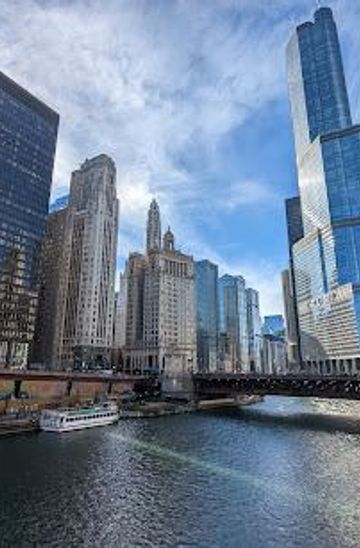
The DuSable Bridge, formerly the Michigan Avenue Bridge, is an iconic bascule bridge in downtown Chicago that carries Michigan Avenue over the Chicago River. Named after Jean Baptiste Point du Sable, Chicago's first non-native settler, it's a landmark known for its architecture, historical sculptures, and role in connecting the city's Magnificent Mile with the Loop.

Plan your visit

A brief summary to DuSable Bridge

Opening times, essentials, and a few local tips gathered into one calmer, easier-to-scan planning section.

Plan your visit

📍
333 Michigan Ave, Chicago, Magnificent Mile, Illinois, 60601, US

Explore places near DuSable Bridge

    See all →

    Unlock the Best of DuSable Bridge

    Find tickets, tours with entry, and experiences available for this location.

    Buy tickets

    No tickets available

    Book tours with entry

    No tours with entry available

    Book tours without entry

    No tours without entry available

    Getting There

    Walking

    From the Magnificent Mile, simply walk south on Michigan Avenue. The DuSable Bridge will be directly ahead as you approach the Chicago River. From the Loop, head north on Michigan Avenue. The bridge will be immediately visible after crossing Wacker Drive.

    Public Transport

    Several bus routes serve the DuSable Bridge area. Check the CTA website or app for the most up-to-date schedules and routes. The closest 'L' train stations are State/Lake (Brown, Green, Orange, Pink, Purple Lines) and Grand (Red Line), both within a 10-15 minute walk. A single ride on a CTA bus or 'L' train is $2.25.

    Taxi/Ride-Share

    Taxis and ride-sharing services like Uber and Lyft are readily available throughout Chicago. A short trip from nearby locations such as Union Station or Navy Pier will typically cost between $7 and $15, depending on traffic and distance.

    Parking

    Parking near the DuSable Bridge can be challenging and expensive. Several parking garages are located in the vicinity, including those at 303 E. Wacker Dr. and 225 N Michigan Ave. Hourly rates typically range from $15 to $40. Consider using parking apps like SpotHero or ParkChirp to find and reserve parking spots in advance. Be aware of street parking restrictions and meter fees.

    Local tips

    Walk along both the upper and lower levels of the bridge for different perspectives of the Chicago River and surrounding architecture.
    Visit the McCormick Bridgehouse & Chicago River Museum in the southwest bridgehouse to learn about the bridge's history and operation.
    Take a Chicago River boat tour for an excellent view of the bridge and its architectural details.
    Observe the bridge lifting during the spring and fall to allow sailboats to pass.
    Look for the brass markers south of the bridge and across East Wacker Drive that mark the site of Fort Dearborn.

    Discover more about DuSable Bridge

    The DuSable Bridge is more than just a functional structure; it's a symbol of Chicago's history, engineering prowess, and urban development. Officially opened in 1920, the bridge was a key component of Daniel Burnham's 1909 Plan of Chicago, designed to improve transportation and enhance the city's riverfront.This double-leaf, double-deck trunnion bascule bridge is an architectural marvel. At the time of its construction, it was believed to be the first double-deck bridge with roadways on both levels. The upper deck carries faster, non-commercial traffic, while the lower deck accommodates slower, commercial vehicles. The bridge can be raised to allow ships to pass, with the bridge operating around fifty times each year for flotillas of migrating sailboats.The four bridgehouses that adorn the bridge's corners are constructed in a neoclassical Beaux-Arts style. The bridge houses feature bas-relief sculptures depicting scenes from Chicago's history. The sculptures on the northern bridgehouses depict French explorers Marquette and Joliet, as well as early settlers Kinzie and DuSable. The sculptures on the southern bridgehouses commemorate the Fort Dearborn Massacre of 1812 and the rebuilding of the city after the Great Chicago Fire of 1871.Visitors can explore the McCormick Bridgehouse & Chicago River Museum, located in the southwest bridgehouse. The museum offers exhibits on the history of the Chicago River and the bridge, and allows visitors to view the bridge's operating machinery. The DuSable Bridge is a defining image of Chicago, a testament to the city's innovative spirit and a must-see for any visitor.

    A brief summary to DuSable Bridge

    Use DuSable Bridge as your starting point for nearby food, family ideas, nightlife, and more local discoveries.

    Mobile App
    Get the app

    Your all‑in‑one travel companion app

    Explore expert travel guides, compare and book tours, experiences, hotels, and more—all from the palm of your hand. Download now for seamless trip planning wherever your wanderlust takes you.

    File:Naperville, Illinois Riverwalk Downtown Water Street.jpg - Wikimedia  Commons

    More about Naperville

    Discover Naperville: A picturesque suburban oasis in Illinois offering historical charm, scenic riverwalks, and a vibrant cultural scene just 28 miles from Chicago.

    Tell me more about Naperville

    Select Currency

    Choose the currency you want prices to display in.