

Free Paola Travel Guide & Mobile App
Plan your Paola trip with Evendo. Get free guides to top attractions, restaurants, hotels, and bars. Web access or download the mobile app.


Paola, Malta combines the Ħal Saflieni Hypogeum, parish churches and southern island culture with easy access to Valletta and historic harbour towns.
Urban History and Sacred Places
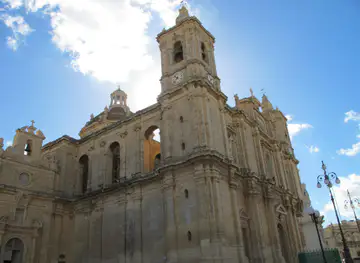
Paola is a compact town in Malta’s south-eastern urban belt, positioned between the historic harbour districts and the island’s older village communities. Known locally as Raħal Ġdid, meaning “New Town”, it grew around the parish and civic development initiated in the seventeenth century by Grand Master Antoine de Paule, whose name the town retains. Its streets combine dense residential architecture, small businesses and busy squares with churches that remain central to community life, particularly the large parish church of Christ the King.Read more about Paola
The Ħal Saflieni Hypogeum
Between Harbour and Countryside
When is the best time to visit Paola?
Best: May–June, October · 24–30°C| Month | High (°C) | Rainfall (mm) |
|---|---|---|
| January | 15 | 85 |
| February | 16 | 72 |
| March | 16 | 59 |
| April | 19 | 48 |
| May (best) | 24 | 36 |
| June (best) | 30 | 18 |
| July | 33 | 10 |
| August | 34 | 9 |
| September | 31 | 17 |
| October (best) | 27 | 46 |
| November | 22 | 59 |
| December | 18 | 72 |
Getting to and around Paola
How to get there
Transportation
Best attractions in Paola
Paola’s defining attraction is the Ħal Saflieni Hypogeum, an underground Neolithic complex whose chambers and ritual spaces were carved into the limestone thousands of years ago; visits are carefully controlled and should be planned in advance. Above ground, the town centre offers a more contemporary view of Malta, with Pjazza Antoine de Paule, parish streets and everyday cafés shaping its local rhythm. The Church of Christ the King is central to Paola’s identity, while the nearby Kordin area reflects the wider harbour region’s industrial and commercial history. The Tarxien Temples are close enough to combine with a Paola visit, but they stand in neighbouring Tarxien rather than within the town. Paola also works as a practical starting point for exploring Valletta, the Three Cities and the southern villages, although its own appeal lies in the contrast between an active residential community and one of Malta’s most important prehistoric sites.
-
Ferry service
Valletta Ferry Service - Cospicua
Explore Malta's history and stunning coastal views with the Valletta Ferry Service in Cospicua, a unique travel experience for every visitor.
5 min drive · 1.7 km from city centre
-
Archaeological site
Tarxien Temples
Explore the ancient Tarxien Temples, a UNESCO World Heritage Site, and witness Malta's rich prehistoric heritage through its remarkable megalithic structures.
7 min walk · 0.6 km from city centre
-
Catholic church
Collegiate Church of the Immaculate Conception
Explore the breathtaking Collegiate Church of the Immaculate Conception in Bormla, a masterpiece of Baroque architecture and a cultural treasure of Malta.
5 min drive · 1.5 km from city centre
-
Tourist attraction
Hompesch Gate
Discover the historical significance and architectural beauty of Hompesch Gate in Ħaż-Żabbar, Malta – a must-visit for every traveler.
5 min drive · 1.8 km from city centre


Best landmarks in Paola
The Ħal Saflieni Hypogeum is Paola’s principal landmark, not because it rises above the streets but because its subterranean architecture preserves an exceptional prehistoric ceremonial and burial complex. Above ground, the Parish Church of Christ the King forms the town’s most prominent religious focus, with its scale and position reflecting the importance of parish institutions in Maltese communities. The Church of Our Lady of Lourdes adds another layer to Paola’s ecclesiastical landscape and to the devotional traditions of the harbour region. Pjazza Antoine de Paule provides the civic centre associated with the town’s seventeenth-century foundation and its continuing public life. Together these places reveal Paola’s unusual historical range: Neolithic builders, Hospitaller-era town planning, Catholic parish culture and modern urban expansion are all represented within a compact limestone settlement.
-
Historical landmark
Ħal Saflieni Hypogeum
Discover the rich history and breathtaking architecture of Hal Saflieni Hypogeum, Malta's extraordinary underground burial complex.
4 min walk · 0.4 km from city centre
-
Archaeological site
Tarxien Temples
Discover Malta's ancient Tarxien Temples, a UNESCO World Heritage site, showcasing remarkable prehistoric architecture and intriguing archaeological finds.
7 min walk · 0.6 km from city centre
-
Shopping mall
Main Street Shopping Complex, Paola
Experience the best of shopping and dining at Main Street Shopping Complex in Paola, Malta's premier shopping destination.
1 min walk · 0.1 km from city centre
-
Mosque
Ċentru Islamiku ta' Malta
Discover the rich heritage and vibrant culture at Ċentru Islamiku ta' Malta, a serene mosque and cultural center in the heart of Paola.
5 min walk · 0.4 km from city centre


Explore Paola on the map
Plan your Paola trip on one map. See where the top attractions, landmarks, restaurants, bars and hotels are, find what's near where you're staying, and book hotels and experiences in a few clicks.
Best hotels in Paola
Best restaurants in Paola
Paola’s dining scene is rooted in ordinary Maltese food rather than destination gastronomy, with bakeries, cafés, snack bars and family-run eateries supplying the rhythms of a residential town. Look for pastizzi, flaky pastry filled with ricotta or seasoned pea mixture, and other savoury pastries associated with Malta’s street-food culture. Maltese cooking commonly combines Mediterranean ingredients with influences shaped by the island’s long maritime history: rabbit, fish, octopus, tomatoes, olives, capers and ġbejna, the small local cheese, appear in traditional meals. Local cafés are useful for coffee, light lunches and sweets, while restaurants across the wider harbour area offer more substantial Maltese menus. Paola’s proximity to Tarxien, Fgura and the Three Cities broadens the choice, but the town itself is best understood through modest neighbourhood establishments rather than a concentrated restaurant quarter.
-
Restaurant
Maxman
Discover Maxman in Paola: where delicious pizzas meet warm hospitality in an inviting atmosphere.
4 min walk · 0.3 km from city centre
-
Fast Food
Burger King
Experience fast food bliss at Burger King Paola with flame-grilled burgers and tasty treats in Malta's vibrant dining scene.
2 min walk · 0.1 km from city centre
-
Turkish
Eda Kebab house
Experience authentic Turkish flavors at Eda Kebab House in Fgura - delicious kebabs and warm hospitality await you.
10 min walk · 0.8 km from city centre
-
Restaurant
San Giorgio Restaurant
Experience authentic Maltese cuisine at San Giorgio Restaurant in Cospicua - where flavor meets tradition in a picturesque setting.
5 min drive · 1.6 km from city centre


Best bars in Paola
Paola has a modest, local evening scene rather than a major club district. Bars connected to parish and neighbourhood life provide places for an unhurried drink, conversation and televised sport, while cafés remain useful for an early evening pause. The town’s most distinctive social atmosphere appears during religious feast celebrations, when streets and squares can host processions, band music, decorations and communal gatherings; dates and programmes vary by parish and year. For larger nightlife choices, visitors generally travel towards Valletta, the Three Cities or the entertainment areas farther north, where the range of late venues is greater. Evening walks should account for traffic and the uneven relationship between busy commercial streets and quieter residential roads. Cultural performances and harbour-area events can offer a more suitable alternative to clubbing, especially for visitors interested in Malta’s music and festival traditions.
-
Pub
The Pavilion Gastro Pub
Discover the vibrant flavors of Malta at The Pavilion Gastro Pub in Paola, where traditional meets contemporary in a cozy setting.
10 min walk · 0.8 km from city centre
-
Restaurant
Maxman
Experience the best of Italian cuisine in Paola at Maxman, where delicious pizzas and a welcoming atmosphere await every visitor.
4 min walk · 0.3 km from city centre
-
Coffee shop
Traffic Lights Cafe
Experience the cozy atmosphere and delightful coffee offerings at Traffic Lights Cafe in Raħal Ġdid, Malta.
2 min walk · 0.2 km from city centre
-
Family-friendly
Paramount Kiosk
Discover the charming Paramount Kiosk in Paola, a family-friendly spot for delightful refreshments and local treats in a vibrant atmosphere.
1 min walk · 0.1 km from city centre


Best nightclubs in Paola
Paola has a modest, local evening scene rather than a major club district. Bars connected to parish and neighbourhood life provide places for an unhurried drink, conversation and televised sport, while cafés remain useful for an early evening pause. The town’s most distinctive social atmosphere appears during religious feast celebrations, when streets and squares can host processions, band music, decorations and communal gatherings; dates and programmes vary by parish and year. For larger nightlife choices, visitors generally travel towards Valletta, the Three Cities or the entertainment areas farther north, where the range of late venues is greater. Evening walks should account for traffic and the uneven relationship between busy commercial streets and quieter residential roads. Cultural performances and harbour-area events can offer a more suitable alternative to clubbing, especially for visitors interested in Malta’s music and festival traditions.
-
Bar
De Paule Band Club
Experience the vibrant culture and live music at De Paule Band Club, a must-visit bar in Paola, Malta.
2 min walk · 0.1 km from city centre
-
Bar
Luglio cafe bar and lounge
Experience the vibrant nightlife of Malta at Luglio Cafe Bar and Lounge, where local flavors and lively entertainment await.
2 min walk · 0.1 km from city centre
-
Bar
Paola Wolves Sports Club Snack Bar
Enjoy a delicious snack and immerse in the local sports culture at Paola Wolves Sports Club Snack Bar, a perfect retreat for every tourist.
5 min walk · 0.4 km from city centre
-
Bar
Lounge 1924 MLP Club
Discover the vibrant nightlife at Lounge 1924 MLP Club, a stylish bar in the heart of Paola, Malta, offering great drinks and a lively atmosphere.
1 min walk · 0.1 km from city centre


Best shops in Paola
Shopping in Paola is practical and local, centred on small food shops, bakeries, pharmacies, cafés and everyday retailers rather than a large luxury or department-store district. The town’s shops are useful for Maltese bakery items, packaged regional foods and modest gifts, while nearby market activity in the wider harbour conurbation offers a more varied look at daily commerce. Visitors interested in traditional products can seek out ġbejna, olive oil, honey, preserves and confectionery, although provenance and packaging should be checked when buying food to take home. Malta’s limestone craft, lace, filigree jewellery and colourful ceramics are more commonly encountered in dedicated craft outlets and tourist areas elsewhere on the island than in Paola itself. The most characteristic shopping experience here is therefore the ordinary rhythm of a southern Maltese town, where independent neighbourhood businesses serve residents first.
-
Shopping mall
Main Street Shopping Complex, Paola
Experience shopping and dining like never before at the Main Street Shopping Complex, Paola – where variety meets vibrancy.
1 min walk · 0.1 km from city centre
-
Gift shop
Flying Tiger Copenhagen
Discover unique gifts and quirky treasures at Flying Tiger Copenhagen, a must-visit shop in Paola for creative finds and delightful souvenirs.
1 min walk · 0.1 km from city centre
-
Indian grocery store
Little India Grocery & Convenience Shop , paola
Experience the rich flavors of India at Little India Grocery & Convenience Shop in Paola, Malta's hub for authentic Indian ingredients and snacks.
2 min walk · 0.2 km from city centre
-
Grocery store
Kerala Stores
Discover unique flavors and local delicacies at Kerala Stores, Paola's vibrant grocery destination for culinary exploration.
1 min walk · 0.1 km from city centre


Get your free copy of our complete guide to Paola, delivered straight to you.
Everything on this page, from attractions and restaurants to essentials and local phrases, in one PDF you can read offline, print or share.
Already have an account? Sign in
Your Paola guide is ready.
We'll send it to · Not you? Sign out

Getting your guide ready…
We are putting together a fresh copy of the Paola guide. This can take up to a minute.
This can take a few moments. If your browser asks, choose Allow so the download can start. You'll find the guide in your Downloads folder.
Nothing happened? Download it again
Sorry, the guide is taking longer than usual. Please try again in a minute, or get it by email instead.
Paola essentials
Currency and Payment
Safety
Emergency Situations
Do's and Don'ts
Local Tips
From Eve
Local phrases worth knowing
You don't need to get them perfect. A few words go a long way, and locals appreciate the effort.
Basics
| English | Local | Say it |
|---|---|---|
| Hello | Merħba | [mer-h-ba] |
| Goodbye | Saħħa | [sa-ha] |
| Yes | Iva | [ee-va] |
| No | Le | [leh] |
| Please/You're welcome | Jekk jogħġbok | [yek-joh-guh-bok] |
| Thank you | Grazzi | [grat-see] |
| Excuse me/Sorry | Skuzi | [skoo-zee] |
| How are you? | Kif int? | [keef int] |
| Fine. And you? | Tajjeb. U int? | [ta-yeb. oo int] |
| Do you speak English? | Titkellem bl-Ingliż? | [tit-ke-lem bling-lees] |
| I don't understand | Ma nifhimx | [ma neef-heemsh] |
Eating & Drinking
| English | Local | Say it |
|---|---|---|
| I'd like to see the menu, please | Nixtieq inara l-menu, jekk jogħġbok | [nishtek in-ara l-may-noo, yek-joh-guh-bok] |
| I don't eat meat | Ma niekolx laħam | [ma nee-e-kolsh la-ham] |
| Cheers! | Saħħa! | [sa-ha] |
| I would like to pay, please | Nixtieq nippruvajt, jekk jogħġbok | [nishtek nip-proo-vait, yek-joh-guh-bok] |
Emergencies
| English | Local | Say it |
|---|---|---|
| Help! | Għajni! | [ay-nee] |
| Go away! | Mur! | [moor] |
| Call the Police! | Ibgħat il-Pulizija! | [ib-gat il-poo-lee-zee-ya] |
| Call a doctor! | Ibqajja' tabib! | [ib-ai-ya tah-beeb] |
| I'm lost | Ninsab f'gwerra | [nins-ab f-gwer-ra] |
| I'm ill | Nixtieq tabib | [nishtek ta-beeb] |
Shopping
| English | Local | Say it |
|---|---|---|
| I'd like to buy... | Nixtieq inixtri... | [nishtek in-ishtree] |
| I'm just looking | Qed nara biss | [kwed nara biss] |
| How much is it? | Kemm huwa? | [kem hoo-wa] |
| That's too expensive | Dan huwa wisq sħiħ | [dan hoo-wa wees-sh sh-hee] |
| Can you lower the price? | Tista' tniżżel il-prezz? | [tis-ta tnee-zzel il-prez] |
Time & Numbers
| English | Local | Say it |
|---|---|---|
| What time is it? | Xi ħin hu? | [she heen hoo] |
| It's one o'clock | Huwa l-ewwel siegħa | [hoo-wa l-ew-wel see-eha] |
| Half past (10) | Noqsan (10) | [noksan] |
| Morning | Filgħodu | [fil-oh-doo] |
| Afternoon | Waranofsinhar | [wa-ra-no-sin-har] |
| Evening | Flimkien | [flim-kee-en] |
| Yesterday | Ilbieraħ | [il-bee-rah] |
| Today | Illum | [ill-um] |
| Tomorrow | Għada | [a-da] |
| 1 | Wieħed | [wee-hed] |
| 2 | Tnejn | [t-neyn] |
| 3 | Tlieta | [t-liet-a] |
| 4 | Erba' | [er-ba] |
| 5 | Ħamsa | [ham-sa] |
| 6 | Sitta | [sit-ta] |
| 7 | Sebgħa | [seb-a] |
| 8 | Tmienja | [t-mien-ya] |
| 9 | Disgħa | [dis-a] |
| 10 | Għaxra | [a-shra] |
Transport & Directions
| English | Local | Say it |
|---|---|---|
| Where's a/the...? | Fejn hemm... | [feyn hemm] |
| What's the address? | X'inhu l-indirizz? | [sheen-hoo l-in-dee-reetz] |
| Can you show me (on the map)? | Tista' tgħanni (fuq il-mappa)? | [tis-ta tan-nee fooq il-mappa] |
| When's the next (bus)? | Meta jmiss? | [me-ta y-miss] |
| A ticket (to ....) | Biljett (għal ....) | [bil-yet tal] |
History of Paola
The Prehistoric Ħal Saflieni Complex
Long before Paola existed as a town, communities of Malta’s Temple Period created the Ħal Saflieni Hypogeum in the limestone plateau now occupied by the locality. Used between roughly 4000 and 2500 BC, the complex developed from an underground cemetery into an elaborate series of chambers, passages and ritual spaces. Its interior imitates features of above-ground megalithic architecture, including rounded doorways and carefully finished surfaces, while surviving ochre decoration offers rare evidence of prehistoric artistic practice in Malta. The site was discovered accidentally in 1902 during building works and excavated in the early twentieth century. Its survival beneath a modern neighbourhood provides an unusually direct link between Paola’s contemporary streets and the island’s distant Neolithic past.
Antoine de Paule’s New Town
Paola’s modern identity began in the seventeenth century, when Grand Master Antoine de Paule of the Order of St John encouraged the development of a settlement in the area. The locality became known as Casal Nuovo, or New Town, and later took the name Paola in his honour. Its establishment reflected the Order’s broader interest in organising Malta’s rural and urban communities around parish structures, roads and agricultural land. Unlike the fortified capital founded at Valletta after the Great Siege, Paola grew as a settlement beyond the main defensive city. The town’s name, parish traditions and central public spaces preserve the memory of this period of planned expansion under Hospitaller rule.
Parish Life and Urban Growth
As the settlement expanded, religious institutions became important markers of local identity. The parish church dedicated to Christ the King eventually emerged as Paola’s principal ecclesiastical landmark, while other chapels and churches served neighbourhood communities. Malta’s characteristic village feast culture, centred on parish patronage, helped shape the calendar and social life of the town. During the nineteenth and twentieth centuries Paola became increasingly connected to the densely populated harbour region, with homes, workshops, shops and civic services filling the spaces between older village cores. Its development was therefore tied not only to local agriculture but also to the growing economic importance of the Grand Harbour and the industrial and commercial districts around it.
War, Reconstruction and the Harbour Region
Paola’s position close to Malta’s Grand Harbour placed it within a region heavily affected by the strategic pressures of the Second World War. The surrounding harbour towns and infrastructure were targets of aerial bombardment, while civilian life was shaped by sheltering, disruption and the wider island’s wartime mobilisation. The post-war decades brought reconstruction and substantial housing growth, transforming Paola into part of Malta’s continuous south-eastern urban area. Roads, public services and commercial streets expanded as residents moved between Paola, Ħamrun, Tarxien, Fgura and the harbour districts. This period explains much of the town’s present-day built character: a mixture of older limestone buildings, post-war homes and practical urban development.
Archaeology and Modern Conservation
The discovery and preservation of the Ħal Saflieni Hypogeum gave Paola a lasting place in the study of prehistoric Mediterranean societies. Conservation has required careful control of humidity, visitor numbers and environmental conditions, since the underground painted surfaces and limestone architecture are vulnerable to change. The site’s protection also illustrates the tension between living urban development and fragile archaeological remains: modern neighbourhoods surround a monument created thousands of years earlier. Today Paola’s identity rests on both dimensions. It is a functioning Maltese town with active parish life and everyday commerce, yet it also safeguards one of the most significant surviving prehistoric ritual complexes in the central Mediterranean.
Paola in Photos
Browse through our photo collection highlighting the charm and character of the destination.
Cities near Paola
The closest cities to Paola, if you have time for more than one stop.
-

-

-

-

-


Swipe for more cities
Explore more
Explore more of Malta
Discover Malta's crystal-clear waters, rich history, and vibrant culture. From ancient temples to modern nightlife, this Mediterranean gem offers something for everyone.
Explore Malta