

Forbidden Island Travel Guide - Free Web & App
Your ultimate guide to Forbidden Island. Discover top landmarks, proposed trips, and local tips. Free on the web or via the Evendo companion app.


Forbidden Island in the Northern Mariana Islands offers Saipan day trips, rugged Pacific scenery, sea caves, coastal hiking and wildlife-rich waters nearby.
A Small Island with a Wild Character
Forbidden Island is an uninhabited islet off the south-eastern coast of Saipan in the Northern Mariana Islands, a short distance from the main island yet markedly different in character. Its pale limestone cliffs, irregular shoreline, sea caves and exposed rock shelves face the open Pacific, while the surrounding water shifts between deep blue channels and lighter coastal shallows. There are no permanent residents, shops, roads or visitor facilities on Forbidden Island, so it is best understood as a natural excursion rather than a self-contained resort destination.Read more about Forbidden Island
Coastline, Water and Wildlife
Gateway on Saipan
When is the best time to visit Forbidden Island?
Best: January–March · 29°C| Month | High (°C) | Rainfall (mm) |
|---|---|---|
| January (best) | 29 | 100 |
| February (best) | 29 | 100 |
| March (best) | 29 | 100 |
| April | 29 | 100 |
| May | 29 | 100 |
| June | 29 | 100 |
| July | 30 | 100 |
| August | 30 | 100 |
| September | 30 | 100 |
| October | 30 | 100 |
| November | 30 | 100 |
| December | 30 | 100 |
Getting to and around Forbidden Island
How to get there
Transportation
Best attractions in Forbidden Island
-
Historical landmark
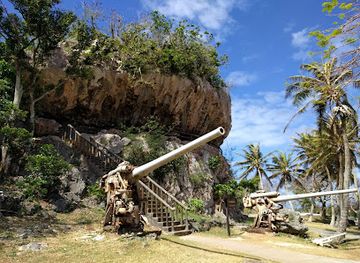
Last Japanese Command Post
Discover the Last Japanese Command Post, a historical landmark in Saipan that unveils the rich military history of World War II in the Northern Mariana Islands.
Explore Forbidden Island on the map
Plan your trip on one map. See where the top attractions, landmarks, restaurants and hotels are, and book hotels and experiences in a few clicks.
Best hotels in Forbidden Island
Best bars in Forbidden Island
There is no nightlife on Forbidden Island: after dark it has no lighting, venues, accommodation or staffed facilities. Evening entertainment is found on Saipan, particularly in and around the island’s settled areas, where visitors may encounter hotel bars, casual drinking places, karaoke and occasional live or cultural events. The atmosphere is generally more relaxed than that of a major resort city, and availability can vary by season and venue. Traditional or locally influenced hospitality is more characteristic of an evening on Saipan than a dedicated night out on the islet. Anyone planning a coastal visit should return well before darkness unless part of a specifically arranged and appropriately equipped activity, since the island’s cliffs, rocks and changing sea conditions make unauthorised night access particularly unsuitable.
-
Island
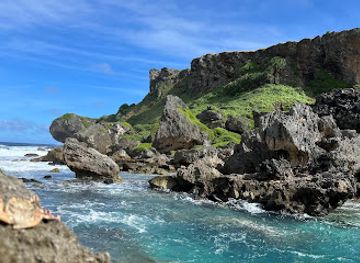
Forbidden Island
Explore the untouched beauty of Forbidden Island, a hidden gem in the Northern Mariana Islands, perfect for adventure and tranquility.
Best shops in Forbidden Island
Forbidden Island has no shops or retail facilities, and visitors should purchase water, food, sun protection and any specialist equipment on Saipan before travelling to the coast. Shopping opportunities are concentrated in Saipan’s settled areas, especially around Garapan and other commercial parts of the island, where visitors can look for groceries, practical outdoor supplies, locally made gifts and products connected with Chamorro and Carolinian culture. Souvenirs may include regional food products, artwork and island-themed crafts, although stock and availability vary. The most responsible purchases are those that support local makers without involving coral, shells, archaeological material or wildlife products. There is no opportunity to buy supplies after crossing the water, and everything carried to the island must be brought back out, including packaging and unused food.
-
Island
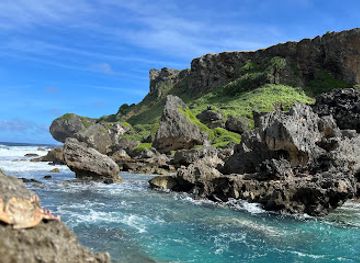
Forbidden Island
Explore Forbidden Island in the Northern Mariana Islands, a hidden gem of stunning beaches, vibrant marine life, and rich cultural heritage waiting to be uncovered.
Get your free copy of our complete guide to Forbidden Island, delivered straight to you.
Everything on this page, from attractions and restaurants to essentials and local phrases, in one PDF you can read offline, print or share.
Already have an account? Sign in
Your Forbidden Island guide is ready.
We'll send it to · Not you? Sign out

Getting your guide ready…
We are putting together a fresh copy of the Forbidden Island guide. This can take up to a minute.
This can take a few moments. If your browser asks, choose Allow so the download can start. You'll find the guide in your Downloads folder.
Nothing happened? Download it again
Sorry, the guide is taking longer than usual. Please try again in a minute, or get it by email instead.
Forbidden Island essentials
Currency and Payment
Safety
Emergency Situations
Do's and Don'ts
Local Tips
From Eve
Local phrases worth knowing
You don't need to get them perfect. A few words go a long way, and locals appreciate the effort.
Basics
| English | Local | Say it |
|---|---|---|
| Hello | Håfa Adai | [HA-fa AH-dye] |
| Goodbye | Adios | [ah-dyohs] |
| Yes | Åmen | [AH-men] |
| No | Ti | [tee] |
| Please/You're welcome | Un dankulu | [oon DAHN-koo-loo] |
| Thank you | Si Yu'us Ma'åse | [see YOO-oos mah-AH-seh] |
| Excuse me/Sorry | Dispensa | [dees-PEHN-sah] |
| How are you? | Kei na'ån-hu? | [kay NAH-ahn-hoo] |
| Fine. And you? | Maolek. Hao si Yu'us? | [mah-OH-lek. hao see YOO-oos] |
| Do you speak English? | Kao maolek na'ån-hu? | [kow mah-OH-lek NAH-ahn-hoo] |
| I don't understand | Ti hu fanå'åsi | [tee hoo fah-nah-AH-see] |
Eating & Drinking
| English | Local | Say it |
|---|---|---|
| I'd like to see the menu, please | Kao un hanao i menu, un dankulu | [kow oon hah-NOW ee MEH-noo, oon DAHN-koo-loo] |
| I don't eat meat | Ti ha na'åmon karne | [tee hah nah-AH-mon KAR-neh] |
| Cheers! | Biba! | [BEE-bah] |
| I would like to pay, please | Kao un hanao i che'lu, un dankulu | [kow oon hah-NOW ee CHE-loo, oon DAHN-koo-loo] |
Emergencies
| English | Local | Say it |
|---|---|---|
| Help! | Ayudame! | [ah-yoo-DAH-meh] |
| Go away! | Lågu! | [LAH-goo] |
| Call the Police! | Tåkkure polisia! | [TAH-koo-reh poh-lee-SEE-ah] |
| Call a doctor! | Tåkkure na doktå! | [TAH-koo-reh nah dohk-TAH] |
| I'm lost | Hu fanå'åsi | [hoo fah-nah-AH-see] |
| I'm ill | Hu infekkåo | [hoo een-fehk-KAH-oh] |
Shopping
| English | Local | Say it |
|---|---|---|
| I'd like to buy... | Kao un hanao i... | [kow oon hah-NOW ee...] |
| I'm just looking | Hu un tumåhalo | [hoo oon too-mah-HAH-loh] |
| How much is it? | Fino' para? | [FEE-noh PAH-rah] |
| That's too expensive | Må'pos na taotao | [mah-OH-pose nah TAH-oh-tao] |
| Can you lower the price? | Må'pos na kuentusi? | [mah-OH-pose nah kwehn-TOO-see] |
Time & Numbers
| English | Local | Say it |
|---|---|---|
| What time is it? | Kåo na tiempo? | [KOW oh-nah tee-EHM-poh] |
| It's one o'clock | Estague i unu | [eh-stah-GWEH ee OO-noo] |
| Half past (10) | Månona (10) | [mah-NOH-nah (tee)] |
| Morning | Manana | [mah-NAH-nah] |
| Afternoon | Agupa' | [ah-GOO-pah] |
| Evening | Aga' | [ah-GAH] |
| Yesterday | Kåo na adalå? | [KOW oh-nah ah-dah-LAH] |
| Today | Kåo na u fa'na'gua' | [KOW oh-nah oo fah-nah-GWAH] |
| Tomorrow | Kåo na u manana | [KOW oh-nah oo mah-NAH-nah] |
| 1 | Mås Uno | [mahs OO-noh] |
| 2 | Mås Dos | [mahs Dohs] |
| 3 | Mås Tres | [mahs Tres] |
| 4 | Mås Kuåtro | [mahs KWAH-tro] |
| 5 | Mås Singko | [mahs SEENG-koh] |
| 6 | Mås Sais | [mahs Sah-eess] |
| 7 | Mås Siete | [mahs SYEH-teh] |
| 8 | Mås Ocho | [mahs OH-choh] |
| 9 | Mås Nueve | [mahs NWEH-veh] |
| 10 | Mås Dje | [mahs DJEH] |
Transport & Directions
| English | Local | Say it |
|---|---|---|
| Where's a/the...? | Siha... | [SEE-hah...] |
| What's the address? | Kåo na direksion? | [KOW oh-nah dee-rehk-SYON] |
| Can you show me (on the map)? | Mamesa hao (sångan litratu)? | [mah-MEH-sah how (sahng-AHN lee-trah-TOO)] |
| When's the next (bus)? | Kåo na siguiente (bus)? | [KOW oh-nah see-GWEN-teh (boos)] |
| A ticket (to ....) | Un bilette (para ...) | [oon bee-LEH-teh (PAH-rah ...)] |
History of Forbidden Island
Limestone Island and Pacific Coast
Forbidden Island belongs to the limestone coastal landscape of Saipan and the wider Mariana island arc, shaped by marine geological processes rather than by human construction. Its cliffs, shelves and cavities reflect the porous character of uplifted limestone exposed to waves, weather and tropical rainfall. The island’s physical form has always influenced how it can be approached: unlike a settled coastal village, it offers no naturally developed transport network or permanent harbour infrastructure. Geological change therefore provides the essential first chapter of its history, explaining both its stark appearance and the limited ways in which people can safely reach its shore.
Chamorro and Carolinian Seascapes
The island should be understood within the maritime world of the Northern Mariana Islands, whose history is rooted in Chamorro culture and later enriched by Carolinian communities. Saipan’s surrounding waters were not empty spaces but part of a wider seascape used for travel, fishing and the exchange of knowledge between islands. Surviving cultural traditions, language, foodways and relationships with the ocean are most visible on inhabited Saipan rather than on Forbidden Island itself. The islet has no documented permanent settlement comparable to Saipan’s villages, and its modern name reflects its difficult, exposed character rather than a separate urban or political history.
Saipan in War and the Modern Era
Forbidden Island sits beside Saipan, an island whose twentieth-century history was profoundly affected by Japanese rule, the Battle of Saipan in 1944 and the wider Pacific War. The celebrated wartime sites are on Saipan proper, not on Forbidden Island, but the islet forms part of the same historical landscape of reefs, bays and coastal approaches. After the war, Saipan developed as the principal population, administrative and tourism centre of the Northern Mariana Islands. Forbidden Island remained uninhabited, increasingly valued as a scenic coastal feature and excursion setting rather than as a site of permanent development.
Nature, Recreation and Stewardship
In the contemporary period, Forbidden Island has become associated with sightseeing, photography, swimming and small-scale coastal adventures arranged from Saipan, although access depends strongly on tides, surf, weather and local judgement. Its lack of buildings preserves a markedly different atmosphere from Saipan’s developed shoreline. Responsible visitation is particularly important on an island with no waste services, no fresh water and sensitive intertidal and bird habitat. Conservation-minded practice means taking all rubbish away, avoiding wildlife disturbance and declining approaches that become hazardous as sea conditions change.
Forbidden Island in Photos
Browse through our photo collection highlighting the charm and character of the destination.
Neighbouring destination travel guides
The closest destinations to Forbidden Island, if you have time for more than one.
-

-

-

-
-


Swipe for more destinations
Explore more

Explore more of Northern Mariana Islands
Uncover the beauty of Northern Mariana Islands, a tropical paradise with stunning beaches, rich history, and diverse cultures, perfect for a serene and adventurous getaway.
Explore Northern Mariana Islands