

Free Yandina Travel Guide & Mobile App
Plan your Yandina trip with Evendo. Get free guides to top attractions, restaurants, hotels, and bars. Web access or download the mobile app.


Yandina, Solomon Islands, offers Russell Islands history, tropical beaches, village culture, reef excursions and quiet Pacific island exploration.
An Island Settlement
Yandina is a small settlement on Mbanika Island in the Russell Islands of Solomon Islands’ Central Province, surrounded by sheltered waters, forested slopes and the broad blue distances of the South Pacific. Its scale is rural rather than urban: life is shaped by village communities, coastal travel, gardening, fishing and the rhythms of island weather. The settlement provides a useful base for experiencing an archipelago that receives far fewer visitors than the country’s principal centres.Read more about Yandina
War and Plantation Heritage
Coastal Life and Island Landscapes
When is the best time to visit Yandina?
Best: July–September · 30°C| Month | High (°C) | Rainfall (mm) |
|---|---|---|
| January | 31 | 331 |
| February | 31 | 324 |
| March | 31 | 315 |
| April | 31 | 286 |
| May | 30 | 217 |
| June | 30 | 152 |
| July (best) | 30 | 110 |
| August (best) | 30 | 91 |
| September (best) | 30 | 101 |
| October | 31 | 142 |
| November | 31 | 224 |
| December | 31 | 288 |
Getting to and around Yandina
How to get there
Transportation
Best landmarks in Yandina
Yandina’s principal landmarks are modest and landscape-based, reflecting its village scale and wartime history. The local airfield is an important practical feature of the settlement and a reminder of the infrastructure needed to connect remote islands. Around Mbanika, traces of the Second World War, including overgrown clearings, concrete remnants and former military or plantation foundations, illustrate the strategic transformation of the Russell Islands in 1943; their exact condition and access should be confirmed locally. Village churches and community buildings are significant markers of everyday social life, although they are functioning places rather than monuments designed for tourism. The surrounding coast, channels and forested hills also carry landmark value, defining the setting in which customary life, commercial copra production and military history have unfolded. Local interpretation is essential because many of these places are dispersed, lightly marked and connected to customary land.
-
 Airport
Yandina Airport
Explore the Solomon Islands with ease from Yandina Airport, your gateway to breathtaking landscapes and rich cultural experiences.
1 min walk · 0.1 km from city centre
Explore Yandina on the map
Plan your Yandina trip on one map. See where the top attractions, landmarks, restaurants, bars and hotels are, find what's near where you're staying, and book hotels and experiences in a few clicks.
Best hotels in Yandina
Best restaurants in Yandina
Yandina has a limited dining scene, and visitors are more likely to eat meals arranged through local accommodation or community hosts than to find a choice of independent restaurants. Home-style cooking may draw on freshly caught fish, coconut, root crops such as cassava and taro, island vegetables and seasonal fruit, reflecting the close relationship between food, gardens and the sea. Rice and imported provisions may also feature, particularly where supplies arrive by boat. Meals are often part of the hospitality of an island stay, so dietary needs should be discussed before arrival and visitors should not assume that ingredients or restaurant-style service will be available on demand. For a broader selection of cafés, markets and takeaway food, Honiara remains the country’s principal dining centre; in Yandina, the culinary interest lies in locally prepared food and the social setting in which it is shared.
-
Chicken
Telin Island restaurant
Experience authentic island cuisine at Telin Island Restaurant, where succulent chicken dishes meet warm hospitality on beautiful Telin Island.
15 min drive · 5.0 km from city centre
Best bars in Yandina
Yandina does not have a developed nightlife district, club scene or concentration of licensed bars. Evenings are generally quiet, shaped by village social life, conversation, family gatherings and the sounds of the coast rather than late-night entertainment. Visitors staying with local hosts may experience informal social occasions, music or community events when these are taking place, but such activities are not fixed products and should be approached with sensitivity. Darkness, limited electricity and the absence of extensive public transport make independent night-time movement impractical, especially beyond the settlement. Those seeking organised nightlife, live music venues or a wider choice of bars will find these principally in Honiara rather than the Russell Islands. In Yandina, an evening walk near accommodation, where locally approved and safe, or quiet observation of the night sky better reflects the character of the place.
-
Chicken
Telin Island restaurant
Discover the authentic taste of the Solomon Islands at Telin Island Restaurant, renowned for its delectable chicken dishes and warm hospitality.
15 min drive · 5.0 km from city centre
Best nightclubs in Yandina
Yandina does not have a developed nightlife district, club scene or concentration of licensed bars. Evenings are generally quiet, shaped by village social life, conversation, family gatherings and the sounds of the coast rather than late-night entertainment. Visitors staying with local hosts may experience informal social occasions, music or community events when these are taking place, but such activities are not fixed products and should be approached with sensitivity. Darkness, limited electricity and the absence of extensive public transport make independent night-time movement impractical, especially beyond the settlement. Those seeking organised nightlife, live music venues or a wider choice of bars will find these principally in Honiara rather than the Russell Islands. In Yandina, an evening walk near accommodation, where locally approved and safe, or quiet observation of the night sky better reflects the character of the place.
-
Airport
Yandina Airport
Experience the vibrant culture and stunning landscapes of Yandina, Solomon Islands, from the welcoming Yandina Airport.
1 min walk · 0.1 km from city centre
Get your free copy of our complete guide to Yandina, delivered straight to you.
Everything on this page, from attractions and restaurants to essentials and local phrases, in one PDF you can read offline, print or share.
Already have an account? Sign in
Your Yandina guide is ready.
We'll send it to · Not you? Sign out

Getting your guide ready…
We are putting together a fresh copy of the Yandina guide. This can take up to a minute.
This can take a few moments. If your browser asks, choose Allow so the download can start. You'll find the guide in your Downloads folder.
Nothing happened? Download it again
Sorry, the guide is taking longer than usual. Please try again in a minute, or get it by email instead.
Yandina essentials
Currency and Payment
Safety
Emergency Situations
Do's and Don'ts
Local Tips
From Eve
Local phrases worth knowing
You don't need to get them perfect. A few words go a long way, and locals appreciate the effort.
Basics
| English | Local | Say it |
|---|---|---|
| Hello | Alu | [ah-loo] |
| Goodbye | Kwaheri | [kwa-heh-ree] |
| Yes | Eo | [eh-oh] |
| No | Kore | [kor-reh] |
| Please/You're welcome | Tangio | [tan-gee-oh] |
| Thank you | Tanem | [tan-em] |
| Excuse me/Sorry | Kwarae | [kwa-rye] |
| How are you? | Kae mae? | [kai-mai] |
| Fine. And you? | Mae. Eo? | [mai. eh-oh] |
| Do you speak English? | Kae mae follo Ingris? | [kai-mai foh-loh in-gris] |
| I don't understand | Koreo moa | [kor-reh-oh moh-ah] |
Eating & Drinking
| English | Local | Say it |
|---|---|---|
| I'd like to see the menu, please | Kae mae follo lokol menu, tangio | [kai-mai foh-loh loh-kohl men-oo, tan-gee-oh] |
| I don't eat meat | Koreo mae follo mea | [kor-reh-oh mai foh-loh meh-ah] |
| Cheers! | Verevere! | [veh-reh-veh-reh] |
| I would like to pay, please | Kae mae follo pei, tangio | [kai-mai foh-loh pay, tan-gee-oh] |
Emergencies
| English | Local | Say it |
|---|---|---|
| Help! | Tulim | [too-leem] |
| Go away! | Lusim | [loo-seem] |
| Call the Police! | Kaulim Polis! | [kow-leem po-lees] |
| Call a doctor! | Kaulim dokta! | [kow-leem dohk-tah] |
| I'm lost | Mae follo lusim | [mai foh-loh loo-seem] |
| I'm ill | Mi sick | [mee sick] |
Shopping
| English | Local | Say it |
|---|---|---|
| I'd like to buy... | Kae mae follo osi... | [kai-mai foh-loh oh-see...] |
| I'm just looking | Mae follo luk olsem | [mai foh-loh look ol-sem] |
| How much is it? | Hao moa? | [hah-oh moh-ah] |
| That's too expensive | Diswan i no gudfala | [dees-wan ee noh good-fah-lah] |
| Can you lower the price? | Kae yu save kisim daon pris? | [kai yoo sah-veh kee-sim da-ohn prees] |
Time & Numbers
| English | Local | Say it |
|---|---|---|
| What time is it? | Hau taem nao? | [hah-oo tah-em now] |
| It's one o'clock | Iuwan taim | [yoo-wahn tah-eem] |
| Half past (10) | Haf pasten | [hahf pahs-tehn] |
| Morning | Mornin | [mohr-neen] |
| Afternoon | Apunun | [ah-poo-noon] |
| Evening | Ivinin | [ee-vee-neen] |
| Yesterday | Yestede | [yes-teh-deh] |
| Today | Tude | [too-deh] |
| Tomorrow | Tamoro | [tah-moh-roh] |
| 1 | Wan | [wahn] |
| 2 | Tu | [too] |
| 3 | Tri | [tree] |
| 4 | Fo | [foh] |
| 5 | Faiv | [fah-eev] |
| 6 | Siks | [siks] |
| 7 | Seven | [seh-vehn] |
| 8 | Eit | [ayt] |
| 9 | Nain | [nayn] |
| 10 | Ten | [tehn] |
Transport & Directions
| English | Local | Say it |
|---|---|---|
| Where's a/the...? | Hao longes... | [hah-oh lohn-gehs] |
| What's the address? | Hao dress? | [hah-oh dress] |
| Can you show me (on the map)? | Kae yu save soem mi (long map)? | [kai yoo sah-veh soh-em mee (lohn map)] |
| When's the next (bus)? | Hao longes next (bus)? | [hah-oh lohn-gehs nekst (buhs)] |
| A ticket (to ....) | Wan tiket (long ....) | [wahn tee-keht (lohn ....)] |
History of Yandina
Island Communities Before Colonial Rule
Long before the appearance of European administrators, the Russell Islands were inhabited by island communities whose lives depended on fishing, gardening, forest resources, seafaring and exchange between neighbouring islands. Mbanika and Pavuvu formed part of a wider maritime world in which knowledge of reefs, currents and customary land and sea rights was essential. Oral traditions remain important to local understanding of place, while languages, kinship networks and village practices reflect the cultural diversity of Solomon Islands. The historical record for the islands is less extensively documented than that of major colonial centres, so their earlier history is best approached through both archaeological evidence and living community knowledge.
The Solomon Islands Protectorate
Britain declared a protectorate over the Solomon Islands in 1893, bringing the Russell Islands increasingly into a colonial administrative and commercial framework. Mission activity, introduced forms of government and new trading relationships gradually altered coastal life, although local communities continued to manage land, labour and customary affairs through established social structures. Colonial contact also connected the islands more closely with shipping routes and regional markets. As elsewhere in the Solomons, the period brought religious and social change alongside the disruptive effects of outside commercial interests, disease and labour demands.
Copra and Commercial Development
During the late nineteenth and twentieth centuries, coconut cultivation and copra processing became important features of the Russell Islands economy. Copra, the dried meat of the coconut, was exported as a source of oil and helped connect remote island settlements with international commodity markets. Plantations and associated facilities introduced a more formal commercial landscape around places such as Yandina, while local households continued to rely on subsistence gardens, fishing and customary exchange. The physical evidence of this period is now interwoven with later wartime remains and the continuing rural character of the islands.
The Second World War in the Russells
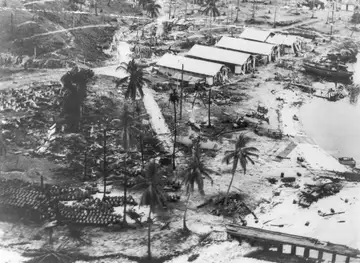
The Russell Islands became a strategic objective during the Pacific War because of their position near Guadalcanal and the approaches to the central Solomons. On 21 February 1943, United States forces landed in the islands in Operation Cleanslate after Japanese forces had used the area during their campaign. The occupation brought airfields, roads, supply installations and intense military activity to an environment previously shaped mainly by village life and plantation production. Surviving concrete fragments, earthworks and altered clearings are reminders of this short but consequential period, although their condition and accessibility vary.
Postwar Rural Continuity
After the war, the Russell Islands returned to a predominantly rural pattern of life, with communities rebuilding homes, gardens and local institutions amid the practical difficulties of island transport. Solomon Islands achieved independence in 1978, and Yandina continued as a small service and settlement centre within Central Province rather than developing into a large town. Today, the legacy of plantations and the Pacific War sits alongside customary landholding, village networks, fishing and small-scale agriculture. The result is a place where history is encountered through landscape and community knowledge as much as through formal museums or monuments.
Yandina in Photos
Browse through our photo collection highlighting the charm and character of the destination.
Cities near Yandina
The closest cities to Yandina, if you have time for more than one stop.
-

-
-

-

-


Swipe for more cities
Explore more
Explore more of Solomon Islands
Discover the Solomon Islands: An unspoiled tropical paradise with pristine beaches, vibrant coral reefs, rich history, and unique cultural experiences.
Explore Solomon Islands