

Great St Mary's, Cambridge Travel Guide
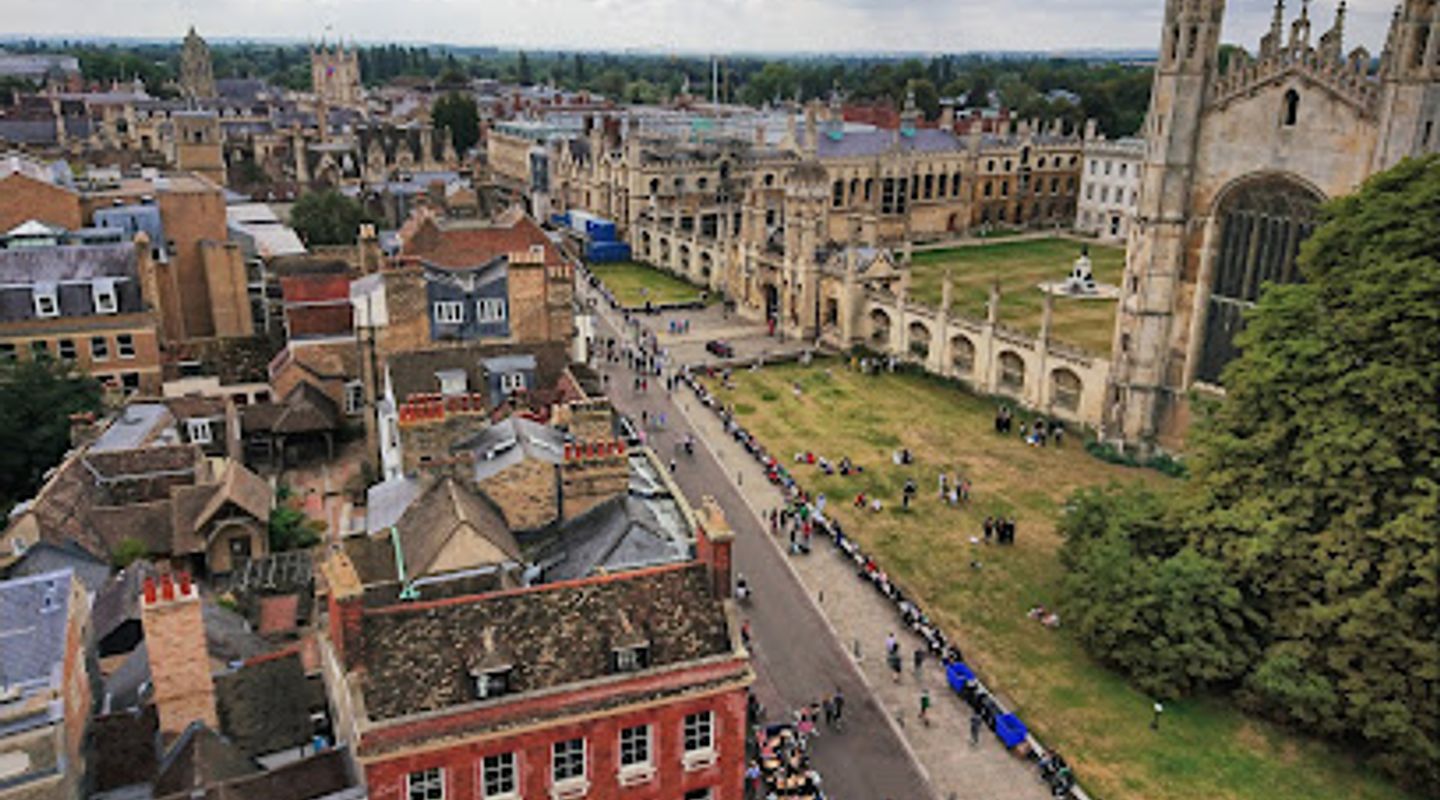
Free Guide: Cambridge's official University Church with a 123-step tower offering 360-degree views over college rooftops and King's College Chapel.


A brief summary of Great St Mary's
Cambridge's official University Church with a 123-step tower offering 360-degree views over college rooftops and King's College Chapel.
Great St Mary's stands at the north end of King's Parade on Senate House Hill, serving as Cambridge's official University Church and the fixed point from which all distances to the city are measured. The Grade I listed Perpendicular Gothic building dates mainly from 1478 to 1608 and contains the original Cambridge Quarters clock chimes. Visitors can explore the free nave with its galleries, organs and memorials before paying to climb the 123-step tower for 360-degree views over the college rooftops and King's College Chapel. The site remains an active parish church with services, concerts and bell-ringing alongside tourist access.
On-site amenities
 Restrooms
 Seating areas
 Information boards
Opening hours
- Mon–Sat10 am–5:30 pm
- Sun12 pm–5 pm
Opening hours as listed on the venue’s Google Business Profile. Hours can change for services and special events, so check with the venue before you go.
- Address
- The University Church, Senate House Hill Cambridge
- Phone
- Website
Getting there
Walking
Bus
Taxi
Discover more about Great St Mary's
Identity and Setting
Great St Mary's occupies a tight urban island between Market Square, King's Parade and the Senate House. It functions as the Church of England parish church, the statutory University Church, and a paid tower viewpoint. The tall square west tower, completed in 1608 and roughly 35 metres high, carries the University Clock and a datum plaque on the southwest buttress that marks the official centre of Cambridge.
Historical Development
A church is recorded on the site from 1205. The present Late Perpendicular nave and aisles were built between 1478 and around 1519 with funding from Richard III and Henry VII. The tower followed in 1608. Scholars used the nave for lectures and degree ceremonies from 1209 until the Senate House opened in 1730. Reformation figures including Erasmus preached here; Martin Bucer's remains were symbolically reinterred after the Marian persecutions. The building received galleries in 1735 for compulsory University Sermons and has undergone restorations by James Essex, George Gilbert Scott and Anthony Salvin. It remains a Liberal Catholic Inclusive Church parish where officers must live within 20 miles and undergraduates within three miles.
Interior and Facilities
The spacious nave contains 18th-century galleries, Victorian stained glass, two self-contained organs and a 1960 Majestas sculpture. Interactive heritage touchscreens and a short film provide context. Step-free access reaches the main nave areas via west and south doors, with an accessible toilet and baby-changing facility by the south entrance. Fixed pew seating includes space for wheelchair users. The adjacent Michaelhouse café occupies a former medieval chapel immediately north on Trinity Street.
Tower Climb and Views
Tower tickets are sold in the gift shop inside the church. The climb ascends 123 narrow spiral stone steps to a refurbished outdoor platform offering uninterrupted 360-degree views. Staff manage one-way flow by microphone. On clear days visitors identify King's College Chapel, the Senate House, Market Square and surrounding college courts. The platform is exposed to wind and bell noise; rain, low cloud or ice can close or discourage the climb even when the nave remains open.
Practical Access
The church lies in the pedestrianised historic core. Walking from Drummer Street bus station takes about five minutes; Cambridge railway station is 1.3 miles away. Frequent city and Park & Ride buses serve nearby stops. No on-site parking exists and central driving is restricted. The nave offers easy access; the tower requires a physically demanding stair climb and is unsuitable for wheelchairs or limited mobility.
Seasonality and Duration
The nave functions year-round. Tower visits peak in summer, at weekends, during school holidays and after lunch when tour groups arrive. Weekday mornings and winter months are quieter. A typical visit lasts 40 to 90 minutes; services and bell-ringing continue around visitor circulation.
Evendo Review Centre
 Google
Guest reviews
Best time to go
Quietest: Jan, Feb & Nov · before 11am or from 6pm
Busy times are Evendo estimates for a typical year, to help you plan. Actual crowds vary with events, school holidays and the weather.
Explore Great St Mary's on the map
A handpicked selection of must-see spots near Great St Mary's, mapped for you.
Get your free copy of our complete guide to Great St Mary's, delivered straight to you.
Everything on this page, from opening hours and how to get there to Eve’s tips and the best time to go, in one PDF you can read offline, print or share.
Already have an account? Sign in
Your Great St Mary's guide is ready.
We'll send it to · Not you? Sign out

Getting your guide ready…
We are putting together a fresh copy of the Great St Mary's guide. This can take up to a minute.
This can take a few moments. If your browser asks, choose Allow so the download can start. You'll find the guide in your Downloads folder.
Nothing happened? Download it again
Sorry, the guide is taking longer than usual. Please try again in a minute, or get it by email instead.
Unlock the best of Great St Mary's
Skip-the-line tickets, guided tours with entry, and walking tours of the area, booked in a few clicks.


Other nearby places you may find interesting
The closest places of the same kind, if this one is not quite what you had in mind.
-
-
-
-
-


Swipe for more places
More to explore near Great St Mary's

 Best experiences near Great St Mary's
 Best hotels near Great St Mary's
 Best landmarks near Great St Mary's
 Best attractions near Great St Mary's
 Best shops near Great St Mary's
 Best restaurants near Great St Mary's
 Best bars near Great St Mary's
Do you manage this location?
Take control to get all the benefits, like improved information, better appearance, and stronger visibility across AI-powered discovery.
Explore more

Explore more of Cambridge
Cambridge travel guide: explore historic colleges, the River Cam, museums, medieval chapels, riverside punting, independent shops and local culture.
Explore Cambridge
Explore more of United Kingdom
Discover the United Kingdom: A blend of rich history, stunning landscapes, and vibrant cities, offering a unique travel experience for every visitor.
Explore United Kingdom
