Free St. Peter's Square Travel Guide & Mobile App
Plan your St. Peter's Square trip with Evendo. Get free guides to top attractions, restaurants, hotels, and bars. Web access or download the mobile app.


St. Peter's Square in Vatican City blends Bernini's colonnade, Renaissance architecture, papal history and access to St Peter's Basilica in Rome.
A Colonnaded Gateway to the Vatican
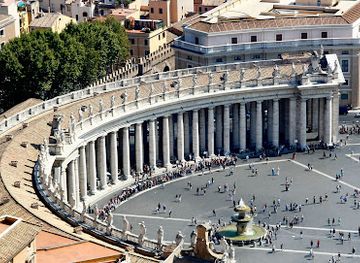
St. Peter’s Square is the ceremonial heart of Vatican City, a vast oval piazza framed by Gian Lorenzo Bernini’s celebrated colonnade. Although the square itself is compact enough to explore on foot, its scale is deliberately theatrical: four rows of columns curve around visitors as if embracing the Catholic world, while the façade of St. Peter’s Basilica rises beyond them. The square stands at the western end of Rome’s Via della Conciliazione, yet crossing its boundary means entering the world’s smallest sovereign state.Read more about St. Peter's Square
Architecture, Ritual and Symbolism
Exploring the Surrounding District
When is the best time to visit St. Peter's Square?
Best: May–June, October · 24–31°C| Month | High (°C) | Rainfall (mm) |
|---|---|---|
| January | 15 | 70 |
| February | 15 | 70 |
| March | 18 | 70 |
| April | 21 | 70 |
| May (best) | 25 | 50 |
| June (best) | 31 | 20 |
| July | 34 | 20 |
| August | 33 | 30 |
| September | 30 | 50 |
| October (best) | 24 | 70 |
| November | 18 | 70 |
| December | 15 | 70 |
Getting to and around St. Peter's Square
How to get there
Transportation
Best landmarks in St. Peter's Square
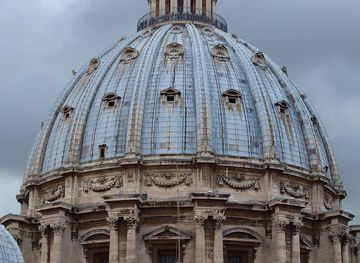
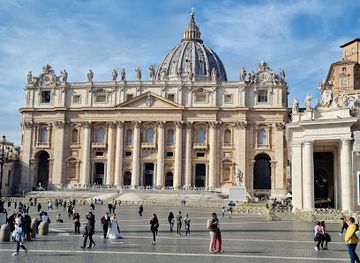
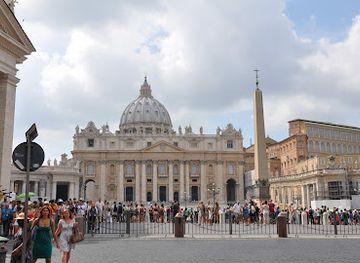
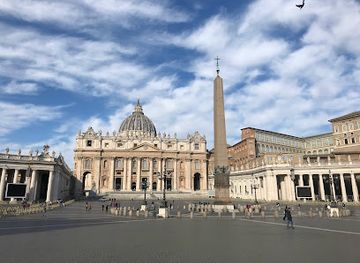
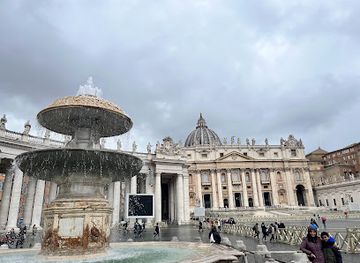
The defining landmark is St. Peter’s Basilica, whose monumental façade, dome and long history embody the religious and artistic importance of the Vatican. Bernini’s colonnade is itself an architectural landmark: its curving arms enclose the piazza while the statues along the upper balustrade create a grand sculptural horizon. At the centre, the Vatican Obelisk is an ancient Egyptian monument transported to Rome in antiquity and repositioned here in 1586, crowned by a Christian cross. The two fountains, associated with Carlo Maderno and Bernini, establish a formal balance around it. Beyond the square, the entrance to the Apostolic Palace and the Scala Regia form part of Bernini’s ceremonial vocabulary, while the nearby Passetto di Borgo represents the defensive and political relationship between the Vatican and medieval Rome.
-
Plaza
Saint Peter's Square
Discover the grandeur of Saint Peter's Square, a historical landmark in Vatican City, surrounded by stunning architecture and spiritual significance.
1 min walk · 0.1 km from city centre
-
Historical landmark
St. Peter Square Obelisk
Discover the historical richness of St. Peter Square Obelisk, a centerpiece of Vatican City, blending ancient history with stunning architecture.
1 min walk · 0.1 km from city centre
-
Historical landmark
Apostolic Palace
Explore the Apostolic Palace, a majestic historical landmark in Vatican City, rich in art, history, and spiritual significance.
2 min walk · 0.1 km from city centre
-
Sculpture
La Pietà di Michelangelo
Discover the breathtaking La Pietà di Michelangelo in Vatican City, a timeless masterpiece that embodies Renaissance artistry and deep emotional narrative.
2 min walk · 0.1 km from city centre
Explore St. Peter's Square on the map
Plan your St. Peter's Square trip on one map. See where the top attractions, landmarks, restaurants, bars and hotels are, find what's near where you're staying, and book hotels and experiences in a few clicks.
Best hotels in St. Peter's Square
Best restaurants in St. Peter's Square
Vatican City itself has limited dining compared with Rome, so most visitors eat in the surrounding Borgo and Prati districts. The local food culture is Roman: dishes such as cacio e pepe, carbonara, amatriciana and supplì appear in trattorias, pizzerias and casual eateries, alongside espresso, gelato and familiar Roman pastries. Borgo offers cafés and restaurants close to St. Peter’s Square, while Prati has a broader spread of neighbourhood dining and food shopping away from the heaviest sightseeing flow. Visitors may also encounter bakeries selling pizza al taglio, presented in rectangular slices and priced by weight, as well as simple panini shops suited to a quick stop between cultural visits. Menus near the Vatican vary considerably, so moving a few streets away from Via della Conciliazione often reveals a more ordinary Roman atmosphere and a wider choice of establishments.

Best shops in St. Peter's Square
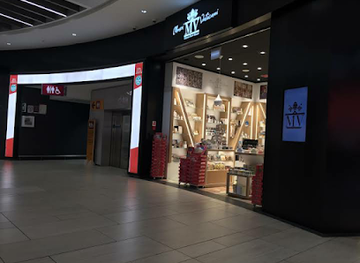
Shopping immediately around St. Peter’s Square centres on religious articles, books, devotional objects, postcards and Vatican-themed souvenirs rather than a broad retail district. The Vatican Post Office is known for stamps and postal services sought by collectors, while museum shops carry catalogues, art reproductions and publications connected with the Vatican collections. In nearby Borgo, small retailers cater to pilgrims and visitors, whereas Prati offers a more conventional Roman shopping environment, including the long commercial axis of Via Cola di Rienzo and streets around it. Visitors can also find Italian leather goods, stationery, food products and clothing in the wider district, though quality and provenance vary between shops. For a less tourist-oriented experience, explore the independent businesses away from the immediate approaches to the square and distinguish officially issued Vatican products from generic souvenirs.
-
Religious goods store
Savelli Religious (Savelli Art and Tradition)
Explore Savelli Religious in Rome, a unique destination for spiritual gifts, exquisite jewelry, and authentic Italian craftsmanship.
2 min walk · 0.1 km from city centre
-
Souvenir store
Tourist Information Office
Discover the Vatican Tourist Information Office for exclusive souvenirs and expert travel advice in the heart of Vatican City.
1 min walk · 0.1 km from city centre
-
Religious goods store
Vatican Souvenir (S.R.L.)
Discover the heart of faith with unique religious souvenirs at Vatican Souvenir, just steps from Vatican City's iconic landmarks.
2 min walk · 0.2 km from city centre
Get your free copy of our complete guide to St. Peter's Square, delivered straight to you.
Everything on this page, from attractions and restaurants to essentials and local phrases, in one PDF you can read offline, print or share.
Already have an account? Sign in
Your St. Peter's Square guide is ready.
We'll send it to · Not you? Sign out

Getting your guide ready…
We are putting together a fresh copy of the St. Peter's Square guide. This can take up to a minute.
This can take a few moments. If your browser asks, choose Allow so the download can start. You'll find the guide in your Downloads folder.
Nothing happened? Download it again
Sorry, the guide is taking longer than usual. Please try again in a minute, or get it by email instead.
St. Peter's Square essentials
Currency and Payment
Safety
Emergency Situations
Do's and Don'ts
Local Tips
From Eve
Local phrases worth knowing
You don't need to get them perfect. A few words go a long way, and locals appreciate the effort.
Basics
| English | Local | Say it |
|---|---|---|
| Hello | Salve | [SAHL-veh] |
| Goodbye | Arrivederci | [ah-ree-veh-DEHR-chee] |
| Yes | Sì | [SEE] |
| No | No | [NOH] |
| Please/You're welcome | Per favore/Prego | [pehr FAH-voh-reh/PRAY-goh] |
| Thank you | Grazie | [GRAH-tsyeh] |
| Excuse me/Sorry | Mi scusi/Scusa | [mee SKOO-zee/SKOO-zah] |
| How are you? | Come stai? | [KOH-meh STAH-ee] |
| Fine. And you? | Bene. E tu? | [BEH-neh. EH too?] |
| Do you speak English? | Parli inglese? | [PAHR-lee een-GLEH-zeh] |
| I don't understand | Non capisco | [nohn kah-PEES-koh] |
Eating & Drinking
| English | Local | Say it |
|---|---|---|
| I'd like to see the menu, please | Vorrei vedere il menù, per favore | [voh-RAY veh-DEH-reh eel meh-NOO pehr FAH-voh-reh] |
| I don't eat meat | Non mangio carne | [nohn MAHN-joh KAR-neh] |
| Cheers! | Salute! | [sah-LOO-teh] |
| I would like to pay, please | Vorrei pagare, per favore | [voh-RAY pah-GAH-reh pehr FAH-voh-reh] |
Emergencies
| English | Local | Say it |
|---|---|---|
| Help! | Aiuto! | [ai-OH-toh] |
| Go away! | Vai via! | [vai VEE-ah] |
| Call the Police! | Chiama la polizia! | [KYAH-mah lah poh-LEE-tsyah] |
| Call a doctor! | Chiama un dottore! | [KYAH-mah oon doh-TOH-reh] |
| I'm lost | Mi sono perso | [mee SOH-noh PEHR-soh] |
| I'm ill | Sto male | [stoh MAH-leh] |
Shopping
| English | Local | Say it |
|---|---|---|
| I'd like to buy... | Vorrei comprare... | [voh-RAY kohm-PRAR-reh] |
| I'm just looking | Sto solo guardando | [stoh SOH-loh gwar-DAHN-doh] |
| How much is it? | Quanto costa? | [KWAHN-toh KOH-stah] |
| That's too expensive | È troppo caro | [eh TROH-poh KAH-roh] |
| Can you lower the price? | Puoi abbassare il prezzo? | [PWEE ahb-bah-SAH-reh eel PREH-tsoh] |
Time & Numbers
| English | Local | Say it |
|---|---|---|
| What time is it? | Che ora è? | [keh OH-rah eh] |
| It's one o'clock | È l'una in punto | [eh LOO-nah een POON-toh] |
| Half past (10) | Le dieci e mezza | [leh DYEH-chee eh MEH-tzah] |
| Morning | Mattina | [maht-TEE-nah] |
| Afternoon | Pomeriggio | [poh-meh-REE-joh] |
| Evening | Sera | [SEH-rah] |
| Yesterday | Ieri | [YEH-ree] |
| Today | Oggi | [OH-jee] |
| Tomorrow | Domani | [doh-MAH-nee] |
| 1 | Uno | [OO-noh] |
| 2 | Due | [DOO-eh] |
| 3 | Tre | [TREH] |
| 4 | Quattro | [KWAT-troh] |
| 5 | Cinque | [CHEEN-kweh] |
| 6 | Sei | [SAY] |
| 7 | Sette | [SEHT-teh] |
| 8 | Otto | [OH-ttoh] |
| 9 | Nove | [NOH-veh] |
| 10 | Dieci | [DYEH-chee] |
Transport & Directions
| English | Local | Say it |
|---|---|---|
| Where's a/the...? | Dov'è un/il... | [doh-VEH oon/eel] |
| What's the address? | Qual è l'indirizzo? | [kwal eh leen-DEER-eet-zoh] |
| Can you show me (on the map)? | Puoi mostrarmi (sulla mappa)? | [PWEE mohs-TRAHR-mee SOO-lah MAHP-pah] |
| When's the next (bus)? | Quando passa il prossimo (autobus)? | [KWAHN-doh PAHS-sah eel PROHS-see-moh (ow-TOH-boos)] |
| A ticket (to ....) | Un biglietto (per ....) | [oon beel-YET-toh (pehr)] |
History of St. Peter's Square
The Vatican Hill and Ancient Rome
The area now occupied by Vatican City lay beyond ancient Rome’s traditional civic centre, on the Vatican Hill beside the Tiber. In the first century AD, the nearby Vatican Circus was associated with the emperor Nero and with the persecution of Christians traditionally linked to the apostle Peter’s martyrdom. A necropolis developed in the vicinity, and later Christian tradition identified Peter’s burial place beneath the present basilica. The archaeological importance of this setting shaped the development of the site for centuries, although the present square did not yet exist. Its later religious prominence grew from the construction of an early Christian basilica and the establishment of the Vatican as a major pilgrimage destination.
Constantine’s Basilica and Pilgrimage
In the fourth century, the emperor Constantine supported the construction of a large basilica over the area traditionally associated with Peter’s tomb. This Constantinian church became one of Christianity’s most important pilgrimage destinations and remained in use for more than a millennium. The surrounding ground was gradually occupied by ecclesiastical buildings, defensive structures and routes serving pilgrims. Medieval popes developed the Vatican complex as an alternative centre of authority to the Lateran, and the area became increasingly identified with the papacy. The open piazza visible today was still absent, but the basilica and the tomb beneath it established the religious importance that would govern every later architectural decision.
The Vatican Obelisk Arrives
The ancient obelisk standing at the centre of St. Peter’s Square was brought from Egypt to Rome during the reign of the emperor Caligula and originally stood in Nero’s Circus. In 1586, Pope Sixtus V commissioned the architect Domenico Fontana to move it to the area in front of the new basilica. The operation was a major feat of Renaissance engineering, requiring elaborate scaffolding and coordinated labour. A cross was placed on its summit, transforming an imperial monument into a Christian symbol. Its central position later became essential to the geometric composition of Bernini’s piazza.
The New Basilica and Bernini’s Piazza
St. Peter’s Basilica was rebuilt over several centuries from the early sixteenth century, involving architects including Donato Bramante, Michelangelo, Carlo Maderno and Gian Lorenzo Bernini. Maderno completed the great façade in the early seventeenth century, but the approach remained an irregular open area. Between 1656 and 1667, Bernini shaped this space for Pope Alexander VII. His elliptical enclosure, defined by the colonnade, created a monumental forecourt that could accommodate large religious gatherings while directing attention towards the basilica. The four rows of columns also produced a controlled visual effect: from particular points, they appear to align as a single row.
From Papal State to Vatican City
The political status of the Vatican changed after the Papal States were incorporated into the Kingdom of Italy in 1870. The resulting dispute between the Italian state and the papacy, known as the Roman Question, was resolved by the Lateran Pacts of 1929. These agreements recognised Vatican City as a sovereign state and regulated its relationship with Italy. St. Peter’s Square consequently became not only a major religious gathering place but also the public ceremonial centre of an independent state. In the twentieth and twenty-first centuries, papal elections, canonisations, audiences and large international pilgrimages have continued to connect the square’s Baroque design with contemporary global Catholic life.
Travel experiences inspired by this city
-
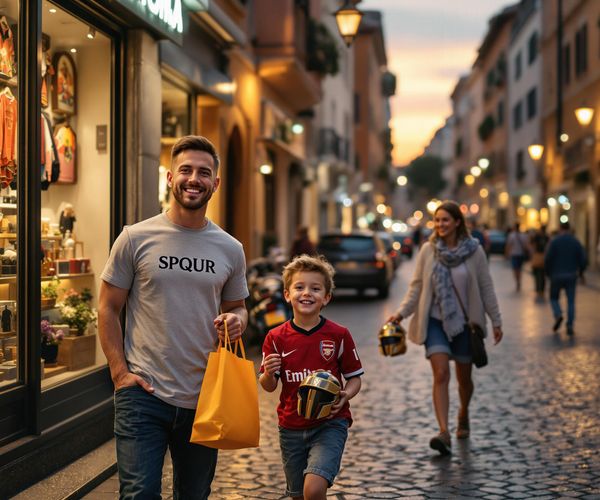 11 Day Trip
Family Adventure Through the Eternal City: Rome
Join us on an 11-day family journey through Rome, where history, culture, and adventure await in the heart of Italy's capital.
11 Day Trip
Family Adventure Through the Eternal City: Rome
Join us on an 11-day family journey through Rome, where history, culture, and adventure await in the heart of Italy's capital.
 15 Sep 2025
By Andrew Taylor -
 7 Day Trip
Family Adventure in the Heart of Rome
Embark on a family adventure through Rome's historic landmarks, vibrant culture, and exquisite cuisine. Experience the eternal city's charm together.
7 Day Trip
Family Adventure in the Heart of Rome
Embark on a family adventure through Rome's historic landmarks, vibrant culture, and exquisite cuisine. Experience the eternal city's charm together.
 20 Feb 2025
By Andreea Albu
Swipe for more travel diaries
St. Peter's Square in Photos
Browse through our photo collection highlighting the charm and character of the destination.
Cities near St. Peter's Square
The closest cities to St. Peter's Square, if you have time for more than one stop.
-

-

-

-

-


Swipe for more cities