

Free St. Peter's Basilica Travel Guide & Mobile App
Plan your St. Peter's Basilica trip with Evendo. Get free guides to top attractions, restaurants, hotels, and bars. Web access or download the mobile app.


St Peter’s Basilica in Vatican City combines Renaissance architecture, papal history, Michelangelo’s dome, sacred art and Rome’s great Christian landmarks.
A Monumental Sacred Space
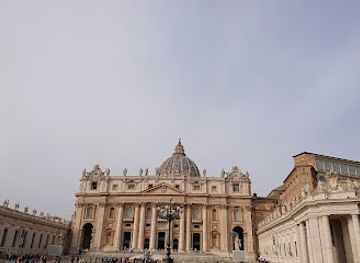
St Peter’s Basilica stands within Vatican City, the world’s smallest independent state and the spiritual centre of the Catholic Church. Its vast façade faces St Peter’s Square, where Bernini’s sweeping colonnades create one of Europe’s most memorable urban settings. The basilica visible today is principally a Renaissance and Baroque reconstruction, raised over the traditional burial place of Saint Peter, one of Jesus’s apostles and the first bishop of Rome according to Catholic tradition.Read more about St. Peter's Basilica
Art, Architecture and Ritual
The Vatican Setting
When is the best time to visit St. Peter's Basilica?
Best: April–May, October · 21–26°C| Month | High (°C) | Rainfall (mm) |
|---|---|---|
| January | 11 | 70 |
| February | 11 | 60 |
| March | 16 | 55 |
| April (best) | 21 | 50 |
| May (best) | 26 | 45 |
| June | 32 | 40 |
| July | 35 | 35 |
| August | 35 | 35 |
| September | 30 | 40 |
| October (best) | 24 | 50 |
| November | 18 | 60 |
| December | 12 | 65 |
Getting to and around St. Peter's Basilica
How to get there
Transportation
Best attractions in St. Peter's Basilica
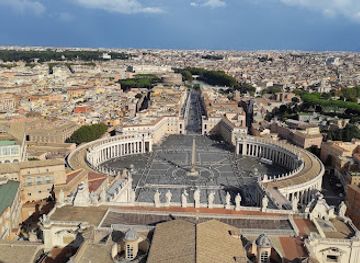
St Peter’s Basilica is the principal attraction of the Vatican enclave, with a vast interior arranged around the papal altar and Bernini’s bronze baldachin. Michelangelo’s Pietà, protected near the entrance, offers an intimate counterpoint to the building’s immense scale, while the dome provides an elevated perspective over the basilica and Rome. St Peter’s Square is an attraction in its own right: Bernini’s curving colonnades, fountains and central obelisk create a ceremonial approach that accommodates pilgrims and public gatherings. The Vatican Grottoes beneath the church contain papal tombs and memorials, while the Scavi archaeological area below them is visited through separately arranged tours and focuses on the ancient necropolis and the traditional site of Peter’s tomb. Nearby, the Vatican Museums and Sistine Chapel extend the cultural visit but have separate entrances and visitor arrangements.
-
 Art museum
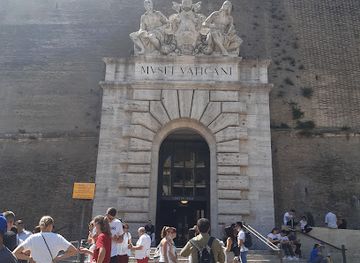
Vatican Museums
Discover the stunning art and history at the Vatican Museums, home to masterpieces like the Sistine Chapel and more in the heart of Vatican City.
6 min walk · 0.5 km from city centre
-
Catholic church
Sistine Chapel
Discover the Sistine Chapel, a stunning fusion of art and spirituality in Vatican City, featuring Michelangelo's breathtaking frescoes and rich historical significance.
1 min walk · 0.1 km from city centre
-
Museum
Museum Leonardo Da Vinci Experience
Discover the brilliance of Leonardo da Vinci at this interactive museum in Rome, a must-visit for art and science enthusiasts.
8 min walk · 0.6 km from city centre
-
Performing arts theater
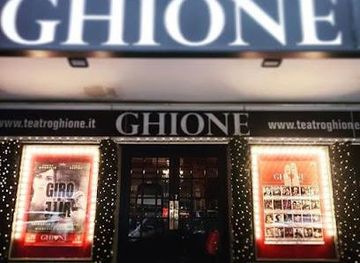
Ghione
Discover the captivating world of performing arts at Ghione Theatre, Rome's vibrant cultural hub in the heart of Trastevere.
5 min walk · 0.4 km from city centre


Best landmarks in St. Peter's Basilica
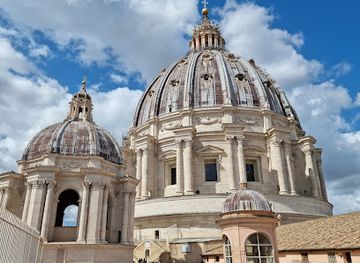
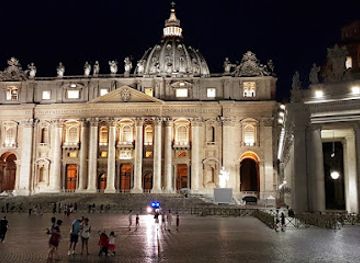
The defining landmark is St Peter’s Basilica itself, whose Renaissance dome dominates the Vatican skyline and whose Baroque interior expresses centuries of papal patronage. In front of it, St Peter’s Square is framed by Bernini’s monumental colonnade, designed as an embracing architectural enclosure for pilgrims and ceremonial gatherings. The ancient Egyptian obelisk at the centre of the square was brought to Rome in antiquity and later incorporated into the Vatican setting, while the twin fountains provide balance within the piazza. The basilica’s broad façade, designed by Carlo Maderno, forms the formal eastern face of the complex. Beyond the square, the Vatican Apostolic Palace and the nearby Passetto di Borgo belong to the wider historic landscape, linking papal administration and fortified movement with the basilica’s religious importance.
-
Art museum
Vatican Museums
Explore the Vatican Museums, a treasure trove of art and history, including the Sistine Chapel's awe-inspiring frescoes and Raphael's masterpieces.
6 min walk · 0.5 km from city centre
-
Catholic church
Sistine Chapel
Explore the Sistine Chapel, a breathtaking fusion of art and spirituality, home to Michelangelo's masterpieces in Vatican City.
1 min walk · 0.1 km from city centre
-
Plaza
Saint Peter's Square
Experience the grandeur of Saint Peter's Square, a historical plaza in Vatican City, where faith and artistry converge in spectacular fashion.
3 min walk · 0.2 km from city centre
-
Historical landmark
St. Peter Square Obelisk
Discover the grandeur of St. Peter Square Obelisk, a historical landmark in Vatican City that embodies ancient history and artistic brilliance.
3 min walk · 0.3 km from city centre
Explore St. Peter's Basilica on the map
Plan your St. Peter's Basilica trip on one map. See where the top attractions, landmarks, restaurants, bars and hotels are, find what's near where you're staying, and book hotels and experiences in a few clicks.
Best hotels in St. Peter's Basilica
Best restaurants in St. Peter's Basilica
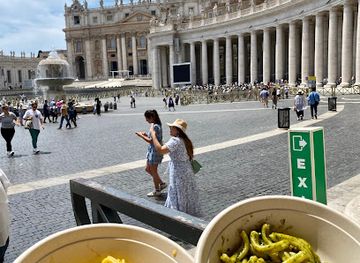
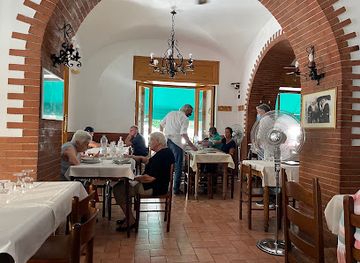
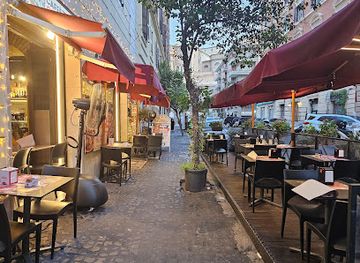
St Peter’s Basilica itself is not a dining district, and Vatican City offers far fewer public eating options than the surrounding Roman neighbourhoods. Visitors generally eat in Borgo Pio, Via di Porta Angelica and the streets leading towards Prati, where cafés, pizzerias, gelaterias and Roman trattorias serve familiar local cooking. Roman specialities include carbonara, amatriciana, cacio e pepe and supplì, while bakeries and espresso bars suit visitors fitting food around religious services or museum visits. Nearby restaurants cater to an international audience, but the strongest sense of local food culture comes from simple pasta dishes, pizza by the slice, seasonal produce and leisurely coffee rituals. Reservations may be useful at popular restaurants, while modest cafés provide practical choices during busy sightseeing periods.
-
Pizza
Ristorante Pizzeria Castello
Experience authentic Roman cuisine at Ristorante Pizzeria Castello - where every dish tells a story of Italy's culinary tradition.
4 min walk · 0.3 km from city centre
-
Italian
Pastasciutta
Experience authentic Italian flavors at Pastasciutta in Rome—where fresh pasta meets warm hospitality in an inviting setting.
6 min walk · 0.4 km from city centre
-
Restaurant
Ristorante dei Musei
Experience authentic Italian cuisine at Ristorante dei Musei in Rome – where delicious pizzas meet rich cultural heritage.
8 min walk · 0.6 km from city centre
-
Restaurant
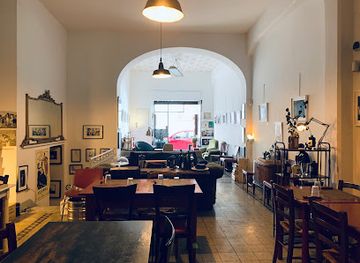
Caffè Delle Commari
Discover authentic Italian flavors at Caffè Delle Commari, where traditional cuisine meets modern coffee culture in the heart of Rome.
8 min walk · 0.7 km from city centre

Best bars in St. Peter's Basilica
St Peter’s Basilica and Vatican City do not have a conventional nightlife scene, and the area becomes notably quieter after the main visiting hours and religious ceremonies. Evening activity is concentrated across the boundary in Borgo and Prati, where wine bars, cafés, trattorias and hotel bars offer subdued places for conversation rather than large clubs. Rome’s broader nightlife districts, including Trastevere and Monti, are reached by public transport or taxi and provide more extensive choices of bars, live music and late-evening entertainment. The Vatican surroundings are best suited to a respectful evening walk around the illuminated square or along Via della Conciliazione, with visitors mindful that the area remains a functioning religious centre and that some streets may be affected by security arrangements.
-
Gastropub
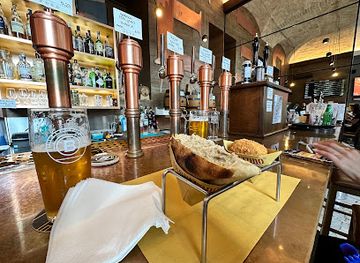
Be.Re. + Trapizzino
Experience the best of Roman street food at Be.Re. + Trapizzino, where tradition meets modern taste in a vibrant gastropub setting.
7 min walk · 0.5 km from city centre
-
Wine bar
Wine Bar De' Penitenzieri
Discover the exquisite wines and charming ambiance of Wine Bar De' Penitenzieri, your perfect stop in Rome for an authentic Italian experience.
7 min walk · 0.6 km from city centre
-
Espresso bar
Caffè Vaticano
Experience authentic Italian coffee culture at Caffè Vaticano, a cozy espresso bar near the Vatican, perfect for tourists seeking a local flavor.
7 min walk · 0.5 km from city centre
-
Bistro
Bukowski's Bar
Discover Bukowski's Bar, a trendy bistro in Rome offering exquisite Italian cuisine, delightful drinks, and a vibrant atmosphere for every occasion.
8 min walk · 0.7 km from city centre
Best nightclubs in St. Peter's Basilica
St Peter’s Basilica and Vatican City do not have a conventional nightlife scene, and the area becomes notably quieter after the main visiting hours and religious ceremonies. Evening activity is concentrated across the boundary in Borgo and Prati, where wine bars, cafés, trattorias and hotel bars offer subdued places for conversation rather than large clubs. Rome’s broader nightlife districts, including Trastevere and Monti, are reached by public transport or taxi and provide more extensive choices of bars, live music and late-evening entertainment. The Vatican surroundings are best suited to a respectful evening walk around the illuminated square or along Via della Conciliazione, with visitors mindful that the area remains a functioning religious centre and that some streets may be affected by security arrangements.
-
Pub
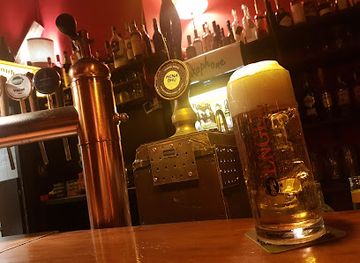
Saxophone Live Pub
Experience the vibrant nightlife of Rome at Saxophone Live Pub, where fantastic live music and a lively atmosphere await you.
8 min walk · 0.6 km from city centre
-
Piano bar
NEW KING CLUB
Discover the vibrant nightlife at New King Club, a premier piano bar in the heart of Rome, offering enchanting live music and a lively atmosphere.
6 min walk · 0.5 km from city centre
-
Night club
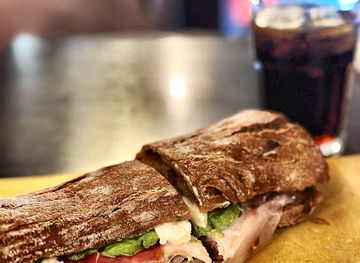
Duecento gradi
Experience the vibrant nightlife and gourmet sandwiches at Duecento Gradi, a unique blend of flavors and fun in the heart of Rome.
7 min walk · 0.5 km from city centre
-
Bar
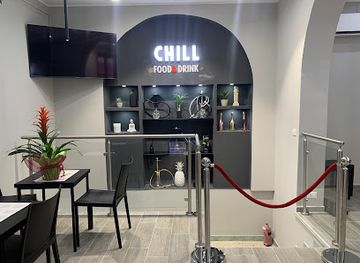
Chill
Experience the vibrant atmosphere of Chill, a trendy bar in Rome offering a wide selection of drinks and a perfect spot to unwind after a day of exploration.
8 min walk · 0.6 km from city centre

Best shops in St. Peter's Basilica
Shopping around St Peter’s Basilica centres on religious articles, books, devotional images, medals, rosaries and Vatican-themed souvenirs rather than a broad fashion district. Official Vatican outlets and the Vatican post office are notable for stamps, coins, publications and collectable material, while shops around Borgo and Via di Porta Angelica sell a mixture of ecclesiastical goods, postcards and tourist merchandise. Visitors seeking a more general retail experience can continue into Prati, where Rome’s ordinary high-street shops, food stores and independent businesses give a fuller picture of contemporary local commerce. Vatican euro coins and stamps are particularly distinctive purchases, but buyers should distinguish official issues from mass-produced souvenirs and choose reputable retailers for religious art or antique-looking objects.
-
Book store
Libreria Ancora Store - Roma
Visit Libreria Ancora Store in Rome for a unique blend of literature and religious goods, ideal for book lovers and spiritual seekers.
6 min walk · 0.4 km from city centre
-
Grocery store
Annona Vatican City
Experience the authentic taste of Italy at Annona in Vatican City, where fresh ingredients and local delicacies come together.
4 min walk · 0.4 km from city centre
-
Religious goods store
Savelli Religious (Savelli Art and Tradition)
Explore Savelli Religious for unique spiritual gifts, exquisite jewelry, and a glimpse into Italy's rich cultural heritage.
4 min walk · 0.3 km from city centre
-
Church supply store
Soprani - shop religious
Discover authentic religious artifacts and liturgical supplies at Soprani, a cherished church supply store in the heart of Rome.
6 min walk · 0.5 km from city centre


Get your free copy of our complete guide to St. Peter's Basilica, delivered straight to you.
Everything on this page, from attractions and restaurants to essentials and local phrases, in one PDF you can read offline, print or share.
Already have an account? Sign in
Your St. Peter's Basilica guide is ready.
We'll send it to · Not you? Sign out

Getting your guide ready…
We are putting together a fresh copy of the St. Peter's Basilica guide. This can take up to a minute.
This can take a few moments. If your browser asks, choose Allow so the download can start. You'll find the guide in your Downloads folder.
Nothing happened? Download it again
Sorry, the guide is taking longer than usual. Please try again in a minute, or get it by email instead.
St. Peter's Basilica essentials
Currency and Payment
Safety
Emergency Situations
Do's and Don'ts
Local Tips
From Eve
Local phrases worth knowing
You don't need to get them perfect. A few words go a long way, and locals appreciate the effort.
Basics
| English | Local | Say it |
|---|---|---|
| Hello | Salve | [sal-veh] |
| Goodbye | Addio | [ad-dee-oh] |
| Yes | Sì | [see] |
| No | No | [noh] |
| Please/You're welcome | Per favore/Prego | [pair fah-voh-reh/preh-goh] |
| Thank you | Grazie | [grah-tsee-eh] |
| Excuse me/Sorry | Mi scusi/Scusa | [mee skoo-zee/skoo-zah] |
| How are you? | Come stai? | [koh-meh stah-ee] |
| Fine. And you? | Bene. E tu? | [beh-neh/eh too] |
| Do you speak English? | Parli inglese? | [par-lee een-gleh-zeh] |
| I don't understand | Non capisco | [non kah-pee-skoh] |
Eating & Drinking
| English | Local | Say it |
|---|---|---|
| I'd like to see the menu, please | Vorrei vedere il menù, per favore | [vor-ray veh-deh-reh eel meh-noo, pair fah-voh-reh] |
| I don't eat meat | Non mangio carne | [non man-joh kahr-neh] |
| Cheers! | Salute! | [sah-loo-teh] |
| I would like to pay, please | Vorrei pagare, per favore | [vor-ray pah-gah-reh, pair fah-voh-reh] |
Emergencies
| English | Local | Say it |
|---|---|---|
| Help! | Aiuto! | [ah-yoo-toh] |
| Go away! | Vai via! | [vah-ee vee-ah] |
| Call the Police! | Chiama la polizia! | [kee-ah-mah lah poh-lee-ts-yah] |
| Call a doctor! | Chiama un dottore! | [kee-ah-mah oon doh-ttoh-reh] |
| I'm lost | Mi sono perso | [mee soh-noh pehr-soh] |
| I'm ill | Sto male | [stoh mah-leh] |
Shopping
| English | Local | Say it |
|---|---|---|
| I'd like to buy... | Vorrei comprare... | [vor-ray kohm-prah-reh] |
| I'm just looking | Sto solo guardando | [stoh soh-loh gwar-dahn-doh] |
| How much is it? | Quanto costa? | [kwahn-toh koh-stah] |
| That's too expensive | È troppo caro | [eh trohp-poh kah-roh] |
| Can you lower the price? | Puoi abbassare il prezzo? | [pwah-ee ahb-bahs-sah-reh eel preh-tsoh] |
Time & Numbers
| English | Local | Say it |
|---|---|---|
| What time is it? | Che ora è? | [keh oh-rah eh] |
| It's one o'clock | È l'una | [eh loo-nah] |
| Half past (10) | Sono le dieci e mezza | [soh-noh leh dyeh-chee eh meh-tsah] |
| Morning | Mattina | [maht-tee-nah] |
| Afternoon | Pomeriggio | [poh-meh-ree-joh] |
| Evening | Sera | [seh-rah] |
| Yesterday | Ieri | [ee-eh-ree] |
| Today | Oggi | [oh-jee] |
| Tomorrow | Domani | [doh-mah-nee] |
| 1 | Uno | [oo-noh] |
| 2 | Due | [doo-eh] |
| 3 | Tre | [treh] |
| 4 | Quattro | [kwah-ttroh] |
| 5 | Cinque | [cheen-kweh] |
| 6 | Sei | [say-ee] |
| 7 | Sette | [seht-teh] |
| 8 | Otto | [oh-ttoh] |
| 9 | Nove | [noh-veh] |
| 10 | Dieci | [dyeh-chee] |
Transport & Directions
| English | Local | Say it |
|---|---|---|
| Where's a/the...? | Dov'è...? | [doh-veh] |
| What's the address? | Qual è l'indirizzo? | [kwal eh leen-dee-reet-tsoh] |
| Can you show me (on the map)? | Puoi mostrarmi (sulla mappa)? | [pwah-ee mohs-trar-mee/suhl-lah mahp-pah] |
| When's the next (bus)? | Quando passa il prossimo (autobus)? | [kwahn-doh pahs-sah eel prohs-see-moh (ow-toh-boos)] |
| A ticket (to ....) | Un biglietto (per ....) | [oon bee-lyet-toh/pair] |
History of St. Peter's Basilica
The Tradition of Saint Peter’s Tomb
The history of St Peter’s Basilica rests on the Christian tradition that the apostle Peter was executed in Rome during the first century and buried in the area of the Vatican Hill. Archaeological investigations beneath the present basilica uncovered a Roman necropolis and a memorial associated with the veneration of Peter, although individual interpretations of the evidence remain subjects of scholarly discussion. The site became one of the principal destinations for Christian pilgrims. Its significance grew as Rome developed its claim to apostolic authority, making the area beside the Tiber a focal point for worship, burial and pilgrimage long before the present building was conceived.
Constantine’s Fourth-Century Basilica
After the Roman emperor Constantine adopted policies favourable to Christianity in the early fourth century, a large basilica was constructed over the traditional site of Peter’s burial. Usually associated with the reign of Constantine and completed during the fourth century, the Constantinian basilica became one of Rome’s major churches. For centuries it received pilgrims, papal ceremonies and important burials, while its five-aisled plan and monumental scale reflected the growing public status of Christianity within the Roman Empire. By the late Middle Ages, however, the ageing structure required extensive repair and no longer matched the ambitions of the papacy.
The Renaissance Reconstruction
The decision to rebuild the old basilica began a project that lasted more than a century and involved several of Italy’s leading architects. Work commenced under Pope Julius II in 1506, with Donato Bramante associated with the initial centralised design. Raphael, Antonio da Sangallo the Younger and Michelangelo subsequently shaped the evolving plan. Michelangelo became chief architect in 1547 and strengthened the central concept, including the design of the dome, but the building was not finished during his lifetime. The reconstruction transformed the Vatican into a principal stage for Renaissance architecture and papal patronage.
The Dome and Baroque Completion
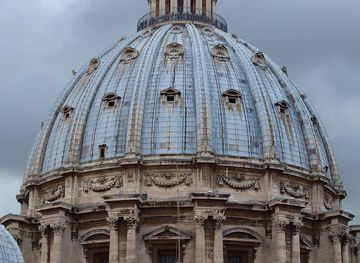
The dome, based on Michelangelo’s design and completed after his death under the direction of Giacomo della Porta and Domenico Fontana, became the defining feature of the basilica’s skyline. In the seventeenth century, Carlo Maderno extended the eastern arm and created the present façade, while Gian Lorenzo Bernini shaped the interior and the great piazza outside. His bronze baldachin, installed above the papal altar, and the surrounding colonnade gave the complex its characteristic Baroque theatricality. These additions redirected the visitor’s experience from the concentrated Renaissance plan towards a grand ceremonial approach.
The Basilica in Modern Vatican City
St Peter’s Basilica continued to serve as a centre of papal worship, pilgrimage and major Catholic ceremonies into the modern period. The Lateran Treaty of 1929 established Vatican City as an independent state, placing the basilica within the territory of the new enclave while preserving its religious role. Twentieth- and twenty-first-century conservation has addressed the building’s stonework, mosaics, artworks and structural demands. Today, the basilica functions simultaneously as a church, a pilgrimage destination, an architectural monument and a setting for papal liturgies, with access and use shaped by the Catholic calendar.
Travel experiences inspired by this city
-
 11 Day Trip
Family Adventure Through the Eternal City: Rome
Join us on an 11-day family journey through Rome, where history, culture, and adventure await in the heart of Italy's capital.
11 Day Trip
Family Adventure Through the Eternal City: Rome
Join us on an 11-day family journey through Rome, where history, culture, and adventure await in the heart of Italy's capital.
 15 Sep 2025
By Andrew Taylor -
 7 Day Trip
Family Adventure in the Heart of Rome
Embark on a family adventure through Rome's historic landmarks, vibrant culture, and exquisite cuisine. Experience the eternal city's charm together.
7 Day Trip
Family Adventure in the Heart of Rome
Embark on a family adventure through Rome's historic landmarks, vibrant culture, and exquisite cuisine. Experience the eternal city's charm together.
 20 Feb 2025
By Andreea Albu
Swipe for more travel diaries
St. Peter's Basilica in Photos
Browse through our photo collection highlighting the charm and character of the destination.
Cities near St. Peter's Basilica
The closest cities to St. Peter's Basilica, if you have time for more than one stop.
-

-

-

-

-


Swipe for more cities
Explore more
Explore more of Vatican City
Explore Vatican City, the spiritual heart of Catholicism, home to St. Peter's Basilica, the Vatican Museums, and the serene Vatican Gardens, where art and faith converge.
Explore Vatican City