

Full day Christian tour following Paul In Athens and Corinth
 Piraeus, GR
 100% of travellers recommend this
Highlights
- Visit to the Acropolis and the Parthenon of Athens
- Visit to the picturesque quarter of ancient agora
- Impressive photos at the Corinth Canal
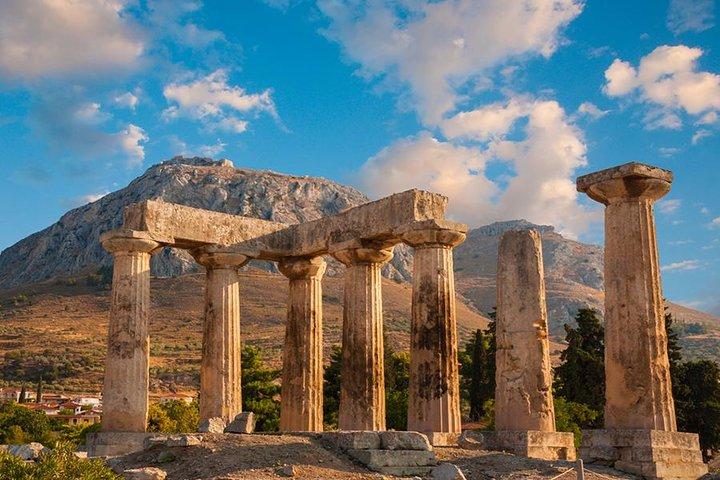
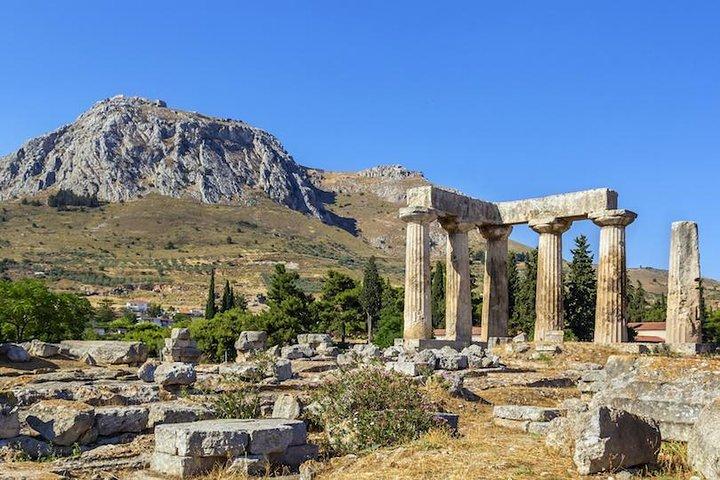
- Exploring the archaeological site of Ancient Corinth
- Customizable tour within the itinerary
-
Duration 8 hours
-
Private Tour
-
English-speaking driver
-
Customizable itinerary
-
Pick-up from Piraeus port
-
Bottled water included
Embark on a full day Christian tour following in the footsteps of Paul in Athens and Corinth. Begin your journey with a visit to the iconic Acropolis and the majestic Parthenon of Athens. Immerse yourself in the picturesque quarter of the ancient agora, capturing stunning photos at the Corinth Canal along the way. Explore the archaeological site of Ancient Corinth and stand on the historic Mars hill. With an experienced English speaking driver, enjoy a safe and comfortable private tour, with the flexibility to customize the itinerary to your preferences. Your driver will provide insightful knowledge of Greek history and culture, guiding you until you enter the archaeological sites and museums. If you desire a licensed tour guide to accompany you inside the sites and museums, it can be arranged at an additional cost. Join this original Christian shore excursion and experience the rich history of Athens and Corinth.
At a Glance
-
 Free cancellation
-
 8 hours
-
 Instant Confirmation
-
 Available in English
-
 Mobile voucher
-
 Private Tour
-
 Guided
-
 Family friendly

Featured Reviews

Explore the Christian heritage in Athens and Corinth with a private, customizable tour, led by an experienced English-speaking driver.
Included
-
 Bottled water
 -
Hotel pickup and drop-off in Athens
-
A professional English speaking driver with good knowledge in history and culture of Greece, to guide you till you enter archaeological sites and museums. Tour drivers are not licensed to companion you inside the archaeological sites and museums. If you'd like to have a licensed by the state tour guide to escort you inside the sites and museums, we can arrange it for you with an additional cost. Licenced by the state tour guides are freelance and it is subject of availability on bookings day!
-
Pick-up from the cruise ship pier at Port of Piraeus Road tolls and local taxes
-
Transport by air-conditioned vehicle appropriate for the size of your group
-
Surcharges on fuel
Excluded
-
 A licensed by the state tour guide. (we can arrange it for you with an additional cost)
 -
Entrance fees to the archaeological sites and museum
-
Food and drinks
-
Gratuities
Pickup
Check if pick-up is available from your location, you will select during checkout (providers may allow other pickup locations)

What to expect
Piraeus
Pick up from your accommodation in Athens, or your cruise ship pier at Piraeus port. We will drive along the coastal road of Saronic Gulf to enjoy the Piraeus and Athens riviera.
20 minutes
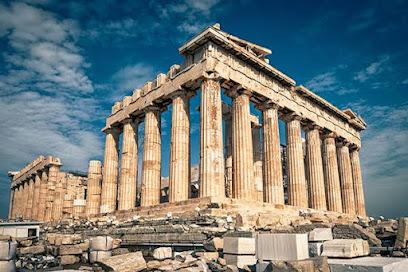
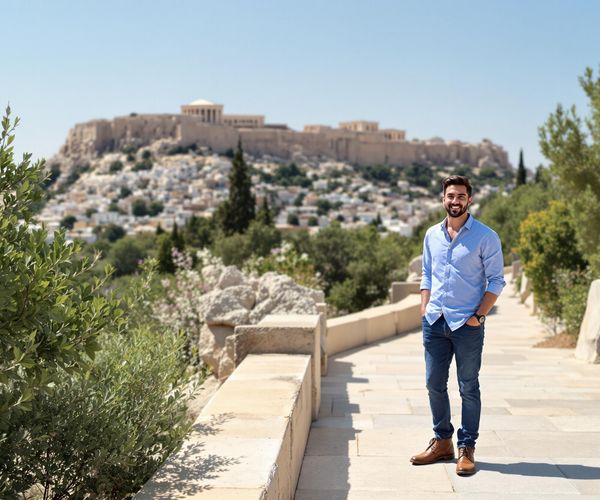
The greatest and finest sanctuary of ancient Athens, dedicated primarily to its patron, the goddess Athena, dominates the centre of the modern city from the rocky crag known as the Acropolis. The most celebrated myths of ancient Athens, its greatest religious festivals, earliest cults and several decisive events in the city's history are all connected to this sacred precinct. The monuments of the Acropolis stand in harmony with their natural setting. These unique masterpieces of ancient architecture combine different orders and styles of Classical art in a most innovative manner and have influenced art and culture for many centuries. The Acropolis of the fifth century BC is the most accurate reflection of the splendor, power and wealth of Athens at its greatest peak, the golden age of Pericles.
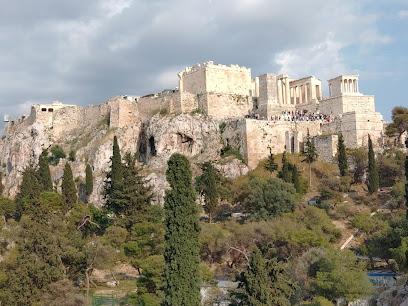
It is located just to the right of the exit of the Acropolis. Also known as the “Hill of Ares”. In classical times, this was the site of the Council of Nobles and the Judicial Court, which mainly dealt with homicide. It is said that Ares was tried here by the Gods for the murder of Alirrothios, one of the sons of Poseidon. Another trial said to have taken place here was that of Orestes who was alleged to have killed his mother Clytemnestra, and her lover. In preclassical times, the Areopagus was where the council of the elders of the city would meet. The members were actually those who were held in high regard in public office. In 480 BC, the hill was used as a campsite by the Persians, when they were undertaking their siege of the Acropolis. It was also at the Areopagus that Saint Paul preached the famous “Sermon on an Unknown God”, apparently after seeing an altar to the “Unknown God”. This speech is commemorated with a bronze plaque that you can see at the foot of the rock.
20 minutes

The Propylaea of the Athenian Acropolis were built on the west side of the hill, where the gate of the Mycenaean fortification once stood. The first propylon, or gate, was constructed in the age of Peisistratos (mid-sixth century BC), after the Acropolis had become a sanctuary dedicated to Athena. A new propylon, built in 510-480 BC, was destroyed by the Persians in 480 BC and repaired after the end of the Persian Wars, during the fortification of the Acropolis by Themistokles and Kimon. The monumental Propylaia admired by modern visitors were part of the great Periklean building program. They were erected in 437-432 BC, after the completion of the Parthenon, by architect Mnesikles. The original building plan was particularly daring both in architectural and artistic terms, but was never completed.
5 minutes
 Admission Not Included
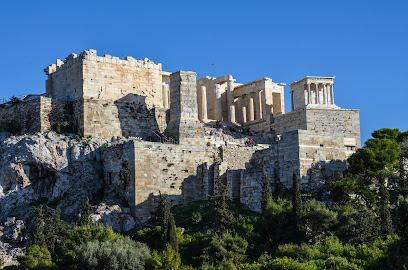
The temple of Athena Nike, designed by the architect Kallikrates, was built between 426 and 421 BC on a bastion at the southwestern edge of the Acropolis. The small Ionic temple had a relief-carved frieze with different thematic representations on each side. On the east was shown a gathering of gods around the enthroned Zeus, while the other sides presented scenes of war between Greeks and Persians or Greeks with other Greeks. The south side depicted the victorious battle of the Greeks against the Persians at Marathon in 490 BC, led by the Athenians. Few sculptural remains are preserved from the temple’s pediments. It is believed the west pediment depicted the victory of the Olympian gods against the Giants (Gigantomachy), while the east depicted the victory of the Athenians against the Amazons (Amazonomachy). Around 410 BC, a marble parapet, adorned with carved reliefs, was installed around the dangerous edge of the temple’s bastion for the protection of visitors.
5 minutes
Admission Not Included
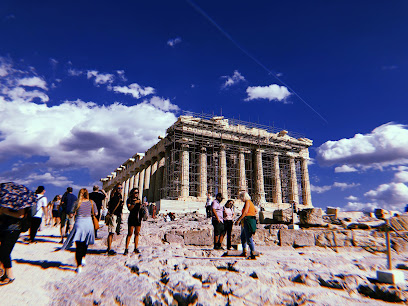
Parthenon; Temple that dominates the hill of the Acropolis at Athens. Built in the mid-5th century BCE and dedicated to the Greek goddess Athena Parthenos. The temple is generally considered to be the culmination of the development of the Doric order, the simplest of the three Classical Greek architectural orders. It was part of a magnificent rebuilding program directed by the Athenian statesman Pericles, following the sack of the Acropolis during the Greco-Persian Wars (492–449 BCE). The project was to include, among other things, the Propylaea, the gateway to the sacred precinct; the Erechtheum, a shrine to the agricultural deities, especially Erichthonius; and the Temple of Athena Nike, an architectural symbol of the harmony with which the Dorian and Ionian peoples lived under the government of Athens.The Parthenon was to be the chief shrine to Athena and also the treasury of the Delian League, a confederacy of ancient Greek states under the leadership of Athens, founded in 478 BCE.
45 minutes
Admission Not Included
Erectheion
On the high stylobate of the south porch of the Erechtheion are six maidens, who take the place of columns in supporting the entablature. Now severely weathered and affected by pollution, five of the caryatids were removed to the Acropolis Museum in 1978 and replaced with replicas. The other figure (the second from the left in the first row of four) was appropriated by Lord Elgin, who, between 1801 and 1805, removed about half of the surviving sculptures from the fallen ruins of the Acropolis and from the Parthenon, itself. They were acquired by the British Museum in 1816 and put on public display the following year. Between 1937 and 1938, even the caryatid you can find in the British Museum in London, which certainly is in better condition than its sisters, was damaged when masons abraded the surface (as well as that of some of the Parthenon sculptures) in a misguided and unauthorized attempt to brighten them for the opening of the new gallery in which they were to be displayed.
5 minutes
Admission Not Included

After our visit at Acropolis ,you will visit the Ancient Agora, 20 min travel. The ancient Agora of Athens is the best-known example of an ancient Greek agora, located to the northwest of the Acropolis and bounded on the south by the hill of the Areopagus and on the west by the hill known as the Agoraios Kolonos, also called Market Hill. The word "agora" applies to an assembly of people and by extension marks the gathering place. In modern Greek, the term means "marketplace". Just about every ancient and modern city includes a place for an agora, and the Agora of Athens is located at the heart of the city, remaining in use either as an assembly, as a commercial, or as a residential area for about 5000 years. Consequently, the area has undergone countless building, destruction, and rebuilding cycles. Today these strata of history have been distilled through excavations to expose the Agora's important functions from Archaic to Greco-Roman and Byzantine times.
80 minutes
Admission Not Included
Peloponnese
Admire the travel along the coastal road of the Saronic golf till we will arrive at the famous Corinth canal in Peloponnese. The Peloponnese is a peninsula and geographic region in southern Greece. It is connected to the central part of the country by the Isthmus of Corinth land bridge which separates the Gulf of Corinth from the Saronic Gulf. Peloponnese grape varieties have a very special place in the treasure of native Greek grape varieties. Τhe Peloponnese Wine Roads take you on a journey to a modern, sometimes rare and definitely unknown to many wine world, full of authenticity and history. Native Peloponnese grape varieties do not only reflect the diversity of Greek and Peloponnesian wine, but also the significance of some very special Greek varieties. Among them are two of the four most renowned varieties of the Greek vineyard in the world’s best markets: the exotic Moschofilero-Mantinia and the captivating Agiorgitiko-Nemea. Moreover, Mavrodafni is known for the popular dessert
60 minutes
Corinth Canal
The Corinth Canal is a waterway that crosses the narrow isthmus of Corinth to link the Gulf of Corinth to the Saronic Gulf. As such, the canal separates the Greek mainland from the Peloponnese, turning it into an island. It is an important navigational route that once allowed ships to enter the Aegean Sea. Dug through the isthmus at sea level, the canal is 6.4 kilometers long with a width of only 25 meters. The canal, though executed in the late 19th century, has been a 2000-year-old dream. Before that, ships in the Aegean Sea that wanted to cross to the Adriatic or anchor in Corinth, a rich shipping city, had to circle the Peloponnese, which would prolong their journey an extra 185 nautical miles. It is believed that Periander, the tyrant of Corinth (602 BC), was the first to conceive of the idea of digging the Corinth Canal. As the project was too complicated, Periander constructed the diolkós, a stone road that allowed ships to be transferred on wheeled platforms.
15 minutes
Food tour Corinth - Eat and live like a local
It is time now for lunch. Free time for lunch in a traditional restaurant in Ancient Corinth to experience a food tour in the Greek cusine.Not included in the prise.
60 minutes
Ancient Corinth (Archaia Korinthos)
After our visit at Corinth canal we will be traveling approx 20 min to reach ancient Corinth. Ancient Corinth was first inhabited in the Neolithic period (6500-3250 B.C.) Its fertile soil but mainly its strategic location at the intersection of land routes from the Balkan peninsula of Aimos and mainland Greece on towards the Peloponnese and waterways that connect the western Mediterranean to its Eastern counterpart, to Asia Minor and to Syro-Palestine, offered the region from very early on enormous potential for communication, growth and prosperity. The city, known since the Mycenaean period. The tremendous output of agricultural products, already in earlier historical periods, favored intense expansion in trade activities mainly towards the Western Mediterranean, while in the 8th century BC Corinthian colonies were founded, like Corfu in the Ionian Sea, Syracuse in Sicily, with an important role in the history of the ancient Mediterranean world.
80 minutes
Admission Not Included
Piraeus
Our tour ends by dropping you off at the same spot we have picked you up in Athens or at Piraeus cruise port.
80 minutes
The experience can be subject to change due to bad weather or unforseen circumstances. We always endeavour to give you the best possible experience.
Additional Information
-
 At time of booking, Cruise ship passengers must provide the following information at time of booking: ship name, docking time, disembarkation time and re-boarding time
 -
Athens International Airport transfers can be arranged on request at an extra cost!
-
Dress code is formal
-
Important note: You will have a professional English-speaking driver with good knowledge of the history and culture of Greece, to guide you till you enter archaeological sites and museums according to the program. Tour drivers are not licensed to companion you inside the archaeological sites and museums. If you'd like to have one, we can arrange it for you at an additional cost. Licensed by the state tour guides are freelance and it is subject to availability on bookings day!
-
Public transportation options are available nearby
-
Specialized infant seats are available
-
Travelers should have at least a moderate level of physical fitness
-
We suggest that you have your admission tickets pre-purchased as there is a chance not to find availability, please note that we can buy the tickets for you in advance -under a small service fee.
What our experts say
-
 Pre-purchase entry tickets to sites.
 -
Try local dishes at a restaurant in Ancient Corinth.
-
Capture photos at the scenic Corinth Canal.
-
Wear comfortable shoes for walking.
-
Visit Mars Hill for a unique view.

More About this Experience
Introduction
Embark on an incredible journey through time and faith with the full day Christian tour following Paul in Athens and Corinth. This unique shore excursion allows you to retrace the footsteps of the apostle Paul, immersing yourself in the rich history and spirituality of these ancient cities. From the iconic Acropolis in Athens to the archaeological site of Ancient Corinth, you will witness the profound connections between Christianity and the ancient world. With an experienced English-speaking driver to guide you, this private tour offers comfort, flexibility, and a deep understanding of the locations you visit.What to expect?
During this immersive full-day tour, you can expect to explore renowned landmarks such as the Acropolis and the Parthenon of Athens. Discover the picturesque quarter of the ancient Agora and capture breathtaking photos at the Corinth Canal. Dive into the captivating history of Ancient Corinth at its archaeological site. Marvel at the beauty of the Mars Hill and customize the tour within the itinerary to make the experience truly your own. By the end of the day, you will have gained a profound understanding of the historical and religious significance of these iconic sites.Who is this for?
This Christian tour following Paul in Athens and Corinth is perfect for anyone with a deep appreciation for history, culture, and spirituality. Whether you are a devout believer looking to connect with the roots of your faith or a history enthusiast eager to explore ancient civilizations, this tour is designed to cater to a wide range of interests. It is also an ideal choice for individuals or small groups seeking a private and personalized experience. No matter your background or beliefs, this tour invites you to uncover the timeless wisdom and beauty preserved within these ancient cities.Why book this?
Immerse yourself in the wonders of ancient Greece as you follow in the footsteps of the apostle Paul. This captivating tour offers a unique and meaningful experience, providing you with an opportunity to deepen your understanding of Christian history and its connection to the ancient world. With the expertise of an experienced English-speaking driver, you can feel confident that you will receive insightful commentary and personalized attention throughout the tour. Discover iconic landmarks, explore ancient sites, and create memories that will last a lifetime.Good to know
On this full-day tour, you can expect a total duration of 480 minutes, giving you ample time to explore each location and delve into their historical significance. The tour begins with a convenient pick-up from your accommodation in Athens or your cruise ship pier at Piraeus port. Comfortably travel along the coastal road of the Saronic Gulf, marveling at the scenic beauty of the Piraeus and Athens riviera. Please note that lunch is not included in the tour, but you will have free time to indulge in a traditional Greek cuisine experience at a restaurant in Ancient CorinthJournals from our explorers at this location





This is a popular product and the date you are looking for just sold out. Next available date is
