

Magical Delphi, Impressive Meteora, Legendary Thermopylae 2d
 Thiva, GR
 100% of travellers recommend this
Highlights
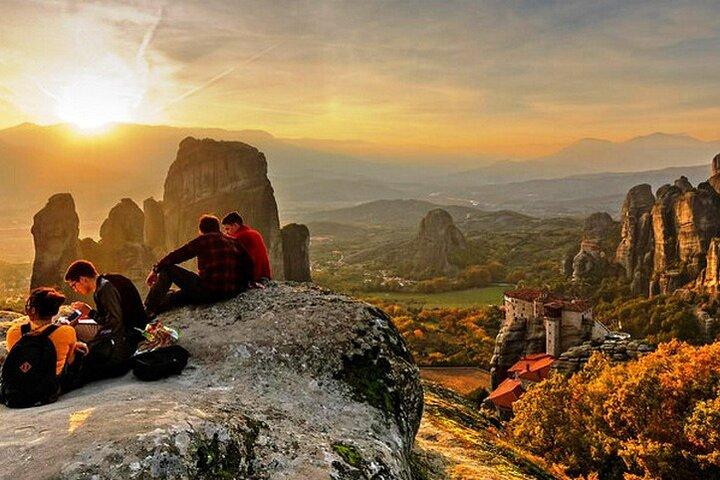
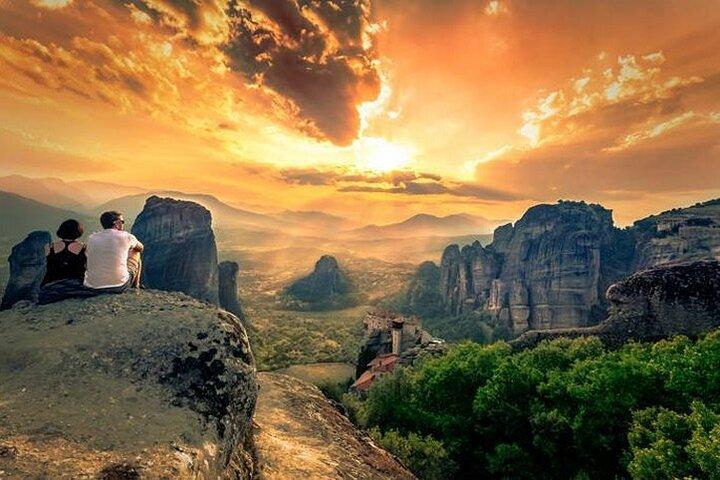
- Experience breathtaking views of Meteora monasteries
- Explore the ancient ruins of Delphi's oracle
- Discover the historical significance of Thermopylae
- Enjoy a scenic drive through picturesque Greece
- Visit charming towns with vibrant local culture
-
Duration 48 hours
-
Private tour for your party
-
Pickup from Athens hotels
-
Professional English-speaking driver
-
Bottled water and breakfast included
-
Entrance fees not included
Embarking on a journey through time, travelers will explore the enchanting landscapes of Greece in the 48-hour adventure of Magical Delphi, Impressive Meteora, and Legendary Thermopylae. They will begin by immersing themselves in the sacred aura of Delphi, home to the famed oracle and the majestic Temple of Apollo. Next, they will marvel at the breathtaking suspended monasteries of Meteora, perched atop towering cliffs that seem to touch the sky, offering a unique glimpse into Byzantine spirituality. The journey also includes a visit to the historic battleground of Thermopylae, where valor and sacrifice resonate through the ages. With a scenic drive through picturesque countryside, travelers will enjoy comfortable transportation, bottled water, and breakfast, making this private tour a perfect blend of history, culture, and natural beauty, tailored for the discerning explorer.
At a Glance
-
 Free cancellation
-
 2 days
-
 Instant Confirmation
-
 Available in English
-
 Mobile voucher
-
 Private Tour
-
 Guided
-
 Family friendly

Featured Reviews

Explore the wonders of Delphi, Meteora, and Thermopylae on this immersive 2-day private tour, showcasing Greece's rich history and stunning landscapes.
Included
-
 OtherTransportation by air-conditioned vehicle appropriate for the size of your group
 -
Bottled waterBottled water
-
OtherA professional English speaking tour driver
-
OtherPrivate tour for you and your party only!
-
BreakfastBreakfast
Excluded
-
 OtherEntrance fees to the archaeological sites and museum
 -
OtherFood and drinks
-
GratuitiesGratuities
-
OtherEnglish-speaking licensed tour guide (We can arrange for a tour guide for you with an extra cost)
Pickup
Check if pick-up is available from your location, you will select during checkout (providers may allow other pickup locations)

What to expect
REGION OF CENTRAL GREECE - REGIONAL UNIT OF VIOTIA
Starting from Athens we will be travelling through Sterea Ellada; The Region of Central Greece till we reach Delphi. The Region of Central Greece colloquially known as Ρούμελη (Roúmeli)) is one of the thirteen administrative regions of Greece. The region occupies the eastern half of the traditional region of Central Greece, including the island of Euboea. To the south it borders the regions of Attica and the Peloponnese, to the west the region of West Greece and to the north the regions of Thessaly and Epirus. Its capital city is Lamia. It is divided geographically into the East and West, with the natural border between them the southern part of the Pindos mountain range. We will pass by Theves, Livadia, and Arachova. Arrive at Delphi and visit the archaeological site!
Arachova
A Cosmopolitan Greek Mountain Experience, the once-quiet village where people stopped to buy folk art before reaching Delphi, is today often referred to by Greeks as the 'Winter Mykonos'. Perched on Mt Parnassos, Arachova is a town that has been transformed into a popular destination for those seeking winter sports and relaxation. It sits at an altitude of 973 meters and thanks to its proximity to Athens, the winter months see it buzzing on weekends with city slickers escaping the everyday race for a break in the refreshing mountain air. Follow in their footsteps and find out why this place is so adored. Cosmopolitan Arachova with its village’s lively tavernas, bars and restaurants are home to endless entertainment – expect to see patrons dancing on the tables and urging you along to join in. But there’s more to Arachova than endless fun on weekends and during the holidays. The rest of the year, when out of the spotlight of visitors, Arachova exudes a cosmopolitan charm.
15 minutes
Delphi
At the foot of Mount Parnassos, lies the Pan-Hellenic sanctuary of Delphi, the most famous oracle of ancient Greece. Delphi was regarded as the centre of the world. According to mythology, it is here that the two eagles sent out by Zeus from the ends of the universe to find the navel of the world met. The sanctuary of Delphi was for many centuries the cultural and religious center and symbol of unity for the Hellenic world. The history of Delphi begins in prehistory. In the beginning, the site was sacred to Mother Earth and was guarded by the terrible serpent Python, killed by Apollo. Apollo's sanctuary was built here by Cretans who arrived at Kirrha, the port of Delphi, accompanied by the god in the form of a dolphin. This myth survived in plays presented during the various Delphic festivals, such as the Septerion, the Delphinia, the Thargelia, the Theophania, and of course, the famous Pythia, which celebrated the death of Python and comprised musical and athletic competitions.
120 minutes
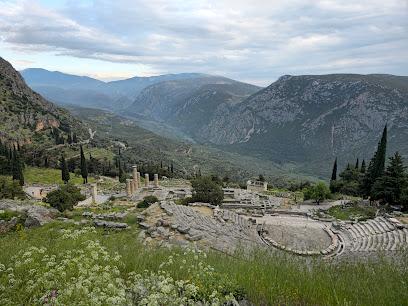
Central among the number of imposing ruins that are interspersed on the Southern slopes of Parnassos mountain is the temple of Apollo. The Temple of Apollo, god of music, harmony, light, healing, and oracles occupied the most important and prominent position in the Delphic Panhellenic Sanctuary. It is an imposing temple of the Doric order whose existence was woven through the turbulent history of the site, and endured numerous incarnations before it settled to the ruinous state we find it today, and which dates back to the 4th c. B.C. The temple of Apollo was first built around the 7th c. B.C. by the two legendary architects Trophonios and Agamedes. It was rebuilt after a fire in the 6th c. B.C.. in tribute to the noble Athenian family that oversaw its construction with funds from all over Greece and foreign emperors. This temple was destroyed in 373 B.C. by an earthquake and was rebuilt for the third time in 330 B.C. Spintharos, Xenodoros, and Agathon, architects from Corinth.
20 minutes
 Admission Not Included
Tholos of Athena Pronaia
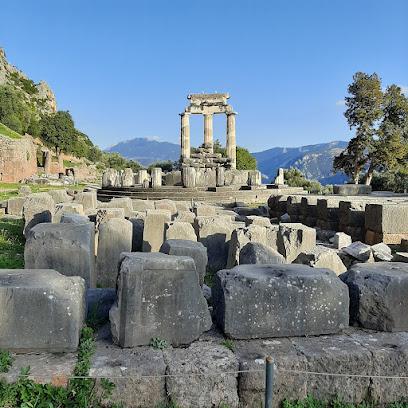
The tholos of the sanctuary of Athena Pronaia, clearly visible from above, is perhaps the most characteristic monument at Delphi and the most important building of this small sanctuary. Located between the later temple of Athena and the Treasury of Massalia, this circular building of unknown purpose is a masterpiece of Classical architecture. It is thought to have been connected with chthonic cults, although Pausanians, who saw its ruins in the second century AD, do not refer to it as a temple. According to Vitruvius, this impressive building was raised in 380 BC on plans by the architect Theodoros of Phocea or Phocis, who even wrote a book about the way it was built. The tholos is a synthesis of most styles of Classical architecture. It rests on a three-stepped podium and the twenty Doric columns of the outer peristyle supported a Doric frieze of triglyphs and metopes with relief decoration. Inside the cella were ten engaged Corinthian columns
20 minutes
Thessaly
Next, you will travel through Thessaly Thessaly, a region of sheer beauty with mountains, rivers, beaches, the popular Plastira Lake, Tempi valley, and last but not least the unique Meteora, the most photogenic spiritual site in Greece. Archeological areas, Byzantine monasteries and churches, traditional settlements and ski resorts complete the fascinating natural beauty of Thessaly and make it a popular holiday destination. Soaring like a sleepless guardian above the city of Volos, Mt Pelion is gorgeous throughout the year. Volos, the city of the Argonauts, where you will definitely pass by a tsipouro taverna as they are dispersed in every nook and cranny. Just a few kilometers to the West, lie Sesklo, the most ancient settlement of Europe, dating back to 6.000 BC, and Dimini, the most important prehistoric settlement in Greece and one of the most important ones of the New Stone Age worldwide.
Kalambaka
Kalabaka town has a population of 12,000 citizens and is situated on the foothills of an extraordinary geological phenomenon, the giant cliffs of Meteora. For thousands of years, people found refuge on the steep cliffs of Meteora and in the surrounding area. An ideal place to survive since people would be able to find clean water, an abundance of food sources, and shelter. In prehistory, the oldest known human settlement in the area dates back to 130,000 years and was found in the prehistoric cave of Theopetra. Just 4km away from the modern town of Kalabaka. The history of Kalambaka began more than 3.000 years ago! A Greek inscription on the wall of one of the town’s old churches (Saint John the Baptist) testifies to the existence of an ancient Greek settlement under the name Aiginion, thriving during the 4th century BC. Historical records refer to the town’s Byzantine name as Stagi when it had become a significant center of the Byzantine Empire.
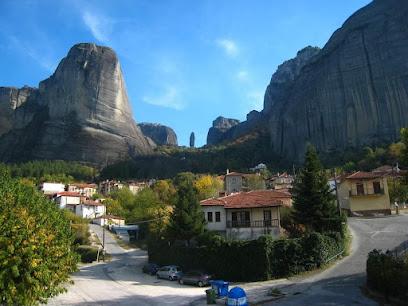
Kastraki is located in the western part of Meteora, amphitheatrically built, among the towering cliffs, and is a municipal district of Kalabaka. Its history is lost in the course of time. In the eastern part, there is the old picturesque district of the village and above the spindle, small but impressive because of the form and the support position. It is mainly the base of climbers coming from different parts of the world, to admire the wonderful landscape formed by the towering rocks. Kastraki has an important local tradition, customs, and folk songs, which all have a uniqueness. The impressive landscape with canyons, plateaus, and the ghostly figures of “sacred rock” pops up through the lush landscape and strives, as if to touch the heavens. Today the village has been declared with the entire region of Meteora Monument and World Heritage by UNESCO, while it has grown into a wonderful place for recreation with camping, taverns, and guest houses, offering pleasant relaxation.
180 minutes
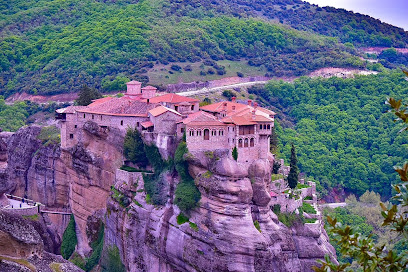
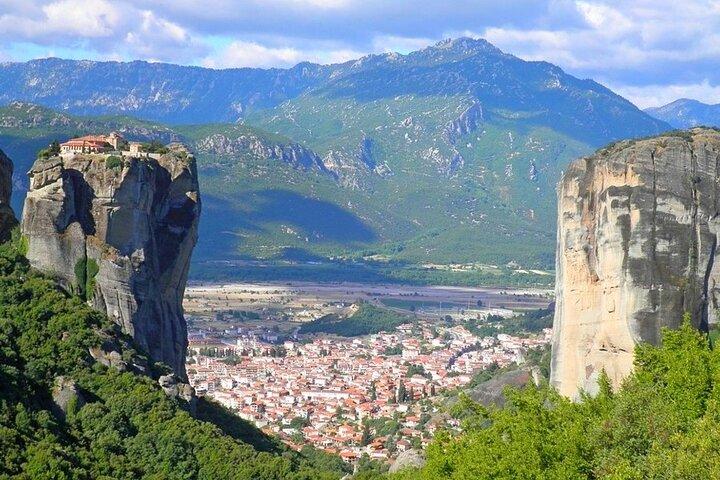
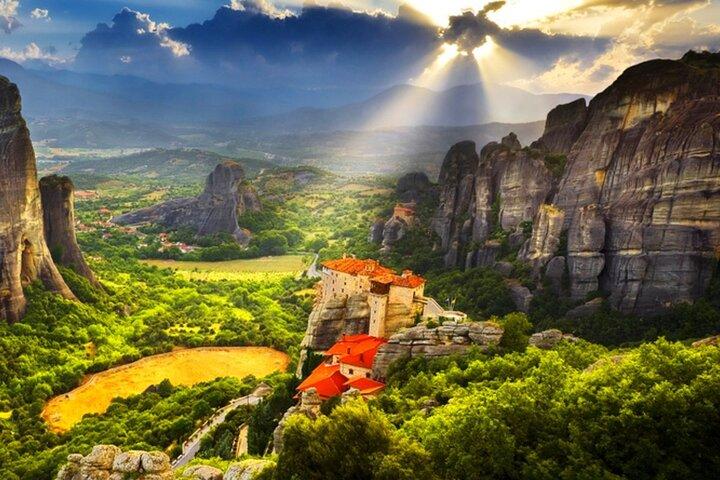
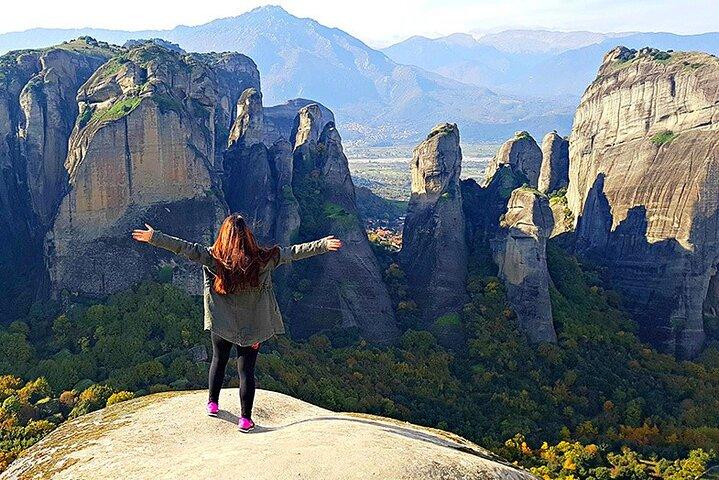
The Meteora is a rock formation in central Greece hosting one of the largest and most precipitously built complexes of Eastern Orthodox monasteries, second in importance only to Mount Athos. The six monasteries are built on immense natural pillars and hill-like rounded boulders that dominate the local area. Meteora monasteries; the miracle of Greece. A few kilometers northwest of the town of Kalabaka, the impressive rocks of Meteora are rising from the plains of Thessaly one of the most amazing places in Greece. Many centuries ago, on these gigantic rocks with the breathtaking landscape reaching heights of more than 600 meters, it was formed one of the most important monastic communities of Greece. In 1988, the Meteora monasteries have been included in the UNESCO World Heritage List and the Meteora-Antichassia area is part of the Natura 2000 network hosting some rare species of birds and flowers.
180 minutes
Holy Monastery of the Great Meteoron - Transfiguration of the Saviour
The Great Meteoro (Grand Meteor), also known as the Holy Monastery of the Metamorphosis (Transfiguration of Christ), is a male monastery and is the oldest and largest of all the monasteries of Meteora. The foundation of the Monastery of Great Meteoron is the starting point of the organized life at Meteora. On the most imposing rock, it occupies a commanding position among the monastic complex of Meteora. It’s the largest and most formal of the extant Meteora Monasteries as its name implies. Founded shortly before the middle of the 14th century by Saint Athanasios the Meteorite, who was also its first founder and the first to organize a systematic monastic community.
90 minutes
Admission Not Included
St. Stephen’s Monastery
St. Stephen was inhabited by monks in the late 12th century. The assembly of the building of the monastery which was founded in the 14th century completed in the 15th and 16th century. First founder of the monastery is the monk, later abbot of it Antonios Kantakouzenos. Antonios in the opinion of some researchers was the son of the Serbian Despot of Epirus Nikephoros II (1359) and a descendant of the great Byzantine family. Secondly, the founder is Monk Philotheos “ex Sklatainas”, which is referred to as the renovator of St. Stephen. Theophilos erected a new the old, now Catholic, built the cells and other facilities of the monastery. During his days(1545) the monastery became stavropegic and retained this privilege of 1743. In 1798 a new church was built dedicated to Saint Charalambos, who in the 17th century was referred to as the second patron of the monastery. In the 18th and 19th century for the first time several buildings and the abbey was built and took the form it has today.
45 minutes
Admission Not Included
Holy Monastery of Saint Nicholas Anapafsas at Meteora
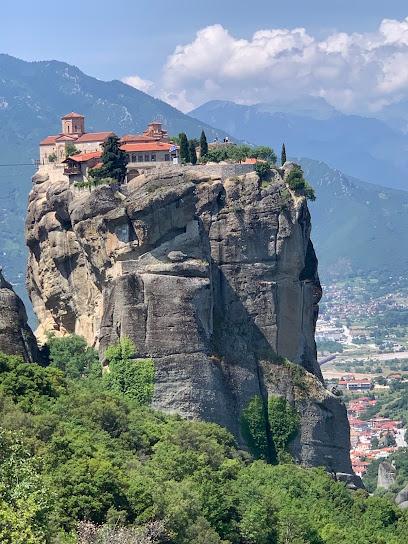
Saint Nicholas Anapafsas Monastery The beginning of the monastic life on the rock of Anapafsas is placed in the 14th century and the name of the monastery is probably due to its old founder. The monastery was renovated in the first decade of the 16th century. The construction and installation of the monastery (tall rectangular building with successive levels) adapted to the capabilities of the very small area of the plateau of the rock in which it was built. Going up you see the small chapel of St. Anthony and the crypt, where previously stored codes and heirlooms. On the walls of the chapel remains frescoes of the 14th century. On the next floor is built the church of the monastery, a small single room, almost square space preceded by a large enough in relation to the church narthex (lite). Upstairs are the old bank of the monastery, which was restored and today serves as the official residence (hostel), the ossuary, and the renovated, since 1971, the church of St. John the Baptist.
40 minutes
Admission Not Included
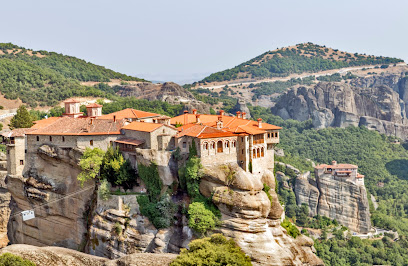
The monastery Varlaam owes its name to the hermit-anchorite Varlaam, who first inhabited the rock in the 14th century. The history of the monastery begins substantially from the early 16th century when the rock settled and organized their priory by the Ioannina brothers Theophanes and Nektarios Apsaras, descendants of the old continent Byzantine family. The Apsaras in 1518 renovated fundamentally the chapel of the Three Hierarchs, which was built on the site of the original Catholic monastery that was built by Varlaam, in 1536 built the winch tower, and in 1541 built the present church dedicated to All Saints. In 1627 the chapel of the Three Hierarchs was rebuilt in place of the Old Catholic who had built the Apsaras and in 1637 was decorated by the artistic crew of John priest and children, who came from Kalabaka. The monastery is distinguished in spiritual prosperity and its participation in national struggles in recent years.
40 minutes
Admission Not Included
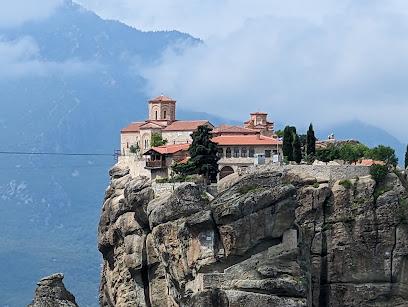
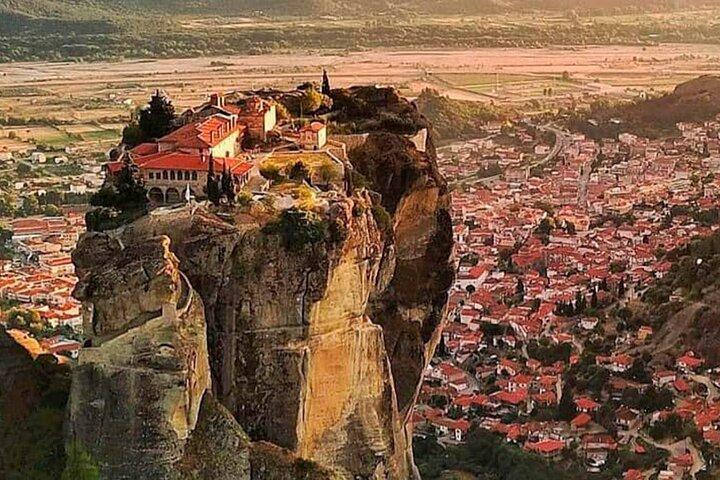
The monastery of the Holy Trinity was made in 1488 by a monk named Dometios. But sources reveal its existence since 1362. The oldest building phase of the monastery is represented by the current church, which was built as we learn from the inscription in the year 1475/6 and is dedicated to the Holy Trinity. The frescos of the church were made by the painter and priest named Antonios and his brother Nicholas, in 1741. The Catholic exonarthex was built in 1689 and decorated in 1692. In 1682, with the expenses and trouble of Hieromonk Damaskinou, Jonah and Partheniou, the chapel of St. John the Baptist were built and decorated. Visitors to reach the monastery must cross a pedestrian path downhill until the foot of the cliff and then climb 145 carved steps. Northwest of the building complex of the monastery, behind the church, the visitor arrives at the highest point of the rock, from the balcony you can enjoy a rare view of the other monasteries and the Meteora rocks.
40 minutes
Admission Not Included
Holy Monastery of Rousanos - Saint Barbara
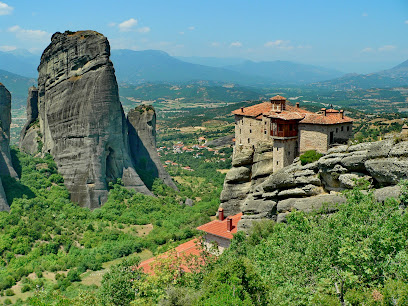
The rock referred to as Rousanou was inhabited from the early 16th century, while the monastery was founded in the 14th century. But the monastery took its present form in the 16th century when the brothers Ioasaf and Maximus from Epirus and the abbot of the monastery of Great Meteoron, the ruined church that was dedicated to the Transfiguration of Jesus Christ. The Catholicon that was built by the two brothers from Giannena in 1545, and decorated with frescoes, is dedicated to this day to the Transfiguration but also honored in the memory of Santa Barbara. The monastery became a refuge for persecuted individuals and families during the various historical vicissitudes of the nation. During the 19th century, the monastery declined and slowly fell into a hermitage for the monks of the monastery Varlaam. Today, after its restoration, in 1980, by the Archaeological Service, it operates as a nunnery.
40 minutes
Admission Not Included
Thermopylae
Thermopylae is a place in Greece where a narrow coastal passage existed in antiquity. It derives its name from its hot sulfur springs. In Greek mythology, the Hot Gates is one of the entrances to Hades. The Battle of Thermopylae was conducted in 480BC among the Greeks and the Persians at the same time the Naval Battle of Artemision took place. The Persian Army led my Xerxis to reache the passageways of Thermopylae. The Greeks have chosen this strategic spot to face the Persian attack. Xerxis has commanded Leonides, the leader of the Greek Army to surrender his armory but he replied 'Come and Get them'. For two days, the Greeks fought heroically. On the third day, Efialtes betrays the Greeks, showing the Persians the passageway so as to get to the backside of the Greeks. So, the Persian Army surrounds the Greeks. Leonides remains at the site of the battle along with 300 Spartans, 700 Thespieis, and 400 Thivaious, loyal to his homeland laws. He falls dead from Persian arrows.
30 minutes
Leonidas Monument
Why did the battle of Thermopylae become one of the most world-famous battles? Thermopylae battle is a perfect example of selflessness, sacrifice, and obedience to the laws of the country. The resistance in the passage is a result of hard military training, better gear, and strategic use of the land in order to multiply the defense abilities. Where is the Thermopylae Memorial? The passage of Thermopylae (that literally means "Hot Gates") doesn't exist anymore since the mud deposition made by the Spercheios river moved the beach and the sea a few kilometers away. Near Thermopylae, next to the national road connecting Athens to Thessaloniki there is a memorial statue of King Leonidas and his soldiers with an inscription saying: "Ὦ ξεῖν’, ἀγγέλλειν Λακεδαιμονίοις ὅτι τῇδε κείμεθα, τοῖς κείνων ῥήμασι πειθόμενοι", which means: "Stranger, tell Spartans that we lay here, staying faithful to Sparta’s laws."
10 minutes
Attica
You will be traveling through Attica, a journey” in 6,000- year history, the land that gave birth to ideas and arts, has created and shaped what we call today the western civilization. Today, a visit to Attica offers visitors a unique experience. A “journey” in its 6,000-year history, including the chance to see renowned monuments and masterpieces of the art of antiquity and the Middle Ages, and the architectural heritage of the 19th and 20th centuries. Here lies Athens, the capital of Greece, the busiest city of the country with the most prominent archaeological site and symbol of the country, the world-famous sacred rock of the Acropolis. Attica is home to some of the world’s most important and fascinating museums and archaeological sites, testimony to its long and prominent role in world history. Festivals featuring ancient Greek drama, as well as performances, sports, or culinary events are organized throughout the year, spellbinding the audience. Then travel towards Peloponnese!
The experience can be subject to change due to bad weather or unforseen circumstances. We always endeavour to give you the best possible experience.
Additional Information
-
 A moderate amount of walking is involved; comfortable shoes are recommended
 -
Athens Airport transfers: arranged on request!
-
Duration time is approximate and may vary based on local traffic and conditions
-
How many monasteries can I see in one day? Before we answer this question we have to specify that everything should be taken into account. It depends on how fit you are, the transportation and time available, weather conditions, etc. Most people are able to visit between 2 to 4 monasteries per day. The few visitors who visit all 6 of them within one day are missing out on a magical, more slow-paced adventure. We recommend at least 2 days' stay in Meteora.
-
Important note: You will have a professional English-speaking driver with good knowledge of the history and culture of Greece, to guide you till you enter archaeological sites and museums according to the program. Tour drivers are not licensed to companion you inside the archaeological sites and museums. If you'd like to have one, we can arrange it for you at an additional cost. Licensed by the state tour guides are freelance and it is subject to availability on bookings day!
-
Is there a dress code to enter a monastery? Appropriate clothing for everyone is required to enter the monasteries. Sleeveless clothing and shorts over the knee for men are prohibited and you‘ll be denied access if dressed that way. For ladies skirts and shawls are available to borrow or buy at the entrance of monasteries in case they don’t have such clothing to cover themselves.
-
Should I take the car to drive to monasteries or is better to use other means? There are many reasons not to want to drive while exploring Meteora like if you’re not confident driving on the opposite side of the road, your spouse is a terrible copilot and you just want to have fun instead of arguing; or if you want to enjoy the scenic road and not to feel stress about the narrow and curvy roads. Lack of parking space outside the monasteries is an especially frequent phenomenon during the pick period in the summer. So joining one of our tours might save you a lot of headaches and unwanted distractions.
-
Specialized infant seats are available
-
Sunscreen and hats are recommended for visits during the summer months
-
Travelers should have a high level of physical fitness
-
We suggest that you have your admission tickets pre-purchased as there is a chance not to find availability, please note that we can buy the tickets for you in advance -under a small service fee.
-
What is the Entrance fee for the monasteries? In each monastery, there is an entrance fee of 3 euros per person. Kids up to 12 years old don’t pay entrance fees in the monasteries.
-
While the local operator does its best to ensure sites are open before travel, they are not responsible for short-term closures
What our experts say
-
 Visit nearby Arachova for lunch
 -
Wear comfortable shoes for walking
-
Bring sunscreen for summer trips
-
Pre-purchase monastery tickets
-
Dress modestly for monastery visits

More About this Experience
Introduction
Discover a journey that intertwines history, spirituality, and breathtaking landscapes with the Magical Delphi, Impressive Meteora, Legendary Thermopylae 2-day tour. This immersive experience invites travelers to explore the ancient wonders of Greece, from the sacred grounds of Delphi to the majestic monasteries of Meteora and the historic battleground of Thermopylae. Over the course of 48 hours, participants will embark on a private tour that promises both comfort and personalized attention, ensuring a unique adventure tailored to their interests. The tour includes an English-speaking driver who will guide you through the rich tapestry of Greek history, offering insights into each location's significance. With convenient pickup from your Athens hotel or the Piraeus cruise terminal, this tour is designed for those who seek to explore Greece’s cultural heritage in an intimate and engaging way. Prepare to be amazed by the stunning landscapes that cradle these historical treasures, making this journey a once-in-a-lifetime experience.What to expect?
Travelers embarking on the Magical Delphi, Impressive Meteora, Legendary Thermopylae tour can expect an unforgettable experience filled with awe-inspiring sights and profound historical significance. The adventure begins at Delphi, where you will explore the ancient ruins that were once the center of the world according to Greek mythology. Marvel at the Temple of Apollo and walk through the archaeological site, soaking in the stories of centuries past. Next, the tour leads to Meteora, where towering rock formations host some of the most stunning Byzantine monasteries perched atop. Visitors will have the chance to wander through these spiritual havens, each offering panoramic views of the stunning landscape below. The journey also includes a visit to Thermopylae, where the legendary stand of King Leonidas and his Spartans took place, allowing you to connect with Greece's rich military history. Along the way, expect a scenic drive through picturesque countryside, making every moment of your trip a visual feast.Who is this for?
The Magical Delphi, Impressive Meteora, Legendary Thermopylae tour is perfect for a diverse range of travelers. Whether you are a history buff eager to delve into the tales of ancient Greece, a lover of breathtaking landscapes seeking unique photo opportunities, or someone simply looking for a memorable getaway, this journey caters to all. Families, couples, and solo adventurers alike will find joy in the rich experiences offered throughout the tour. Even those with varying levels of physical fitness can enjoy the sights, as the itinerary can be tailored to suit different needs. For individuals craving a deeper connection to Greece’s cultural roots, or for those who wish to escape the hustle and bustle of city life, this tour presents an ideal opportunity to explore some of the most significant and beautiful locations in the country.Why book this?
Booking the Magical Delphi, Impressive Meteora, Legendary Thermopylae tour is a gateway to experiencing Greece like never before. Unlike generic tours, this private journey provides an intimate setting that allows travelers to engage with their surroundings fully. The knowledgeable English-speaking driver adds value by sharing historical insights and cultural anecdotes, enhancing the overall experience. The customized nature of the tour means that you can explore at your own pace, whether that means spending extra time at a specific site or taking a moment to savor the breathtaking views. With comfortable transportation and included amenities like bottled water and breakfast, every detail has been thoughtfully considered to ensure a stress-free experience. This tour not only showcases the wonders of Greece but does so in a way that allows for personal reflection and enjoyment, making it a worthwhile addition to any travel itinerary.Good to know
Before embarking on this incredible journey, there are a few essential details that travelers should keep in mind. While the tour provides a convenient pickup and drop-off service from Athens hotels or the Piraeus cruise terminal, it’s crucial to be aware that entrance fees to archaeological sites and monasteries are not included in the package. Travelers should also consider dressing appropriately for visits to the monasteries, as there are specific dress codes in place. Comfortable shoes are recommended due to the moderate amount of walking involved. It's also a good idea to pre-purchase admission tickets, especially during peak tourist seasons, to avoid potential disappointments at the sites. Finally, the local operator strives to ensure that all sites are open during the tour, but short-term closures can occur, so flexibility in your travel plans is always beneficial.Reviews
Feedback from those who have experienced the Magical Delphi, Impressive Meteora, Legendary Thermopylae tour has been overwhelmingly positive, with many praising the breathtaking scenery and the depth of historical context provided by the knowledgeable driver. Travelers have expressed appreciation for the personalized nature of the tour, noting that the private experience allowed them to connect with the places they visited in a unique way. The stunning views of Meteora's monasteries perched atop towering cliffs have been a highlight for many, leaving them in awe of the natural beauty surrounding them. Additionally, the convenience of the tour logistics has been commended, with guests feeling well taken care of from start to finish. Overall, this tour has left a lasting impression on those who have embarked on this unforgettable journey through Greece's most magical sites.Journals from our explorers at this location






Your all‑in‑one travel companion app
Explore expert travel guides, compare and book tours, experiences, hotels, and more—all from the palm of your hand. Download now for seamless trip planning wherever your wanderlust takes you.


This is a popular product and the date you are looking for just sold out. Next available date is
