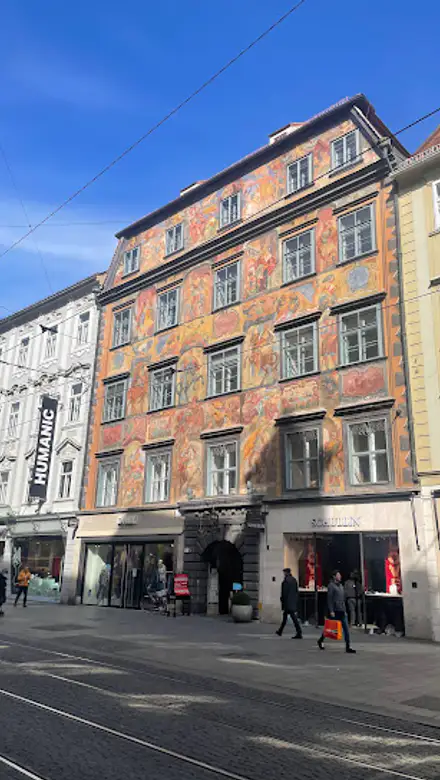
Gemaltes Haus Travel Guide
Free Guide: Discover Graz's Gemaltes Haus: A Renaissance masterpiece with vibrant frescoes depicting Greco-Roman mythology, a testament to the city's artistic heritage.


A brief summary of Gemaltes Haus
Discover Graz's Gemaltes Haus: A Renaissance masterpiece with vibrant frescoes depicting Greco-Roman mythology, a testament to the city's artistic heritage.
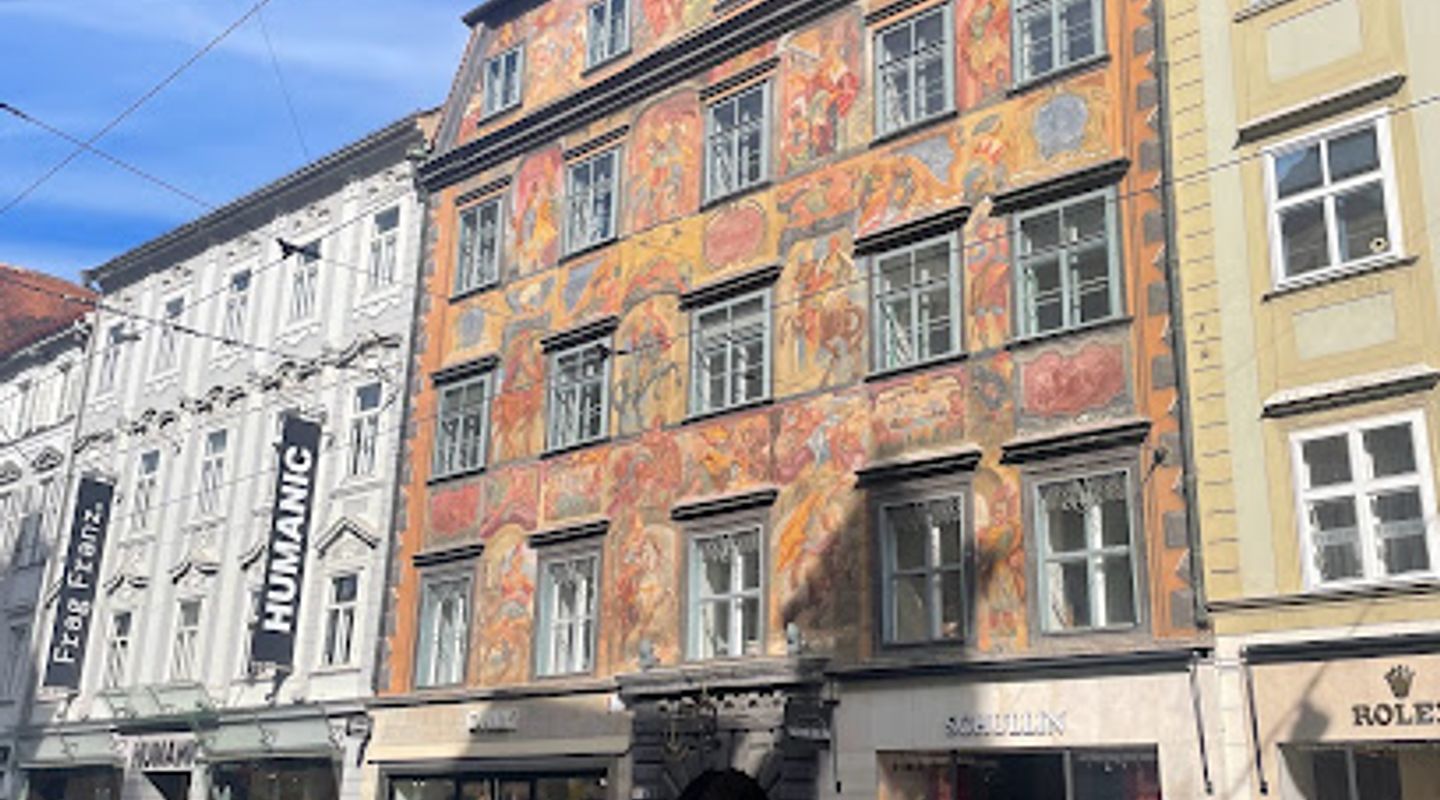
The Gemaltes Haus, or Painted House, is a stunning 16th-century building in Graz, Austria, famous for its elaborate facade covered in vibrant frescoes depicting scenes from Greek and Roman mythology. A highlight of the city's Herrengasse, it showcases Baroque artistry and Graz's rich cultural heritage.
Opening hours
- Every dayOpen 24 hours
Opening hours as listed on the venue’s Google Business Profile. Hours can change for services and special events, so check with the venue before you go.
- Address
- Herrengasse 3, 8010 Graz
- Phone
- Website
Getting there
Walking
Public Transport
Discover more about Gemaltes Haus
Overview
The Gemaltes Haus, also known as the Herzogshof, stands as a jewel in Graz's architectural crown, captivating visitors with its stunning facade and rich history. Located on Herrengasse, the main thoroughfare of Graz, this painted house is more than just a building; it's a vibrant canvas that tells a story of art, mythology, and the city's evolution.The building's origins trace back to 1360 when it was first documented as the Herzogshof, serving as a crucial administrative center. Here, the Dukes of Styria conducted their official business and granted land to their subjects until the completion of Graz Castle in 1450. This historical significance adds another layer to the building's allure, connecting it to the very foundations of Graz's past.Around 1600, the house underwent its first transformation into a work of art when it was initially painted by Giovanni Pietro de Pomis, the court painter of Ferdinand II. De Pomis, who later designed Ferdinand's mausoleum, brought his artistic vision to the building's facade, setting the stage for its future fame. However, none of de Pomis's original work remains today. The Gemaltes Haus as we know it today is largely the creation of Johann Mayer, a painter from Vorau, who was commissioned in 1742 by Franz von Lathurner, the then-owner of the house. Mayer, a student of Johann Cyriak Hackhofer, embarked on an ambitious project to cover the entire facade with frescoes depicting gods and heroes from Greco-Roman mythology.These vibrant paintings, executed in the Baroque style, transformed the building into a breathtaking spectacle that continues to draw crowds. The frescoes cover an area of over 220 square meters, making the Gemaltes Haus unique in Austria. The paintings are organized in a hierarchical manner, with different tiers representing various realms of the mythological world. The lowest zone features gods closely associated with everyday life, including Bacchus (god of wine), Vulcan (god of crafts), and Vesta (goddess of the hearth). Above them are Apollo (god of light), Jupiter (father of the gods), and Pluto (god of the underworld). The uppermost row includes Mercury (god of commerce and travelers), Mars (god of war), Minerva (goddess of war and the arts), and Aesculapius (god of medicine), along with heroes from Greek and Roman mythology.
Evendo Review Centre
 Google
Guest reviews
Explore Gemaltes Haus on the map
A handpicked selection of must-see spots near Gemaltes Haus, mapped for you.
Get your free copy of our complete guide to Gemaltes Haus, delivered straight to you.
Everything on this page, from opening hours and how to get there to Eve’s tips and the best time to go, in one PDF you can read offline, print or share.
Already have an account? Sign in
Your Gemaltes Haus guide is ready.
We'll send it to · Not you? Sign out

Getting your guide ready…
We are putting together a fresh copy of the Gemaltes Haus guide. This can take up to a minute.
This can take a few moments. If your browser asks, choose Allow so the download can start. You'll find the guide in your Downloads folder.
Nothing happened? Download it again
Sorry, the guide is taking longer than usual. Please try again in a minute, or get it by email instead.
Unlock the best of Gemaltes Haus
Skip-the-line tickets, guided tours with entry, and walking tours of the area, booked in a few clicks.


Other nearby places you may find interesting
The closest places of the same kind, if this one is not quite what you had in mind.
-
-
-
-
-


Swipe for more places
More to explore near Gemaltes Haus

 Best experiences near Gemaltes Haus
 Best hotels near Gemaltes Haus
 Best landmarks near Gemaltes Haus
 Best attractions near Gemaltes Haus
 Best shops near Gemaltes Haus
 Best restaurants near Gemaltes Haus
 Best bars near Gemaltes Haus
Do you manage this location?
Take control to get all the benefits, like improved information, better appearance, and stronger visibility across AI-powered discovery.
Explore more

Explore more of Styria
Discover Styria: A picturesque region in Austria known for its lush landscapes, historic architecture, and exceptional wine. Perfect for both outdoor adventures and cultural experiences.
Explore Styria
Explore more of Austria
Discover Austria's blend of alpine landscapes, rich cultural heritage, and culinary delights, from Vienna's historic charm to Tyrol's dramatic beauty.
Explore Austria