Background

Stanford Memorial Church: A Timeless Masterpiece

Discover Stanford Memorial Church, a stunning architectural masterpiece with breathtaking mosaics and stained glass, offering a serene space for reflection and spiritual connection on the Stanford University campus.

4.8

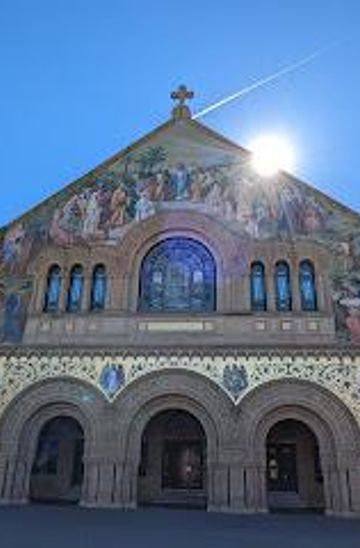
Stanford Memorial Church, affectionately known as 'MemChu,' stands as the architectural crown jewel of Stanford University. Built by Jane Stanford as a memorial to her husband Leland, this non-denominational church has been a spiritual and architectural beacon since its dedication in 1903. Its Romanesque form and Byzantine details, inspired by the churches of Venice and Ravenna, create a stunning visual experience. Inside, visitors are greeted by breathtaking stained glass windows, intricate mosaics depicting religious scenes, and the harmonious sounds of five pipe organs. The church has withstood major earthquakes, testaments to its enduring construction and the enduring spirit it embodies, offering solace, inspiration, and a space for reflection for all who enter.

A brief summary to Memorial Church

  • Monday 9 am-4 pm
  • Tuesday 9 am-4 pm
  • Wednesday 9 am-4 pm
  • Thursday 9 am-4 pm
  • Friday 9 am-1 pm

Local tips

  • Visit during the afternoon to witness the stained glass windows illuminated by the sun, creating a spectacular display of colors inside the church.
  • Attend a Sunday service to experience the church's vibrant musical tradition, featuring its renowned pipe organs and talented choral ensembles.
  • Take the free docent-led tour on Fridays at 11 AM to learn about the church's rich history, architectural details, and the stories behind its stunning artwork.
  • Check the Office for Religious & Spiritual Life's website for upcoming events, concerts, and interfaith services held at the church.
  • Combine your visit with a stroll around Stanford's Main Quad and explore other nearby attractions like the Cantor Arts Center and the Rodin Sculpture Garden.
widget icon

Getting There

  • Walking

    From the center of Stanford's Main Quad, Memorial Church is easily accessible on foot. Simply head towards the eastern end of the quad, and the church's impressive facade will be directly in front of you. The walk is short and offers excellent views of the surrounding architecture.

  • Public Transport

    If arriving by Caltrain at the Palo Alto Transit Center, take the free Stanford Marguerite Shuttle. Several lines serve the campus, including lines that stop near the Main Quad. Check the Marguerite Route Map for specific routes and schedules. From the shuttle stop, it's a short walk to the church. The Marguerite Shuttle is free.

  • Driving

    If driving, visitor parking is available in several locations on campus, including near the Cantor Arts Center on Lomita Drive and in the Tresidder lot. Parking is enforced Monday-Friday from 6 a.m. to 4 p.m., with the exception of the Oval which is enforced until 6 p.m. Visitor parking costs $4.46 per hour. Payment is managed through ParkMobile, with a $0.40 transaction fee. After 4 PM on weekdays and on weekends, parking is generally free in 'A', 'C', and shared resident/commuter lots, but always check posted signs for specific restrictions.

Unlock the Best of Memorial Church

Buy tickets

    No tickets available

Book tours with entry

    No tours available

Book tours without entry

    No tours available

Discover more about Memorial Church

Stanford Memorial Church, often called 'MemChu', is located at the heart of Stanford University's main quad, a lasting monument to love and a beacon of spiritual and architectural significance. Jane Stanford built the church in memory of her husband, Leland Stanford, Sr., who co-founded the university. Dedicated in 1903, it has since served as a non-denominational sanctuary open to all, embodying the Stanfords' vision of a university that nurtures both intellect and spirit. The church's design, conceived by architect Charles A. Coolidge, draws inspiration from Romanesque and Byzantine styles, reminiscent of the magnificent churches in the Venice and Ravenna regions of Italy. This architectural fusion results in a visually stunning structure that seamlessly blends into the California landscape while evoking a sense of timeless grandeur. Approaching the church, visitors are immediately struck by its imposing façade, constructed from sandstone and adorned with intricate carvings. The detailed stonework, crafted by a team of skilled artisans over two years, showcases biblical figures and ornate patterns, reflecting the Stanfords' deep appreciation for art and their commitment to creating a space of beauty and reverence. The original 85-foot steeple collapsed in the 1906 earthquake and was never replaced. Stepping inside, the church reveals its true splendor. Light streams through the vibrant stained-glass windows, illuminating the interior with a kaleidoscope of colors. These windows, created by J. & R. Lamb Studios, depict scenes from the Old and New Testaments, showcasing the Stanfords' desire to share the stories and values of the Bible with the university community. The mosaics, crafted by Venetian artisans from Salviati & Co., are another highlight of the church's interior. Pope Leo XIII granted special permission to reproduce The Last Supper fresco from the Sistine Chapel for a Memorial Church mosaic. These mosaics depict various biblical scenes and figures, adding depth and richness to the church's artistic tapestry. The faces of the cherubs at the top of the sanctuary's sandstone columns were modeled on children of faculty and staff who lived on campus during the church's construction. Music plays a vital role in the church's spiritual life. Five pipe organs, each with its unique tonal character, fill the sanctuary with harmonious sounds. These organs, including a Tudor English organ built specifically for historically accurate performances, allow musicians to explore a wide range of musical styles, from classical compositions to contemporary pieces. Throughout its history, Stanford Memorial Church has faced adversity, most notably in the form of earthquakes. The 1906 San Francisco earthquake caused significant damage, requiring extensive reconstruction. The church was completely disassembled after heavy damage from the 1906 earthquake. Pieces were individually numbered and labeled, and reconstruction began two years later, but the work wasn't finished until 1916. The Loma Prieta earthquake of 1989 also caused damage, leading to further renovations. These events have tested the church's physical structure, but they have also reinforced its symbolic significance as a place of resilience and renewal. Today, Stanford Memorial Church continues to serve as a vibrant center for spiritual life at Stanford University. Regular services, concerts, and events are held throughout the year, welcoming people of all faiths and backgrounds. The church also hosts numerous weddings, continuing a tradition that began in 1903. The church's first christening was held between the two services. Visitors can explore the church's art and architecture during open hours. Docent-led tours are available on Fridays, providing insights into the church's history, art, and spiritual significance. Whether you are drawn to its architectural grandeur, its artistic treasures, or its spiritual atmosphere, Stanford Memorial Church offers a unique and enriching experience. Beyond its aesthetic and spiritual value, Memorial Church has also played a role in pivotal moments in Stanford's history. During the Vietnam War era, the church opened its doors to student protests, providing a space for dialogue and reflection. This willingness to engage with social issues reflects the Stanfords' vision of a university that is both a center of learning and a force for positive change in the world. Stanford Memorial Church stands as a testament to the enduring power of love, faith, and artistic expression. It is a place where visitors can connect with history, contemplate the spiritual dimension of life, and appreciate the beauty of human creativity. As the architectural crown jewel of Stanford University, it continues to inspire and uplift all who enter its doors.

Popular Experiences near Memorial Church

Popular Hotels near Memorial Church

Select Currency