

Free Annobón Island Travel Guide & Mobile App
Explore Annobón Island with free travel guides. Discover regional history, expert tips, proposed trips, and audio guides on web or mobile app.




Annobón Island in Equatorial Guinea offers remote Atlantic scenery, volcanic trails, island culture, secluded beaches and rare wildlife.
Read more about Annobón Island
When is the best time to visit Annobón Island?
Best: December–February · 29°C| Month | High (°C) | Rainfall (mm) |
|---|---|---|
| January (best) | 29 | 88 |
| February (best) | 29 | 114 |
| March | 30 | 149 |
| April | 30 | 169 |
| May | 30 | 179 |
| June | 29 | 189 |
| July | 29 | 199 |
| August | 28 | 219 |
| September | 29 | 229 |
| October | 29 | 209 |
| November | 29 | 159 |
| December (best) | 29 | 129 |
Getting to and around Annobón Island
How to get there
Transportation
Explore Annobón Island on the map
Plan your trip on one map. See where the top cities, national parks and sights are, and book hotels and experiences in a few clicks.
Best hotels in Annobón Island
Best bars in Annobón Island
Annobón does not have a developed nightclub circuit or a concentrated late-night entertainment district. Evening social life is more likely to centre on small local bars, informal gatherings, music and conversation in San Antonio de Palé, with activity varying according to community routines, supplies and power availability. Visitors should not expect dependable opening hours, extensive drinks menus or organised nightlife. The island’s rural areas become quiet after dark, and limited lighting makes walking outside the settlement impractical without local guidance. A respectful evening may involve sharing a meal, listening to local music or talking with hosts rather than seeking commercial entertainment. Alcohol should be consumed moderately, particularly where transport, boats, steep paths or limited medical support are involved.
-
Hotel
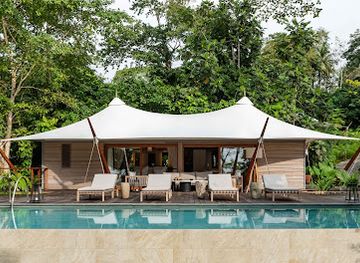
Sundy Praia Príncipe Island
Discover the enchanting Sundy Praia, a luxurious resort on Príncipe Island that combines stunning nature with exquisite hospitality for an unforgettable getaway.
-
 Hotel
HotelHotel Anda China Malabo
Experience comfort and hospitality at Hotel Anda in Ciudad de Malabo, your serene retreat in Equatorial Guinea's vibrant capital.
-
Hotel
ibis Malabo
Discover comfort and convenience at ibis Malabo, your perfect base to explore the beauty and culture of Equatorial Guinea.
-
Hotel
Magno Suites Exclusive Hotel & Restaurant
Discover the luxurious comfort and exquisite dining at Magno Suites in Malabo, Equatorial Guinea.
Best shops in Annobón Island
Shopping on Annobón is limited and practical rather than retail-oriented. San Antonio de Palé has small shops and informal trading activity, but visitors should not expect a substantial high street, department store, tourist market or dependable range of imported goods. Fresh fish, plantains, cassava, fruit and other everyday provisions may be available according to local supply and season. Handicrafts and locally made items can sometimes be obtained through personal contacts, but purchases should be arranged respectfully and should not encourage the removal of wildlife, shells, archaeological material or protected natural objects. Bring specialist clothing, medicines, toiletries, batteries and outdoor equipment from a larger Equatorial Guinean centre. Useful souvenirs are more likely to be locally produced foodstuffs or small craft items than branded merchandise, and asking permission before buying directly from households or fishers is good practice.
-
Travel agency
Rumbo Malabo
Explore Equatorial Guinea with Rumbo Malabo - your ultimate travel agency for unforgettable canoeing, kayaking, and sightseeing adventures.
-
Corporate office
Finca Sampaka
Explore Finca Sampaka: A Unique Agricultural Experience in Malabo, Equatorial Guinea, Showcasing Sustainable Practices and Local Culture.
-
International airport
Annobón Airport
Explore the untamed beauty of Annobón Island through Annobón Airport, your gateway to adventure in Equatorial Guinea.
-
Industrial design company
Nuevo puerto
Explore the fusion of industrial design and local culture at Nuevo Puerto, a unique gem in San Antonio de Palé, Equatorial Guinea.
Get your free copy of our complete guide to Annobón Island, delivered straight to you.
Everything on this page, from attractions and restaurants to essentials and local phrases, in one PDF you can read offline, print or share.
Already have an account? Sign in
Your Annobón Island guide is ready.
We'll send it to · Not you? Sign out

Getting your guide ready…
We are putting together a fresh copy of the Annobón Island guide. This can take up to a minute.
This can take a few moments. If your browser asks, choose Allow so the download can start. You'll find the guide in your Downloads folder.
Nothing happened? Download it again
Sorry, the guide is taking longer than usual. Please try again in a minute, or get it by email instead.
Annobón Island essentials
Currency and Payment
Safety
Emergency Situations
Do's and Don'ts
Local Tips
From Eve
Local phrases worth knowing
You don't need to get them perfect. A few words go a long way, and locals appreciate the effort.
Basics
| English | Local | Say it |
|---|---|---|
| Hello | Bona | [bo-na] |
| Goodbye | Adeu | [a-deu] |
| Yes | Si | [si] |
| No | No | [no] |
| Please/You're welcome | Por favor | [por fa-vor] |
| Thank you | Gracias | [gra-thi-as] |
| Excuse me/Sorry | Desculpa | [des-kul-pa] |
| How are you? | Komo ta? | [ko-mo ta] |
| Fine. And you? | Ta bien. E tu? | [ta byen. e tu] |
| Do you speak English? | Ta fala ingles? | [ta fa-la in-gles] |
| I don't understand | No ta comprende | [no ta kom-pren-de] |
Eating & Drinking
| English | Local | Say it |
|---|---|---|
| I'd like to see the menu, please | Quisiera ver el menú, por favor | [ki-sie-ra ver el me-nu, por fa-vor] |
| I don't eat meat | No como carne | [no ko-mo kar-ne] |
| Cheers! | Salud! | [sa-lud] |
| I would like to pay, please | Quisiera pagar, por favor | [ki-sie-ra pa-gar, por fa-vor] |
Emergencies
| English | Local | Say it |
|---|---|---|
| Help! | Ayuda! | [a-yu-da] |
| Go away! | Vete! | [ve-te] |
| Call the Police! | Llama a la policía! | [ya-ma a la po-li-cia] |
| Call a doctor! | Llama a un médico! | [ya-ma a un me-di-co] |
| I'm lost | Estoy perdido | [es-toy per-di-do] |
| I'm ill | Estoy enfermo | [es-toy en-fer-mo] |
Shopping
| English | Local | Say it |
|---|---|---|
| I'd like to buy... | Quisiera comprar... | [ki-sie-ra kom-prar] |
| I'm just looking | Solo estoy mirando | [so-lo es-toy mi-ran-do] |
| How much is it? | Cuánto cuesta? | [kwan-to kwes-ta] |
| That's too expensive | Eso ta muy caro | [e-so ta muy ka-ro] |
| Can you lower the price? | Puedes bajar el precio? | [pwe-des ba-har el pre-cio] |
Time & Numbers
| English | Local | Say it |
|---|---|---|
| What time is it? | Que hora es? | [ke o-ra es] |
| It's one o'clock | Es la una | [es la u-na] |
| Half past (10) | Y media (10) | [i me-dia (10)] |
| Morning | Mañana | [ma-ña-na] |
| Afternoon | Tarde | [tar-de] |
| Evening | Noche | [no-che] |
| Yesterday | Ayer | [a-yer] |
| Today | Hoy | [oy] |
| Tomorrow | Mañana | [ma-ña-na] |
| 1 | Uno | [u-no] |
| 2 | Dos | [dos] |
| 3 | Tres | [tres] |
| 4 | Cuatro | [kwa-tro] |
| 5 | Cinco | [sin-co] |
| 6 | Seis | [seis] |
| 7 | Siete | [sye-te] |
| 8 | Ocho | [o-cho] |
| 9 | Nueve | [nwe-ve] |
| 10 | Diez | [diez] |
Transport & Directions
| English | Local | Say it |
|---|---|---|
| Where's a/the...? | Onde ta...? | [on-de ta] |
| What's the address? | Qual é o endereço? | [kwal e o en-de-re-so] |
| Can you show me (on the map)? | Podes me mostrar (no mapa)? | [po-des me mos-trar] |
| When's the next (bus)? | Quando ta o próximo (autocarro)? | [kwan-do ta o pro-xi-mo] |
| A ticket (to ....) | Um bilhete (para....) | [um bi-lhe-te] |
History of Annobón Island
Portuguese Exploration and the Naming of Annobón
Portuguese navigators reached the island in the late fifteenth century and gave it the name Ano Bom, generally understood as referring to the day of its discovery or sighting. Annobón was not a large commercial centre, but its position in the Gulf of Guinea and South Atlantic connected it to Portuguese maritime routes. Settlement, agriculture and the movement of people from different parts of the Portuguese Atlantic world helped create the linguistic and cultural foundations of Fá d’Ambô, the island’s distinctive Portuguese-based Creole language.
Portuguese Colonial Administration
For several centuries Annobón remained within Portugal’s Atlantic colonial sphere. Its small population and remote location limited the development of the extensive plantation systems found on some larger islands, but the island was linked to wider networks of Christianity, seafaring and Atlantic trade. The community that developed there combined African ancestry and local adaptation with cultural influences carried through Portuguese maritime routes. These connections remain visible in place names, language and aspects of religious and social tradition.
The 1778 Treaty and Spanish Rule
The Treaty of El Pardo in 1778 transferred Portuguese claims over Annobón, Fernando Pó and territories on the African mainland to Spain. Spanish authority was initially difficult to impose consistently because of the island’s distance and challenging communications. Over time, however, Annobón became part of Spanish Guinea and was administered alongside Spain’s other possessions in the Gulf of Guinea. This period introduced Spanish institutions and language while leaving the island’s Portuguese-derived Creole culture intact.
Colonial Isolation and Island Society
During the Spanish colonial era, Annobón remained much less developed and less commercially integrated than Fernando Pó, now Bioko, or the mainland territories. Islanders relied heavily on fishing, small-scale farming and maritime exchange, with local settlements shaped by volcanic terrain and restricted transport. The island’s isolation contributed to the survival of distinctive customs and speech, but it also meant limited infrastructure, infrequent services and a close dependence on changing sea conditions.
Equatorial Guinea’s Independence in 1968
Equatorial Guinea became independent from Spain on 12 October 1968, and Annobón entered the new republic as one of its insular territories. The island’s distance from Malabo and the mainland continued to affect public administration, transport and access to services. National political upheavals in the early post-independence period also had consequences for communities across the country. Annobón’s later history has therefore been shaped both by national developments and by the practical difficulties of governing a small island far from the main population centres.
Contemporary Annobón
Today Annobón is an administrative province of Equatorial Guinea, with San Antonio de Palé as its principal settlement. Government services, communications and transport have improved in some periods, though reliable access remains a central issue for residents and visitors. The island’s volcanic landscapes, surrounding waters and distinctive cultural heritage have increased interest in carefully managed tourism and conservation. Its contemporary identity continues to rest on the relationship between a small island community, a demanding environment and a history connecting Central Africa with the Portuguese and Spanish Atlantic worlds.
Annobón Island in Photos
Browse through our photo collection highlighting the charm and character of the destination.
Neighbouring regions of Annobón Island
The closest regions to Annobón Island, if you have time for more than one.
-

-

-

-

-


Swipe for more regions
Explore more
Explore more of Equatorial Guinea
Discover Equatorial Guinea – A captivating blend of colonial history, lush rainforests, pristine beaches, and vibrant culture in the heart of Central Africa.
Explore Equatorial Guinea