

Free Woleu-Ntem Province Travel Guide & Mobile App
Explore Woleu-Ntem Province with free travel guides. Discover regional history, expert tips, proposed trips, and audio guides on web or mobile app.


Explore Woleu-Ntem in northern Gabon for forest landscapes, Fang heritage, cocoa country and demanding journeys beyond the main tourist routes.
Read more about Woleu-Ntem Province
When is the best time to visit Woleu-Ntem Province?
Best: January–March · 28–29°C| Month | High (°C) | Rainfall (mm) |
|---|---|---|
| January (best) | 28 | 100 |
| February (best) | 28 | 90 |
| March (best) | 29 | 110 |
| April | 28 | 120 |
| May | 28 | 130 |
| June | 28 | 140 |
| July | 27 | 150 |
| August | 27 | 160 |
| September | 28 | 150 |
| October | 28 | 140 |
| November | 28 | 130 |
| December | 28 | 120 |
Getting to and around Woleu-Ntem Province
How to get there
Transportation
Explore Woleu-Ntem Province on the map
Plan your trip on one map. See where the top cities, national parks and sights are, and book hotels and experiences in a few clicks.
Best hotels in Woleu-Ntem Province
Best restaurants in Woleu-Ntem Province
Dining in Woleu-Ntem is centred on local households, modest restaurants, market stalls and hotel dining rooms rather than a formal restaurant scene. Common foods include cassava, plantains, rice, maize, leafy sauces, grilled or stewed chicken and fish, with ingredients varying according to season and availability. Forest communities may also use wild plants and other locally gathered foods, but visitors should avoid bushmeat and ask about provenance. Oyem and Bitam offer the widest choice of simple eateries, where meals may be accompanied by spicy sauces, peanuts or palm-derived ingredients. Cocoa is an important agricultural product and is encountered more often as a local crop and trade than as a polished visitor attraction. Breakfasts and market snacks can be useful for travellers on the road, although hygiene standards vary; choose busy stalls where food is cooked thoroughly and served hot. In rural areas, carry water and do not assume that every accommodation offers a full evening meal.
-
African
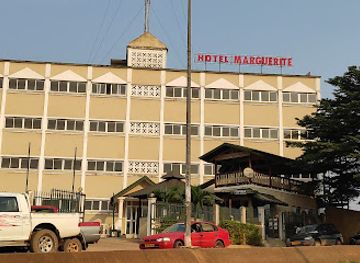
Hotel Marguerite Oyem
Discover African flavors and vibrant nightlife at Hotel Marguerite Oyem - your gateway to local culture and unforgettable experiences.
-
Restaurant
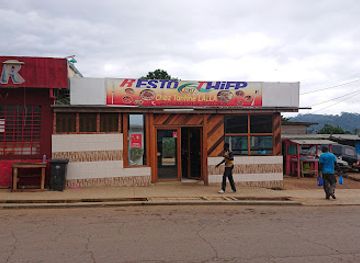
RESTO THIEP
Discover authentic Gabonese flavors at Resto Thiep in Mitzic - a cozy restaurant showcasing local culinary traditions.
Best bars in Woleu-Ntem Province
Evening life in Woleu-Ntem is concentrated in Oyem and, to a lesser extent, Bitam. Small bars, hotel lounges and neighbourhood drinking places provide settings for conversation, football broadcasts and music, while restaurants offer the most dependable evening meals. In smaller towns and villages, social life is quieter and may centre on family compounds, community gatherings or occasional music rather than dedicated nightclubs. The province does not have the concentrated club scene associated with Libreville, and venues, hours and entertainment can change without formal notice. Visitors should return to accommodation by arranged transport after dark, keep valuables discreet and ask locally about appropriate places to go. A respectful approach matters: nightlife is part of ordinary urban life, not a performance staged for visitors.
-
Bar
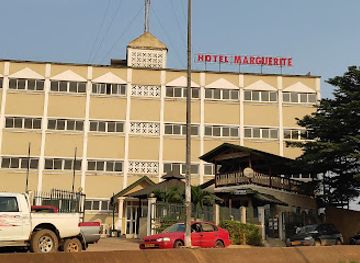
Hotel Marguerite Oyem
Experience the vibrant culture and authentic African cuisine at Hotel Marguerite Oyem in Woleu Ntem, a must-visit for every traveler.
-
Restaurant
La Goourmandise
Experience the essence of Gabonese cuisine in a vibrant setting at La Gourmandise, a culinary gem in Oyem.
-
Bar
Snack bar le chalet
Discover the cozy ambiance of Snack Bar Le Chalet in Oyem, where local flavors meet a welcoming atmosphere for a delightful evening.
-
 Restaurant
Delicious Barbecue Beef And Chicken
Discover the authentic taste of Oyem at Delicious Barbecue Beef And Chicken, where every bite is a celebration of local flavors.
Best nightclubs in Woleu-Ntem Province
Evening life in Woleu-Ntem is concentrated in Oyem and, to a lesser extent, Bitam. Small bars, hotel lounges and neighbourhood drinking places provide settings for conversation, football broadcasts and music, while restaurants offer the most dependable evening meals. In smaller towns and villages, social life is quieter and may centre on family compounds, community gatherings or occasional music rather than dedicated nightclubs. The province does not have the concentrated club scene associated with Libreville, and venues, hours and entertainment can change without formal notice. Visitors should return to accommodation by arranged transport after dark, keep valuables discreet and ask locally about appropriate places to go. A respectful approach matters: nightlife is part of ordinary urban life, not a performance staged for visitors.
-
Bar
Démocratie Bar
Discover the vibrant nightlife at Démocratie Bar in Bitam, where local flavors and friendly vibes await every traveler.
-
Bar
Chez John
Discover the vibrant nightlife of Oyem at Chez John, a lively bar offering a unique blend of local drinks and cultural experiences.
Best shops in Woleu-Ntem Province
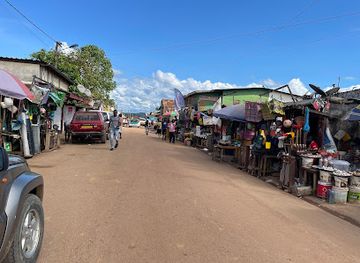
Shopping in Woleu-Ntem is mainly practical and local, with Oyem and Bitam offering the broadest choice of markets, small shops and roadside stalls. Markets sell plantains, cassava, seasonal fruit, vegetables, smoked or dried foods, household goods and clothing, while smaller vendors may offer snacks suitable for a road journey. Cocoa is closely associated with the provincial economy and may be encountered through farmers and traders, although packaged visitor products are not consistently available. Locally made baskets, carved objects and other crafts can sometimes be found through personal introductions rather than in dedicated souvenir centres; ask about materials and buy only items whose production does not involve protected wildlife. Mitzic and Minvoul have more modest retail scenes, focused on everyday needs rather than fashion or luxury goods. Bargaining may be possible in informal markets, but agree prices courteously and pay in CFA francs. Carrying reusable bags is useful, particularly when buying produce or provisions for travel.
-
Shopping mall
Marché Banane du PK8
Discover the colorful and lively Marché Banane du PK8, a shopping paradise in Libreville showcasing local crafts, food, and culture.
-
Shopping mall
ABC mall
Explore ABC Mall in Libreville for a unique shopping experience, featuring local boutiques, international brands, and delightful dining options.
-
Grocery store
Marché De Bitam
Discover the vibrant flavors and local culture at Marché De Bitam, a must-visit grocery store in the heart of Bitam, Gabon.
-
General store
Cecado
Discover unique local products and experience the heart of Oyem at Cecado, a vibrant general store that embodies the spirit of the community.
Get your free copy of our complete guide to Woleu-Ntem Province, delivered straight to you.
Everything on this page, from attractions and restaurants to essentials and local phrases, in one PDF you can read offline, print or share.
Already have an account? Sign in
Your Woleu-Ntem Province guide is ready.
We'll send it to · Not you? Sign out

Getting your guide ready…
We are putting together a fresh copy of the Woleu-Ntem Province guide. This can take up to a minute.
This can take a few moments. If your browser asks, choose Allow so the download can start. You'll find the guide in your Downloads folder.
Nothing happened? Download it again
Sorry, the guide is taking longer than usual. Please try again in a minute, or get it by email instead.
Woleu-Ntem Province essentials
Currency and Payment
Safety
Emergency Situations
Do's and Don'ts
Local Tips
From Eve
Local phrases worth knowing
You don't need to get them perfect. A few words go a long way, and locals appreciate the effort.
Basics
| English | Local | Say it |
|---|---|---|
| Hello | Bonjour | [Bohn-zhoor] |
| Goodbye | Au revoir | [Oh ruh-vwahr] |
| Yes | Oui | [Wee] |
| No | Non | [Nohn] |
| Please/You're welcome | S'il vous plaît | [Seel voo pleh] |
| Thank you | Merci | [Mehr-see] |
| Excuse me/Sorry | Excusez-moi | [Ehks-kew-zay mwah] |
| How are you? | Comment ça va? | [Coh-mohn sah vah] |
| Fine. And you? | Bien. Et vous? | [Byehn. Ay voo] |
| Do you speak English? | Parlez-vous anglais? | [Par-lay voo ahn-glay] |
| I don't understand | Je ne comprends pas | [Zhuh nuh kohm-prahn pah] |
Eating & Drinking
| English | Local | Say it |
|---|---|---|
| I'd like to see the menu, please | Je voudrais voir le menu, s'il vous plaît | [Zhuh voo-dray vwah leuh meh-nu, seel voo pleh] |
| I don't eat meat | Je ne mange pas de viande | [Zhuh nuh mahnj pah duh vyahnd] |
| Cheers! | Santé! | [Sahn-tay] |
| I would like to pay, please | Je voudrais payer, s'il vous plaît | [Zhuh voo-dray pay-ay, seel voo pleh] |
Emergencies
| English | Local | Say it |
|---|---|---|
| Help! | Au secours! | [Oh se-koor] |
| Go away! | Allez-vous-en! | [Ah-lay voo-zahn] |
| Call the Police! | Appelez la police! | [Ah-peh-lay lah poh-lees] |
| Call a doctor! | Appelez un médecin! | [Ah-peh-lay uhn may-deh-sahn] |
| I'm lost | Je suis perdu | [Zhuh swee pair-doo] |
| I'm ill | Je suis malade | [Zhuh swee mah-lahd] |
Shopping
| English | Local | Say it |
|---|---|---|
| I'd like to buy... | Je voudrais acheter... | [Zhuh voo-dray ah-sheh-tay] |
| I'm just looking | Je regarde juste | [Zhuh ruh-gard zhuhst] |
| How much is it? | C'est combien? | [Say kohm-byen] |
| That's too expensive | C'est trop cher | [Say troh shair] |
| Can you lower the price? | Pouvez-vous baisser le prix? | [Poo-vay voo beh-say leuh pree] |
Time & Numbers
| English | Local | Say it |
|---|---|---|
| What time is it? | Quelle heure est-il? | [Kel uhr eh-teel] |
| It's one o'clock | Il est une heure | [Eel eh ewn uhr] |
| Half past (10) | Dix heures et demie | [Dee uhr eh duh-mee] |
| Morning | Matin | [Mah-tan] |
| Afternoon | Après-midi | [Ah-pray mee-dee] |
| Evening | Soir | [Swahr] |
| Yesterday | Hier | [Yair] |
| Today | Aujourd'hui | [Oh-zhoor-dwee] |
| Tomorrow | Demain | [Duh-mahn] |
| 1 | Un | [Uhn] |
| 2 | Deux | [Duh] |
| 3 | Trois | [Trwah] |
| 4 | Quatre | [Kah-truh] |
| 5 | Cinq | [Sank] |
| 6 | Six | [Seez] |
| 7 | Sept | [Set] |
| 8 | Huit | [Wheet] |
| 9 | Neuf | [Nuhf] |
| 10 | Dix | [Dee] |
Transport & Directions
| English | Local | Say it |
|---|---|---|
| Where's a/the...? | Où est un/une...? | [Oo eh uhn/ewn] |
| What's the address? | Quelle est l'adresse? | [Kel eh l'ah-dress] |
| Can you show me (on the map)? | Pouvez-vous me montrer (sur la carte)? | [Poo-vay voo muh mohn-tray (soor lah kart)] |
| When's the next (bus)? | Quand est le prochain (bus)? | [Kahn eh luh pro-shen (boos)] |
| A ticket (to ....) | Un billet (pour ....) | [Uhn bee-yay (poor ....)] |
History of Woleu-Ntem Province
Early Forest Communities and Fang Expansion
The forests of northern Gabon have long been inhabited by communities whose livelihoods combined cultivation, hunting, fishing and the gathering of forest products. Fang-speaking peoples became especially prominent across Woleu-Ntem over the course of the nineteenth century, moving and reorganising communities within a wider cultural area that also extends into southern Cameroon and Equatorial Guinea. These movements were not a single migration event but a long process shaped by warfare, trade, family alliances and access to land. The continuing importance of Fang languages, kinship and artistic traditions is one of the clearest historical features of the province.
Precolonial Trade and Regional Exchange
Before European colonial rule, northern Gabon was connected to wider exchange networks linking the interior forest to the coast and to neighbouring territories. Iron tools, salt, cloth, livestock, foodstuffs and other goods circulated through relationships between communities rather than through a single centralised state. The routes that later became roads towards Cameroon and Equatorial Guinea followed a region already shaped by movement and commerce. Markets in towns such as Oyem and Bitam continue to reflect this cross-border geography, although modern trade is governed by national borders and customs regulations.
French Equatorial Africa and Colonial Administration
French influence expanded into the area during the late nineteenth and early twentieth centuries, and Woleu-Ntem was incorporated into the colonial structures of French Equatorial Africa. Administrators, missionaries and commercial interests established stations and routes, while colonial rule imposed taxation, labour demands and new political boundaries. The area was administered alongside neighbouring territories whose borders did not correspond neatly to Fang cultural geography. Oyem and other emerging centres gained importance as administrative and commercial points, leaving a legacy visible in town layouts, official buildings, road corridors and the continued use of French in public life.
Cocoa, Food Crops and the Rural Economy
Agriculture became increasingly important under and after colonial rule, with cocoa cultivation developing alongside cassava, plantains, maize and other food crops. Smallholder farming remains central to life in much of Woleu-Ntem, particularly around the more settled corridors near Oyem and Bitam. Cocoa production has experienced changing prices, infrastructure constraints and periods of decline, but it remains part of the province's economic identity. The contrast between cultivated clearings and surrounding forest reflects a long history of adapting agricultural systems to humid tropical conditions.
Independence and the Modern Province
Gabon became independent from France in 1960, and Woleu-Ntem developed as one of the country's northern provinces within the new national state. Oyem consolidated its role as the provincial capital, while roads, schools, health services and administrative institutions connected a larger number of communities to the national economy. Cross-border family and commercial links continued, but the frontiers with Cameroon and Equatorial Guinea acquired greater practical significance. Contemporary Woleu-Ntem combines urban administration, subsistence and commercial farming, regional trade and extensive forest landscapes.
Forest Conservation and a Changing Economy
Late twentieth- and early twenty-first-century conservation policies placed greater emphasis on protecting Gabon's forests and wildlife. The extensive Minkébé forest became especially important in national discussions about biodiversity, logging, elephant conservation and the balance between local livelihoods and protected landscapes. Conservation has not removed the need for roads, economic opportunity or community participation, and access to remote areas remains difficult. For visitors, the province's modern identity is therefore defined by both its agricultural and cross-border economy and its role in safeguarding one of Central Africa's major forest ecosystems.
Woleu-Ntem Province in Photos
Browse through our photo collection highlighting the charm and character of the destination.
Neighbouring regions of Woleu-Ntem Province
The closest regions to Woleu-Ntem Province, if you have time for more than one.
-

-

-

-

-


Swipe for more regions
Explore more
Explore more of Gabon
Gabon: Discover Africa's untouched paradise with pristine beaches, diverse wildlife, and rich cultural heritage.
Explore Gabon