

Free Hellshire Hills Travel Guide & Mobile App
Explore Hellshire Hills with free travel guides. Discover regional history, expert tips, proposed trips, and audio guides on web or mobile app.


Explore Hellshire Hills in Jamaica for dry limestone forest, rare wildlife, coastal scenery and conservation-led outdoor adventures near Kingston.
Read more about Hellshire Hills
When is the best time to visit Hellshire Hills?
Best: January–March · 29–30°C| Month | High (°C) | Rainfall (mm) |
|---|---|---|
| January (best) | 29 | 45 |
| February (best) | 29 | 40 |
| March (best) | 30 | 50 |
| April | 31 | 55 |
| May | 31 | 70 |
| June | 32 | 80 |
| July | 32 | 90 |
| August | 32 | 100 |
| September | 32 | 110 |
| October | 31 | 120 |
| November | 30 | 100 |
| December | 30 | 80 |
Getting to and around Hellshire Hills
How to get there
Transportation
Best attractions in Hellshire Hills
Hellshire Hills is primarily an ecological and outdoor destination rather than a concentration of built attractions. Its dry limestone forest, scrub-covered ridges, caves and seasonal gullies provide the setting for guided walks focused on geology, botany and Jamaican natural history. The principal draw is the habitat of the Jamaican iguana, although the endangered reptile is carefully protected and sightings cannot be promised. Birdwatching and the study of drought-adapted vegetation are more realistic expectations than a conventional wildlife encounter. The coastal margins around the peninsula add views across southern Jamaica and towards Kingston Harbour, but access and swimming conditions vary and facilities are limited. The wider Hellshire and Portmore area, outside the hills’ conservation interior, offers more developed seaside recreation and everyday services, while nearby Kingston provides museums, historic buildings and cultural venues rather than regional attractions belonging to Hellshire Hills itself. Visitors interested in environmental management can learn about the challenges created by invasive predators, quarrying, roads and urban expansion. The strongest experiences here are therefore guided, low-impact and interpretive: walking slowly through a specialised dry-forest ecosystem and understanding why this small area is important to Jamaica’s biodiversity.
-
Travel lounge
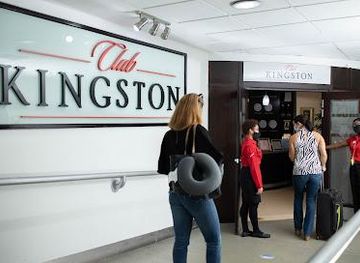
Club Kingston - VIP Airport Lounge / VIP Attractions
Discover the luxurious comfort of Club Kingston, a VIP lounge at Norman Manley International Airport, ensuring a serene travel experience in Jamaica.
Best landmarks in Hellshire Hills
Hellshire Hills’ most significant landmarks are natural rather than monumental. The peninsula’s pale limestone ridges and dry-forest slopes form a recognisable geological landscape close to Kingston Harbour and the urban plain of St Catherine. Cavities, rocky outcrops and seasonal drainage lines reflect the porous limestone beneath the hills, while the vegetation demonstrates how Jamaican ecosystems adapt to a comparatively dry climate. The habitat of the Jamaican iguana is the area’s most important living landmark: it represents the last known natural stronghold of a species found nowhere else. Hellshire Bay and the southern coastal edge provide geographic reference points, although the coastline is not uniformly developed or suitable for casual swimming. The hills should be viewed as a protected ecological landscape rather than a site of grand architecture. Historic Port Henderson and the more developed Portmore surroundings are nearby points of context outside Hellshire Hills, but they should not be presented as landmarks within the conservation area itself. Their proximity helps explain the peninsula’s importance as a remaining natural refuge beside Jamaica’s expanding southern urban corridor.
-
Mountain peak
Hellshire Point
Explore the breathtaking views and serene landscapes of Hellshire Point, Jamaica's hidden mountain gem for nature lovers and adventure seekers.

Explore Hellshire Hills on the map
Plan your trip on one map. See where the top cities, national parks and sights are, and book hotels and experiences in a few clicks.
Best hotels in Hellshire Hills
Best restaurants in Hellshire Hills
Hellshire Hills itself has no established restaurant district, and visitors should not expect cafés, shops or dependable food outlets along conservation trails. Bring water and a packed meal arranged in advance, while checking with a guide whether food may be consumed at the planned stopping points. The wider Hellshire and Portmore area, outside the hills, has Jamaican cooking ranging from roadside grills and casual fish vendors to cafés, takeaways and family restaurants. Seafood, jerk-seasoned meats, rice and peas, fried plantain, patties and fresh fruit are among the foods commonly encountered in southern Jamaica, though menus and standards vary by establishment. Portmore is the most practical nearby place for supplies and a broader choice of everyday dining; Kingston offers a more extensive restaurant scene and international cuisine. Visitors should distinguish food associated with Jamaica nationally from dishes specifically originating in Hellshire Hills, which is better understood as a conservation landscape than a culinary region.
-
Seafood
Bev And Sons
Experience authentic Jamaican seafood at Bev And Sons on Hellshire Beach - where every dish tells a story of freshness and flavor.
-
Seafood
Screechies seafood and bar
Experience fresh seafood delights at Screechies Seafood and Bar in Portmore – where local flavors meet breathtaking ocean views.
-
Restaurant
Prendy's On The Beach
Experience authentic Jamaican cuisine with stunning ocean views at Prendy's On The Beach in Hellshire.
-
Seafood
Aunt May’s Fish Restaurant
Experience authentic Jamaican seafood at Aunt May's Fish Restaurant in Hellshire - where every dish tells a story.


Best bars in Hellshire Hills
Nightlife is not a feature of Hellshire Hills, where there is no established evening entertainment zone and visitors should leave the conservation area well before dark unless participating in a specifically organised programme. Evening options are found outside the region in Portmore and Kingston, where local bars, casual restaurants, sports bars, live-music venues and larger entertainment spaces provide a more developed social scene. The Hellshire and Portmore coast may have informal food-and-drink activity, but businesses, transport and opening arrangements can change, so confirm details locally rather than relying on assumptions. A guided nature excursion is best paired with an evening in an urban base, not with an attempt to camp or explore the hills after sunset. Drink responsibly, use pre-arranged transport and avoid carrying unnecessary valuables in unfamiliar areas.
-
Bar
Ken's Wildflower
Dive into the lively atmosphere of Ken's Wildflower, where vibrant nightlife meets authentic Jamaican culture in Portmore.
-
Sports bar
Timber Lounge
Experience the thrill of sports and delicious food at Timber Lounge, the premier sports bar in Portmore, Jamaica.
-
Seafood
Bev And Sons
Discover the flavors of Jamaica at Bev And Sons, a seafood paradise on Hellshire Beach, where fresh catches meet stunning ocean views.
-
Grill
Beer Grillz
Discover the vibrant taste of Jamaican grilling at Beer Grillz, where every bite is a celebration of flavor in Portmore.


Best nightclubs in Hellshire Hills
Nightlife is not a feature of Hellshire Hills, where there is no established evening entertainment zone and visitors should leave the conservation area well before dark unless participating in a specifically organised programme. Evening options are found outside the region in Portmore and Kingston, where local bars, casual restaurants, sports bars, live-music venues and larger entertainment spaces provide a more developed social scene. The Hellshire and Portmore coast may have informal food-and-drink activity, but businesses, transport and opening arrangements can change, so confirm details locally rather than relying on assumptions. A guided nature excursion is best paired with an evening in an urban base, not with an attempt to camp or explore the hills after sunset. Drink responsibly, use pre-arranged transport and avoid carrying unnecessary valuables in unfamiliar areas.
-
Night club
Go Go Club
Discover the heart of Portmore's nightlife at Go Go Club, where vibrant music, local culture, and unforgettable memories await.
-
Club
Klub Ova-Dose
Immerse yourself in the lively nightlife of Portmore at Klub Ova-Dose, where great music and dancing create unforgettable memories.
-
Bar
Blush Sports Bar
Experience the lively atmosphere of Blush Sports Bar in Portmore, where great drinks, tasty bites, and a vibrant crowd await you.
-
Club
Cookies Exotic Day & Nite Club
Discover an unforgettable nightlife experience at Cookies Exotic Day & Nite Club, the heart of Portmore's vibrant party scene.


Best shops in Hellshire Hills
Shopping facilities are virtually absent within Hellshire Hills, so visitors should obtain water, food, sun protection and other necessities in Kingston, Portmore or another established settlement before travelling into the hills. The practical shopping experience is therefore preparation rather than browsing. Portmore, outside the region, provides everyday supermarkets, pharmacies, markets and small retail areas, while Kingston offers a much wider selection of crafts, books, art and Jamaican-made food products. Suitable souvenirs connected with Hellshire Hills should be ethically sourced items such as books or conservation-related materials, not rocks, plants, shells or wildlife products collected from the habitat. Local Jamaican specialities including coffee, spices, sauces, rum products and handmade crafts can be found beyond the hills, but they are national or island-wide products rather than goods uniquely produced in Hellshire Hills.
-
Shopping mall
Sovereign Centre
Discover the ultimate shopping experience at Sovereign Centre, Kingston's premier destination for retail, dining, and entertainment.
-
Shopping mall
Portmore Mall
Explore Portmore Mall: Your ultimate shopping and dining destination in Jamaica, offering diverse shops, delicious food, and local culture.
-
Shopping mall
Sovereign Village
Discover shopping delights and local dining at Sovereign Village, Portmore's premier shopping destination.
-
Supermarket
Shoppers Fair Supermarket
Explore local flavors and vibrant shopping at Shoppers Fair Supermarket in Portmore, Jamaica - a must-visit for tourists seeking authentic experiences.


Get your free copy of our complete guide to Hellshire Hills, delivered straight to you.
Everything on this page, from attractions and restaurants to essentials and local phrases, in one PDF you can read offline, print or share.
Already have an account? Sign in
Your Hellshire Hills guide is ready.
We'll send it to · Not you? Sign out

Getting your guide ready…
We are putting together a fresh copy of the Hellshire Hills guide. This can take up to a minute.
This can take a few moments. If your browser asks, choose Allow so the download can start. You'll find the guide in your Downloads folder.
Nothing happened? Download it again
Sorry, the guide is taking longer than usual. Please try again in a minute, or get it by email instead.
Hellshire Hills essentials
Currency and Payment
Safety
Emergency Situations
Do's and Don'ts
Local Tips
From Eve
Local phrases worth knowing
You don't need to get them perfect. A few words go a long way, and locals appreciate the effort.
Basics
| English | Local | Say it |
|---|---|---|
| Hello | Wah gwaan | [Wah gwaan] |
| Goodbye | Likkle more | [Likkle more] |
| Yes | Yea | [Yea] |
| No | Nuh | [Nuh] |
| Please/You're welcome | Pleez/No problem | [Pleez/No problem] |
| Thank you | Tank yuh | [Tank yuh] |
| Excuse me/Sorry | Scuse me/Sorry | [Scuse me/Sorry] |
| How are you? | How yuh stay? | [How yuh stay?] |
| Fine. And you? | Mi deh yah. An yuh? | [Mi deh yah. An yuh?] |
| Do you speak English? | Yuh speak English? | [Yuh speak English?] |
| I don't understand | Mi nuh undastand | [Mi nuh undastand] |
Eating & Drinking
| English | Local | Say it |
|---|---|---|
| I'd like to see the menu, please | Mi wud like fi si di menu, pleez | [Mi wud like fi si di menu, pleez] |
| I don't eat meat | Mi nuh eat meat | [Mi nuh eat meat] |
| Cheers! | Cheers! | [Cheers!] |
| I would like to pay, please | Mi wud like fi pay, pleez | [Mi wud like fi pay, pleez] |
Emergencies
| English | Local | Say it |
|---|---|---|
| Help! | Help! | [Help!] |
| Go away! | Gweh! | [Gweh!] |
| Call the Police! | Call di police! | [Call di police!] |
| Call a doctor! | Call a doctor! | [Call a doctor!] |
| I'm lost | Mi lost | [Mi lost] |
| I'm ill | Mi sick | [Mi sick] |
Shopping
| English | Local | Say it |
|---|---|---|
| I'd like to buy... | Mi wud like fi buy... | [Mi wud like fi buy...] |
| I'm just looking | Mi jus a look | [Mi jus a look] |
| How much is it? | How much fi dis? | [How much fi dis?] |
| That's too expensive | Dat too pricey | [Dat too pricey] |
| Can you lower the price? | Yuh can lower di price? | [Yuh can lower di price?] |
Time & Numbers
| English | Local | Say it |
|---|---|---|
| What time is it? | Wah time it deh? | [Wah time it deh?] |
| It's one o'clock | A one o'clock | [A one o'clock] |
| Half past (10) | Half past ten | [Half past ten] |
| Morning | Mornin' | [Mornin'] |
| Afternoon | Afternoon | [Afternoon] |
| Evening | Evenin' | [Evenin'] |
| Yesterday | Yesterday | [Yesterday] |
| Today | Today | [Today] |
| Tomorrow | Tomorrow | [Tomorrow] |
| 1 | One | [One] |
| 2 | Two | [Two] |
| 3 | Three | [Three] |
| 4 | Four | [Four] |
| 5 | Five | [Five] |
| 6 | Six | [Six] |
| 7 | Seven | [Seven] |
| 8 | Eight | [Eight] |
| 9 | Nine | [Nine] |
| 10 | Ten | [Ten] |
Transport & Directions
| English | Local | Say it |
|---|---|---|
| Where's a/the...? | Whey di...? | [Whey di...?] |
| What's the address? | Wah di address? | [Wah di address?] |
| Can you show me (on the map)? | Yuh can show mi (pon di map)? | [Yuh can show mi (pon di map)?] |
| When's the next (bus)? | Wen di next (bus)? | [Wen di next (bus)?] |
| A ticket (to ....) | A ticket (to ....) | [A ticket (to ....)] |
History of Hellshire Hills
Taíno Jamaica and the Southern Limestone Landscape
Before European colonisation, Jamaica was inhabited by Taíno communities who used the island’s coastal plains, forests and limestone regions for settlement, farming, fishing and gathering. The caves and dry woodland of southern Jamaica formed part of a wider ecological landscape rather than an isolated wilderness. Archaeological evidence across Jamaica records Taíno activity, although individual sites in Hellshire Hills should not be assumed without specialist confirmation. The region’s limestone geology, seasonal water availability and coastal position influenced how people moved through and used the peninsula long before the modern conservation era.
Spanish Rule and the British Conquest, 1494–1655
Christopher Columbus reached Jamaica in 1494, and Spain established colonial control during the sixteenth century. Spanish settlement and the forced labour of Indigenous people and Africans transformed the island’s population and economy. In 1655, English forces captured Jamaica, beginning British rule and a new phase of plantation expansion. Hellshire Hills was not one of Jamaica’s principal plantation centres, but its position beside the developing southern lowlands meant that the peninsula formed part of a wider landscape shaped by colonial agriculture, ports, roads and changing land ownership.
Plantation Society and Enslavement
Under British rule, Jamaica’s wealth was increasingly tied to sugar and other plantation commodities produced through the enslavement of Africans. The plains and coastal districts around the Hellshire peninsula were connected to this economy through landholding, transport and maritime trade, while the rougher dry hills were less intensively cultivated than more fertile plantation areas. Enslaved people resisted the colonial system in many forms, from everyday acts of defiance to organised rebellion. Emancipation in the 1830s and the end of apprenticeship in 1838 fundamentally altered Jamaica’s labour system, though economic inequality and contested land access continued.
Kingston Harbour, Port Henderson and the Southern Corridor
The waters and lowlands around southern St Catherine became increasingly connected to Kingston Harbour and Jamaica’s coastal trading system. Port Henderson, near modern Portmore and outside the hills themselves, developed as a significant historic maritime and commercial location. Roads, coastal activity and later industrial infrastructure brought the peninsula into closer relationship with Kingston and the expanding settlements of St Catherine. This history helps explain the contrast visible today: a relatively undeveloped dry-forest interior lies close to major roads, urban communities and economically important coastal facilities.
Portmore’s Expansion and Changing Land Use
From the second half of the twentieth century, Portmore grew rapidly as a planned and later extensively expanded urban area across the southern St Catherine plain. New housing, roads, utilities, quarries and industrial activity increased pressure on neighbouring natural habitats, including the dry limestone forests of Hellshire. The resulting tension between urban growth and ecosystem protection is central to the region’s modern story. Hellshire Hills is therefore not simply a remote natural area; it is a surviving ecological refuge situated beside one of Jamaica’s most populous urban corridors.
The Jamaican Iguana’s Rediscovery and Conservation
The Jamaican iguana was long believed to have disappeared until a surviving population was rediscovered in Hellshire Hills in 1990. The finding transformed scientific and conservation attention on the peninsula, whose dry forest provides the species’ last known natural stronghold. Conservation programmes have used habitat protection, monitoring, captive rearing and the release of juveniles to improve survival prospects, while invasive predators and habitat loss remain serious challenges. The iguana has made Hellshire Hills one of Jamaica’s most important sites for threatened-species conservation.
Hellshire Hills in Photos
Browse through our photo collection highlighting the charm and character of the destination.
Neighbouring regions of Hellshire Hills
The closest regions to Hellshire Hills, if you have time for more than one.
-

-

-

-

-


Swipe for more regions
Explore more
Explore more of Jamaica
Discover Jamaica: A Caribbean paradise with stunning beaches, rich culture, and thrilling adventures. Experience the island's vibrant music, delicious cuisine, and warm hospitality.
Explore Jamaica