Best Landmarks in Zurich
Planning a trip to Zurich? Discover the best landmarks in Zurich with history, expert tips, and routes. Free on web or the Evendo app.


The best landmarks in Zurich
- Top rated
- Closest to the centre
- Price level: low to high
- Time to spend: shortest first
- A–Z
100 landmarks
-
Protestant church4.5★10,095 reviews
Grossmünster
Grossmünster stands as Zurich’s defining Romanesque landmark on the east bank of the Limmat, its twin towers rising above the Old Town. The church played a central role in the Swiss Reformation under Huldrych Zwingli and remains an active place of worship. Inside, visitors find medieval crypt murals, stained-glass windows by Augusto Giacometti and Sigmar Polke, and a cloister garden. The Karlsturm offers a steep climb to enclosed views over the city, river and lake.
Time to spend 0.5–1.5 hrs
-
Train station4.4★5,952 reviews
Zürich HB
Switzerland’s busiest railway station combines a grand 19th-century concourse, extensive underground ShopVille retail, and seamless connections to national and local transport. Travellers use the historic main hall for quick transfers, meals, or browsing while the station’s public art and central position make it a practical city-centre anchor.
Time to spend 15–60 hrs
-
Observation deck4.6★5,225 reviews
Aussichtsturm Uetliberg
The 70-metre Aussichtsturm rises above Uetliberg’s summit at 871 metres, offering an open-air platform reached by 178 steps. From here the view stretches across Zürich, its lake and, on clear days, the Alps. The steel tower, rebuilt in 1990, stands beside the UTO KULM hotel yet remains a distinct public viewpoint. Visitors reach the summit by the S10 railway followed by a short uphill walk, then climb for a more elevated panorama than the surrounding ridge provides. The experience centres on the weather-exposed platform and the wide sweep of landscape rather than indoor exhibits or lengthy trails.
Daily 0:00–24:00Price level $Time to spend 0.5–1 hr
-
Evangelical church4.5★3,660 reviews
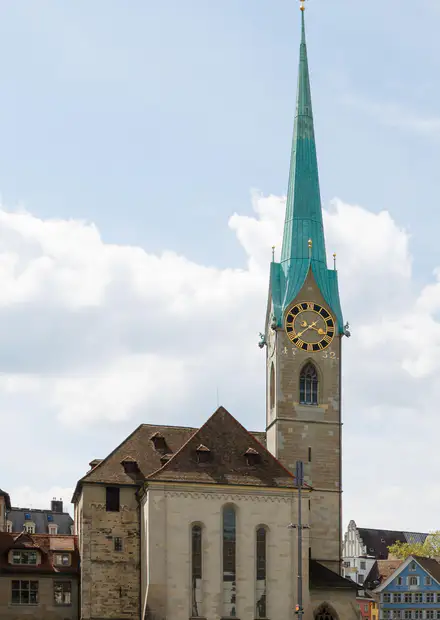
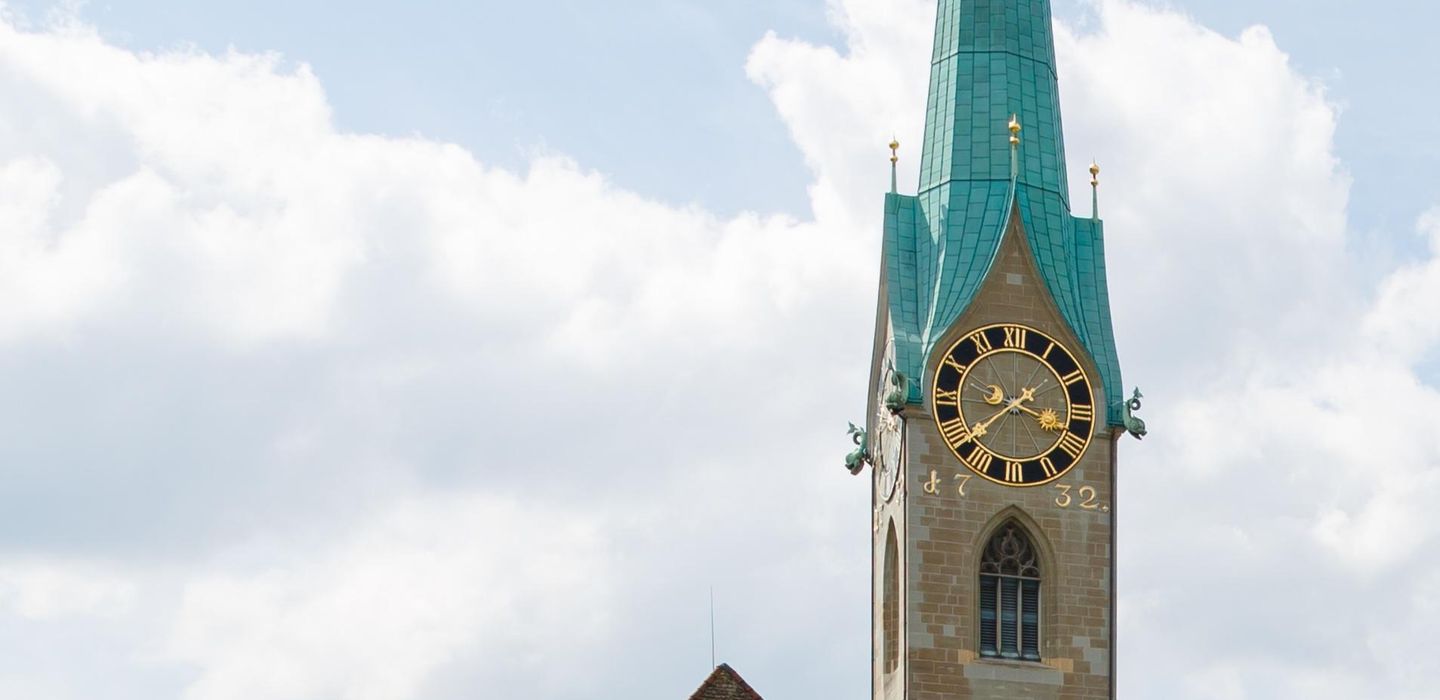
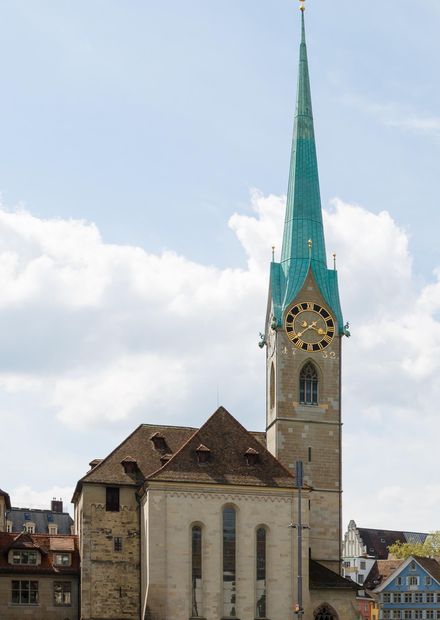
Fraumünster Church
Fraumünster stands as a working Protestant church whose Romanesque and Gothic interior draws visitors chiefly for its luminous stained-glass windows by Marc Chagall. Founded in 853 as part of a women’s abbey, the building carries more than a millennium of Zürich history. A compact visit takes in the nave, transepts and choir, then descends to the crypt museum for context on the abbey’s former power and the Reformation changes that followed. The experience remains quiet and respectful, set within an active place of worship rather than a dedicated tourist venue.
Price level $Time to spend 0.5–1 hr
-
Bridge4.7★2,557 reviews
Quaibrücke
Quaibrücke carries trams, traffic and pedestrians across the point where Lake Zürich narrows into the Limmat. The short crossing offers open views south over the lake and north toward the Old Town and distant Alps. Built in the 1880s as part of the city’s waterfront redevelopment, it remains an active urban route rather than a dedicated viewpoint. Most visitors pause briefly while walking between Bürkliplatz and Bellevue, using the bridge as a practical link between the lakeside promenades and central Zürich.
Daily 0:00–24:00Time to spend 5–15 hrs
-
Catholic church4.6★1,783 reviews
Jesuitenkirche Hl. Franz Xaver
Switzerland’s first major Baroque church stands directly on the Reuss in central Lucerne. Built between 1666 and 1677, the Jesuitenkirche Hl. Franz Xaver remains an active place of worship with a richly stuccoed interior, high altar, and notable organ. Its riverside position and acoustics make it a compact, memorable stop for architecture and sacred-music visitors.
Daily 6:30–18:30Time to spend 15–30 hrs
-
Protestant church4.5★1,738 reviews
St. Peter
St. Peter stands on a raised square in Zürich’s Old Town as the city’s oldest parish church. Its 8.64-metre clock face dominates the street scene while the compact Baroque nave inside offers a quiet contrast to the surrounding medieval fabric. Visitors enter for reflection or a brief architectural visit, experiencing the only Baroque church interior in Zürich within an active Reformed congregation. The site’s long history reaches back to the ninth century, and the present building remains both a place of worship and a stop on any Old Town walk.
Time to spend 15–30 hrs
-
Tourist attraction4.5★1,214 reviews
Paradeplatz
Paradeplatz serves as a busy central square and major tram interchange at the upper end of Bahnhofstrasse. Visitors encounter converging tram lines, surrounding bank buildings, and the steady flow of pedestrians moving between the shopping street, the Old Town, and Lake Zurich. The square functions primarily as a transit point and orientation landmark rather than a destination with dedicated attractions or activities. Its compact urban setting reflects Zurich’s commercial core, with the historic name change from a former livestock market underscoring its long commercial role. A short pause here offers a direct sense of the city’s daily rhythm and its prominent financial district.
Time to spend 5–15 hrs
-
University4.7★1,049 reviews
ETH Zürich
The Main Building of ETH Zürich stands on elevated ground above the Old Town, its 19th-century architecture framing a broad public terrace with open views across the city and, on clear days, toward Lake Zurich. Designed initially by Gottfried Semper and later extended, the building remains an active university site where visitors can explore public areas and the central hall without charge. The terrace itself functions as a popular city viewpoint, while the institution’s history includes Albert Einstein among its students and faculty. Casual visits fit easily into a city itinerary, with the Polybahn funicular providing a direct link from Central station.
Mon–Fri 6:00–22:00 · Sat–Sun 8:00–17:00Time to spend 0.5–1.5 hrs
-
Castle4.6★921 reviews
Stiftung Schloss Regensberg
The round keep of Schloss Regensberg rises above the preserved medieval hill town. Visitors climb a steep internal staircase past historical panels to a viewing platform that surveys the Zürcher Unterland and the Lägern ridge. The compact, self-guided ascent forms the main public experience at this active educational foundation.
Price level $Time to spend 0.5–1 hr


Prime Tower
Prime Tower rises 126 metres above Zürich-West as the city's tallest building. Completed in 2011, its angular green-tinted glass façade stands out in the former industrial district. The main visitor draw is CLOUDS, the public restaurant, bistro and bar on the upper floors offering city, lake and Alpine views when conditions allow. The tower itself remains an active office building with roughly 2,000 workspaces, so the elevated experience is tied to dining or drinks rather than a standalone viewing platform.
Mon–Fri 7:00–20:00Price level $$Time to spend 0.2–2 hrs

Bahnhofstrasse
Bahnhofstrasse stretches 1.4 kilometres from Zürich Hauptbahnhof to Lake Zürich, forming the city’s main retail artery. Lined with luxury fashion houses, Swiss watchmakers, jewellery stores and department stores, the boulevard mixes high-end shopping with everyday city life. Trams glide past grand buildings while Paradeplatz marks the financial core. The walk ends at Bürkliplatz beside the lake, offering a straightforward urban route that connects the station, central shopping blocks and waterfront in a single linear experience.
Price level $$Time to spend 0.3–2 hrs

Liebfrauenkirche
Liebfrauenkirche stands as Zürich’s late-19th-century Catholic parish church built in the form of an early Christian basilica. Its tall Italianate tower rises above the Unterstrass district near the main station. Inside, the three-aisled nave directs attention toward the apse, while mosaics and wall paintings recount the life of Jesus. Below lies a crypt used for quiet prayer. Regular services and church concerts fill the space with music and ceremony. Visitors find a working place of worship rather than a museum, where architecture, acoustics and active parish life combine in one compact urban site.
Time to spend 0.2–1 hr

Geiserbrunnen
The Geiserbrunnen stands on Bürkliplatz as a monumental limestone fountain completed in 1911. Sculptor Jakob Brüllmann created the central group of a man restraining a powerful bull, while architect Jean Freytag designed the surrounding basin with its twelve water outlets. Commissioned through a bequest from city master builder Arnold Geiser, the work commemorates his civic contributions without depicting his likeness. Visitors can examine the forceful carving at close range and photograph the dramatic composition against the lakefront setting. The fountain forms a brief, free stop within a central Zürich lakeside walk.
Open 24 hoursTime to spend 5–15 min

Citykirche Offener St. Jakob
An active Evangelical Reformed church in Zürich’s Aussersihl district that functions as an adaptable city-church venue for worship, reflection and cultural events. Built 1899–1901 in a transitional historicist–Art Nouveau style, the building offers a flexible nave without fixed pews, a large romantic organ and a programme of concerts, talks and gatherings. Its position directly opposite the busy Stauffacher tram interchange makes it an easy urban pause point for visitors of any background.
Daily 7:00–19:00Time to spend 0.2–1 hr

Münsterbrücke
Münsterbrücke spans the Limmat in Zürich’s Old Town, linking the Grossmünster and Fraumünster sides. Built 1836–1838, this masonry arch bridge offers clear river views and a direct pedestrian route between the two landmark churches. It functions as both a practical city crossing and a short scenic pause within the historic street network, framed by riverside buildings rather than open parkland.
Open 24 hoursTime to spend 5–20 hrs

Pestalozzi-Denkmal
A bronze figure on a stone plinth honours Johann Heinrich Pestalozzi, the Zurich-born educator whose ideas on teaching poor children shaped modern education. Standing six metres high in a compact garden beside Bahnhofstrasse, the 1899 monument by Hugo Siegwart offers a quiet pause amid the city’s busiest shopping street. Visitors can study the sculpture, read the inscription, and rest on nearby benches in the small green space known as Pestalozzianlage. The site is free, always accessible, and reached in a two-minute walk from Zurich Main Station, making it an easy addition to any central stroll.
Daily 0:00–24:00Time to spend 5–15 hrs

Ganymede
A bronze sculpture by Hermann Hubacher stands on the raised Bürkliterrasse beside Lake Zürich. Completed in 1952, it shows Ganymed reaching toward an eagle that represents Zeus. The work draws on Greek myth while offering views across the water toward the Alps. Its lakeside position and documented connection to Zürich’s mid-century gay community give the piece a distinctive place among the city’s public artworks.
Daily 0:00–24:00Time to spend 5–15 hrs

Castle Uster
Uster Castle stands on a hill above the town as its defining landmark. Visitors climb the tower for a compact look at historic rooms such as the Knights’ Hall and reach an open viewing platform with wide views across Uster and the surrounding countryside. The short seasonal opening on summer Sunday afternoons makes the visit a focused, free stop rather than a full museum day.
Time to spend 0.5–1 hr

Predigerpl.
Predigerkirche stands in Zurich’s Old Town as a working Evangelical Reformed church whose fabric reaches back to 1231. Visitors enter a calm interior shaped by Romanesque origins, a Gothic choir added after fire damage, and an early Baroque redesign that followed the Reformation. The space remains open for quiet reflection and prayer, with free entry and a small reading area offering Bibles and religious books in several languages. Its tower rises prominently above Zähringerplatz, yet the experience inside stays understated and self-directed.
Mon 12:00–17:00 · Tue–Sun 10:00–17:00Time to spend 15–30 hrs

Shiva Temple
Arulmigu Sivan Kovil stands as Switzerland’s first and largest Shiva-dedicated Hindu temple, created by Tamil migrants in an adapted industrial building in Opfikon. Daily pujas at 9:00, 12:00 and 19:00 draw the local community for worship inside a modest, functional space that reflects both religious tradition and the practical story of settlement in the Zürich region.
Daily 9:00–14:00, 18:30–21:00Time to spend 0.5–1 hr

Kirche Auf der Egg
A striking example of early reinforced-concrete sacred architecture, Kirche Auf der Egg stands on an elevated green ridge in Zürich’s Wollishofen district. Designed by Walter Henauer and Ernst Witschi and completed in 1937, the curved hall, pale limestone cladding and slim tower form part of a planned ensemble with vicarage and terraced housing. The broad interior and noted acoustics suit concerts and events, while the open site offers views toward Lake Zürich. Casual visitors experience the building and setting mainly from outside; interior access depends on services or arranged visits.
Time to spend 0.2–1.5 hrs

Reformierte Kirche Enge
Reformierte Kirche Enge stands as a prominent Neo-Renaissance landmark on an elevated moraine hill in Zürich’s Enge quarter. Designed by Alfred Friedrich Bluntschli and completed between 1892 and 1894, the church features a domed central plan and a separate campanile-style tower that define its silhouette above the city and lake. Visitors can explore the formal granite staircase approach, landscaped grounds, and the light-filled interior used for worship and events. On scheduled dates, guided tours climb the tower to a viewing platform offering broad panoramas over Zürich and the lake basin. The building remains an active Reformed congregation site, so services or events may occasionally affect access.
Daily 7:00–19:30Time to spend 15–45 min

Waid Aussicht über die Stadt Zürich
An elevated public lookout on the Käferberg above Höngg delivers a broad panorama across Zürich, Lake Zürich and the Alps on clear days. Visitors reach the open-air site for photographs, a short outdoor pause or as a turnaround point on local walks. The hillside setting contrasts with the city below, and sunrise or sunset light often enhances the view. No admission applies and the outlook remains accessible throughout the day.
Daily 0:00–24:00Time to spend 0.2–1 hr

Wehrmännerdenkmal
The Forchdenkmal rises like a tall copper flame above the Wassberg plateau near Küsnacht. Inaugurated in 1922, the 18-metre memorial honours Zurich servicemen who died on active duty during the First World War, including those lost to the 1918 influenza pandemic. Visitors approach on foot along local paths, circle the stepped base to read the gold-lettered inscription, and take in the elevated views across the Zurich region. Its protected hilltop setting and distinctive form make it a quiet, self-guided stop on regional walking routes rather than a staffed attraction.
Daily 0:00–24:00Time to spend 15–45 min

Mahmood Mosque, Zürich
Mahmud Mosque stands as Switzerland’s first purpose-built Islamic place of worship. Completed in 1963 by the Ahmadiyya Muslim Jamaat on Forchstrasse in Zürich, the modest two-storey building with its slender minaret occupies a quiet residential stretch of the Balgrist neighbourhood. Visitors see an active neighbourhood mosque rather than a conventional tourist site: the compact exterior and occasional view into the prayer hall convey the building’s role in the city’s religious landscape. The mosque remains open daily for worship and community use, offering a direct encounter with contemporary Ahmadiyya practice and a modest landmark in Zürich’s built environment.
Daily 5:00–21:00Time to spend 10–30 hrs

Katholische Pfarrei St. Peter und Paul
This neo-Gothic parish church in Aussersihl marks the return of public Roman Catholic worship to Zürich after the Reformation. Completed in 1874 and expanded with its landmark tower façade in the 1890s, the building remains an active place of worship rather than a tourist site. Visitors find a quiet, narrow nave and a 60-metre tower that still defines the neighbourhood skyline.
Mon–Fri 6:00–19:00 · Sat–Sun 8:00–19:00Time to spend 15–30 hrs

Madni Masjid Zurich
Madni Masjid Zürich operates as an active community mosque on Weinbergstrasse in the Unterstrass district. Established in 1996 by the Swiss Muslim Society, it serves local worshippers for daily prayers and Friday congregations while remaining open to respectful visitors seeking to experience a working Muslim place of worship in Zürich.
Time to spend 0.2–1 hr

Russian Orthodox Church of the Holy Resurrection
A modest urban parish church serving Zürich’s Russian Orthodox community since 2002. The 1910 Emmaus Chapel was adapted with an onion dome and iconostasis, creating a quiet place of worship and reflection in the Oberstrass district. Visitors can attend services or view the interior during limited public hours, experiencing traditional Orthodox liturgy in a compact, historically layered setting.
Time to spend 15–180 hrs

Stadthaus Zürich
The Stadthaus stands as Zurich’s working municipal headquarters on the Limmat, its tall neo-Gothic riverside façade and sculpted half-figures marking a late-19th-century expansion of city government. Visitors can view the exterior and accessible interior spaces during weekday hours, with occasional free exhibitions on Zurich topics adding cultural depth when scheduled.
Mon–Fri 8:00–16:30Time to spend 10–20 hrs

Reformierte Stadtkirche Winterthur
The Reformierte Stadtkirche Winterthur stands at the centre of the Old Town as a working Protestant church whose interior features an unusually rich set of 1920s wall paintings and a Baroque organ introduced after two centuries without organ music in Reformed worship. Visitors enter a quiet, light-filled nave to view the paintings by Paul Zehnder and the historic instrument while the building continues its daily role as a place of worship. The twin-towered exterior is a familiar skyline element, and the north tower offers an elevated view reachable only on guided tours that also explore the surrounding historic lanes.
Time to spend 15–30 hrs

Römisch-Katholische Kirchgemeinde Maria-Lourdes
This 1930s Catholic parish church in Zürich-Seebach combines modernist architecture with an attached Lourdes grotto that serves as a local Marian pilgrimage site. Visitors can enter the broad hall interior with its altar painting and coloured glass, then step into the reproduction grotto chapel for quiet prayer amid votive plaques and candles.
Daily 7:00–19:30Time to spend 18–42 min

Flower Clock
A compact floral clock set into a planted bed beside Lake Zurich on Bürkliplatz. The hands and seasonal flowers create a distinctive visual detail for a quick lakeside pause.
Open 24 hoursTime to spend 5–15 hrs

Church of St. Anton
The Church of St. Anton is an early-20th-century Roman Catholic parish church in Zürich’s Hottingen quarter. Designed by Robert Curjel and Karl Moser and completed in 1908, it combines Romanesque basilica forms with early-modern restraint. Inside, frescoes by Fritz Kunz and the 1914 Kuhn organ, Zürich’s oldest fully preserved organ, give the broad, light-filled nave its principal visual and musical interest. The building remains an active parish church that also hosts English-language Masses, making it a place for both quiet architectural appreciation and regular worship.
Time to spend 15–30 hrs

Zürich's Town Hall
Zürich’s Rathaus stands on Limmatquai beside and partly over the river, its late-seventeenth-century façade combining Renaissance form with Baroque detail. The building has housed civic and parliamentary functions since a town hall first occupied the site in 1252. For most visitors the experience is external: the riverside position, the view from Münsterbrücke, and the compact historic setting within the Old Town. Interior access is limited to pre-arranged group tours and is currently affected by planned renovation work.
Time to spend 10–20 hrs

Synagoge Agudas Achim
Synagoge Agudas Achim stands as the active Orthodox synagogue of Zürich’s Eastern European Jewish community. Completed in 1960 to a design by Walter Sonanini, the compact cubic building on Erikastrasse presents a distinctive façade marked by the Star of David, the tablets of the Ten Commandments and a menorah. Its name translates as “Community of Brothers,” reflecting the congregation founded in the late 1920s by immigrants from Poland, Russia and the Baltic states. The synagogue functions first as a place of worship and study rather than a conventional visitor attraction, so the most common experience is respectful observation from the street. Those with a serious interest in Jewish religious life or mid-century synagogue architecture should contact the community in advance to inquire about possible interior access.
Time to spend 6–18 min

St. Katharina
St. Katharina stands out for its late-modernist concrete design and sheltered courtyard complex, completed in 1974. The fan-shaped worship space, angular massing and separate bell tower create a distinctive neighbourhood landmark beside busy Wehntalerstrasse. Visitors encounter a protected inner court that contrasts with the traffic-facing exterior, offering a quiet setting for brief architectural appreciation or attendance at parish services and concerts.
Time to spend 20–45 hrs

Heart of Jesus Church
The Heart of Jesus Church serves as the active Roman Catholic parish church for Zürich’s Oerlikon district. Built during the area’s late-19th-century industrial growth and later expanded, the building reflects successive phases of local Catholic life rather than a single historic moment. Visitors can attend weekday or Sunday services or look around quietly when the doors are open. The parish explicitly welcomes people of other faiths and those who rarely attend church. After the main Sunday morning Mass, the adjacent parish café offers coffee and heart-shaped waffles on the lawn in good weather, giving a glimpse of everyday parish rhythms in a residential neighbourhood.
Daily 8:00–20:00Time to spend 10–60 hrs

Burg Friesenberg
Burg Friesenberg is a compact medieval castle ruin on a wooded spur of Zürich’s Uetliberg. First documented in 1218, the site was abandoned by the late 14th century and later excavated. Most visible masonry dates from 20th-century reconstruction and 2020–21 conservation work that preserved the original wall lines. Visitors walk among low stone terraces and a former well on a 35-by-30-metre footprint, reading the defensive layout of upper plateau, boundary wall and lower terrace. The steep natural slopes and man-made neck ditch explain its hilltop position. It offers a short, quiet stop for history and woodland walking rather than furnished rooms or panoramic platforms.
Daily 0:00–24:00Time to spend 15–30 hrs

Hans Waldmann Denkmal
An imposing bronze equestrian statue of Hans Waldmann stands on Münsterbrücke, commemorating Zürich’s late-medieval military commander and mayor. Created by Hermann Haller between 1932 and 1937, the figure rises from a shell-limestone pedestal beside the Limmat, framed by the towers of the Fraumünster and Grossmünster. The monument offers a compact, free stop that rewards a brief pause during an Old Town walk.
Daily 0:00–24:00Time to spend 5–15 hrs

Augustinerkirche
Augustinerkirche stands at Münzplatz in Zürich’s Old Town as a quiet Christian Catholic church with a layered past. Built around 1270 for Augustinian Hermits, it later served as a coin workshop for roughly three centuries before returning to worship in 1841. The restrained interior features a simply arranged choir, a crucifixion group, block altar, baptismal font by Franz Fischer, and stained-glass windows by August Wanner. Visitors find a place for brief reflection or a short look at the building’s history rather than a museum-style visit. Its central position near Bahnhofstrasse and Paradeplatz makes it an easy stop during a walk through District 1.
Daily 10:00–19:00Time to spend 15–30 hrs

Limmatquai
Limmatquai follows the east bank of the Limmat through Zürich’s Old Town, offering a direct riverside walk framed by historic guildhouses, the Rathaus, and church towers. The central section between Münsterbrücke and Rudolf-Brun-Brücke has been closed to ordinary motor traffic since 2004 and redeveloped as a pedestrian-oriented promenade served by trams. Visitors stroll past water views, cross-river bridges, and narrow lanes leading into Niederdorf, combining the route with nearby sights rather than treating it as a standalone destination. The experience is open-ended and urban: a practical link between Bellevue and Central that reveals the city’s commercial and civic history along the river.
Time to spend 0.2–1.5 hrs

Römisch-katholische Pfarrkirche St. Gallus
This active Roman Catholic parish church in Zürich’s Schwamendingen district stands out for its tall parabolic barrel-vaulted nave and concrete construction completed between 1955 and 1957. The elongated interior directs attention toward a large colored choir window installed in 1987, while a concrete lattice band along the south wall forms a modern Way of the Cross. Visitors encounter a bright, open worship space shaped by patterned glazing and slender supports rather than traditional stonework. The freestanding bell tower rises prominently beside the street-level entrance reached by steps. As a functioning parish, the building serves local worship and occasional concerts, offering a clear example of mid-century Swiss church design within an ordinary urban neighborhood.
Time to spend 15–30 min

Leninwohnung
A modest commemorative plaque on Spiegelgasse marks the Zurich address where Vladimir Lenin and Nadezhda Krupskaya lived in 1916–1917 during their Swiss exile. The original house no longer stands, yet the site retains its historical resonance within the narrow streets of the Niederdorf. Visitors pause briefly to read the inscription and picture the everyday circumstances of Lenin’s final months in Switzerland before his sealed-train departure for Russia in April 1917.
Open 24 hoursTime to spend 5–15 hrs

Aussichtspunkt Käferberg
An open-air viewpoint on Zürich’s Käferberg slope offering an elevated outlook across the city, lake and Alps on clear days. The spot suits a short pause for photographs or a quiet break during a local walk. Reached by public transport and a final walk along Obere Waidstrasse, it forms part of the broader K äferberg woodland paths rather than a formal viewing platform. No admission fee applies and no facilities stand at the exact pin, so visitors treat it as a simple scenic stop within easy reach of the city centre.
Daily 0:00–24:00Time to spend 10–30 hrs

Roman Catholic. Rectory St. Felix and Regula
This 1950 parish church in Zürich’s Hard quarter stands out for its unusual oval plan and Ferdinand Gehr’s colored windows. Architect Fritz Metzger designed the space to bring worshippers closer to a freestanding altar, creating an intimate postwar modern interior within a working-class neighborhood setting. The dark asphalt floor, cement-block walls and concrete roof provide a restrained backdrop for the vivid glazing that depicts scriptural and liturgical themes. Light through the windows can produce striking interior effects when sunlight is strong. As an active Roman Catholic parish dedicated to Zürich’s patron saints, the church remains a place of worship rather than a dedicated tourist site. A brief visit focuses on the architecture and windows, with discretion required during services.
Mon–Fri 9:00–11:00, 14:00–16:00 · Sun 9:30–19:30Time to spend 15–30 min

Equippers Friedenskirche Zürich
A protected Neo-Gothic church from 1890 that hosts contemporary Sunday worship with English and Spanish interpretation in central Zürich. The active Equippers congregation meets in the historic Friedenskirche on Hirschengraben, offering a participatory service followed by informal coffee and community time.
Sun 10:00–12:00Time to spend 1.5–2 hrs

Alfred Escher Statue
The Alfred Escher-Brunnen stands directly outside Zürich Hauptbahnhof, where sculptor Richard Kissling’s 1889 bronze figure of the railway pioneer rises above a fountain basin. Positioned at the head of Bahnhofstrasse, the monument links the city’s transport hub with its financial district and commemorates Escher’s role in the Gotthard railway and the founding of what became Credit Suisse. Visitors pause for photographs against the station façade or read the ensemble as part of a short central Zürich walk. The open square remains a working transport space with trams and pedestrian flows rather than a quiet memorial garden, so the experience is brief and urban. No admission is charged and the monument is visible from the pavement at any hour.
Daily 0:00–24:00Time to spend 5–15 hrs

Synagoge der Israelitischen Religionsgesellschaft Zürich (IRGZ) hatte
This 1924 Orthodox synagogue stands on the site of the former Freigut estate in Zurich’s Selnau district. Designed by Henauer & Witschi, the symmetrical three-storey building with its raised forecourt, hipped roof and façade medallions bearing menorah and Star of David reliefs forms a quiet but distinctive presence in the urban landscape. It serves the Israelitische Religionsgesellschaft Zürich, a community founded in 1895, and remains an active place of worship rather than a conventional visitor attraction.
Time to spend 0.2–1 hr

Centralhof Monument
A 1877 cast-iron fountain with three winged lions stands in the sheltered Zentralhof courtyard off Bahnhofstrasse. The compact urban feature replaced an earlier horse trough and offers a brief visual pause amid central Zürich’s commercial streets. Its roughly four-metre height and solid presence create a clear focal point within the enclosed space, contrasting with the surrounding traffic and shopping activity. Visitors reach the fountain on foot as part of a city-centre walk; no ticket or special transport is required.
Open 24 hoursTime to spend 5–15 hrs

Ruine Manegg
The modest stone traces of Burg Manegg stand on a wooded spur of the Albis ridge above Zürich-Leimbach. Once the seat of the Manesse family linked to the Codex Manesse, the site today offers a short, quiet stop on a forest walk rather than substantial castle walls or exhibits. Visitors reach the ruin by steep paths through woodland, where the setting and the climb form the main experience. Little masonry survives after centuries of erosion and a recorded fire in 1409, so the attraction lies in the historical association and the surrounding trees rather than panoramic views or restored interiors.
Daily 0:00–24:00Time to spend 15–30 min

Holy Cross (Roman-Catholic Church)
A modern Roman Catholic parish church built in 1978–1979 in Zürich’s Altstetten district, featuring exposed concrete, a copper-clad pyramidal roof and a retained 1930s bell tower from the previous church on the site.
Mon–Fri 9:00–12:00, 14:00–16:00Time to spend 15–30 min

Ulrich Zwingli Monument
This bronze statue of Ulrich Zwingli stands in the open air beside the Wasserkirche on Zürich’s Limmatquai. The larger-than-life figure holds a Bible in one hand and a sword in the other, giving a clear visual summary of the reformer’s dual role as preacher and civic leader. Created by Austrian sculptor Heinrich Natter and unveiled in 1885, the memorial forms a compact, free stop on any walk through the Old Town. Its riverside setting places it directly among other Reformation landmarks, making it easy to view the sculpture, read its details, and continue on without tickets or queues.
Open 24 hoursTime to spend 5–15 hrs

Synagoge Löwenstrasse der Israelitischen Cultusgemeinde Zürich (ICZ)
The Synagogue Löwenstrasse stands at a busy central corner in Zurich as the city’s oldest surviving intact synagogue. Built in 1883–84 in a distinctive Moorish style with twin towers, it remains an active Orthodox house of worship for the Israelitische Cultusgemeinde Zürich. Most visitors experience the building from the street, where its historic architecture can be viewed respectfully without entering. Organised tours are available by prior arrangement with the congregation and provide access to the sanctuary and context on Jewish life in Zurich. The site combines architectural interest with its continuing role as a living religious community.
Time to spend 5–30 hrs

Viewpoint Kopf Hoch - Zürichsee
Stones submerged in Lake Zürich spell the quiet encouragement “Kopf Hoch” at the lakeside end of Quaibrücke. This understated public artwork sits at water level beside Bürkliplatz, offering a brief pause to look for the lettering while taking in the open lake, passing boats and the central waterfront promenade. The feature is small and easily missed, best noticed during a lakeside walk rather than as a standalone destination. Light, reflections and water conditions affect visibility, so the experience rewards a slow, curious glance from the public shore. It forms a modest visual detail within Zürich’s historic Quaianlagen rather than a raised viewpoint or organised attraction.
Time to spend 5–15 hrs

Kreuzkirche
Kreuzkirche stands on a raised terrace in Zürich’s Hottingen district, its prominent dome marking the skyline above Dolderstrasse. Built 1902–1905 by architects Otto Pfleghard and Max Haefeli, the cross-shaped Reformed church features a bright central space beneath a large dome and hosts organ and choral performances. The protected building and its landscaped grounds offer a quiet architectural visit during weekday opening hours, with the 75-register organ providing notable acoustics for music events.
Mon–Fri 8:00–16:00Time to spend 15–30 min

Katholische Kirche Bruder Klaus
Built in 1932–33, this reinforced-concrete basilica in Zürich’s Unterstrass district was the first church in the world dedicated to Brother Klaus. Its square tower and corner statue mark a modest urban parish church that remains an active place of worship rather than a sightseeing venue.
Time to spend 15–30 min

Hedwig Fountain
The Hedwig Fountain stands on Lindenhof as a 1912 bronze sculpture by Gustav Siber commemorating the legend of Zurich’s women who dressed as soldiers in 1292 to deter an invading army. Set within the tree-shaded historic square, the fountain combines civic story with public art. Visitors pause to view the figure and stone trough, then continue to the terrace’s viewpoint over the Limmat and Old Town streets. The stop fits naturally into an Old Town walk and offers a quiet moment amid the raised terrace’s benches and chess tables.
Daily 0:00–24:00Time to spend 5–15 hrs

Johanneskirche
Johanneskirche stands at Limmatstrasse 112 in Zurich’s Industriequartier as an active Evangelical Reformed church built in 1897–1898. Designed by Basel architect Paul Reber in a simple German Renaissance style, the three-aisled basilica features a prominent tower, bright interior with four-sided galleries, and a polygonal wooden ceiling. The congregation places strong emphasis on music, collaborating with the Zurich University of the Arts for organ, choral and ensemble performances. Its Tuesday evening vesper offers a regular, roughly 30-minute service of music and reflection open to visitors. Sunday services occur less frequently. The church remains a working place of worship rather than a museum, so attendance at scheduled events provides the most reliable experience. Quiet, respectful conduct is expected during gatherings.
Time to spend 0.2–1 hr

Zürichsee Kreisel
A compact observation deck extending over Lake Zurich in the Tiefenbrunnen area provides a close-up vantage across the water. It sits within a recreational lakeshore stretch on Zürich’s eastern side and pairs naturally with a walk along the shore or a visit to the adjacent bathing facility. Clear days may reveal distant alpine outlines, while the platform itself remains a modest stop rather than a destination in its own right.
Daily 0:00–24:00Time to spend 5–15 min

English-speaking Catholic Mission
The English-Speaking Catholic Mission provides regular English-language Masses for Zürich’s international Catholic community at St Anton Church. Founded in 1962, it serves more than 700 families from over 70 nationalities and welcomes visitors seeking familiar worship in English. Services take place at the substantial early-20th-century church whose long nave, coloured marble and painted chancel create a reflective setting for liturgy and quiet prayer.
Time to spend 0.2–1 hr

Jewish Liberal Community Or Chadash
A liberal Jewish congregation founded in 1978 that offers Shabbat services, religious education, and cultural programmes in Zürich’s District 4. Visitors attend by prior arrangement to experience contemporary Jewish worship and community life rather than a conventional sightseeing stop.
Time to spend 60–120 hrs

Katholische Kirche St. Konrad
A mid-20th-century Roman Catholic parish church in Zürich-Albisrieden, St. Konrad stands out for its post-war modern architecture. Designed by Ferdinand Pfammatter and Walter Rieger and consecrated in 1956, the building features a curved vaulted roof, extensive coloured glazing by Paul Monnier, and a freestanding 34-metre bell tower. The interior creates a directed worship space through concrete structure and light. Visitors find a functioning parish church rather than a museum, open daily for quiet reflection or prayer. The forecourt offers modest seating, and the complex includes a later chapel. Regular services take place on weekends, with the site reached easily by local buses 33 and 67 at the Sackzelg stop.
Mon–Fri 9:00–18:00Time to spend 15–30 hrs

Plaza Casa Lenin
A simple commemorative plaque on Spiegelgasse 14 marks the Zürich residence where Vladimir Lenin lived with Nadezhda Krupskaya from February 1916 to April 1917 while preparing for the Russian Revolution. The narrow Old Town street address offers a brief, self-guided stop focused on the exterior marker and its connection to Lenin’s exile years. Visitors read the inscription and consider the historical setting rather than entering a museum or plaza. The site sits steps from Cabaret Voltaire, birthplace of Dada, though no confirmed personal link exists between the two. The experience suits travellers interested in revolutionary history and Zürich’s First World War era.
Daily 0:00–24:00Time to spend 5–15 hrs

Katholische Kirche Dreikönigen
A compact 1951 Catholic parish church in Zürich’s Enge district, built by Ferdinand Pfammatter and Walter Rieger. Its light-filled nave, tall patterned windows, and stained-glass works by Paul Monnier create a quiet, modern sacred space that remains an active place of worship and reflection.
Time to spend 15–30 min

Mühlesteg
A compact pedestrian bridge spanning the Limmat in central Zürich, Mühlesteg offers direct river views and a convenient link between Bahnhofquai and the Niederdorf old town. Its railings carry hundreds of love locks, giving the crossing its local nickname, Liebesbrücke.
Open 24 hoursTime to spend 5–15 hrs

Oppidum Uetliberg
An archaeological landscape on the Uetliberg ridge near Zurich, Oppidum Uetliberg preserves traces of prehistoric settlement and defensive works across a forested plateau. Visitors walk established paths through woodland to locate subtle earthworks and gain sweeping views over the city and Lake Zurich. The site rewards those who enjoy combining a short mountain outing with an interest in early history rather than expecting visible ruins or interpretive displays.
Time to spend 0.5–3 hrs

David Brunnen
A compact 1908 bronze fountain in Zürich’s Old Town shows a winegrower with his traditional basket beneath a stone canopy. The sculpture marks Weinplatz’s centuries-old role as a centre for local wine trading and sits in a busy pedestrian square beside the Limmat.
Daily 0:00–24:00Time to spend 5–15 hrs

St Andrew's Anglican Church
St Andrew's Anglican Church offers English-language worship in a historic Gothic Revival building at the heart of Zurich's Old Town. The active congregation welcomes visitors to traditional and sung Holy Communion services on Sundays and a weekday service on Wednesdays. Set on the Hohe Promenade near the Kunsthaus, the church combines regular Anglican liturgy with choral music and a listed nineteenth-century interior. Attending a service is the primary way to experience the space, with the sung Eucharist providing the fuller musical setting. The congregation draws an international mix of residents and travellers and maintains a welcoming atmosphere for families and individuals of any denomination.
Wed 9:15–9:45 · Sun 9:00–9:45, 10:30–11:45Time to spend 45–90 hrs

Roman Heater System
Thermengasse presents the excavated remains of Roman public baths from ancient Turicum, visible through a metal grating in a narrow Old Town street. The compact display shows hypocaust pillars and traces of heated rooms from bathhouses dating back to around AD 70, later enlarged in the second and third centuries. Explanatory panels and a case of finds provide context on Roman bathing culture and the city’s early history. The site functions as a quick, free stop for walkers exploring Zürich’s historic centre rather than a full museum visit.
Daily 0:00–24:00Time to spend 5–15 hrs

Sechseläutenplatz
Sechseläutenplatz is Zürich’s largest inner-city square, a broad paved plaza beside Lake Zürich that serves as both everyday meeting point and stage for the city’s most distinctive public festivals. Visitors cross its Vals quartzite surface between Bellevue and the Opera House, rest on movable chairs beneath tree islands, or watch water features while linking lakeside walks with central tram lines. Its defining character emerges during events, when the spring Sechseläuten festival fills the space with the ritual burning of the Böögg snowman effigy, a tradition maintained here since 1904.
Time to spend 0.2–1 hr

Rotes Schloss
The Rotes Schloss stands out on Zürich’s western lakefront with its imposing red facade and castle-like roofline. Built between 1891 and 1893 as a grand apartment complex during the city’s lakeshore expansion, it remains a privately occupied residential and commercial building. Visitors appreciate its scale and historicist detailing from the public streets and promenade. The structure is listed as an A-category cultural property. It forms a quick, free stop during a walk along General-Guisan-Quai, best combined with the nearby Kongresshaus, Tonhalle, or Arboretum.
Open 24 hoursTime to spend 10–20 min

Schlachtendenkmal
A compact stone memorial on Zürichberg commemorates the First and Second Battles of Zürich in 1799. Set among woodland paths near the Hanslinweg and Massénastrasse junction, the roughly pyramid-shaped monument bears inscriptions recalling the fighting and a centenary poem. Visitors reach it on foot through the trees to read the plaques and note nearby traces of old earthworks. The site offers a quiet, self-guided historical stop rather than a viewpoint or staffed attraction.
Daily 0:00–24:00Time to spend 9–18 min

Christkatholische Kirchgemeinde
In Zurich’s compact Old Town, the Augustinerkirche stands as the active parish church of the city’s Christian Catholic community. Built around 1270 for Augustinian hermits, the building later served as a mint before returning to worship. Today it remains a modest-scale, working church with a simple choir, block altar, baptismal font by Franz Fischer and stained glass by August Wanner. The attached parish house at Augustinerhof 8 handles administration and community events, while services and occasional concerts take place next door at Münzplatz 3.
Time to spend 15–30 min

James Joyce's Grave
A bronze seated portrait of James Joyce marks his family grave in Zurich's Fluntern Cemetery. The memorial, installed in 1966, shows the author with a book in a contemplative pose. Visitors reach the site by tram to the Zoo terminus then a short walk into the hillside cemetery grounds. The setting is quiet and green, with other notable burials nearby and views across the city. It is a modest, respectful stop for those interested in Joyce's final years in Zurich and his literary legacy rather than a full-scale attraction.
Mon–Fri 8:30–11:30, 13:30–16:30Time to spend 18–45 min

Münzplatz
Münzplatz is a compact public square in Zürich’s Old Town where the name itself recalls the Augustinerkirche’s three-century role as a mint. The small paved space is framed by the church and narrow historic façades, with the 1577 Augustinerbrunnen fountain providing the main visual focus. Visitors typically pause here for a few minutes while walking between Bahnhofstrasse and the surrounding lanes, absorbing the local atmosphere and the direct link to Reformation-era coin production. The adjoining church offers an optional quiet extension when open, but the square itself is an outdoor waypoint rather than a destination requiring extended time.
Time to spend 10–40 hrs

Rennweg
Rennweg is a medieval street turned upscale pedestrian shopping promenade in central Zürich. It rises gently from Bahnhofstrasse toward Lindenhof, offering a direct route through the Old Town with historic buildings and boutiques on either side. The straight course once made it the city's widest thoroughfare, and the name likely refers to a hillside slope. Visitors use it for relaxed strolling and browsing between major sights rather than as a standalone destination.
Time to spend 10–30 hrs

Sternwarte ETH
The former Federal Observatory designed by Gottfried Semper in 1861–64 stands on a Zurich hillside as a preserved piece of ETH’s scientific heritage. Visitors can view a compact display of historical astronomical instruments in the entrance foyer, including items linked to founder Rudolf Wolf. Scheduled tours allow access to the dome and solar-observation tower, revealing the building’s original research layout now adapted for academic use by the Collegium Helveticum.
Time to spend 0.2–1 hr

Augustinergasse
Augustinergasse is a short, narrow street in Zürich’s Altstadt lined with historic buildings whose projecting bay windows create a distinctive architectural feature. Visitors walk slowly along the lane, looking up at the colourful façades that once brought light indoors and allowed residents to watch the street below. The street connects busy Bahnhofstrasse with quieter Old Town squares near the former Augustiner Church and St. Peter’s Church, offering a compact passage through Zürich’s historic core. It works best as part of a short stroll rather than a stand-alone destination.
Time to spend 10–20 hrs

Das weisse Schloss
Das Weisse Schloss is a protected late-19th-century residential and commercial complex on Zurich’s General-Guisan-Quai. Its pale limestone façade, corner turrets and elaborate roofline create a castle-like silhouette directly beside Lake Zurich. The building dates from 1890–1893 and remains in mixed residential and office use. Visitors view the ornamented exterior from the public street and waterfront; no public interior access is available. It serves as a concise architectural stop during lakefront walks rather than a staffed attraction.
Time to spend 5–15 hrs

Klima-Zwingli Statue
A three-metre replica of Huldrych Zwingli, dressed for a climate-themed public-art project during Zürich’s 2019 Reformation anniversary. The figure carries a polluted globe and stands as a contemporary reinterpretation of the city’s famous reformer. Created for the temporary Zwingli-Stadt initiative, it is an outdoor sculpture rather than a permanent monument. Its current display location remains uncertain after the project figures were auctioned.
Time to spend 5–15 hrs

Israelitische Religions- Gesellschaft Zürich
The synagogue of the Israelitische Religionsgesellschaft Zürich stands at Freigutstrasse 37 as an active Orthodox place of worship completed in 1924. Its symmetrical façade, raised forecourt and symbolic reliefs mark the building’s religious purpose within a former estate setting on elevated ground between the Sihl and Lake Zurich.
Time to spend 6–30 min

Sculpture
A monumental cast-in-place concrete sculpture by Swiss artist Fredi Thalmann stands on the ETH Zurich campus at Gloriastrasse 35. Created in 1979, the stark form was preserved during later campus redevelopment and now serves both as artwork and level-change separator between research buildings.
Time to spend 5–15 hrs

Brunnen am Zentralhof
A compact 1877 cast-iron fountain stands at the centre of a planted courtyard off central Zürich’s busy streets. Its three-winged lion design and the enclosed setting create a brief, quiet pause between Bahnhofstrasse and Paradeplatz. The fountain marks the site of an earlier horse trough once used by stagecoaches, now surrounded by façades that shelter the space from surrounding traffic. Visitors reach it on foot from nearby tram stops or shopping streets. The stop requires only a few minutes yet offers a clear contrast between the commercial district and this small historic enclave.
Time to spend 5–15 hrs

Rhino statue
A life-size rust-brown iron rhinoceros sculpture by Swiss artist John A. Tobler stands on the pavement outside the Zürcher Kantonalbank headquarters. The 500-kilogram artwork, assembled from roughly 1,000 parts, was installed in 1983 and quickly became a familiar photo subject and meeting point on Zürich’s main shopping street. Positioned at street level near the Kantonalbank tram stop, it offers a brief, free encounter with contemporary public art amid the flow of pedestrians and trams.
Time to spend 2–10 hrs

Monty-Statue
A modest bronze sculpture honours Monty, an orange cat once familiar to residents and visitors around Untere Zäune and Spiegelgasse in Zurich’s Old Town. Community-funded after Monty’s death in 2016, the memorial sits beside a small playground in the narrow historic lanes. Travellers on an Old Town walk can pause for a brief look at this neighbourhood tribute and the everyday city life it recalls.
Daily 0:00–24:00Time to spend 5–15 hrs

Government Buildings of Canton Lucerne
A Renaissance palace at the heart of Lucerne serves as the working seat of the Canton’s government and parliament. Visitors can enter the central courtyard on weekdays and view a striking 16th-century Death Dance painting cycle when offices are open.
Mon–Fri 8:00–11:30, 14:00–17:00Time to spend 15–30 min

Spiegelgasse platz
A compact sloping square in Zürich’s Niederdorf where Napfgasse meets Spiegelgasse, centred on the Napfbrunnen fountain first recorded in 1576. Narrow lanes, closely set historic façades and uneven paving create a quiet pocket of the old town best experienced as a brief pause during a walk through the right-bank historic centre.
Time to spend 5–15 hrs

Hirschenpl.
Hirschenplatz is a compact historic square in Zürich’s Niederdorf quarter. Created in the late nineteenth century on the site of former hospital buildings, it takes its name from the adjacent Gasthof zum Hirschen inn. The square offers a brief pause amid the pedestrian lanes of the Old Town, where surrounding buildings and passing street life define its character.
Time to spend 5–15 hrs

Postbrücke
Postbrücke is a short road bridge spanning the Sihl immediately south of Zürich Hauptbahnhof. It links the station area with Kasernenstrasse and the Sihlpost district in a busy central transport setting. The crossing offers quick views of the river channel and the substantial Sihlpost building, making it a useful orientation point during walks between the station, Europaallee, and surrounding streets.
Time to spend 5–15 hrs

Denkmal für Hans Künzi von Carsten Höller, 2017 (#KiöR)
An abstract 2017 light installation by Carsten Höller commemorates Hans Künzi, the mathematician and politician known as the father of the Zürich S-Bahn. Roughly 400 illuminated circles move at different speeds across the ceiling of the station passage toward Europaplatz, turning a routine transit route into a subtle study of movement and systems.
Open 24 hoursTime to spend 2–5 hrs

Das Haus zum Loch
Haus zum Loch stands at Zwingliplatz 1 directly opposite the Grossmünster in Zürich’s Old Town. This compact medieval secular house dates to the early fourteenth century and once featured an elaborate heraldic ceiling painted around 1306. The ceiling sequence of coats of arms reflected the social standing of Zürich’s urban elites and may have been created for a royal visit. Original painted elements were later moved to the Swiss National Museum, so visitors today appreciate the building’s exterior and its place in the historic streetscape rather than any interior display.
Open 24 hoursTime to spend 5–15 hrs

Mosaic
A 1934–35 stone mosaic by Karl Hügin frames the entrance portal of the cantonal administrative building at Walcheplatz. The artwork depicts civic themes and forms part of the Walche complex’s integrated public art. Viewers see it from the street in central Zurich’s government quarter, where the piece relates directly to the architecture of the Walchetor.
Time to spend 5–15 hrs

Krattenturm
A modest stone memorial on a wooded slope of the Zürichberg marks the vanished site of a medieval watchtower that once formed part of Zürich’s outer defences. Visitors find only plaques and a quiet clearing rather than any surviving structure. The spot commemorates a tower destroyed in 1444 during the Old Zürich War, when Confederate forces overran the Letzi line. Today it offers a brief, reflective pause for those walking the hillside paths above Oberstrass.
Daily 0:00–24:00Time to spend 15–30 hrs

La Boule d’or centenaire
A small gold-plated sphere embedded in the floor of Zürich Hauptbahnhof’s main concourse forms the centrepiece of this century-long conceptual artwork by Dieter Meier. Viewers look down through reinforced glass to see the stationary piece amid the constant movement of passengers and trains. The installation is designed as a quiet, easily overlooked discovery rather than a conventional sculpture or exhibition. Its concept centres on stillness and the passage of time, with the sphere scheduled to be rolled along a wooden track on only a handful of dates across 100 years.
Open 24 hoursTime to spend 3–10 hrs

Drahtschmidlisteg
A compact steel truss bridge spanning the Limmat in central Zürich, Drahtschmidlisteg links Platzspitz park with the right-bank riverside paths. It offers a quick, open-air crossing with brief river views and serves as a practical connection for walkers and cyclists moving between the main station area and Sihlquai.
Time to spend 5–15 hrs

Häringsplatz
Häringsplatz is a modest public square tucked into Zürich’s Niederdorf quarter, the historic right-bank core of the Old Town. It forms one small node in the dense network of lanes that visitors traverse while exploring the pedestrian-friendly district. The square itself offers no exhibitions, viewpoints, or programmed activities. Its value lies in the immediate surroundings of narrow streets, historic buildings, and the everyday rhythm of the quarter. Travellers encounter it naturally during unhurried walks between nearby landmarks, cafés, and shops rather than as a standalone destination.
Time to spend 2–10 hrs

Sri Sivasubramaniar Temple
A Tamil Shaivite Hindu temple dedicated to Lord Murugan that served as a key religious and cultural centre for Zürich-area Tamil communities from 1994 until its departure from the Sihlweg site in late 2026.
Time to spend 0.5–2 hrs

Bambibrunnen
A compact granite fountain topped by Arnold Huggler’s bronze doe and fawn stands at a street corner in Zürich’s Oberstrass district. Installed in 1931 and linked by plaque to Felix Salten, who finished his Bambi novel in the city, the sculpture offers a quick, free encounter with local public art and literary history. Visitors pause to view the figures, read the inscription, and note the contrast between the dark bronze and pale Segheria granite basin. The site sits beside the Langmauerstrasse tram stop in an everyday residential neighborhood, making it an easy, informal stop rather than a planned destination. Its modest scale suits a brief look during a walk through Kreis 6.
Open 24 hoursTime to spend 5–15 hrs

Brunnen
A compact public fountain beside Zürich Hauptbahnhof where a high central jet falls beneath a reflective cover that amplifies the sound of splashing water. A separate rim stream provides drinking water. Positioned on Louis-Favre-Platz between Zollstrasse and the station tracks, the fountain offers a brief urban pause amid commuter flows and railway noise rather than a tranquil park setting.
Time to spend 5–15 hrs
Explore Zurich on the map
A handpicked selection of must-see spots in Zurich, mapped for you.
More about Zurich
Zurich travel guide
Zurich combines medieval lanes, lake views and world-class museums with Swiss food, design, finance and nearby Alpine landscapes for culture-rich city breaks.
Tell me more about ZurichMore to explore in Zurich

 Best attractions in Zurich

 Best shops in Zurich

 Best bars in Zurich

 Best restaurants in Zurich

 Best nightclubs in Zurich

 Best experiences in Zurich

 Best hotels in Zurich

 All neighbourhoods in Zurich
Explore more

Explore more of Switzerland
Discover Switzerland's majestic landscapes, vibrant cities, and rich culture. From alpine adventures to urban exploration, experience the best of Europe in one destination.
Explore Switzerland
Getting your guide ready…
We are putting together a fresh copy of the Zurich guide. This can take up to a minute.
This can take a few moments. If your browser asks, choose Allow so the download can start. You'll find the guide in your Downloads folder.
Nothing happened? Download it again
Sorry, the guide is taking longer than usual. Please try again in a minute, or get it by email instead.