

Maracas Bay Travel Guide - Free Web & App
Your ultimate guide to Maracas Bay. Discover top landmarks, proposed trips, and local tips. Free on the web or via the Evendo companion app.


Maracas Bay, Trinidad and Tobago, pairs a famous north-coast beach with bake and shark, rainforest hills, scenic drives and access from Port of Spain.
Beach and Landscape
Maracas Bay is one of Trinidad’s best-known coastal destinations, a broad sweep of golden sand on the island’s north coast, reached by the winding North Coast Road from Port of Spain. The beach lies between steep, forested hills and the Northern Range, giving the bay a distinctly tropical setting without separating it from the capital by a long journey. Atlantic swells shape the shoreline, while the surrounding vegetation reflects the humid rainforest environment of northern Trinidad. The main beach is the focus of day trips, swimming when conditions permit, coastal walks and views across the bay.Read more about Maracas Bay
Local Character and Food
Visiting the Bay
Getting to and around Maracas Bay
How to get there
Transportation
Best attractions in Maracas Bay
-
 Hiking area
Cerro de las Cuevas y Maracas
Discover the breathtaking landscapes and rich biodiversity at Cerro de las Cuevas y Maracas, a must-visit hiking area in Trinidad.
Explore Maracas Bay on the map
Plan your trip on one map. See where the top attractions, landmarks, restaurants and hotels are, and book hotels and experiences in a few clicks.
Best hotels in Maracas Bay
Get your free copy of our complete guide to Maracas Bay, delivered straight to you.
Everything on this page, from attractions and restaurants to essentials and local phrases, in one PDF you can read offline, print or share.
Already have an account? Sign in
Your Maracas Bay guide is ready.
We'll send it to · Not you? Sign out

Getting your guide ready…
We are putting together a fresh copy of the Maracas Bay guide. This can take up to a minute.
This can take a few moments. If your browser asks, choose Allow so the download can start. You'll find the guide in your Downloads folder.
Nothing happened? Download it again
Sorry, the guide is taking longer than usual. Please try again in a minute, or get it by email instead.
Maracas Bay essentials
Currency and Payment
Safety
Emergency Situations
Do's and Don'ts
Local Tips
From Eve
Local phrases worth knowing
You don't need to get them perfect. A few words go a long way, and locals appreciate the effort.
Basics
| English | Local | Say it |
|---|---|---|
| Hello | Wah Gwan | [Wah Gwan] |
| Goodbye | Later | [Later] |
| Yes | Yes | [Yes] |
| No | Nah | [Nah] |
| Please/You're welcome | Please | [Please] |
| Thank you | Tank yuh | [Tank yuh] |
| Excuse me/Sorry | Scuse me | [Scuse me] |
| How are you? | How yuh doin? | [How yuh doin] |
| Fine. And you? | Ahight. An yuh? | [Ahight. An yuh] |
| Do you speak English? | Yuh speak English? | [Yuh speak English] |
| I don't understand | Ah doh understand | [Ah doh understand] |
Eating & Drinking
| English | Local | Say it |
|---|---|---|
| I'd like to see the menu, please | Lemme see de menu nah | [Lemme see de menu nah] |
| I don't eat meat | Ah doh eat meat | [Ah doh eat meat] |
| Cheers! | Cheers! | [Cheers!] |
| I would like to pay, please | Ah go pay nah | [Ah go pay nah] |
Emergencies
| English | Local | Say it |
|---|---|---|
| Help! | Help! | [Help!] |
| Go away! | Go way! | [Go way!] |
| Call the Police! | Call de Police! | [Call de Police!] |
| Call a doctor! | Call ah doctor! | [Call ah doctor!] |
| I'm lost | Ah loss | [Ah loss] |
| I'm ill | Ah sick | [Ah sick] |
Shopping
| English | Local | Say it |
|---|---|---|
| I'd like to buy... | Ah wud like tuh buy... | [Ah wud like tuh buy] |
| I'm just looking | Ah jes lookin | [Ah jes lookin] |
| How much is it? | How much dis is? | [How much dis is] |
| That's too expensive | Dat too pricy | [Dat too pricy] |
| Can you lower the price? | Yuh cud drop de price? | [Yuh cud drop de price] |
Time & Numbers
| English | Local | Say it |
|---|---|---|
| What time is it? | Wah time it is? | [Wah time it is] |
| It's one o'clock | It one o'clock | [It one o'clock] |
| Half past (10) | Half ten | [Half ten] |
| Morning | Mornin | [Mornin] |
| Afternoon | Afternoon | [Afternoon] |
| Evening | Evenin | [Evenin] |
| Yesterday | Yesterday | [Yesterday] |
| Today | Today | [Today] |
| Tomorrow | Tomorrow | [Tomorrow] |
| 1 | One | [One] |
| 2 | Two | [Two] |
| 3 | Tree | [Tree] |
| 4 | Fo' | [Fo'] |
| 5 | Five | [Five] |
| 6 | Six | [Six] |
| 7 | Seven | [Seven] |
| 8 | Eight | [Eight] |
| 9 | Nine | [Nine] |
| 10 | Ten | [Ten] |
Transport & Directions
| English | Local | Say it |
|---|---|---|
| Where's a/the...? | Weh de..? | [Weh de] |
| What's the address? | Wah de address dey? | [Wah de address dey] |
| Can you show me (on the map)? | Yuh cud show me (on de map)? | [Yuh cud show me (on de map)] |
| When's the next (bus)? | When de nex (bus)? | [When de nex (bus)] |
| A ticket (to ....) | Ah ticket (to ....) | [Ah ticket (to ....)] |
History of Maracas Bay
Indigenous Northern Coast
Long before modern tourism, Trinidad’s north coast was part of the wider landscape used and travelled by Indigenous peoples, including communities associated with the island’s wider Amerindian heritage. Coastal resources, forest products and inland routes connected the shore with the Northern Range. Surviving evidence and historical interpretation are stronger at some sites elsewhere in Trinidad than at Maracas Bay itself, so the bay is best understood as part of a larger human landscape rather than as an isolated historical settlement. Its steep terrain and dense vegetation also helped preserve the north coast’s relatively rural character compared with the more intensively settled central and western parts of the island.
Plantations and Rural Settlement
During the colonial period, Trinidad’s valleys and hills were altered by estates, agriculture and timber extraction, while coastal communities developed around roads, smallholdings and access to the sea. The Northern Range supported cocoa cultivation and other forms of tropical agriculture in suitable valleys, and the wider Maracas area became linked to the island’s pattern of rural production. Maracas Bay itself did not develop as a major colonial town or port; its importance lay more in the coastal route and its relationship with inland settlements. This distinction remains visible in the area’s scattered development and heavily wooded slopes.
The Road to the North Coast
Maracas Bay’s modern visitor identity grew as road access improved between Port of Spain and the north coast. The route through the Northern Range transformed the beach from a relatively difficult coastal destination into a practical day excursion for the capital’s residents. The road remains an important part of the experience, with bends, steep hills and changing views contributing to the journey. Improved access encouraged recreational visits, roadside food commerce and the growth of Maracas Bay as one of Trinidad’s most recognisable public beaches, while leaving much of the surrounding mountain landscape comparatively undeveloped.
A Public Beach Tradition
In the twentieth and twenty-first centuries, Maracas Bay became established as a popular leisure destination for Trinidadians as well as international visitors. The beach’s food culture, especially bake and shark, developed alongside this pattern of domestic recreation and helped give the bay an identity extending beyond its scenery. Today, the area combines coastal enjoyment with the practical pressures of popularity, including busy peak periods, traffic and the need to manage waste and sensitive natural surroundings. Its continuing appeal rests on the close relationship between accessible beach life, the Northern Range and the North Coast Road.
Maracas Bay in Photos
Browse through our photo collection highlighting the charm and character of the destination.
Neighbouring destination travel guides
The closest destinations to Maracas Bay, if you have time for more than one.
-

-

-

-

-


Swipe for more destinations
Explore more

Explore more of San Juan-Laventille
San Juan-Laventille combines multicultural urban Trinidad with Northern Range valleys, rainforest roads, Maracas Bay and distinctive local food.
Explore San Juan-Laventille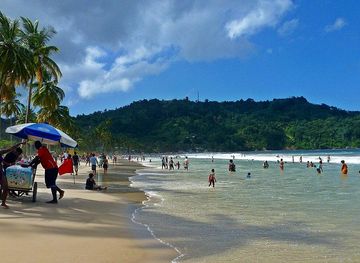
Explore more of Trinidad and Tobago
Discover Trinidad and Tobago: A Caribbean paradise where vibrant culture meets stunning natural beauty, offering unique experiences from lively festivals to serene beaches.
Explore Trinidad and Tobago