Sherlock Holmes Statue, London Travel Guide
Free Guide: Bronze sentinel of Baker Street: where Victorian mystery meets modern London pilgrimage.


A brief summary of Sherlock Holmes Statue
Bronze sentinel of Baker Street: where Victorian mystery meets modern London pilgrimage.
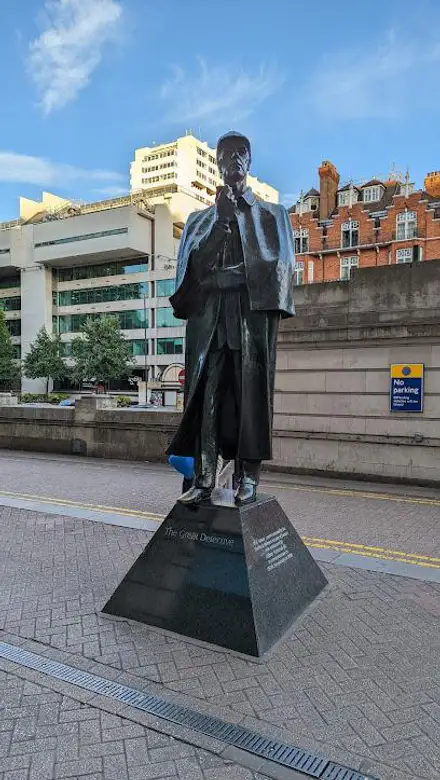
Standing sentinel outside Baker Street Station on Marylebone Road, this bronze statue honours the world's most famous fictional detective. Unveiled in 1999 and sculpted by John Doubleday, the life-size figure captures Holmes in his iconic deerstalker and coat, pipe in hand. Commissioned by Abbey National Building Society—whose headquarters occupied the legendary 221B Baker Street address—the statue has become an essential pilgrimage point for literary enthusiasts and Sherlock devotees from around the globe. A perfect photo opportunity and starting point for exploring London's rich Sherlock Holmes heritage.
On-site amenities
 Restrooms
 Drink options
 Food options
 Information boards
Opening hours
- Mon–SatOpen 24 hours
- Sun6 am–11:30 pm
Opening hours as listed on the venue’s Google Business Profile. Hours can change for services and special events, so check with the venue before you go.
- Address
- 4 Marylebone Rd, London NW1 5LD
Getting there
Underground (Tube)
Walking from Marylebone Station
London Bus
Taxi or Rideshare
Discover more about Sherlock Holmes Statue
A Monument to Literary Genius
The Sherlock Holmes Statue stands as a tangible tribute to one of literature's most enduring creations. Unveiled on 23 September 1999, this life-size bronze sculpture by renowned artist John Doubleday captures the essence of Sir Arthur Conan Doyle's legendary detective in his most iconic form: pipe in hand, deerstalker hat firmly in place, and an expression of keen observation. The statue's creation emerged from a fascinating convergence of literary history and commercial enterprise. When Abbey National Building Society relocated its headquarters to 221B Baker Street in the 1930s—a number that didn't exist during Conan Doyle's lifetime but was created when Upper Baker Street was absorbed into the main thoroughfare—the company began receiving thousands of letters addressed to Sherlock Holmes himself. Fans from across the world sent inquiries, requests for assistance with missing persons and lost items, and even monetary donations. Rather than discard this outpouring of affection, Abbey National eventually channelled unclaimed funds toward commissioning this permanent monument.
The Statue's Artistic Significance
John Doubleday's sculpture represents a masterwork of figurative bronze casting, capturing not merely Holmes's physical appearance but his intellectual character. The detective's posture suggests active contemplation, while his gaze appears to pierce through the mundane world surrounding him. The craftsmanship extends to meticulous details: the texture of his coat, the curve of his pipe, and the distinctive silhouette of the deerstalker hat that has become inseparable from Holmes's image in popular culture. The statue's placement directly outside Baker Street Underground Station ensures that millions of commuters and tourists encounter it annually, making it arguably the most photographed Sherlock Holmes monument in the world. Its prominence in the urban landscape has transformed it from mere sculpture into a cultural landmark that bridges fiction and reality.
A Gateway to Sherlock's London
Located at 4 Marylebone Road, the statue serves as the natural gateway to exploring London's Sherlock Holmes heritage. Just a two-minute walk away stands 221B Baker Street itself, home to the Sherlock Holmes Museum, which occupies the building that originally numbered 239 but was renumbered following legal proceedings. The statue's position at street level, easily accessible and prominently displayed, makes it an ideal starting point for literary pilgrims and casual tourists alike. The surrounding Marylebone neighbourhood retains much of the Victorian character that Conan Doyle described in his stories, allowing visitors to walk the same streets that inspired the author's imagination. The proximity to Baker Street Station, one of London's busiest transport hubs, means the statue receives constant foot traffic from people of all nationalities and backgrounds.
Cultural Impact and Tourism Legacy
Since its installation, the statue has become integral to London's literary tourism landscape. The character of Sherlock Holmes holds the Guinness World Record for being the most portrayed literary human character in film and television, and this enduring popularity translates into sustained visitor interest. The statue has witnessed the evolution of Sherlock Holmes adaptations across multiple media, from classic BBC productions to contemporary interpretations, each wave of popularity bringing new generations of fans to Baker Street. The monument's presence validates the fictional address as a real destination, allowing visitors to experience a tangible connection to stories published over a century ago. Photography at the statue has become a rite of passage for Sherlock enthusiasts, with countless images shared across social media platforms, further amplifying its cultural significance.
The Intersection of Fiction and Reality
What makes the Sherlock Holmes Statue particularly compelling is its role in transforming literary fiction into lived experience. Conan Doyle created Holmes in 1887, setting him at an address that didn't officially exist at the time. Yet through a series of historical coincidences and deliberate cultural curation, 221B Baker Street has become as real to visitors as any actual residence. The statue embodies this paradox: it commemorates a character who never lived, yet its presence makes that character's existence feel undeniably authentic. Visitors standing before the bronze figure often experience a peculiar suspension of disbelief, momentarily accepting that the detective might step down from his pedestal and stride off into the London fog to solve another impossible case. This psychological phenomenon—the ability of art and architecture to collapse the distance between imagination and reality—represents one of the statue's most profound achievements.
Evendo Review Centre
 Google
Guest reviews
Best time to go
Quietest: Jan, Feb & Mar · before 6am or from 11pm
Busy times are Evendo estimates for a typical year, to help you plan. Actual crowds vary with events, school holidays and the weather.
Explore Sherlock Holmes Statue on the map
A handpicked selection of must-see spots near Sherlock Holmes Statue, mapped for you.
Get your free copy of our complete guide to Sherlock Holmes Statue, delivered straight to you.
Everything on this page, from opening hours and how to get there to Eve’s tips and the best time to go, in one PDF you can read offline, print or share.
Already have an account? Sign in
Your Sherlock Holmes Statue guide is ready.
We'll send it to · Not you? Sign out

Getting your guide ready…
We are putting together a fresh copy of the Sherlock Holmes Statue guide. This can take up to a minute.
This can take a few moments. If your browser asks, choose Allow so the download can start. You'll find the guide in your Downloads folder.
Nothing happened? Download it again
Sorry, the guide is taking longer than usual. Please try again in a minute, or get it by email instead.
Unlock the best of Sherlock Holmes Statue
Skip-the-line tickets, guided tours with entry, and walking tours of the area, booked in a few clicks.

Other nearby places you may find interesting
The closest places of the same kind, if this one is not quite what you had in mind.
-

-
-
-
-


Swipe for more places
More to explore near Sherlock Holmes Statue

 Best experiences near Sherlock Holmes Statue
 Best hotels near Sherlock Holmes Statue
 Best landmarks near Sherlock Holmes Statue
 Best attractions near Sherlock Holmes Statue
 Best shops near Sherlock Holmes Statue
 Best restaurants near Sherlock Holmes Statue
 Best bars near Sherlock Holmes Statue
Do you manage this location?
Take control to get all the benefits, like improved information, better appearance, and stronger visibility across AI-powered discovery.
Explore more

Explore more of London
Explore London: A city of iconic landmarks, rich history, vibrant culture, and endless attractions that cater to every taste, making it a must-visit destination.
Explore London
Explore more of United Kingdom
Discover the United Kingdom: A blend of rich history, stunning landscapes, and vibrant cities, offering a unique travel experience for every visitor.
Explore United Kingdom