St. Patrick Travel Guide
Free Guide: Historic Catholic church in Edinburgh’s Old Town, blending neoclassical architecture with deep Irish community roots and serene spiritual ambiance.


A brief summary of St. Patrick
Historic Catholic church in Edinburgh’s Old Town, blending neoclassical architecture with deep Irish community roots and serene spiritual ambiance.
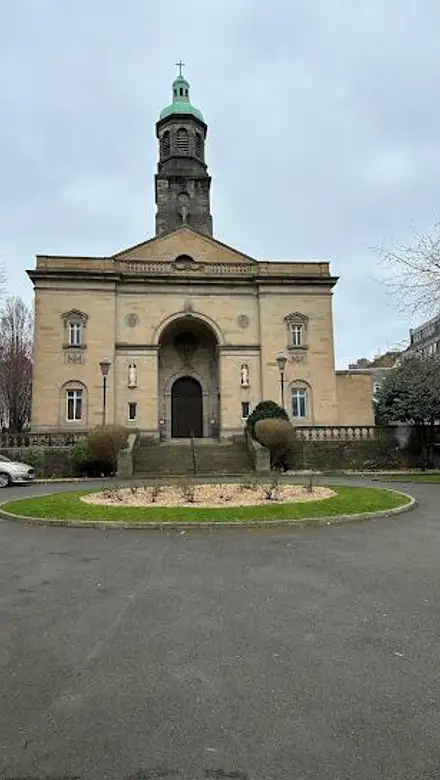
St Patrick's Church, located in Edinburgh's historic Old Town near Cowgate, is a significant Catholic church with roots dating back to 1774. Originally built as an Episcopalian chapel, it became a Catholic church in 1856 to serve the Irish immigrant community. The church features a notable neoclassical facade added in 1929, alongside chapels commemorating parishioners and war heroes. Today, it remains a peaceful spiritual oasis and architectural landmark in the city centre.
On-site amenities
 Restrooms
 Seating areas
 Information boards
Opening hours
- Mon–Sat8 am–7 pm
- Sun8 am–6 pm
Opening hours as listed on the venue’s Google Business Profile. Hours can change for services and special events, so check with the venue before you go.
- Address
- 5, 40 S Gray's Cl, High St, Edinburgh EH1 1TQ
- Phone
- Website
Getting there
Bus
Tram and Walk
Taxi
Discover more about St. Patrick
Origins and Early History of the Building
St Patrick's Church was originally constructed between 1771 and 1774 as a chapel for the Scottish Episcopal Church, designed by architect John Baxter. Known initially as the “English Chapel” due to its Episcopalian roots, it featured an oval apse decorated with a major religious painting by Alexander Runciman, considered the first significant public religious artwork in Scotland since the Reformation. The building was funded by public subscription, a considerable sum at the time, and served various Protestant congregations until 1856.
Transition to a Catholic Church and Irish Community Role
In 1856, Bishop James Gillis purchased the building for £4,000 to establish a Catholic church serving the growing Irish immigrant population in Edinburgh's Cowgate area, known as ‘Little Ireland.’ The local community, despite poverty, contributed half the cost, demonstrating their determination for a dedicated place of worship. St Patrick’s was officially opened as a Catholic church on August 3, 1856, with a congregation of around 2,600 people attending the inaugural Mass.
Architectural Enhancements and Memorials
Throughout the late 19th and early 20th centuries, the church underwent several significant additions. In 1898, a new sanctuary was built extending from the north wall, and a high altar was installed. The 1920s saw the construction of a mortuary chapel honoring 320 parishioners who died in World War I, along with a Lady Chapel and a Sacred Heart Chapel. In 1929, architect Reginald Fairlie designed the impressive neoclassical facade featuring statues of St Patrick and St Brigid, completing the church’s striking frontage and terrace.
Artistic and Spiritual Significance
The church’s interior preserves remnants of Runciman’s original paintings, despite earlier overpainting by Presbyterian owners. Efforts have been made to restore these artworks, highlighting the church’s cultural value. St Patrick’s also honors Margaret Sinclair, a former congregant on the path to sainthood, with a dedicated side chapel. Beyond its architectural and historical importance, the church serves as a tranquil spiritual refuge amid the bustling city centre.
Community and Cultural Heritage
St Patrick’s has long been intertwined with Edinburgh’s Irish Catholic community, providing not only religious services but also social cohesion. The church’s history is linked to the founding of the Hibernian football club in 1875, which fostered community spirit among local youth. Today, St Patrick’s continues to be a vibrant parish with daily opening hours, welcoming worshippers and visitors alike.
Present-Day Role and Visitor Experience
Situated on South Gray’s Close off the High Street, St Patrick’s remains an active Catholic church, open daily from early morning until evening. Its location in the Old Town makes it a notable landmark and an oasis of peace for both locals and tourists. Visitors can admire its neoclassical architecture, contemplative chapels, and rich history while experiencing a serene atmosphere in the heart of Edinburgh.
Evendo Review Centre
 Google
Guest reviews
Best time to go
Quietest: Jan, Feb & Dec · before 6am or at 10pm
Busy times are Evendo estimates for a typical year, to help you plan. Actual crowds vary with events, school holidays and the weather.
Explore St. Patrick on the map
A handpicked selection of must-see spots near St. Patrick, mapped for you.
Get your free copy of our complete guide to St. Patrick, delivered straight to you.
Everything on this page, from opening hours and how to get there to Eve’s tips and the best time to go, in one PDF you can read offline, print or share.
Already have an account? Sign in
Your St. Patrick guide is ready.
We'll send it to · Not you? Sign out

Getting your guide ready…
We are putting together a fresh copy of the St. Patrick guide. This can take up to a minute.
This can take a few moments. If your browser asks, choose Allow so the download can start. You'll find the guide in your Downloads folder.
Nothing happened? Download it again
Sorry, the guide is taking longer than usual. Please try again in a minute, or get it by email instead.
Other nearby places you may find interesting
The closest places of the same kind, if this one is not quite what you had in mind.
-
-
-
-
-


Swipe for more places
More to explore near St. Patrick

 Best experiences near St. Patrick
 Best hotels near St. Patrick
 Best landmarks near St. Patrick
 Best attractions near St. Patrick
 Best shops near St. Patrick
 Best restaurants near St. Patrick
 Best bars near St. Patrick
Do you manage this location?
Take control to get all the benefits, like improved information, better appearance, and stronger visibility across AI-powered discovery.
Explore more

Explore more of Peeblesshire
Discover the serene beauty of Peeblesshire in the Scottish Borders, where history, nature, and local charm come together for an unforgettable experience.
Explore Peeblesshire
Explore more of United Kingdom
Discover the United Kingdom: A blend of rich history, stunning landscapes, and vibrant cities, offering a unique travel experience for every visitor.
Explore United Kingdom