

Castle Mill Basin, West Midlands Travel Guide
Underground limestone basin where industrial heritage meets subterranean exploration through historic canal tunnels.
Castle Mill Basin is a historic underground canal basin at the heart of Dudley's limestone mining heritage. Originally constructed in the 1780s as a junction between Lord Ward's private canal and the main Dudley Canal, this atmospheric location served as the central hub for transporting limestone extracted from the surrounding mines. Today, visitors can explore the basin and access boat trips through the remarkable network of underground tunnels and caverns that honeycomb through the surrounding hills, experiencing firsthand the industrial archaeology of the Black Country.
A brief summary to Castle Mill Basin
- 84 Forest Rd, Dudley, DY1 4BX, GB
- Click to display
- Duration: 1.5 to 3 hours
- Mid ranged
-
 Mixed
Mixed
- Mobile reception: 4 out of 5

Know before you go
Hi, I'm Eve. Here are a few practical things to know before exploring Castle Mill Basin.
- Book boat trips in advance during peak season (summer months and school holidays), as spaces fill quickly. The boat journey takes approximately 1.5 to 2 hours and involves navigating through multiple caverns and tunnels.
- Wear warm clothing even in summer, as underground temperatures remain cool year-round (typically 10-12°C). The atmosphere can be damp, so avoid loose items that might get wet.
- Arrive early to explore the basin area and visitor facilities before your boat departure. The surrounding landscape includes exposed geological features and information boards explaining the mining history.
- Combine your visit with the nearby Black Country Living Museum, which features historic lime kilns and industrial heritage buildings, located within walking distance of the basin.
- Photography inside the tunnels is challenging due to low light and movement of boats. Consider bringing a camera with good low-light performance or simply enjoy the experience without recording.
Do you manage this location?
Take control to get all the benefits, like improved information, better appearance, and stronger visibility across AI-powered discovery. Learn more about listing your business on Evendo
Activate your presenceOther nearby places you may find interesting
The closest places of the same kind, if this one is not quite what you had in mind.

Explore Castle Mill Basin on the Map
A handpicked selection of must-see spots near Castle Mill Basin, mapped for you.
Getting There
-
Bus from Dudley Town Centre
Local buses serve the Forest Road area near Castle Mill Basin. Journey time from Dudley town centre is approximately 10-15 minutes depending on traffic and service route. Buses run regularly throughout the day with reduced frequency on Sundays. Fares are typically 1.50 to 2.50 GBP for a single journey. Check local transport operator schedules for current routes serving the DY1 4BX postcode area.
-
Car with Parking
Castle Mill Basin is accessible by car via Forest Road in Dudley. Limited on-street parking is available near the basin entrance, though spaces are often occupied during peak visiting hours. Nearby car parks in Dudley town centre are within 0.5 kilometers and typically charge 1.00 to 3.00 GBP for several hours. Journey time from Dudley town centre is approximately 5-10 minutes by car.
-
Walking from Dudley Town Centre
Castle Mill Basin is approximately 1.2 kilometers from Dudley town centre. The walk takes 15-20 minutes via Forest Road and involves some gentle inclines through residential areas. The route is well-established and suitable for most fitness levels, though the final approach includes some steps and uneven ground near the basin entrance.
-
Train to Dudley Station
Dudley railway station is approximately 1.5 kilometers from Castle Mill Basin. From the station, local buses or a 20-25 minute walk via Forest Road provides access to the basin. Train services connect Dudley to Birmingham and surrounding areas with regular departures throughout the day. Single fares vary by origin but typically range from 2.00 to 8.00 GBP.
For the on-the-go comforts that matter to you
-
 Restrooms
-
 Drink Options
-
 Food Options
-
 Seating Areas
-
 Information Boards
-
 Visitor Center
Discover more about Castle Mill Basin
The Industrial Heart of Dudley's Limestone Trade
Castle Mill Basin stands as a pivotal junction in the Dudley Canal system, originally constructed around 1785 as the meeting point between Lord Ward's private canal tunnel (completed in 1778) and the main Dudley Canal line. The basin was engineered to connect limestone extraction operations across multiple underground mine systems, serving as the central distribution point for one of the region's most significant industrial enterprises. By the 19th century, the basin had become so productive that in 1853 alone, more than 41,000 boats transported limestone from these mines to the kilns, making it a vital artery of the Black Country's industrial economy.Geological Foundations and Mining Heritage
The limestone beneath Castle Mill Basin was laid down during the Silurian period, approximately 443 to 419 million years ago, forming two parallel seams running through Dudley, Wren's Nest, and Mons Hill at roughly 45-degree angles. Mining in the Dudley area dates back to the 11th century, when stone was quarried for Dudley Castle, and continued through the 12th century for St James' Priory. By the 17th century, formal lime works were established, and the underground mine network expanded dramatically. The basin connects to multiple tunnel systems: the Cathedral Arch tunnel leading to Parkhead, the Murder Mine branch, and crucially, the 718-meter tunnel driven westward around 1805 to access the Wren's Nest mine workings with their vast underground basins.Transformation from Industrial Hub to Cultural Venue
As limestone extraction declined in the late 19th century, the basin's role evolved. Lord Dudley installed gas lighting and a bandstand in the nearby Dark Cavern (also known as Cavern 144), transforming it into a venue for concerts, balls, and scientific lectures. In 1849, the renowned geologist Sir Roderick Murchison delivered a lecture on fossil evidence to an estimated 15,000 people within these underground chambers, cementing the site's significance as both an industrial monument and a space for intellectual discourse. The collection of fossils and geological specimens from these mines became part of the Dudley Council Museum Service's holdings.Restoration and Modern Access
The basin's modern history began on 1 January 1964, when canal enthusiasts formed the Dudley Canal Tunnel Preservation Society. A major turning point came in 1970 with a "big dig" organized in collaboration with the Waterway Recovery Group, when 300 volunteers arrived at Park Head to undertake restoration work. In 1972, Dudley Corporation became the first local authority in Britain to finance canal restoration, funding half the repair costs for the tunnel branch. The tunnel was successfully reopened in 1973, and by 1987, increasing visitor demand necessitated the creation of a round-trip boat route through the caverns. New tunnels were excavated to connect the Singing Cavern and Little Tess cavern, with a new tunnel built from Castle Mill Basin to Little Tess to accommodate the growing number of visitors.The Underground Landscape Today
Castle Mill Basin now serves as the primary departure point for boat trips through the underground tunnel network. The basin itself, along with the adjacent Shirts Mill Basin, had its roof removed in the 19th century to allow daylight access and to showcase the scale of the historic mining operations. Visitors descend into a landscape shaped by centuries of limestone extraction, navigating narrow boats through passages that once echoed with the sounds of commercial traffic. The surrounding hills contain multiple interconnected caverns and tunnels, each with its own history and character, from the vast underground basins of the East and West Mines to the atmospheric passages beneath Castle Hill.












Your all‑in‑one travel companion app
Explore expert travel guides, compare and book tours, experiences, hotels, and more—all from the palm of your hand. Download now for seamless trip planning wherever your wanderlust takes you.


Explore More of West Midlands
Looking beyond Castle Mill Basin? Discover West Midlands for broader travel guides, local hot-spots, and regional highlights.
Explore West Midlands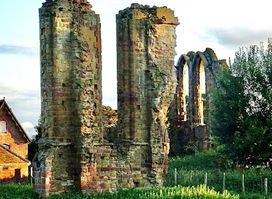
A quiet, evocative ruin of a 13th-century Premonstratensian abbey, visible from a footpath in the West Midlands countryside.

Discover Dudley’s underground limestone caverns and canals on a captivating boat tour through 428 million years of history.
