
Japanese Tea Garden: A Tranquil Oasis in Golden Gate Park
Discover tranquility and harmony in the heart of Golden Gate Park at the oldest public Japanese garden in the U.S.
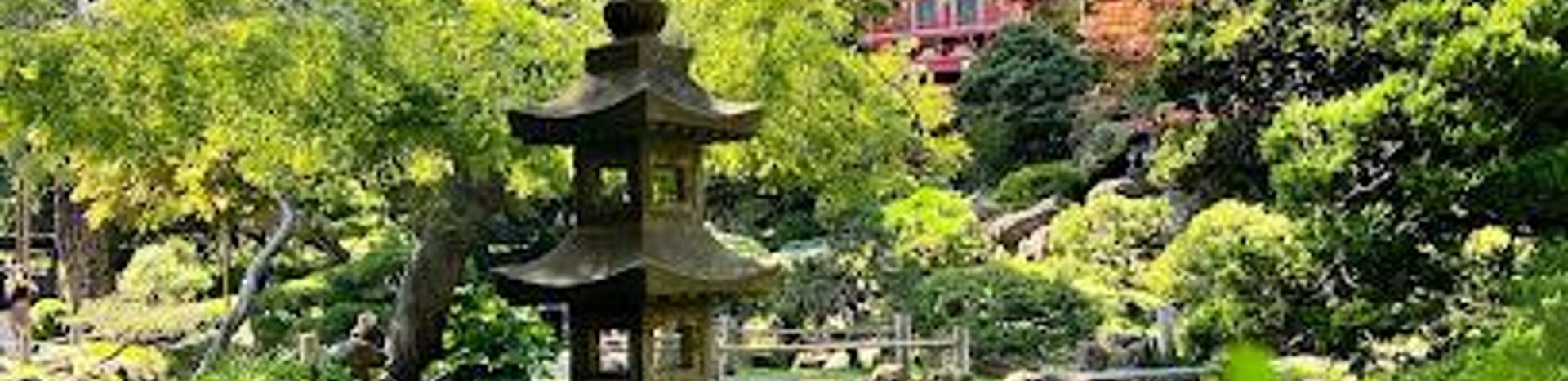
The Japanese Tea Garden in San Francisco's Golden Gate Park offers visitors a unique opportunity to experience Japanese culture and serene natural beauty. Originally created as a Japanese Village exhibit for the 1894 California Midwinter International Exposition, the garden has evolved into a beloved San Francisco landmark. Designed to promote peace, relaxation, and flow, the garden incorporates elements of Buddhism, Shintoism, and Taoism. Traditional Japanese garden features include meticulously pruned plants and trees, serene koi ponds, stone lanterns, and winding paths. The garden also showcases architectural structures like the iconic Drum Bridge, a five-story pagoda, and a traditional tea house. Visitors can explore various distinct areas within the garden, such as the Zen garden, which embodies the essence of mindfulness, and the strolling garden, inviting visitors to wander through vibrant flowers and trees. The Tea House offers a place to relax and enjoy authentic Japanese refreshments in a beautiful setting. The garden also features significant historical artifacts, including a bronze Buddha statue from 1790 and the Lantern of Peace, symbolizing friendship between the U.S. and Japan. Throughout its history, the garden has undergone many changes. During World War II, the Hagiwara family, who maintained the garden for decades, were interned, and the garden was renamed the "Oriental Tea Garden". In later years, the city restored the garden's original name and honored the Hagiwara family for their contributions. Today, the Japanese Tea Garden continues to enchant visitors with its tranquil atmosphere and timeless beauty.
Local tips
- Visit during the spring (mid-March to April) to witness the cherry blossoms, azaleas, and magnolias in full bloom.
- Take advantage of the free admission hour from 9 a.m. to 10 a.m. on Mondays, Wednesdays, and Fridays.
- Explore the garden at a slower pace to fully appreciate the meticulously designed plant sculptures and rock arrangements.
- Consider a free walking tour offered by San Francisco City Guides to learn more about the garden's history and features.
- Enjoy traditional Japanese refreshments at the Tea House for a complete cultural experience.

A brief summary to Japanese Tea Garden
- 75 Hagiwara Tea Garden Dr, San Francisco, Golden Gate Park, California, 94118, US
- +1415-661-1316
- Visit website
- Monday 9 am-5:30 pm
- Tuesday 9 am-5:30 pm
- Wednesday 9 am-5:30 pm
- Thursday 9 am-5:30 pm
- Friday 9 am-5:30 pm
- Saturday 9 am-5:30 pm
- Sunday 9 am-5:30 pm
Getting There
-
Public Transport
Several Muni bus and light rail lines provide access to Golden Gate Park and the Japanese Tea Garden. The 44 O'Shaughnessy bus stops directly at the Tea Garden. Alternatively, take the N Judah streetcar to 9th Avenue and walk into the park, turning right onto Hagiwara Tea Garden Drive. The 5 Fulton bus stops at 8th Avenue and Fulton Street; from there, walk into the park, turn right onto JFK Drive, and continue past the de Young Museum. A single Muni fare is $2.50.
-
Walking
From the de Young Museum or the California Academy of Sciences, the Japanese Tea Garden is a short walk. Follow signs within Golden Gate Park. The garden is located near the corner of Hagiwara Tea Garden Drive and Martin Luther King Drive.
-
Free Shuttle
The free Golden Gate Park Shuttle provides access to the Japanese Tea Garden, with a stop at the Music Concourse, a short walk from the entrance. The shuttle operates seven days a week, with varying hours depending on the day. Check the schedule for the most up-to-date information.
-
Driving
Enter Golden Gate Park via 9th Avenue or 8th Avenue onto JFK Drive. Limited street parking is available on Golden Gate Park streets, including MLK Drive and Stow Lake Drive. Paid parking is available at the Music Concourse Garage underneath the de Young Museum. The garage entrances are located off Fulton Street at 10th Avenue and at the west end of the California Academy of Sciences on Concourse Drive. Parking rates are approximately $2.25/hour on weekdays and $3.25/hour on weekends.


