

Saint Olai Church, Copenhagen Region Travel Guide
Red-brick Gothic cathedral with a luminous white interior, rich Renaissance furnishings and a living “baby tree” tradition in the historic heart of Helsingør.
Saint Olai Church, also known as Helsingør Cathedral, is a striking red-brick Gothic church in the heart of Helsingør’s old town. With origins around 1200 and its present form completed in 1559, it combines a serene whitewashed interior, soaring arches and a richly carved Renaissance altarpiece and pulpit. Free to enter, it remains an active Lutheran cathedral, home to atmospheric organ music, maritime votive ships, and a moving “baby tree” celebrating newborns from the local community.
A brief summary to Saint Olai Church
- Sct Anna Gade 12, Helsingør, 3000, DK
- Click to display
- Click to display
- Duration: 0.5 to 1.5 hours
- Free
-
 Indoor
- Mobile reception: 4 out of 5
- Tuesday 10 am-2 pm
- Wednesday 10 am-2 pm
- Thursday 10 am-2 pm
- Friday 10 am-2 pm
- Saturday 10 am-2 pm
- Sunday 9:30 am-12 pm

Know before you go
Hi, I'm Eve. Here are a few practical things to know before exploring Saint Olai Church.
- Time your visit for a weekday late morning when the cathedral is usually open and quieter, giving you space to admire the altarpiece, chapels and ceiling details.
- Look up to spot the hanging model ship and take a close look at the carved pulpit and altarpiece, which reveal fine Renaissance craftsmanship and maritime symbolism.
- Seek out the baby tree inside the church, with red leaves bearing the names of newborns from the parish, for a touching glimpse of local community life.
- Dress modestly, keep voices low, and avoid flash photography, especially if a service, organ rehearsal or private ceremony is taking place.
- Combine your visit with a stroll through Helsingør’s old town and Kronborg Castle nearby, as everything is within comfortable walking distance.
Do you manage this location?
Take control to get all the benefits, like improved information, better appearance, and stronger visibility across AI-powered discovery. Learn more about listing your business on Evendo
Activate your presenceOther nearby places you may find interesting
The closest places of the same kind, if this one is not quite what you had in mind.

Explore Saint Olai Church on the Map
A handpicked selection of must-see spots near Saint Olai Church, mapped for you.
Unlock the Best of Saint Olai Church
Buy tickets
-
No tickets available
Book tours with entry


Getting There
-
Train from central Copenhagen
From Copenhagen’s main rail hub, frequent regional trains run to Helsingør in about 45–50 minutes. Trains usually depart several times per hour during the day. A standard adult single ticket typically costs around 80–100 DKK, depending on exact zones and time of travel. Helsingør Station is roughly a 10–15 minute walk on mostly level, paved streets through the historic centre to the cathedral; the route is suitable for most visitors, though cobblestones can be uneven for wheelchairs or strollers.
-
Local bus within Helsingør area
If you are staying elsewhere in North Zealand, local buses operated under the regional public transport system connect surrounding towns with Helsingør in roughly 20–40 minutes, depending on distance. A single adult fare is generally in the range of 24–40 DKK. Buses typically stop near the station or central streets in the old town, from where you continue on foot along pedestrian-friendly lanes. Services run throughout the day but may be less frequent in evenings and on Sundays, so check departure times in advance.
-
Car or rental car
Driving from northern Copenhagen or nearby coastal towns to Helsingør usually takes 35–50 minutes via main roads, depending on traffic. There is no dedicated parking at the cathedral itself, but public car parks and street parking are available around the harbour and old town, generally within 5–15 minutes’ walk. Expect to pay around 10–25 DKK per hour in central zones, with some time limits during the day. Narrow, cobbled streets and one‑way sections can make the immediate vicinity less convenient for larger vehicles.
-
Ferry from Helsingborg (Sweden) plus walking
If you are arriving from Helsingborg, the passenger and car ferries cross the Øresund in about 20 minutes and operate frequently throughout the day. A walk‑on passenger ticket typically costs around 50–80 DKK one way, with separate fares for vehicles. Once you disembark in Helsingør, it is about 10–15 minutes on foot through the harbourfront and historic streets to reach the cathedral. The walk is mostly level but includes cobblestones, which can be less comfortable for small wheels in wet or icy weather.
For the on-the-go comforts that matter to you
-
 Restrooms
-
 Seating Areas
-
 Information Boards
-
 Trash Bins
Discover more about Saint Olai Church
A medieval church at the heart of Helsingør
Saint Olai Church rises above Helsingør’s cobbled streets, its red-brick tower a familiar landmark just a short stroll from the harbour and Kronborg Castle. Founded as a Romanesque parish church around 1200, it grew alongside the town, which prospered on Sound Dues from ships passing through the Øresund. By the mid‑16th century the old village church had been transformed into the tall Gothic cathedral you see today, its present structure completed in 1559.The dedication to Saint Olaf of Norway hints at the town’s seafaring links and medieval devotion. In 1961 the church was formally made cathedral for the newly created Diocese of Helsingør, confirming a role it had long played as the city’s principal place of worship. Despite the change in status, it has retained the feel of a local church, closely tied to the daily life of residents.Brick Gothic outside, white light within
From the outside, Saint Olai is a textbook example of North European Brick Gothic, with stepped gables, buttresses and a sturdy western tower. The warm reddish tones of the masonry contrast beautifully with the often slate-grey sky and the colourful houses of the old town. A later spire crowns the tower, recalling the days when church towers were vital navigation marks for sailors approaching Helsingør.Step through the porch and the atmosphere shifts dramatically. The interior is almost entirely whitewashed, with tall, rib-vaulted ceilings and slender pillars creating a sense of height and lightness. The plain walls draw attention to the intricate woodcarving of the furnishings, the play of daylight through tall windows, and the rhythm of the Gothic arches leading your eye towards the altar.Renaissance craftsmanship and noble chapels
The cathedral’s showpiece is its richly carved Renaissance altarpiece, created by skilled craftsmen at a time when Helsingør was one of Denmark’s wealthiest towns. Painted biblical scenes, gilded details and sculpted figures crowd the panels, offering a vivid glimpse of 16th‑ and 17th‑century devotional art. Nearby, the ornate pulpit, also from the Renaissance period, displays delicate woodwork and classical motifs carved by a master cabinet‑maker associated with the royal workshops at Kronborg.Along the sides of the church you will notice chapels and memorials linked to prominent local families and officials, including the Oxe family’s Trinity Chapel. Stone epitaphs, coats of arms and carved tomb monuments tell stories of customs officers, merchants and mayors whose fortunes were built on the busy shipping lane outside. Together they turn the cathedral into a kind of three‑dimensional archive of Helsingør’s rise as a trading town.Maritime memories and living traditions
Hanging from the ceiling is a model ship, a classic feature of Danish coastal churches and a reminder of the town’s bond with the sea. Votive ships like this were offered in thanks for safe voyages and protection from storms; here it adds a quietly maritime note to the sacred space. Organ pipes tower above the nave, and at service times the sound of music fills the high vaults with a rich resonance.One of the most distinctive modern touches is the so‑called baby tree, adorned with red leaves bearing the names of babies born in the parish that year. It is a gentle symbol of continuity, linking centuries of baptisms and family stories. Even when no service is underway, candles, soft footsteps on old tiles and the rustle of hymn books give the sense of a building still very much in use.Visiting the cathedral today
Visitors are welcome to enter free of charge during opening hours, with the main doors usually open on weekdays and weekends in the late morning and early afternoon. Simple information displays and printed leaflets help you interpret the furnishings and artwork, while seating in the nave invites you to pause, listen and look. Photography is generally allowed if you are respectful and avoid disrupting quiet moments.Because the cathedral sits within the compact historic centre, it is easy to combine a visit with nearby streets, museums and the castle. Saint Olai offers both a calm break from sightseeing and a window into Helsingør’s long history, from medieval trade and the Reformation to today’s community life. Plan around 30 to 60 minutes to explore, or longer if you wish to sit through an organ rehearsal or service.












Your all‑in‑one travel companion app
Explore expert travel guides, compare and book tours, experiences, hotels, and more—all from the palm of your hand. Download now for seamless trip planning wherever your wanderlust takes you.


Explore More of Copenhagen Region
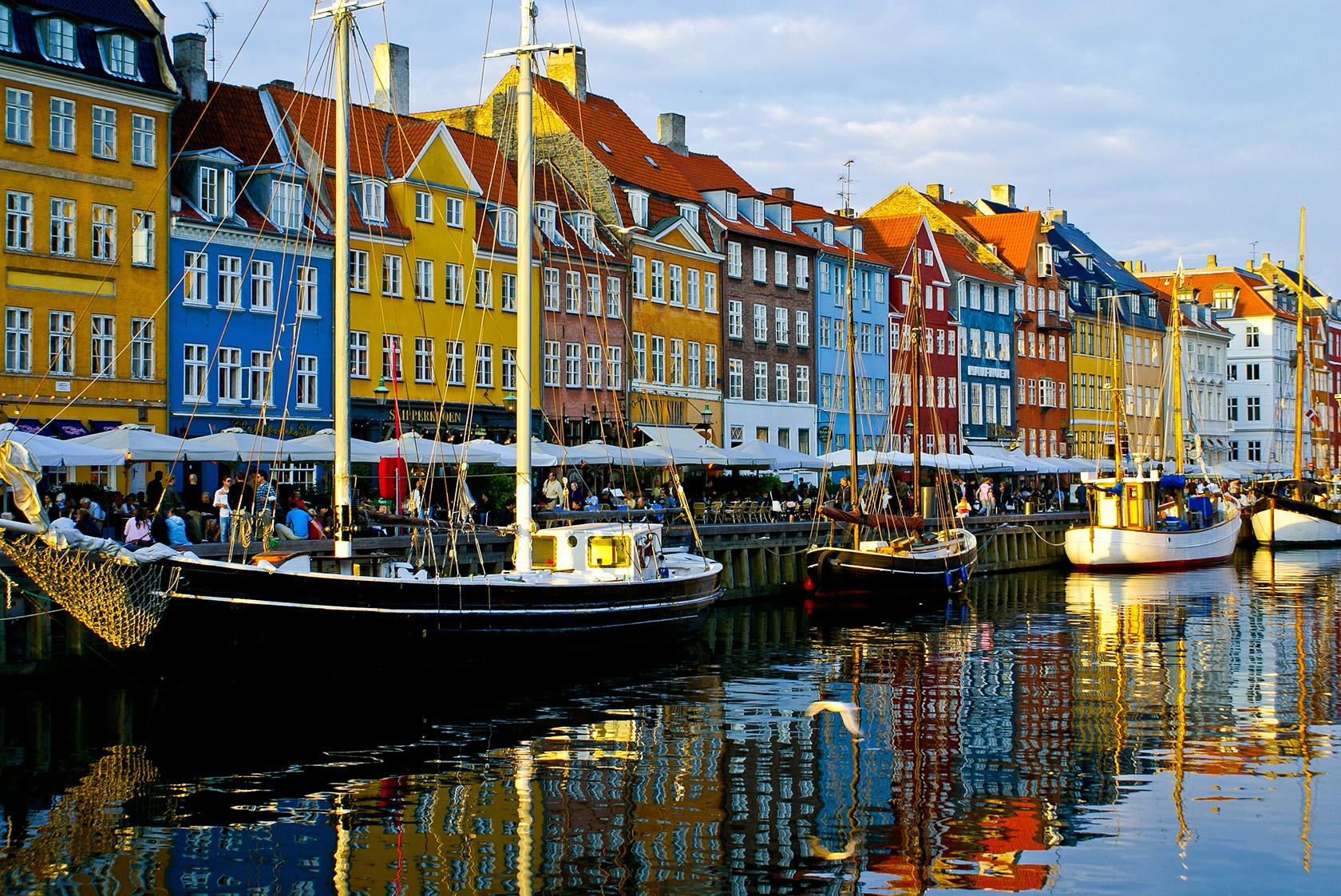
Looking beyond Saint Olai Church? Discover Copenhagen Region for broader travel guides, local hot-spots, and regional highlights.
Explore Copenhagen Region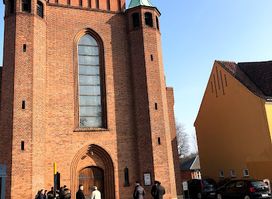
North Zealand’s only Roman Catholic church, a white-towered 1930 sanctuary in Helsingør offering quiet reflection, modest Romanesque-inspired architecture and living parish life.
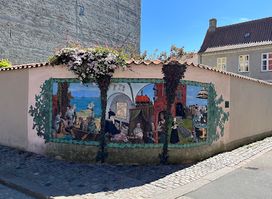
A storytelling gable in Helsingør’s old town, this mural compresses centuries of church history into a single vivid scene between two medieval sanctuaries.
