'The maritime history' mural, Helsingor Travel Guide
Free Guide: A harbour gable transformed into a sweeping, collage-like tribute to 300 years of Danish seafaring, anchoring Helsingør’s shipyard era in vivid colour and form.


A brief summary of 'The maritime history' mural
A harbour gable transformed into a sweeping, collage-like tribute to 300 years of Danish seafaring, anchoring Helsingør’s shipyard era in vivid colour and form.
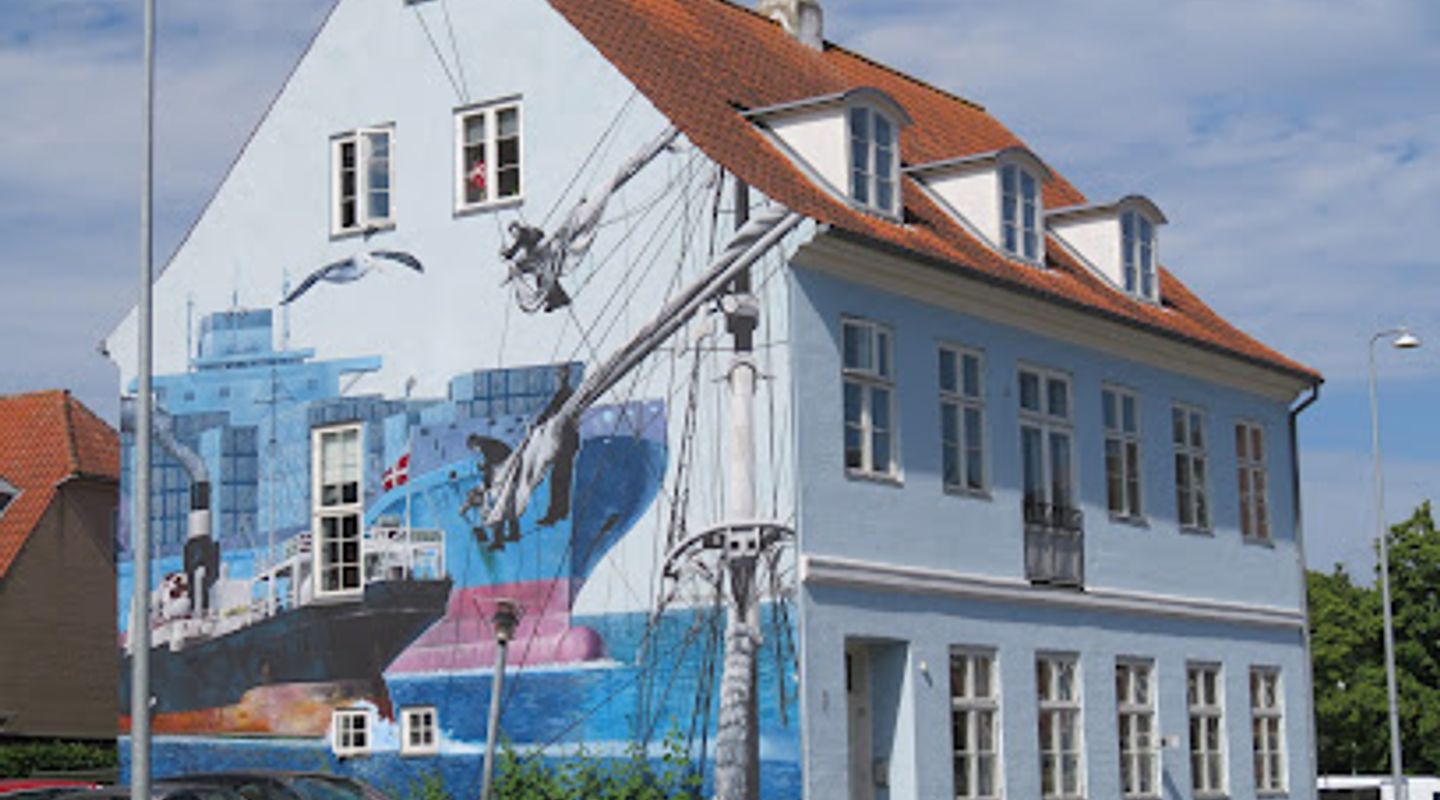
On the gable of Allegade 7 in Helsingør’s old harbour district, ‘The Maritime History’ mural unfolds as a collage-like tribute to 300 years of Danish shipping. Painted directly on the wall by Spanish artist Oriol Caminal Martinez and Italian artist Piercarlo Carella, it weaves together wooden sailing ships, steamers and modern vessels in one sweeping narrative. Created in collaboration with the Maritime Museum and local cultural institutions, this outdoor artwork anchors the city’s broader story of shipbuilding, trade and life at sea in a single, richly detailed façade.
On-site amenities
 Restrooms
 Drink options
 Drinking water
 Food options
 Seating areas
 Trash bins
 Information boards
- Address
- Allegade 7, 3000 Helsingør
- Website
Getting there
Train and walk
Bus within Helsingør
Car or taxi
Discover more about 'The maritime history' mural
A harbour wall turned seafaring storybook
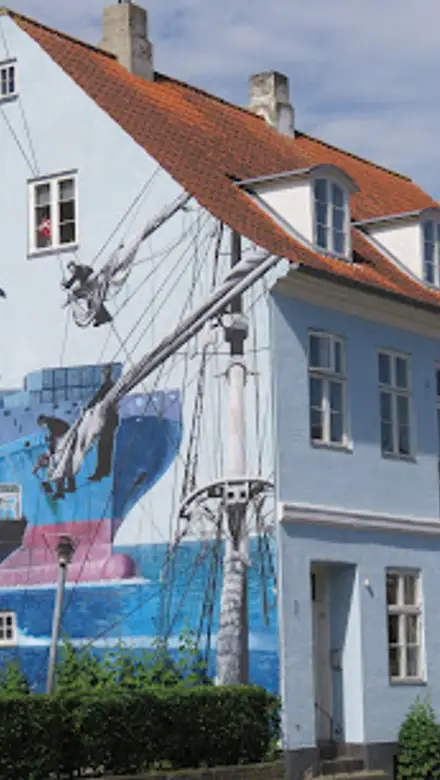
The gable of Allegade 7 looks out toward Helsingør’s historic shipyard, and on it a vast mural transforms bare brick into a living chronicle of maritime life. ‘The Maritime History’ mural functions like an illustrated timeline, condensing centuries of seafaring into one sweeping collage. From the cobbles below, the first impression is of movement: masts, funnels and hulls overlap in a dense choreography, as if ship after ship were gliding past the quay.Step a little closer and individual episodes begin to separate from the flow. A wooden sailing vessel leans into the wind, its canvas straining as if it has just rounded Kronborg Castle. Nearby, a stockier steamship cuts through stylised waves, smoke curling into a pale northern sky. Modern cargo vessels, with their geometric profiles, complete the ensemble, hinting at the global shipping lanes that still connect the Øresund to distant oceans.
Three ages of Danish shipping on one façade
At the heart of the mural is a visual conversation between three eras of Danish shipping. Wooden boats under sail evoke a time when tolls at Helsingør controlled access to the Baltic and every passing ship was part of the town’s livelihood. The arrival of steam power appears in compact, dark-hulled steamers, signalling industrial progress and the shipyard boom that reshaped the harbourfront. Sleek contemporary vessels, painted with cleaner lines and bolder colour blocks, stand for today’s container age.Rather than separating these periods, the artists weave them together in layers, letting rigging, cranes and hulls intersect. The effect is almost cinematic: the eye jumps from detail to detail as if scanning archival footage. Subtle references to navigation – a compass, a glimpse of charts, fragments of harbour machinery – reinforce the sense that this is more than decoration; it is a compressed archive of working life by the water.
International artists and local collaboration
The mural is the work of Spanish artist Oriol Caminal Martinez and Italian artist Piercarlo Carella, both invited to Helsingør to create a site-specific piece. They sketched on location, allowing the proportions of the gable, the changing northern light and the view toward the former shipyard gate to shape their composition. Painting directly onto the plastered wall, they built up the surface with broad, gestural fields of colour, then tightened certain areas with crisp lines and fine detail.Behind the scenes, the project was developed in collaboration with the Maritime Museum and the local Art and Public Space initiative. Curators and museum staff helped compile historical material, images and stories from the shipyard era so that the mural would resonate with the city’s own archives. Former shipyard workers contributed memories and visual references, ensuring that the cranes, silhouettes and workaday details feel grounded in lived experience rather than generic industrial imagery.
A gateway to the shipyard era district
‘The Maritime History’ mural is paired visually and thematically with a neighbouring mural on Kongensgade 23, where American artist Garin Baker has created a hyper-realistic scene from the old Elsinore Shipyard. Together they frame the entrance to the former shipyard area, now a cultural district anchored by the Maritime Museum and the Culture Yard. Standing in front of Allegade 7, you are effectively on the threshold between the historic town and the reimagined harbour.From this spot, the mural becomes a kind of open-air prologue to what lies beyond: galleries, museums and waterfront promenades that continue the narrative of work, trade and technology. Yet the gable painting remains resolutely public and everyday. It belongs as much to passersby running errands in the old streets as to anyone seeking out art, stitching maritime heritage into the routine fabric of the city.
Colour, texture and the feel of the port
Visually, the mural balances weathered tones with sharper accents. Blues and greys echo sea and steel, while rust reds and ochres suggest hull paint, brick warehouses and sunlit rigging. In some places the brushwork is loose and almost impressionistic, hinting at spray, smoke or low cloud over the Sound. In others, the lines tighten to bring out a winch, a deckhouse window or the edge of a quay.Seen up close, the texture of the wall is part of the experience. Hairline cracks and the grain of the plaster interact with the paint, reminding you that this narrative is literally embedded in the old building stock of Helsingør. On bright days, shadows cast by neighbouring roofs and street fixtures move across the scene, adding another shifting layer, as if time continues to wash over the ships just as the tide washes along the harbour edge.
A quiet pause in a working townscape
Despite its scale, the mural sits quietly within the narrow street. There is no formal viewing platform, only the natural pause of a small urban square and the rhythm of people passing through. It invites a short stop – a moment to look up, trace the curve of a hull, imagine the sound of hammers in the yard or the creak of a loaded vessel turning toward open water.For many visitors, this becomes an informal starting point for exploring Helsingør’s broader network of historical murals, each dealing with a different chapter of the town’s past. For others, it is simply a striking image encountered on the way to the harbour. Either way, ‘The Maritime History’ mural succeeds in what street art does best: quietly folding memory and meaning into an ordinary corner of the city.
Evendo Review Centre
 Google
Guest reviews
Best time to go
Quietest: Jan, Feb & Mar · before 6am or from 11pm
Busy times are Evendo estimates for a typical year, to help you plan. Actual crowds vary with events, school holidays and the weather.
Explore 'The maritime history' mural on the map
A handpicked selection of must-see spots near 'The maritime history' mural, mapped for you.
Get your free copy of our complete guide to 'The maritime history' mural, delivered straight to you.
Everything on this page, from opening hours and how to get there to Eve’s tips and the best time to go, in one PDF you can read offline, print or share.
Already have an account? Sign in
Your 'The maritime history' mural guide is ready.
We'll send it to · Not you? Sign out

Getting your guide ready…
We are putting together a fresh copy of the 'The maritime history' mural guide. This can take up to a minute.
This can take a few moments. If your browser asks, choose Allow so the download can start. You'll find the guide in your Downloads folder.
Nothing happened? Download it again
Sorry, the guide is taking longer than usual. Please try again in a minute, or get it by email instead.
Other nearby places you may find interesting
The closest places of the same kind, if this one is not quite what you had in mind.
-
-
-
-
-


Swipe for more places
More to explore near 'The maritime history' mural
-
 Best experiences near 'The maritime history' mural
-
 Best hotels near 'The maritime history' mural
-
 Best landmarks near 'The maritime history' mural
-
 Best attractions near 'The maritime history' mural
-
 Best shops near 'The maritime history' mural
-
 Best restaurants near 'The maritime history' mural
-
 Best bars near 'The maritime history' mural


Do you manage this location?
Take control to get all the benefits, like improved information, better appearance, and stronger visibility across AI-powered discovery.
Explore more

Explore more of Helsingor
Discover Helsingør, Denmark's historic coastal city, home to Kronborg Castle and a vibrant cultural scene, offering a blend of history, scenic beauty, and local charm.
Explore Helsingor
Explore more of Denmark
Discover Denmark: A perfect blend of history, modern design, and the cozy concept of hygge. Explore vibrant cities, serene landscapes, and world-class cuisine.
Explore Denmark