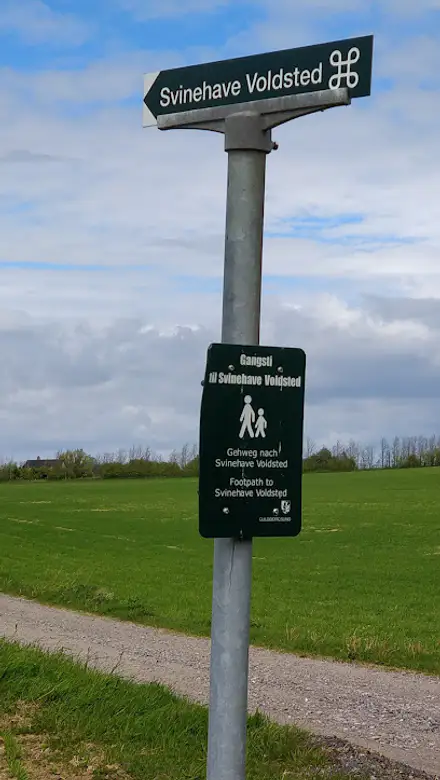
Svinehave Voldsted Travel Guide
Free Guide: Modest earthworks in the fields near Gedser tell the quiet story of a medieval royal manor, long vanished yet still etched into the Falster landscape.


A brief summary of Svinehave Voldsted
Modest earthworks in the fields near Gedser tell the quiet story of a medieval royal manor, long vanished yet still etched into the Falster landscape.
Svinehave Voldsted is a quiet archaeological site near Gedser on Falster, where a medieval royal farm and fortified manor once stood. Today only grassy earthworks and a surrounding moat remain, forming a low, tree-fringed mound in the landscape. It is a modest but atmospheric stop for history-minded travelers exploring Denmark’s southernmost town and the windy shores around Gedser Odde.
Opening hours
- Every dayOpen 24 hours
Opening hours as listed on the venue’s Google Business Profile. Hours can change for services and special events, so check with the venue before you go.
- Address
- 4874 Gedser
- Website
Getting there
Car from Nykøbing Falster
Bus and short walk from Nykøbing Falster
Cycling on Falster
Discover more about Svinehave Voldsted
A forgotten royal stronghold on Falster
Svinehave Voldsted looks unassuming at first glance: a rounded rise in the fields, ringed by a shallow moat and scattered trees. Yet this modest hillfort is all that remains of Gjedzør Kongsgård, once a royal and noble stopping place for journeys across the Baltic. In the Middle Ages, when kings, envoys and merchants sailed towards the Hanseatic ports or to relatives in Mecklenburg, they paused in this area to rest, regroup and wait for favorable winds.Over the centuries, the timber buildings disappeared and the political map of the Baltic shifted, but the earthworks survived. Today the defensive banks, ditches and moat contours are still readable in the terrain, offering a tactile sense of how a fortified manor was laid out in low-lying Danish countryside.
Landscape of wind, fields and distant sea
The setting of Svinehave Voldsted is typically Falster: open agricultural land, scattered shelterbelts and the faint sound of the Baltic carried on the wind. You are only a short distance from Gedser and the southernmost point of Denmark, yet the hillfort feels quietly detached from modern infrastructure and ferry traffic.In spring and summer, grasses and wildflowers soften the banks, while small birds flit through the bushes that now crown the mound. On clear days, the sky feels broad and high, with passing clouds casting moving shadows over the rounded shapes of the old ramparts. It is an easy place to pause on a wider circuit of Gedser’s lighthouse, naval station and beaches.
Reading the earthworks beneath your feet
There is little in the way of built interpretation here, so the experience revolves around learning to read the ground itself. As you walk the perimeter, the change in elevation marks where defensive banks once stood, while the shallow depression of the moat forms a ring around the core of the site.It takes only a bit of imagination to picture timber palisades, storage buildings and a hall within the enclosure, connected to the wider world by muddy tracks and coastal landings. The simplicity of the remains invites a slower, more mindful visit: tracing edges with your eyes, feeling the gradient underfoot and sensing how the site once controlled its immediate surroundings.
Quiet moments and unhurried exploration
Svinehave Voldsted is not a place of grand spectacle but of small details and quiet atmosphere. Visits are generally short; many travelers pair it with nearby sights in Gedser town or stops at the southernmost cliffs and lighthouse. It works well as a leg-stretcher on a road trip across Lolland-Falster, or as a contemplative diversion on a cycling route between beaches and villages.Because there are no formal facilities, the experience is pleasantly low-key. You step straight from everyday life into a small pocket of medieval history, then back again, carrying with you a sense of how much of the past in Denmark lies just beneath the surface of fields and hedgerows.
Connecting Gedser’s wider story
Seen alongside Gedser’s water tower, naval station and lighthouse, Svinehave Voldsted adds a much older chapter to the area’s story. Where later centuries focused on ferry routes, shipping lanes and Cold War lookouts, this hillfort recalls an era when power was expressed through manor complexes and control of coastal approaches.Taking a moment here helps tie together the region’s long relationship with the Baltic Sea: from medieval royal journeys to 19th-century maritime navigation and modern ferry crossings. Svinehave Voldsted may be a small stop, but it anchors Gedser’s windswept landscape in almost a millennium of strategic importance.
Evendo Review Centre
 Google
Guest reviews
Best time to go
Quietest: Jan, Feb & Nov · before 8am or at 8pm
Busy times are Evendo estimates for a typical year, to help you plan. Actual crowds vary with events, school holidays and the weather.
Explore Svinehave Voldsted on the map
A handpicked selection of must-see spots near Svinehave Voldsted, mapped for you.
Get your free copy of our complete guide to Svinehave Voldsted, delivered straight to you.
Everything on this page, from opening hours and how to get there to Eve’s tips and the best time to go, in one PDF you can read offline, print or share.
Already have an account? Sign in
Your Svinehave Voldsted guide is ready.
We'll send it to · Not you? Sign out

Getting your guide ready…
We are putting together a fresh copy of the Svinehave Voldsted guide. This can take up to a minute.
This can take a few moments. If your browser asks, choose Allow so the download can start. You'll find the guide in your Downloads folder.
Nothing happened? Download it again
Sorry, the guide is taking longer than usual. Please try again in a minute, or get it by email instead.
Other nearby places you may find interesting
The closest places of the same kind, if this one is not quite what you had in mind.
-
-
-
-
-


Swipe for more places
More to explore near Svinehave Voldsted

 Best experiences near Svinehave Voldsted
 Best hotels near Svinehave Voldsted
 Best landmarks near Svinehave Voldsted
 Best attractions near Svinehave Voldsted
 Best shops near Svinehave Voldsted
 Best restaurants near Svinehave Voldsted
 Best bars near Svinehave Voldsted
Do you manage this location?
Take control to get all the benefits, like improved information, better appearance, and stronger visibility across AI-powered discovery.
Explore more

Explore more of Gedser Odde
Discover Gedser Odde, Denmark's southernmost point, offering stunning Baltic Sea views, rich birdlife, and a peaceful retreat in untouched nature.
Explore Gedser Odde
Explore more of Denmark
Discover Denmark: A perfect blend of history, modern design, and the cozy concept of hygge. Explore vibrant cities, serene landscapes, and world-class cuisine.
Explore Denmark