

Roskilde Jars, Roskilde Travel Guide
Free Guide: Monumental ceramic sculptures greeting you at Roskilde’s station square, the Roskilde Jars fuse ancient jar symbolism with bold contemporary public art.


A brief summary of Roskilde Jars
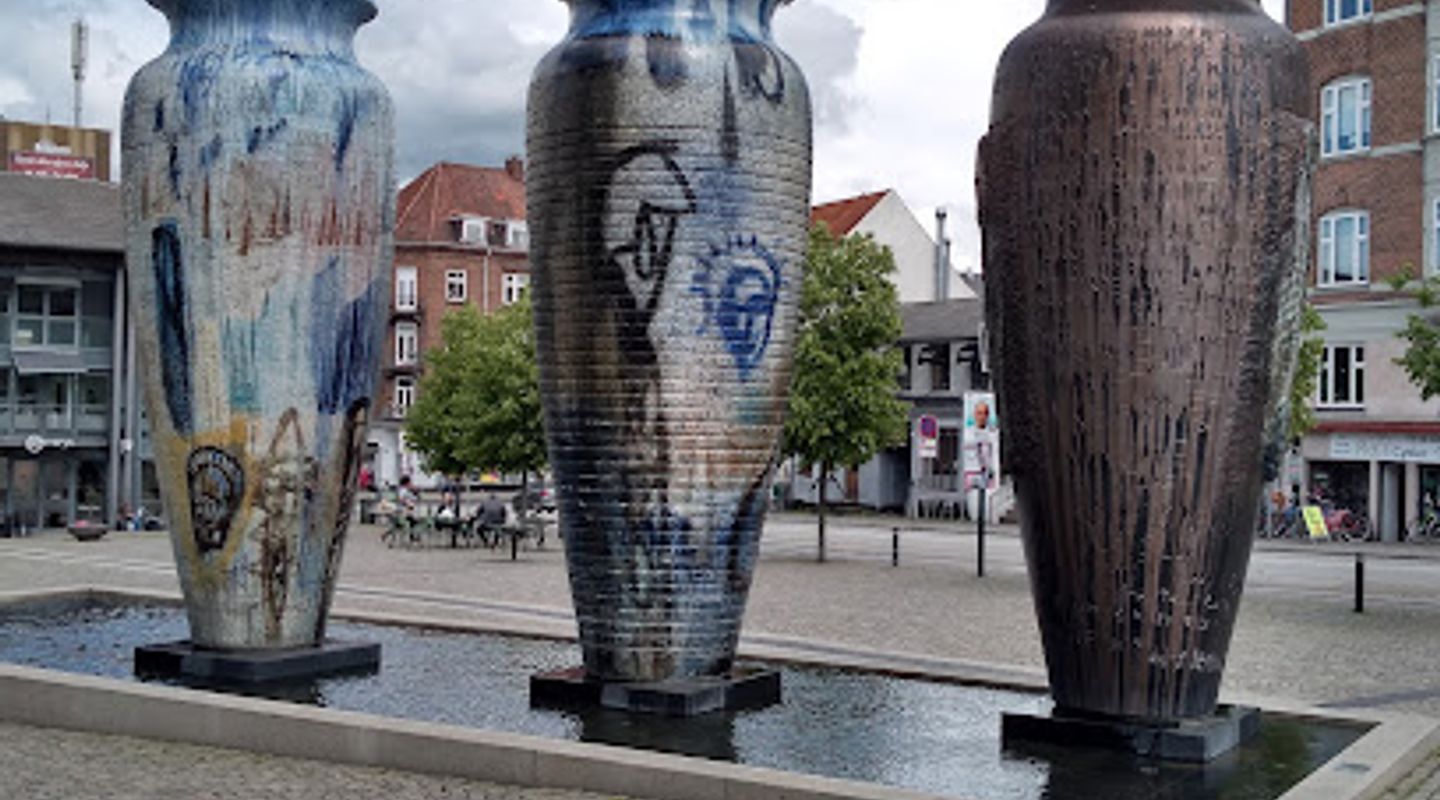
Monumental ceramic sculptures greeting you at Roskilde’s station square, the Roskilde Jars fuse ancient jar symbolism with bold contemporary public art.
Rising dramatically on the square by Roskilde’s main railway station, the three monumental Roskilde Jars are a striking meeting of contemporary art and ancient symbolism. Each towering ceramic vessel stands around 5 m tall, together weighing some 24 tons, their faceted, earth-toned surfaces reflected in a shallow water basin. Created in 1998 by Danish sculptor Peter Brandes as a gift marking Roskilde’s 1,000th anniversary, the jars echo the city’s Viking roots while anchoring its busy modern center with a bold, sculptural landmark that is free to enjoy at any time of day.
On-site amenities
 Restrooms
 Drink options
 Drinking water
 Food options
 Seating areas
 Sheltered areas
 Trash bins
 Information boards
 Visitor centre
Opening hours
- Every dayOpen 24 hours
Opening hours as listed on the venue’s Google Business Profile. Hours can change for services and special events, so check with the venue before you go.
- Address
- Stændertorvet 3 C, 4000 Roskilde
- Phone
- Website
Getting there
Train from Copenhagen
Regional bus within Zealand
Car from central Copenhagen
Discover more about Roskilde Jars
Colossal ceramics at the city’s front door
Standing on the broad square beside Roskilde’s railway station, the Roskilde Jars are impossible to miss. Three vast ceramic vessels rise around five metres high, grouped within a shallow water basin that mirrors their massive silhouettes. Their scale alone is startling: together they weigh roughly 24 tons, turning what could have been a simple forecourt into a powerful outdoor sculpture space and an instant visual introduction to the city.The jars were unveiled in 1998, a symbolic year that marked Roskilde’s 1,000th anniversary. Placing them at one of the city’s main arrival points was a deliberate choice, framing the first impression of Roskilde with contemporary art that hints at deep historical roots. Trains, buses, cyclists and pedestrians constantly cross the square, yet the jars anchor the movement with their calm, monumental presence.
An artist’s tribute to ancient forms
The work is by Danish sculptor Peter Brandes, known for his abstract, often monumental ceramics and strong interest in mythology and religion. Here he chose the simple, timeless form of a jar: broad-shouldered, tapering, and slightly asymmetrical, with surfaces that reveal the marks of hand and kiln rather than mechanical perfection. Up close you notice variations in glaze, from earthy browns to almost metallic sheens, catching the changing Nordic light.Historically, jars have carried layered meanings. They stored grain and oil, safeguarding life through hard seasons, and they also served as urns, holding the dead. Brandes draws on these associations so that the Roskilde Jars quietly suggest both nourishment and mortality. Their rounded bodies seem protective and enclosing, yet their scale and solidity also hint at memorials, standing watch over the passing crowd.
Gift to a thousand-year-old city
The jars were commissioned by Elsebeth Stryhn of the local food company Stryhns Leverpostej and presented as a gift to the citizens of Roskilde. It was an unusually generous gesture: a private business funding a large-scale public artwork that would belong to everyone. Installed on the station square, the piece does not sit behind a fence or inside a museum; instead it lives in the daily flow of commuters, shoppers and students.Roskilde’s long history, from Viking trading hub to medieval royal center and modern university town, is never far away. Though thoroughly contemporary, the jars nod to an older world where pottery was essential technology and decorative art at once. Seen in that light, the gift bridges eras: an industrial-era company commissioning handcrafted ceramics to celebrate a city that has continually reinvented itself for a millennium.
Everyday landmark and meeting point
For visitors, the square around the jars is an easy place to linger for a few minutes between trains or on the way into the historic core. The basin provides gentle reflections on still days, while the robust ceramic forms stand up to all kinds of Danish weather. People often pause on nearby benches, children circle the water’s edge, and the jars become a natural backdrop for photographs and casual meetings.The setting also offers a strong sense of Roskilde’s character. Look one way and you see tracks and buses leading toward Copenhagen and the wider island of Zealand; look the other and streets rise toward the old town, cathedral spires and museums. The jars sit at this seam between everyday routine and cultural exploration, a reminder that art can greet you the moment you arrive.
Details reward a closer look
Although many experience the Roskilde Jars in passing, they reward slow viewing. Fine variations in texture become visible when you walk the full circle around them: ridges where clay was built up, subtle glazing runs, areas where colour deepens or thins. Light plays differently on their curved surfaces at morning, midday and dusk, creating new shadows and highlights.Because the work is outdoors and freely accessible, there is no fixed route or correct way to experience it. You can step back to appreciate the composition of three forms together, or move in close to study how each jar differs in profile and finish. In doing so, you participate in the artwork’s everyday life: not as a museum visitor following a prescribed path, but as part of the urban rhythm it was designed to inhabit.
Evendo Review Centre
 Google
Guest reviews
Best time to go
Quietest: Jan, Feb & Mar · before 6am or at 10pm
Busy times are Evendo estimates for a typical year, to help you plan. Actual crowds vary with events, school holidays and the weather.
Explore Roskilde Jars on the map
A handpicked selection of must-see spots near Roskilde Jars, mapped for you.
Get your free copy of our complete guide to Roskilde Jars, delivered straight to you.
Everything on this page, from opening hours and how to get there to Eve’s tips and the best time to go, in one PDF you can read offline, print or share.
Already have an account? Sign in
Your Roskilde Jars guide is ready.
We'll send it to · Not you? Sign out

Getting your guide ready…
We are putting together a fresh copy of the Roskilde Jars guide. This can take up to a minute.
This can take a few moments. If your browser asks, choose Allow so the download can start. You'll find the guide in your Downloads folder.
Nothing happened? Download it again
Sorry, the guide is taking longer than usual. Please try again in a minute, or get it by email instead.
Other nearby places you may find interesting
The closest places of the same kind, if this one is not quite what you had in mind.
-
-
-

-
-


Swipe for more places
More to explore near Roskilde Jars

 Best experiences near Roskilde Jars
 Best hotels near Roskilde Jars
 Best landmarks near Roskilde Jars
 Best attractions near Roskilde Jars
 Best shops near Roskilde Jars
 Best restaurants near Roskilde Jars
 Best bars near Roskilde Jars
Do you manage this location?
Take control to get all the benefits, like improved information, better appearance, and stronger visibility across AI-powered discovery.
Explore more

Explore more of Roskilde
Discover Roskilde: A blend of rich history, Viking heritage, and vibrant music culture in the heart of Denmark, just a short journey from Copenhagen.
Explore Roskilde
Explore more of Denmark
Discover Denmark: A perfect blend of history, modern design, and the cozy concept of hygge. Explore vibrant cities, serene landscapes, and world-class cuisine.
Explore Denmark
