

Bishop's Square Travel Guide
Free Guide: Historic Bishop’s Square turned modern urban living room, framed by cathedral and theatre, where Viking‑age roots, royal monuments and everyday Aarhus life meet in the open air.


A brief summary of Bishop's Square
Historic Bishop’s Square turned modern urban living room, framed by cathedral and theatre, where Viking‑age roots, royal monuments and everyday Aarhus life meet in the open air.
Bispetorv, or Bishop’s Square, is a broad, modern public square in the very heart of Aarhus, framed by the soaring Aarhus Cathedral, the ornate Aarhus Theatre and the atmospheric Latin Quarter. Once a medieval burial site and later a car park, it was transformed in the 2010s into a lively urban space with trees, wooden decks, fountains and the equestrian statue of King Christian X. Today it hosts markets, concerts and festivals, and works as a relaxed meeting point between some of the city’s most important cultural and historic sights.
On-site amenities
 Drinking water
 Seating areas
 Trash bins
 Information boards
 Food options
 Drink options
 Restrooms
Opening hours
- Every dayOpen 24 hours
Opening hours as listed on the venue’s Google Business Profile. Hours can change for services and special events, so check with the venue before you go.
- Address
- Bispetorvet, 8000 Aarhus
- Website
Getting there
Train and walk from Aarhus H
Light rail (Letbanen) and short walk
City bus to central stops
Bicycle within Aarhus
Discover more about Bishop's Square
From pagan burial ground to city centerpiece
The space now known as Bispetorv has been central to Aarhus for more than a thousand years. Long before it became a paved square, this was a pagan burial site on the edge of an early Viking settlement, already close to the heart of town. When Aarhus became the seat of a diocese in the 10th century, the area’s role shifted from sacred ground to church power base, setting the tone for centuries to come.In the late 11th century, bishop Peder Vognsen began building Aarhus Cathedral just north of the former burial field, consolidating the area as the religious nucleus of the city. Canon houses and clerical buildings clustered around what would evolve into Bispetorv, and for generations the square was dominated by the bishop’s residence and its extensive garden, shielded from the street by walls along the lane that would become Kannikegade.
Opening the cathedral quarter to the city
After the Reformation, the old chapter house became the bishop’s home, but by the late 19th century its enclosed garden felt out of step with a growing modern town. In 1881, the municipality bought and demolished the bishop’s residence to create a more generous public space and give the cathedral “room to breathe”. A later building blocking the line between Store Torv and the new open area was removed in 1921, giving Bispetorv roughly the outline we recognize today.For much of the 20th century, however, the square functioned mainly as a car park. The historical importance of the site lay largely hidden beneath asphalt until archaeological digs in the 1960s revealed rich finds from the Viking Age. These discoveries led to the creation of the small underground Viking Museum nearby, displaying objects excavated around the square and hinting at layers of history under your feet.
Designing a contemporary urban living room
In the 2000s Aarhus decided to reclaim Bispetorv for people rather than cars. Through workshops with local residents, cultural institutions and urban designers, a new vision emerged: a green, flexible city square that could host both small everyday encounters and large events. The resulting redesign, completed around 2016–2017, introduced groves of trees and an undulating wooden deck that threads through the space.This sculpted deck levels parts of the naturally sloping ground and doubles as seating, stage, playground and informal terrace for outdoor cafés. Low sandstone edges define the square, while two small fountains offer drinking water and playful calm in warm weather. The overall effect is a public “living room” that feels both contemporary and deeply rooted in its setting between cathedral, theatre and historic streets.
Monuments, markets and moments in the open air
The equestrian statue of King Christian X provides a focal point on the northwest side of Bispetorv. The monarch gained symbolic importance during the German occupation of Denmark in the Second World War, when his unescorted daily rides became an emblem of quiet resistance. Standing beneath the bronze figure, it is easy to sense how the square connects national memory with everyday city life.Throughout the year Bispetorv acts as a stage for Aarhus. In summer its open expanse is used for concerts, cultural festivals and performances spilling out from Aarhus Theatre. Seasonal markets and occasional car‑boot and flea markets turn the cobbles into rows of stalls, where locals browse for vintage finds in the shadow of the cathedral spire. At quieter times it is simply a generous patch of open sky in the dense inner city, a place to pause with a coffee, meet friends or watch the flow of pedestrians between the Latin Quarter and the shopping streets.
A crossroads of culture in the historic core
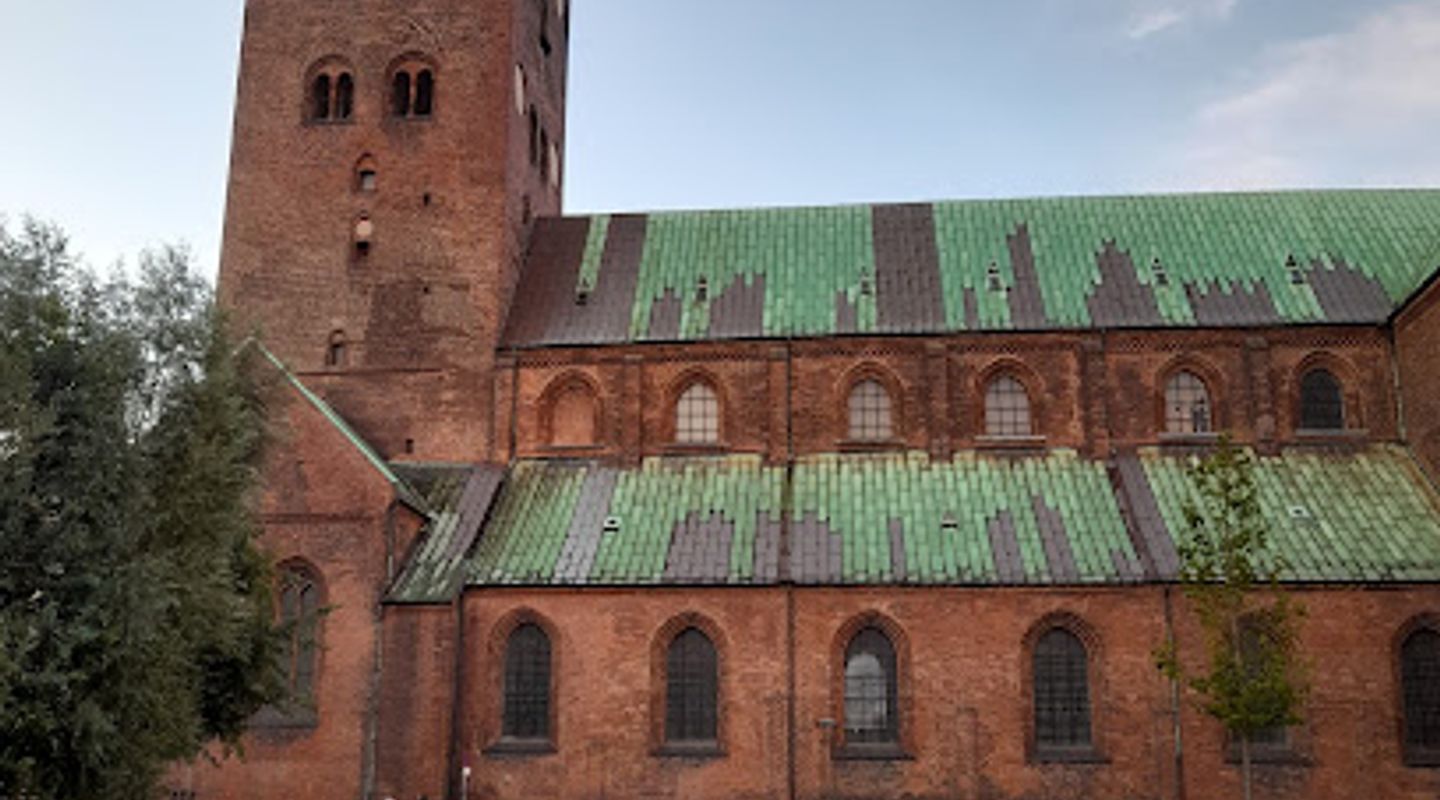
What makes Bispetorv compelling is not grandeur but context. To the north, the long brick flank and tower of Aarhus Cathedral dominate the skyline. To the east, the richly decorated façade of Aarhus Theatre anchors one side of the square. Just beyond lie the narrow lanes and independent shops of the Latin Quarter, while a short stroll brings you to the Viking Museum and other small institutions clustered in the old town.As a result, Bispetorv works both as a destination and as a hinge between experiences: sacred and secular, medieval and modern, formal culture and relaxed street life. Its recent transformation into a greener, more humane space reflects a broader shift in Aarhus towards walkable streets and people‑focused planning. For visitors, it is an ideal place to orient yourself, absorb the rhythm of the city and feel how many centuries of history converge in a single, open square.
Evendo Review Centre
 Google
Guest reviews
Best time to go
Quietest: Jan, Feb & Mar · before 8am
Busy times are Evendo estimates for a typical year, to help you plan. Actual crowds vary with events, school holidays and the weather.
Explore Bishop's Square on the map
A handpicked selection of must-see spots near Bishop's Square, mapped for you.
Get your free copy of our complete guide to Bishop's Square, delivered straight to you.
Everything on this page, from opening hours and how to get there to Eve’s tips and the best time to go, in one PDF you can read offline, print or share.
Already have an account? Sign in
Your Bishop's Square guide is ready.
We'll send it to · Not you? Sign out

Getting your guide ready…
We are putting together a fresh copy of the Bishop's Square guide. This can take up to a minute.
This can take a few moments. If your browser asks, choose Allow so the download can start. You'll find the guide in your Downloads folder.
Nothing happened? Download it again
Sorry, the guide is taking longer than usual. Please try again in a minute, or get it by email instead.
Other nearby places you may find interesting
The closest places of the same kind, if this one is not quite what you had in mind.
-
-
-
-
-


Swipe for more places
More to explore near Bishop's Square

 Best experiences near Bishop's Square
 Best hotels near Bishop's Square
 Best landmarks near Bishop's Square
 Best attractions near Bishop's Square
 Best shops near Bishop's Square
 Best restaurants near Bishop's Square
 Best bars near Bishop's Square
Do you manage this location?
Take control to get all the benefits, like improved information, better appearance, and stronger visibility across AI-powered discovery.
Explore more

Explore more of South Jutland
Discover the beauty and charm of South Jutland, Denmark's southern treasure, with its rich history, stunning landscapes, and delightful local cuisine.
Explore South Jutland
Explore more of Denmark
Discover Denmark: A perfect blend of history, modern design, and the cozy concept of hygge. Explore vibrant cities, serene landscapes, and world-class cuisine.
Explore Denmark
