

Luxor Temple Travel Guide
Free Guide: Explore Luxor Temple, a majestic monument in Luxor, Egypt, showcasing ancient Theban architecture, history, and religious significance from 1400 BCE.


A brief summary of Luxor Temple
Explore Luxor Temple, a majestic monument in Luxor, Egypt, showcasing ancient Theban architecture, history, and religious significance from 1400 BCE.
Luxor Temple, located in the heart of Luxor, Egypt, stands as a testament to the grandeur of ancient Thebes. Built primarily by Pharaoh Amenhotep III around 1400 BCE and later expanded by rulers like Ramses II, this temple is dedicated to the Theban Triad of Amun, Mut, and Khonsu, symbolizing rejuvenation of kingship. Unlike other temples, Luxor Temple isn't dedicated to a cult god or deified pharaoh, adding to its unique historical significance.
Opening hours
- Every day6 am–10 pm
Opening hours as listed on the venue’s Google Business Profile. Hours can change for services and special events, so check with the venue before you go.
- Address
- Luxor City, Luxor, Luxor Governorate 1362501
- Website
Getting there
Walking
Public Transport
Taxi
Discover more about Luxor Temple
Overview
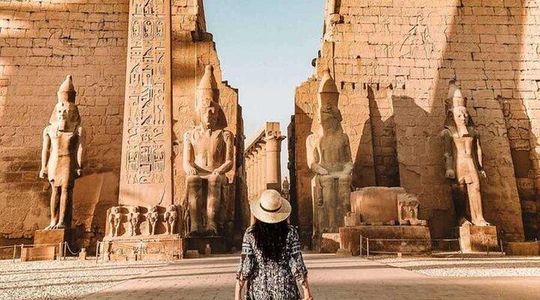
Luxor Temple, known to the ancient Egyptians as Ipet-resyt or “Southern Sanctuary,” lies about three kilometers south of Karnak Temple, with which it was once connected by a processional way bordered by sphinxes. Construction began around 1392 BCE by Amenhotep III, with contributions from Tutankhamun, Horemheb, and Ramesses II. The temple deviates from the typical east-west axis, oriented instead toward Karnak, making it the focal point of the annual Opet Festival. During this significant religious celebration, the cult images of Amun, Mut, and Khonsu were carried in a grand procession from Karnak to Luxor Temple.Upon entering the temple, visitors encounter the massive pylon of Ramses II, adorned with colossal statues and a single remaining obelisk (its twin now stands in Paris). Inside, the Great Court, lined with statues of Ramses II, leads to the Hypostyle Hall with its towering columns intricately carved with scenes of gods and pharaohs. Further within are smaller courts, chapels, and the sanctuary, each bearing unique designs and historical significance. A granite shrine dedicated to Alexander the Great can be found toward the rear of the temple.Throughout its history, Luxor Temple has been repurposed, serving as a Christian church and later with the construction of the Mosque of Sufi Shaykh Yusuf Abu al-Hajjaj, which was preserved when the temple was uncovered. Today, Luxor Temple stands as one of Egypt's best-preserved monuments, drawing visitors worldwide to marvel at its architecture, learn about its rich history, and experience the awe-inspiring ambiance of ancient Egypt.
Evendo Review Centre
 Google
Guest reviews
Explore Luxor Temple on the map
A handpicked selection of must-see spots near Luxor Temple, mapped for you.
Get your free copy of our complete guide to Luxor Temple, delivered straight to you.
Everything on this page, from opening hours and how to get there to Eve’s tips and the best time to go, in one PDF you can read offline, print or share.
Already have an account? Sign in
Your Luxor Temple guide is ready.
We'll send it to · Not you? Sign out

Getting your guide ready…
We are putting together a fresh copy of the Luxor Temple guide. This can take up to a minute.
This can take a few moments. If your browser asks, choose Allow so the download can start. You'll find the guide in your Downloads folder.
Nothing happened? Download it again
Sorry, the guide is taking longer than usual. Please try again in a minute, or get it by email instead.
Unlock the best of Luxor Temple
Skip-the-line tickets, guided tours with entry, and walking tours of the area, booked in a few clicks.


Other nearby places you may find interesting
The closest places of the same kind, if this one is not quite what you had in mind.
-
-
-
-
-


Swipe for more places
More to explore near Luxor Temple

 Best experiences near Luxor Temple
 Best hotels near Luxor Temple
 Best landmarks near Luxor Temple
 Best attractions near Luxor Temple
 Best shops near Luxor Temple
 Best restaurants near Luxor Temple
 Best bars near Luxor Temple
Do you manage this location?
Take control to get all the benefits, like improved information, better appearance, and stronger visibility across AI-powered discovery.
Explore more

Explore more of Eastern Desert
Discover the Eastern Desert of Egypt: An ancient land of rugged beauty, hidden oases, and timeless adventures between the Nile and the Red Sea.
Explore Eastern Desert
Explore more of Egypt
Discover Egypt: From the timeless pyramids to the vibrant Red Sea, experience a land where ancient wonders meet modern adventures.
Explore Egypt
