

Mykines Island Travel Guide - Free Web & App
Your ultimate guide to Mykines Island. Discover top landmarks, proposed trips, and local tips. Free on the web or via the Evendo companion app.


Mykines Island, Faroe Islands: see puffins, dramatic cliffs, the village and Mykineshólmur lighthouse for a remote North Atlantic island day trip.
A Remote Western Island
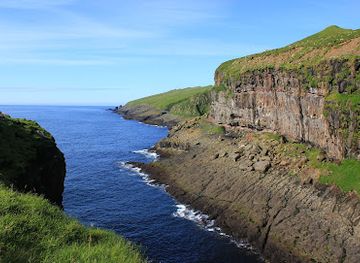
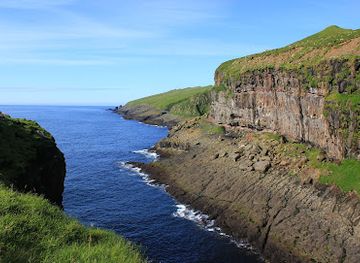
Mykines is the westernmost of the main Faroe Islands, a small, weather-exposed landmass reached from the village of Sørvágur on neighbouring Vágar or, in suitable conditions, by helicopter. Its steep green slopes descend towards the North Atlantic, while sea cliffs, narrow inlets and offshore stacks reveal the island’s position at the edge of the Faroese archipelago. The settlement of Mykines, with its turf-roofed and brightly painted houses, occupies a sheltered coastal hollow and remains the island’s principal human focus.Read more about Mykines Island
Birdlife and Mykineshólmur
Village Life and Visiting
When is the best time to visit Mykines Island?
Best: June–August · 11–13°C| Month | High (°C) | Rainfall (mm) |
|---|---|---|
| January | 6 | 180 |
| February | 6 | 160 |
| March | 6 | 150 |
| April | 6 | 140 |
| May | 8 | 120 |
| June (best) | 11 | 110 |
| July (best) | 13 | 100 |
| August (best) | 13 | 120 |
| September | 12 | 150 |
| October | 10 | 160 |
| November | 7 | 180 |
| December | 6 | 200 |
Getting to and around Mykines Island
How to get there
Transportation
Best attractions in Mykines Island
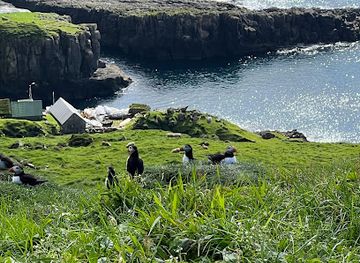
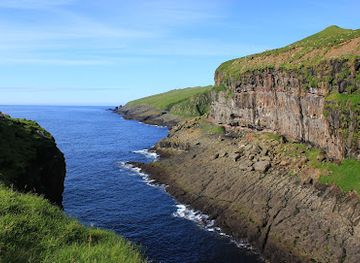
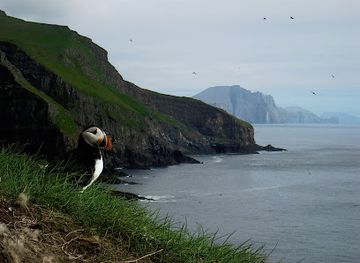
Mykines village is the island’s principal attraction, a compact cluster of houses set above the landing place and surrounded by steep grassland. From here, a marked walking route heads west towards Mykineshólmur, the offshore islet associated with a lighthouse, seabird cliffs and a narrow connecting bridge; its availability depends on weather, maintenance and local access rules. The surrounding headlands offer views across the North Atlantic and towards the Faroese sea cliffs, while the island’s breeding-season birdlife is a major reason for visiting. Atlantic puffins are especially emblematic, although sightings are seasonal and never guaranteed, and visitors must keep to paths and avoid disturbing colonies. The walk itself is as important as the destination, revealing the contrast between the sheltered village, open slopes and precipitous coastline. With few buildings, museums or commercial attractions, Mykines rewards close observation of its landscape, traditional settlement and working rural environment rather than a packed sightseeing itinerary.
-
Island
Mykines
Discover Mykines: Faroe's westernmost island, a puffin paradise with dramatic landscapes and rich birdlife, offering an unforgettable nature experience.
Best landmarks in Mykines Island
Mykineshólmur is the island’s defining landmark: a small offshore islet reached by a narrow bridge when the route is open and recognised by its lighthouse, which marks the exposed western maritime setting. The surrounding basalt cliffs and sea stacks are equally important, rising from the North Atlantic and providing habitat for breeding seabirds. Mykines village forms a cultural landmark in its own right, with a compact pattern of traditional Faroese houses, many characterised by painted timber and turf roofs. The landing place and steep paths demonstrate how closely the settlement is tied to the sea and the terrain. These features should be understood as a combination of natural formation, maritime infrastructure and lived heritage rather than as isolated monuments. The island’s significance lies in their relationship: a small community, a navigational outpost and bird-rich cliffs occupying the western edge of the Faroese archipelago.
-
Historical landmark
Memorial Monument
Explore the Memorial Monument in Mykines, a captivating historical landmark surrounded by breathtaking landscapes of the Faroe Islands.
Explore Mykines Island on the map
Plan your trip on one map. See where the top attractions, landmarks, restaurants and hotels are, and book hotels and experiences in a few clicks.
Best hotels in Mykines Island
Best bars in Mykines Island
Mykines has no recognised nightlife district, nightclub scene or substantial evening entertainment. After day visitors depart, the island’s atmosphere is shaped by weather, darkness, seabirds and the small settlement rather than by bars or programmed events. Visitors staying locally, where accommodation and seasonal services are available, should expect quiet evenings and should confirm whether meals or drinks are provided. For a wider choice of pubs, cafés and evening hospitality, Sørvágur and other settlements on Vágar are more practical, although they remain distinctly low-key compared with the capital. Evening travel depends on the availability of boats, helicopters and accommodation, so returning to the mainland after a late outing should never be assumed. Mykines is best suited to visitors seeking a calm rural night, not a destination built around entertainment.
-
Island
Mykines
Explore Mykines Island, a birdwatcher's paradise in the Faroe Islands, where stunning cliffs and serene landscapes await your discovery.
-
Cafe
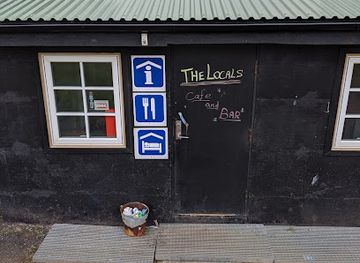
The Locals
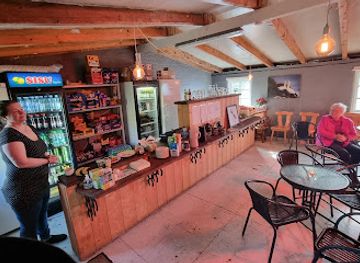
Experience the charm of Mykines at The Locals, a cozy café offering local flavors and breathtaking views in the heart of the Faroe Islands.
Best nightclubs in Mykines Island
Mykines has no recognised nightlife district, nightclub scene or substantial evening entertainment. After day visitors depart, the island’s atmosphere is shaped by weather, darkness, seabirds and the small settlement rather than by bars or programmed events. Visitors staying locally, where accommodation and seasonal services are available, should expect quiet evenings and should confirm whether meals or drinks are provided. For a wider choice of pubs, cafés and evening hospitality, Sørvágur and other settlements on Vágar are more practical, although they remain distinctly low-key compared with the capital. Evening travel depends on the availability of boats, helicopters and accommodation, so returning to the mainland after a late outing should never be assumed. Mykines is best suited to visitors seeking a calm rural night, not a destination built around entertainment.
-
Island
Mykines
Explore Mykines Island - A breathtaking paradise in the Faroe Islands known for its dramatic cliffs, rich wildlife, and serene landscapes.
-
Cafe
The Locals
Experience the heart of Mykines at The Locals Cafe, where delicious local flavors meet breathtaking views in the Faroe Islands.
Best shops in Mykines Island
Shopping on Mykines is extremely limited and should not be treated as a reason to visit. The island does not have a substantial retail centre, and any small seasonal sales or locally produced goods may not operate consistently. Visitors should buy food, water, outdoor supplies and any practical items in Sørvágur or elsewhere on Vágar before departure. In the wider Faroe Islands, independent shops and craft outlets offer opportunities to find woollen goods, knitwear, local art, design pieces and regional food products, with the greatest choice in larger settlements such as Tórshavn. Buying directly from a local producer, where arrangements are clearly established, can support island communities, but visitors should respect private property and avoid treating working homes as shops. Mykines’s most characteristic souvenirs are photographs and memories of its landscape rather than a developed commercial craft market.
-
Sightseeing tour agency
Visit Mykines
Discover the stunning natural beauty and rich wildlife of Mykines, a picturesque village in the Faroe Islands, perfect for hiking and birdwatching.
Get your free copy of our complete guide to Mykines Island, delivered straight to you.
Everything on this page, from attractions and restaurants to essentials and local phrases, in one PDF you can read offline, print or share.
Already have an account? Sign in
Your Mykines Island guide is ready.
We'll send it to · Not you? Sign out

Getting your guide ready…
We are putting together a fresh copy of the Mykines Island guide. This can take up to a minute.
This can take a few moments. If your browser asks, choose Allow so the download can start. You'll find the guide in your Downloads folder.
Nothing happened? Download it again
Sorry, the guide is taking longer than usual. Please try again in a minute, or get it by email instead.
Mykines Island essentials
Currency and Payment
Safety
Emergency Situations
Do's and Don'ts
Local Tips
From Eve
Local phrases worth knowing
You don't need to get them perfect. A few words go a long way, and locals appreciate the effort.
Basics
| English | Local | Say it |
|---|---|---|
| Hello | Halló | [hah-loh] |
| Goodbye | Farvæl | [far-vail] |
| Yes | Ja | [yah] |
| No | Nei | [nay] |
| Please/You're welcome | Vænligst/Takk fyri | [vain-list/tahk fy-ree] |
| Thank you | Takk | [tahk] |
| Excuse me/Sorry | Fyrirgev | [feer-ir-gev] |
| How are you? | Hvussu hevur tú tað? | [hvoo-soo heh-vur too tah] |
| Fine. And you? | Gott. Og tú? | [got oh too] |
| Do you speak English? | Talar tú enskt? | [tah-lar too entskt] |
| I don't understand | Eg skilji ikki | [eg skeel-yee ik-kee] |
Eating & Drinking
| English | Local | Say it |
|---|---|---|
| I'd like to see the menu, please | Eg vil síggja menyin, vænligst | [eg vil see-dja men-yin, vain-list] |
| I don't eat meat | Eg eti ikki kjøt | [eg eh-tee ik-kee chot] |
| Cheers! | Skál! | [skowl] |
| I would like to pay, please | Eg vil gjalda, vænligst | [eg vil yal-dah, vain-list] |
Emergencies
| English | Local | Say it |
|---|---|---|
| Help! | Hjálp! | [hyawlp] |
| Go away! | Far út! | [far oot] |
| Call the Police! | Ring politið! | [reeng poh-lee-the] |
| Call a doctor! | Ring læknin! | [reeng leh-kneen] |
| I'm lost | Eg eri týst | [eg eh-ree teest] |
| I'm ill | Eg eri sjúk | [eg eh-ree shyook] |
Shopping
| English | Local | Say it |
|---|---|---|
| I'd like to buy... | Eg vil keypa... | [eg vil keh-pah] |
| I'm just looking | Eg líti bara | [eg lee-tee bah-rah] |
| How much is it? | Hvat kostar tað? | [kvaht kost-ar tah] |
| That's too expensive | Tað er ov dyrt | [tah err ohv deert] |
| Can you lower the price? | Kan tú skerja prísin? | [kan too skair-ya prees-in] |
Time & Numbers
| English | Local | Say it |
|---|---|---|
| What time is it? | Hvat er klokkan? | [kvaht err klohk-an] |
| It's one o'clock | Tað er eitt | [tah err aytt] |
| Half past (10) | Hálfundan (10) | [howl-foond-an (tay-zahn)] |
| Morning | Morgun | [mor-gun] |
| Afternoon | Ettermiðdagur | [eh-ter-mith-da-goor] |
| Evening | Kvøld | [kvool] |
| Yesterday | Í gjár | [ee gyowr] |
| Today | Í dag | [ee dah] |
| Tomorrow | Í morgin | [ee mor-gin] |
| 1 | Eitt | [aytt] |
| 2 | Tvær | [tvaer] |
| 3 | Tríggjar | [tree-gyar] |
| 4 | Fýra | [foo-rah] |
| 5 | Fimm | [feem] |
| 6 | Seks | [seks] |
| 7 | Seyði | [sey-thee] |
| 8 | Átta | [ow-tah] |
| 9 | Ni | [nee] |
| 10 | Tíggju | [tee-gyoo] |
Transport & Directions
| English | Local | Say it |
|---|---|---|
| Where's a/the...? | Hvar er ein/tað...? | [kvar err ayn/tah] |
| What's the address? | Hvat er adressan? | [kvaht err ah-dress-an] |
| Can you show me (on the map)? | Kan tú vísa mær (á kortinum)? | [kan too vee-sah myar (ow kort-ih-num)] |
| When's the next (bus)? | Nær kemur næsta (bussur)? | [nyar keh-moor nyst-ah (boos-oor)] |
| A ticket (to ....) | Ein miði (til ....) | [ayn mee-thee (teel)] |
History of Mykines Island
A Volcanic Atlantic Landscape
Mykines belongs to the Faroe Islands, a North Atlantic archipelago formed from extensive volcanic activity millions of years ago. Successive basalt lava flows were later cut and shaped by marine erosion, weather and glacial processes, producing the island’s steep slopes, cliff edges and separate offshore stacks. The exposed western position helps explain both the dramatic landforms and the demanding conditions that have influenced settlement, travel and land use. Mykineshólmur, now recognised for its lighthouse and seabird colonies, is part of this wider geological and maritime setting rather than an isolated scenic feature.
Norse Settlement and Island Community
Like other inhabited parts of the Faroe Islands, Mykines was incorporated into the Norse settlement world of the North Atlantic during the Viking Age, although the precise details of its earliest occupation are difficult to separate from later tradition. A small farming and fishing community developed around the natural harbour and cultivated or managed the limited land available between the cliffs. Life depended on sheep, seabirds, fishing and carefully organised access to the sea. The village’s compact form reflects the practical realities of maintaining a community on a remote, weather-exposed island.
Farming, Fishing and Seabird Harvesting
For centuries, Mykines households combined small-scale agriculture with maritime work and the seasonal use of the island’s bird-rich cliffs. Seabirds and eggs formed part of traditional Faroese food and resource practices, while sheep farming shaped the open grassland landscape. Such activities required local knowledge of cliffs, tides, weather and ropes, and were undertaken within customary community systems. Modern visitors encounter a landscape that is natural in appearance but has been influenced by generations of grazing, settlement and careful use of the island’s limited resources.
Lighthouse, Modern Access and Conservation
Mykineshólmur’s lighthouse reflects the island’s strategic position beside North Atlantic shipping routes and the continuing importance of maritime navigation. In the modern period, improved boat and helicopter connections have made the island more accessible to visitors, while depopulation and limited local services have reinforced its fragile character. Tourism now centres on the village, bird cliffs and route towards the islet, but access is shaped by weather, safety and conservation requirements. The island’s history is therefore still visible in its settlement and land use, even as seasonal visitors have become more prominent than traditional industries.
Mykines Island in Photos
Browse through our photo collection highlighting the charm and character of the destination.
Neighbouring destination travel guides
The closest destinations to Mykines Island, if you have time for more than one.
-

-

-

-

-


Swipe for more destinations
Explore more

Explore more of Mykines
Discover Mykines in the Faroe Islands: A secluded paradise offering stunning landscapes, rich birdlife, and serene hiking trails for an unforgettable adventure.
Explore Mykines
Explore more of Faroe Islands
Discover the Faroe Islands: A land of rugged beauty, rich history, and tranquil villages, perfect for nature lovers and adventurers seeking an off-the-beaten-path destination.
Explore Faroe Islands