

Lucas Cranach Haus, Erfurt Travel Guide
Free Guide: Discover the Renaissance legacy of Lucas Cranach the Elder at his historic Weimar home, now a cultural landmark and home to the Theater im Gewölbe.


A brief summary of Lucas Cranach Haus
Discover the Renaissance legacy of Lucas Cranach the Elder at his historic Weimar home, now a cultural landmark and home to the Theater im Gewölbe.
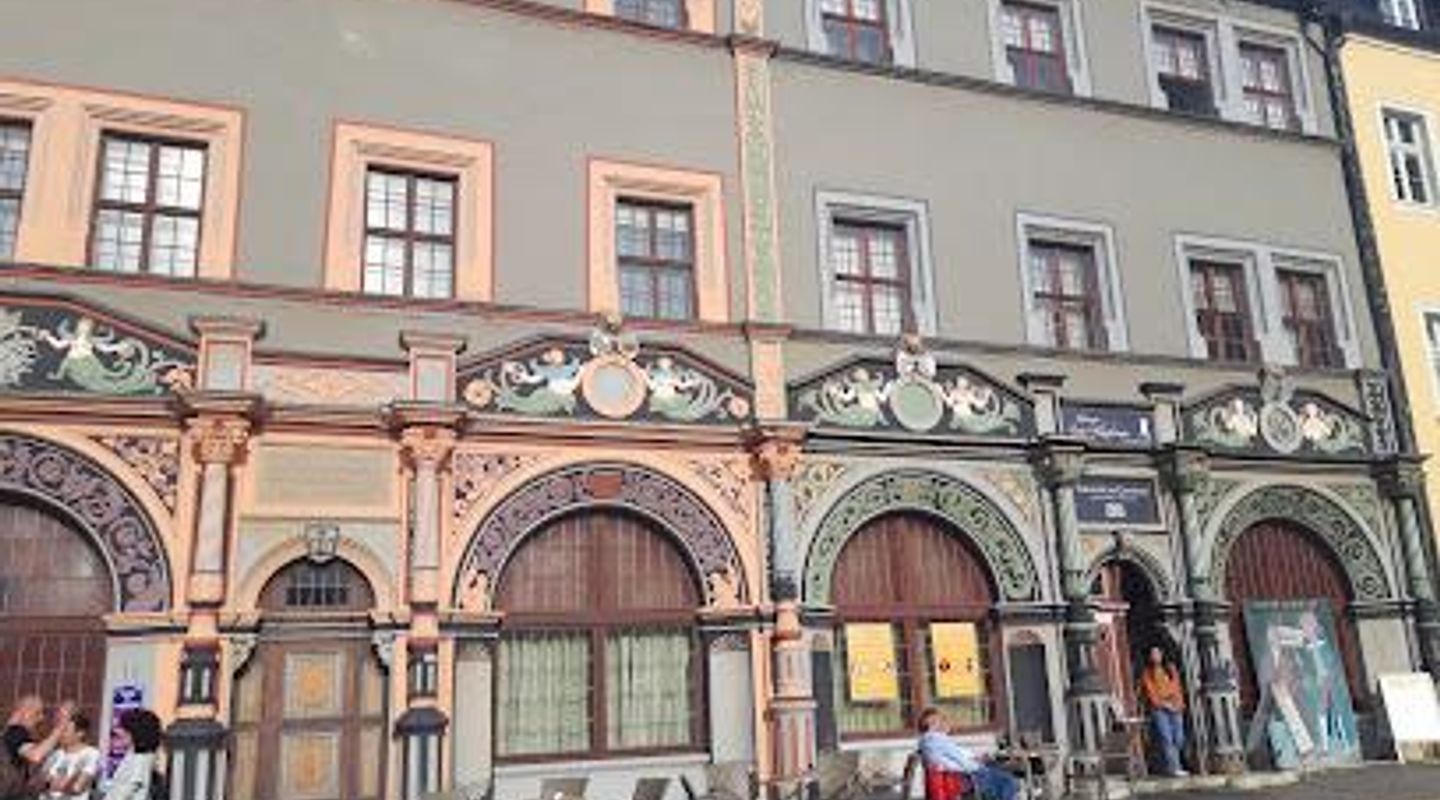
The Lucas Cranach Haus, situated on Weimar's historic Markt, stands as a testament to the city's rich artistic heritage. This Renaissance building, dating back to the mid-16th century, was once home to the renowned painter Lucas Cranach the Elder and later his son. Today, it serves as a cultural landmark, housing the Theater im Gewölbe, an intimate venue for classical plays, and offering visitors a glimpse into the life and times of one of Germany's most influential artistic families. Its location on the Markt, surrounded by other historical buildings, makes it a central point for exploring Weimar's cultural treasures. The house itself is a beautiful example of Renaissance architecture, featuring scrolled gables and vaulted ceilings, making it a must-see for anyone interested in art, history, and theater.
- Address
- Markt 11, 99423 Weimar
- Website
Getting there
Walking
Public Transport
Taxi/Ride-Share
Driving
Discover more about Lucas Cranach Haus
Overview
The Lucas Cranach Haus, prominently located on the east side of Weimar's bustling Markt (Market Square), is more than just a building; it's a portal into the heart of the German Renaissance and a tribute to one of its most influential artistic figures. This historic house, built between 1547 and 1549, served as the home and workshop of Lucas Cranach the Elder, a painter and printmaker who played a pivotal role in the German Reformation. Later, his son, Lucas Cranach the Younger, also resided and worked here, continuing the family's artistic legacy. Stepping onto the Markt, the Cranach Haus immediately captures attention with its distinctive Renaissance architecture. The facade boasts scrolled gables, a hallmark of the era, and the building's structure reflects the prosperity and artistic fervor of 16th-century Weimar. Above one of the arches, visitors can spot the emblem of the Cranach family – a winged serpent, a symbol that frequently appeared in the artist's works. Lucas Cranach the Elder's life and career were deeply intertwined with the political and religious upheavals of his time. As a court painter to the Elector of Saxony, he became a close confidant of Martin Luther and a key visual propagandist for the Reformation. His paintings, woodcuts, and engravings helped to spread Luther's ideas throughout Germany and beyond. Cranach's artistic output was prolific, ranging from portraits of religious figures and political leaders to mythological scenes and allegorical works. His style was characterized by its clarity, simplicity, and attention to detail, making his art accessible to a wide audience. The Cranach Haus was not only a residence but also a thriving artistic workshop. Here, Cranach trained apprentices and produced a vast number of artworks, many of which are now housed in museums around the world. It was in his attic studio that Cranach continued to work until his death in Weimar in 1553, completing the famous three-winged altar in the Stadtkirche St. Peter und Paul (City Church of St. Peter and Paul), a task finished by his son. In the centuries following Cranach's death, the house underwent various transformations. However, its historical significance remained intact. In the late 20th century, the Cranach Haus served as a gallery, showcasing the works of international artists such as Friedensreich Hundertwasser, Christo, and Jeanne-Claude, adding another layer to its artistic legacy. Today, the Lucas Cranach Haus is home to the Theater im Gewölbe (Theater Below the Arches), an intimate performance venue that stages classical plays, particularly those by Goethe and Schiller, Weimar's most famous literary figures. The theater's vaulted ceilings and historic atmosphere create a unique and immersive experience for audiences. Visiting the Cranach Haus offers a multifaceted experience. Art enthusiasts can admire the building's Renaissance architecture and imagine the creative energy that once filled its rooms. History buffs can delve into the life and times of Lucas Cranach the Elder and his role in the Reformation. Theatergoers can enjoy captivating performances in a unique setting. And anyone interested in Weimar's cultural heritage can appreciate the house's enduring legacy as a symbol of the city's artistic and intellectual achievements. The Markt itself, where the Cranach Haus is located, is a vibrant hub of activity. Surrounded by colorful Renaissance and Baroque buildings, the square hosts regular markets, where locals and visitors can browse fresh produce, regional delicacies, and handmade crafts. Cafés and restaurants with outdoor seating provide a perfect spot to relax and soak in the atmosphere. Other notable landmarks on the Markt include the Rathaus (Town Hall), with its neo-Gothic facade and glockenspiel, and the Stadthaus, which houses the Tourist Information Center. The Lucas Cranach Haus is also conveniently located near other major attractions in Weimar. Goethe's House and the Goethe National Museum are just a short walk away, offering insights into the life and work of Germany's most celebrated writer. Schiller's House, the former residence of Friedrich Schiller, another literary giant, is also nearby. The Bauhaus Museum, dedicated to the influential art and design movement, is another must-see for art and architecture lovers. Exploring Weimar's rich cultural heritage is an enriching experience, and the Lucas Cranach Haus stands as a central point for discovering the city's artistic and historical treasures. Whether you're an art aficionado, a history enthusiast, or simply a curious traveler, a visit to the Cranach Haus is sure to leave a lasting impression.
Evendo Review Centre
 Google
Guest reviews
Explore Lucas Cranach Haus on the map
A handpicked selection of must-see spots near Lucas Cranach Haus, mapped for you.
Get your free copy of our complete guide to Lucas Cranach Haus, delivered straight to you.
Everything on this page, from opening hours and how to get there to Eve’s tips and the best time to go, in one PDF you can read offline, print or share.
Already have an account? Sign in
Your Lucas Cranach Haus guide is ready.
We'll send it to · Not you? Sign out

Getting your guide ready…
We are putting together a fresh copy of the Lucas Cranach Haus guide. This can take up to a minute.
This can take a few moments. If your browser asks, choose Allow so the download can start. You'll find the guide in your Downloads folder.
Nothing happened? Download it again
Sorry, the guide is taking longer than usual. Please try again in a minute, or get it by email instead.
Unlock the best of Lucas Cranach Haus
Skip-the-line tickets, guided tours with entry, and walking tours of the area, booked in a few clicks.

Other nearby places you may find interesting
The closest places of the same kind, if this one is not quite what you had in mind.
-
-
-

-
-


Swipe for more places
More to explore near Lucas Cranach Haus

 Best experiences near Lucas Cranach Haus
 Best hotels near Lucas Cranach Haus
 Best landmarks near Lucas Cranach Haus
 Best attractions near Lucas Cranach Haus
 Best shops near Lucas Cranach Haus
 Best restaurants near Lucas Cranach Haus
 Best bars near Lucas Cranach Haus
Do you manage this location?
Take control to get all the benefits, like improved information, better appearance, and stronger visibility across AI-powered discovery.
Explore more
Explore more of Erfurt
Discover Erfurt: A medieval city with stunning architecture, rich history, and vibrant culture in the heart of Germany.
Explore Erfurt
Explore more of Germany
Experience Germany: where history meets innovation, and urban energy blends with natural beauty. Discover diverse cultures, delicious cuisine, and stunning landscapes.
Explore Germany
