

Free Main Street Travel Guide & Mobile App
Plan your Main Street trip with Evendo. Get free guides to top attractions, restaurants, hotels, and bars. Web access or download the mobile app.


Main Street Gibraltar combines British heritage, Mediterranean culture, historic landmarks, shopping and easy access to the Rock’s unforgettable sights.
A Street Shaped by Empires
Main Street is the historic commercial and civic spine of Gibraltar, running northwards from the old defensive gateway at Casemates Square through a compact centre of shops, churches, cafés and government buildings. Although only a street rather than a separate city, it offers one of the clearest introductions to Gibraltar’s layered identity: British in its institutions and street signs, Mediterranean in its light and architecture, and shaped by centuries of Spanish, Moorish and military history. The pedestrianised route changes character as it passes from the open square at its northern end into narrower streets and covered passages farther south.Read more about Main Street
Heritage Along the Shopping Route
When is the best time to visit Main Street?
Best: May–June, September · 23–27°C| Month | High (°C) | Rainfall (mm) |
|---|---|---|
| January | 17 | 80 |
| February | 18 | 70 |
| March | 19 | 60 |
| April | 21 | 50 |
| May (best) | 23 | 40 |
| June (best) | 26 | 20 |
| July | 29 | 20 |
| August | 29 | 30 |
| September (best) | 27 | 40 |
| October | 24 | 60 |
| November | 20 | 70 |
| December | 18 | 80 |
Getting to and around Main Street
How to get there
Transportation
Best attractions in Main Street
Main Street’s principal attraction is the experience of moving through Gibraltar’s compact historic centre, beginning at Casemates Square and continuing past shops, cafés, churches and civic buildings towards Irish Town. The Gibraltar National Museum, close to the southern end of the route, interprets the territory’s prehistoric, Moorish, Spanish and British past and includes remains of the medieval settlement. Nearby, the Cathedral of the Holy Mary the Crowned occupies an important place in Gibraltar’s Spanish and Catholic history, while the Cathedral of the Holy Trinity introduces the Anglican character of the British period. The Convent, the official residence of Gibraltar’s governor, is another notable building on the central route. Visitors can also follow lanes towards the old town walls and Gibraltar’s port, or use Main Street as a starting point for the Moorish Castle, Upper Rock and nature reserve, which lie beyond the street itself.
-
Historical landmark
The Convent, Governors Residence
Explore the historic Convent in Gibraltar, the Governor's residence, where history and stunning architecture meet in a beautiful setting.
1 min walk · 0.1 km from city centre

Best landmarks in Main Street
Main Street and its adjoining lanes contain a dense sequence of landmarks that explain Gibraltar’s layered identity. The Cathedral of the Holy Mary the Crowned stands on the site of the principal mosque of the medieval town and reflects the territory’s Spanish Catholic heritage, while the nearby King’s Chapel belongs to the British military and Anglican story. The Cathedral of the Holy Trinity, built in the nineteenth century, serves Gibraltar’s Church of England community and has distinctive Moorish Revival elements. The Convent, now the governor’s official residence, began as a Franciscan convent before becoming associated with British administration. At the northern end, Casemates Square and its vaulted casemates preserve the defensive character of the former garrison town. Above the centre, the Moorish Castle provides a visible reminder of medieval Islamic rule, although it is outside Main Street itself.
-
Historical landmark
The Convent, Governors Residence
Explore The Convent, an iconic historical landmark in Gibraltar, where colonial heritage meets stunning architecture and beautiful gardens.
1 min walk · 0.1 km from city centre
-
Anglican church
King's Chapel
Discover King's Chapel in Gibraltar: a historic Anglican church with a rich past, architectural beauty, and serene atmosphere. Open Wednesdays and Fridays.
1 min walk · 0.1 km from city centre


Explore Main Street on the map
Plan your Main Street trip on one map. See where the top attractions, landmarks, restaurants, bars and hotels are, find what's near where you're staying, and book hotels and experiences in a few clicks.
Best hotels in Main Street
Best bars in Main Street
Evenings around Main Street tend to be sociable and relaxed rather than dominated by large nightclubs. Casemates Square is the main central gathering point, with bars and restaurants extending into the surrounding town centre, while Irish Town and nearby lanes offer pubs and smaller venues. Gibraltar’s British connections are visible in its pub culture, but Spanish and Mediterranean influences shape the late-evening pace and outdoor social life. Live music, seasonal events and performances may add activity to the central squares, while the Gibraltar Music Festival and other cultural programmes vary from year to year. Nightlife is more concentrated in the compact centre than spread across separate districts, and the atmosphere can change markedly between busy event periods and quieter evenings.
-
Pub
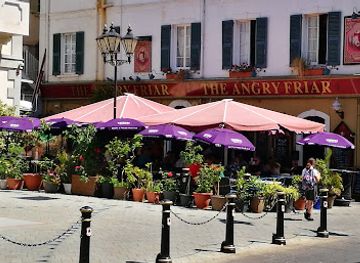
The Angry Friar
Discover the heart of Gibraltar at The Angry Friar, a lively pub offering delicious local cuisine and a vibrant atmosphere for all visitors.
1 min walk · 0.1 km from city centre

Best nightclubs in Main Street
Evenings around Main Street tend to be sociable and relaxed rather than dominated by large nightclubs. Casemates Square is the main central gathering point, with bars and restaurants extending into the surrounding town centre, while Irish Town and nearby lanes offer pubs and smaller venues. Gibraltar’s British connections are visible in its pub culture, but Spanish and Mediterranean influences shape the late-evening pace and outdoor social life. Live music, seasonal events and performances may add activity to the central squares, while the Gibraltar Music Festival and other cultural programmes vary from year to year. Nightlife is more concentrated in the compact centre than spread across separate districts, and the atmosphere can change markedly between busy event periods and quieter evenings.
-
Pub
The Angry Friar
Experience the vibrant culture of Gibraltar at The Angry Friar, a local pub offering a delightful mix of drinks and traditional cuisine.
1 min walk · 0.1 km from city centre
Best shops in Main Street
Main Street is Gibraltar’s principal shopping route, with a pedestrianised commercial stretch extending between Casemates Square and the older lanes of the town centre. Shops range from everyday retailers and pharmacies to jewellers, fashion outlets, cafés and businesses serving visitors, while Irish Town contributes smaller premises and a more irregular historic streetscape. The territory’s tax arrangements have long helped shape its reputation for shopping, although prices and any duty advantages vary by product and should be compared rather than assumed. Souvenirs commonly draw on Gibraltar’s identity, including miniature Rock imagery, British-themed goods and locally branded products, while food shops reflect Spanish and Mediterranean proximity. The lanes around the main route can be more rewarding for browsing independent businesses than the larger commercial frontages, and Casemates Square provides a natural starting point for exploring.
-
Home goods store
Pashmina
Explore Pashmina in Gibraltar for exquisite home goods that blend quality and local craftsmanship, perfect for souvenirs or home enhancements.
1 min walk · 0.1 km from city centre
-
Store
Namaste
Explore the unique offerings at Namaste, Gibraltar's charming store featuring handcrafted goods and local souvenirs that capture the spirit of the region.
1 min walk · 0.1 km from city centre
-
Women's clothing store
FLASH BOUTIQUE GIBRALTAR
Explore the stylish offerings at Flash Boutique Gibraltar, your go-to destination for women's fashion in the heart of Gibraltar.
1 min walk · 0.1 km from city centre


Get your free copy of our complete guide to Main Street, delivered straight to you.
Everything on this page, from attractions and restaurants to essentials and local phrases, in one PDF you can read offline, print or share.
Already have an account? Sign in
Your Main Street guide is ready.
We'll send it to · Not you? Sign out

Getting your guide ready…
We are putting together a fresh copy of the Main Street guide. This can take up to a minute.
This can take a few moments. If your browser asks, choose Allow so the download can start. You'll find the guide in your Downloads folder.
Nothing happened? Download it again
Sorry, the guide is taking longer than usual. Please try again in a minute, or get it by email instead.
Main Street essentials
Currency and Payment
Safety
Emergency Situations
Do's and Don'ts
Local Tips
From Eve
Local phrases worth knowing
You don't need to get them perfect. A few words go a long way, and locals appreciate the effort.
Basics
| English | Local | Say it |
|---|---|---|
| Hello | Hola | [o-la] |
| Goodbye | Adiós | [a-di-ós] |
| Yes | Sí | [sí] |
| No | No | [no] |
| Please/You're welcome | Por favor/De nada | [por fa-vor/de na-da] |
| Thank you | Gracias | [gra-cias] |
| Excuse me/Sorry | Perdón/Lo siento | [per-dón/lo cien-to] |
| How are you? | ¿Cómo estás? | [¿có-mo es-tás?] |
| Fine. And you? | Bien. ¿Y tú? | [bien. ¿y tú?] |
| Do you speak English? | ¿Hablas inglés? | [¿ha-blas in-glés?] |
| I don't understand | No entiendo | [no en-tien-do] |
Eating & Drinking
| English | Local | Say it |
|---|---|---|
| I'd like to see the menu, please | Me gustaría ver el menú, por favor | [me gus-ta-ría ver el me-nú, por fa-vor] |
| I don't eat meat | No como carne | [no co-mo car-ne] |
| Cheers! | ¡Salud! | [¡sa-lud!] |
| I would like to pay, please | Me gustaría pagar, por favor | [me gus-ta-ría pa-gar, por fa-vor] |
Emergencies
| English | Local | Say it |
|---|---|---|
| Help! | ¡Ayuda! | [¡a-yu-da!] |
| Go away! | ¡Vete! | [¡ve-te!] |
| Call the Police! | ¡Llama a la Policía! | [¡ya-ma a la po-li-cía!] |
| Call a doctor! | ¡Llama a un médico! | [¡ya-ma a un mé-di-co!] |
| I'm lost | Estoy perdido/a | [es-toy per-di-do/a] |
| I'm ill | Estoy enfermo/a | [es-toy en-fer-mo/a] |
Shopping
| English | Local | Say it |
|---|---|---|
| I'd like to buy... | Me gustaría comprar... | [me gus-ta-ría com-prar...] |
| I'm just looking | Solo estoy mirando | [so-lo es-toy mi-ran-do] |
| How much is it? | ¿Cuánto cuesta? | [¿cuan-to cues-ta?] |
| That's too expensive | Esto es demasiado caro | [es-to es de-ma-sia-do ca-ro] |
| Can you lower the price? | ¿Puedes bajar el precio? | [¿pue-des ba-jar el pre-cio?] |
Time & Numbers
| English | Local | Say it |
|---|---|---|
| What time is it? | ¿Qué hora es? | [¿qué ho-ra es?] |
| It's one o'clock | Es la una en punto | [es la u-na en pun-to] |
| Half past (10) | Las diez y media | [las diez y me-dia] |
| Morning | Mañana | [ma-ña-na] |
| Afternoon | Tarde | [tar-de] |
| Evening | Noche | [no-che] |
| Yesterday | Ayer | [a-yer] |
| Today | Hoy | [hoy] |
| Tomorrow | Mañana | [ma-ña-na] |
| 1 | Uno | [u-no] |
| 2 | Dos | [dos] |
| 3 | Tres | [tres] |
| 4 | Cuatro | [cua-tro] |
| 5 | Cinco | [cin-co] |
| 6 | Seis | [seis] |
| 7 | Siete | [sie-te] |
| 8 | Ocho | [o-cho] |
| 9 | Nueve | [nue-ve] |
| 10 | Diez | [diez] |
Transport & Directions
| English | Local | Say it |
|---|---|---|
| Where's a/the...? | ¿Dónde está un/el...? | [¿dón-de es-tá un/el...?] |
| What's the address? | ¿Cuál es la dirección? | [¿cual es la di-rec-ción?] |
| Can you show me (on the map)? | ¿Puedes mostrarme (en el mapa)? | [¿pue-des mos-trar-me (en el ma-pa)?] |
| When's the next (bus)? | ¿Cuándo es el próximo (autobús)? | [¿cuan-do es el pró-xi-mo (au-to-bús)?] |
| A ticket (to ....) | Un billete (a ....) | [un bi-lle-te (a ....)] |
History of Main Street
Early Peoples and Mediterranean Voyages
The Rock of Gibraltar has been associated with human activity since prehistoric times, most famously through Neanderthal remains found in caves on the eastern and southern sides of the territory. Its position at the entrance to the Mediterranean also gave it importance to ancient seafarers. Phoenician activity in the wider region and later Greek and Roman connections reflect Gibraltar’s place on maritime routes between Europe and North Africa, although the present alignment and commercial role of Main Street belong to much later urban development. The limestone Rock remained the defining geographical feature, offering a commanding position over the Strait and a natural landmark for vessels approaching the Mediterranean.
Muslim Rule and the Moorish Town
In 711, forces associated with the Umayyad conquest of Iberia landed at or near Gibraltar, which became known in Arabic as Jabal Tariq, the mountain of Tariq. Muslim rule lasted for several centuries, interrupted by changes in regional power, and left the territory’s most enduring medieval remains. The Moorish Castle and fortified walls on the Rock testify to Gibraltar’s military value, while the lower settlement developed around the protected northern approach. Main Street does not preserve a single intact medieval streetscape, but its position within the old town reflects the importance of that defended urban area. The town’s later buildings were repeatedly altered as control of Gibraltar changed.
Castilian Conquest and Spanish Gibraltar
Castilian forces captured Gibraltar from the Nasrid rulers of Granada in 1462, bringing the territory into the Christian kingdoms of Iberia. Gibraltar became part of the Crown of Castile and subsequently Spain, and its fortifications were strengthened because control of the Strait remained strategically important. The settlement endured attacks and periods of insecurity, with military works shaping the location and circulation of the lower town. Religious and civic institutions established under Spanish rule helped form the historical framework around today’s central streets, even though many visible buildings were later rebuilt. The Cathedral of the Holy Mary the Crowned, at the southern end of Main Street, stands as a continuing reminder of the Spanish period and the town’s Catholic heritage.
British Capture and the Treaty of Utrecht
An Anglo-Dutch force captured Gibraltar in 1704 during the War of the Spanish Succession. Spain’s cession of the territory to Britain was confirmed by the Treaty of Utrecht in 1713, subject to the treaty’s terms. The change of sovereignty transformed the town’s administration, population and military role. Many Spanish residents left, while new communities arrived from Britain, Genoa, Portugal, Malta, North Africa and elsewhere around the Mediterranean. English became central to public life, but the resulting society remained linguistically and culturally mixed. Main Street developed as the principal commercial route through this British garrison town, linking military infrastructure with shops, offices, religious institutions and the daily life of a growing civilian population.
The Great Siege and the Garrison Town
From 1779 to 1783, Spanish and French forces conducted the Great Siege of Gibraltar, one of the longest and most intense sieges of the eighteenth century. The garrison resisted through bombardment, shortages and attacks from land and sea, and the conflict reinforced Gibraltar’s military significance within British strategy. The town around Main Street was closely connected to the defensive system, although much of the visible central architecture dates from rebuilding and later adaptation. Military works, gates and open spaces continued to control movement between the harbour, settlement and Upper Rock. The siege became a defining episode in Gibraltar’s historical identity and remains central to the interpretation of its museums and fortifications.
War, Evacuation and Modern Gibraltar
Gibraltar’s strategic position again became decisive during the Second World War, when much of the civilian population was evacuated while the territory served as a British military base and naval staging point. The post-war return of residents and the gradual expansion of civilian institutions strengthened Gibraltar’s modern identity. Political relations with Spain brought further pressure, including the closure of the land frontier in 1969 and its reopening in stages from 1982. Today, Main Street combines government, retail and heritage functions within a territory whose constitutional relationship with the United Kingdom remains distinctive. Its busy pedestrian centre therefore sits within a continuing story of strategic geography, cultural mixture and political complexity.
Main Street in Photos
Browse through our photo collection highlighting the charm and character of the destination.
Cities near Main Street
The closest cities to Main Street, if you have time for more than one stop.
-

-

-
-

-


Swipe for more cities
Explore more

Explore more of Gibraltar
Discover Gibraltar, a unique blend of British and Spanish cultures, stunning natural beauty, and rich history at the gateway to the Mediterranean.
Explore Gibraltar