

Ladadika (Thessaloniki) Travel Guide - Free
Explore Ladadika in Thessaloniki with Evendo's free guide. Find the best shops, historic streets, restaurants, and gems on web or mobile.


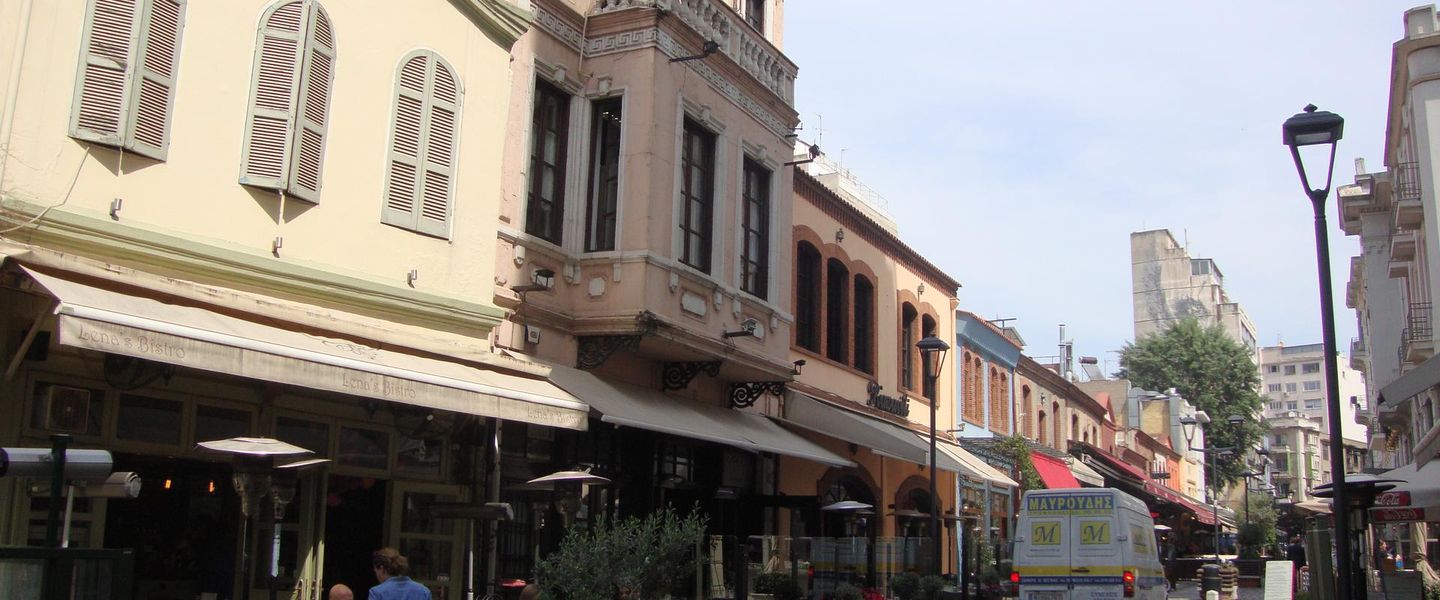


Ladadika in Thessaloniki brings restored Ottoman-era warehouses, meze tavernas, live music, harbour walks and late-night dining to the city's historic port quarter.
Warehouses by the Harbour
Ladadika occupies a compact quarter beside Thessaloniki’s old commercial port, west of Aristotelous Square and close to the waterfront. Its name comes from the Greek word ladi, meaning oil, recalling the merchants and warehouses that once handled olive oil and other provisions here. The area’s surviving nineteenth-century and early twentieth-century buildings, with rendered façades, timber details and broad warehouse interiors, give its narrow streets a distinctive mercantile character.Read more about Ladadika
From Trade District to Evening Quarter
Food, Music and Port-Side Strolls
Best attractions in Ladadika
Ladadika’s principal attraction is the quarter itself: a walk through Katouni, Syngrou and the connecting lanes reveals restored merchant buildings, painted façades, timber details and former warehouses adapted for restaurants and bars. The compact street plan makes it easy to move between architectural details, small squares and the port edge without following a fixed sightseeing route. At the southern side, the harbour setting opens towards the water and the broader port precinct, where the Thessaloniki Cinema Museum occupies a former warehouse and explores the history of Greek cinema through film equipment, posters and archival material. Aristotelous Square and the central markets of Kapani and Modiano are nearby rather than part of Ladadika proper, but they can be included in a longer walking circuit. The quarter is particularly rewarding when visited twice: in daylight for its built fabric and after dark for its social atmosphere.
-
Tourist attraction
Aristotle Square Clock
Experience the charm of Thessaloniki at the Aristotle Square Clock, a floral landmark in the city's most vibrant square.
4 min walk · 0.3 km from neighbourhood centre

Best landmarks in Ladadika
Ladadika’s landmarks are chiefly architectural: its preserved warehouse blocks, narrow lanes and port-related commercial buildings form a coherent record of Thessaloniki’s trading past. Katouni Street is the best-known spine, while Syngrou and the surrounding lanes display the scale and texture of the former merchant quarter, including upper-storey façades above contemporary restaurant fronts. The buildings are significant less for monumental decoration than for their relationship to storage, commerce and the harbour. At the edge of the wider port precinct, the former warehouse now used by the Thessaloniki Cinema Museum adds a cultural landmark connected with the city’s film history. Aristotelous Square and the port passenger buildings are close reference points, but they lie outside the core of Ladadika. Together, these structures show how a practical commercial district was retained and given new cultural and hospitality uses.
-
Monument
Statue of Eleftherios Venizelos
A tribute to a visionary leader and a symbol of Greek heritage in the heart of Thessaloniki, easily accessible on Egnatia Street.
3 min walk · 0.2 km from neighbourhood centre
-
Historical landmark
Emilianos Lazaridis Monument
A historical landmark in Thessaloniki honoring Emilianos Lazaridis, reflecting the city's rich cultural and historical identity.
3 min walk · 0.2 km from neighbourhood centre


Explore Ladadika on the map
A handpicked selection of must-see spots in Ladadika, mapped for you.
Best hotels in Ladadika
Best bars in Ladadika
Ladadika is primarily an evening quarter, with its former warehouses accommodating bars, music venues and late-opening restaurants. The atmosphere begins with drinks and conversation around Katouni and Syngrou before becoming livelier later at venues offering DJs, Greek music or other programmed entertainment. Rather than functioning as one large club strip, the district is a cluster of small-to-medium spaces where dining and nightlife overlap, making it possible to move between a meze meal, a bar and a music venue on foot. Some evenings are energetic and crowded, while daytime streets can feel almost quiet once deliveries and commercial activity have finished. The port and central streets provide additional evening options nearby, but venues outside Ladadika should not be treated as part of the quarter. Visitors should expect noise around busy premises and show consideration to residents and workers when leaving late.
-
Bar
OLD str. Downtown Bar
OLD str. Downtown Bar in Thessaloniki: A lively bar offering exquisite cocktails and a vibrant atmosphere perfect for unwinding after a day of exploration.
3 min walk · 0.2 km from neighbourhood centre

Best shops in Ladadika
Shopping in Ladadika is limited compared with Thessaloniki’s central retail streets, because the quarter’s commercial identity now centres on food, drink and evening hospitality rather than everyday retail. Visitors will find small specialist businesses and gift-oriented shops among the restaurants, but the principal pleasure is browsing the architecture and moving between the port quarter and the markets immediately to the east. Kapani Market, near the boundary of the historic centre, offers produce, spices, fish, meat and household goods, while Modiano Market provides a more formally redeveloped market environment; both are nearby rather than strictly within Ladadika. Egnatia and Tsimiski supply broader shopping, from independent businesses to mainstream retailers. The contrast is useful: Ladadika preserves the atmosphere of a former wholesale district, while the adjacent markets reveal the continuing importance of food commerce in central Thessaloniki.
-
Women's clothing store
Kellys Shop & Accessories
Explore Kellys Shop & Accessories in Thessaloniki – your go-to destination for stylish women's clothing and unique accessories.
3 min walk · 0.2 km from neighbourhood centre
-
Gift shop
Tο ανέκδοτο
Explore Tο ανέκδοτο in Thessaloniki for an unforgettable shopping experience filled with unique gifts and local artistry.
3 min walk · 0.3 km from neighbourhood centre
-
Souvenir store
Souvenirs from Thessaloniki
Explore Thessaloniki's vibrant culture through unique souvenirs, crafted with love by local artisans, perfect for memories and gifts.
2 min walk · 0.2 km from neighbourhood centre


Ladadika essentials
Getting There
Getting Around
Safety
Emergency Situations
Do's and Don'ts
Local Tips

From Eve
Local phrases worth knowing
You don't need to get them perfect. A few words go a long way, and locals appreciate the effort.
Basics
| English | Local | Say it |
|---|---|---|
| Hello | Γεια σας | [Ya sas] |
| Goodbye | Αντίο | [Adio] |
| Yes | Ναι | [Ne] |
| No | Όχι | [Ohi] |
| Please/You're welcome | Παρακαλώ | [Parakalo] |
| Thank you | Ευχαριστώ | [Efharisto] |
| Excuse me/Sorry | Συγνώμη | [Signomi] |
| How are you? | Πώς είσαι; | [Pos ise;] |
| Fine. And you? | Καλά. Εσύ; | [Kala. Esi;] |
| Do you speak English? | Μιλάτε Αγγλικά; | [Milate Anglika;] |
| I don't understand | Δεν καταλαβαίνω | [Den katalaveno] |
Eating & Drinking
| English | Local | Say it |
|---|---|---|
| I'd like to see the menu, please | Θα ήθελα να δω το μενού, παρακαλώ | [Tha ithela na do to menu, parakalo] |
| I don't eat meat | Δεν τρώω κρέας | [Den troo kreas] |
| Cheers! | ΥΓΕΙΑ! | [Yia] |
| I would like to pay, please | Θα ήθελα να πληρώσω, παρακαλώ | [Tha ithela na plirososso, parakalo] |
Emergencies
| English | Local | Say it |
|---|---|---|
| Help! | Βοήθεια! | [Voithia!] |
| Go away! | Φύγε! | [Fiye!] |
| Call the Police! | Καλέστε την Αστυνομία! | [Kaleste tin Astinomia!] |
| Call a doctor! | Καλέστε ένα γιατρό! | [Kaleste ena giatro!] |
| I'm lost | Έχω χαθεί | [Eho hafi] |
| I'm ill | Είμαι άρρωστος | [Ime arrostos] |
Shopping
| English | Local | Say it |
|---|---|---|
| I'd like to buy... | Θα ήθελα να αγοράσω... | [Tha ithela na agoraso...] |
| I'm just looking | Απλά κοιτάω | [Apla kitao] |
| How much is it? | Πόσο κοστίζει; | [Poso kostizi;] |
| That's too expensive | Αυτό είναι πολύ ακριβό | [Afto ine poli akribo] |
| Can you lower the price? | Μπορείτε να χαμηλώσετε την τιμή; | [Borite na hamilosete tin timi;] |
Time & Numbers
| English | Local | Say it |
|---|---|---|
| What time is it? | Τι ώρα είναι; | [Ti ora ine;] |
| It's one o'clock | Είναι μία ώρα | [Ine mia ora] |
| Half past (10) | Μισή (10) | [Misi (Deka)] |
| Morning | Πρωί | [Proi] |
| Afternoon | Απόγευμα | [Apoyevma] |
| Evening | Βράδυ | [Vradi] |
| Yesterday | Χθες | [Hthes] |
| Today | Σήμερα | [Simera] |
| Tomorrow | Αύριο | [Avrio] |
| 1 | Ένα | [Ena] |
| 2 | Δύο | [Dio] |
| 3 | Τρία | [Tria] |
| 4 | Τέσσερα | [Tessera] |
| 5 | Πέντε | [Pente] |
| 6 | Έξι | [Exi] |
| 7 | Εφτά | [Efta] |
| 8 | Οκτώ | [Okto] |
| 9 | Εννέα | [Ennea] |
| 10 | Δέκα | [Deka] |
Transport & Directions
| English | Local | Say it |
|---|---|---|
| Where's a/the...? | Πού είναι ένα/το...; | [Pou ine ena/to...;] |
| What's the address? | Ποια είναι η διεύθυνση; | [Pia ine i diefthinsi;] |
| Can you show me (on the map)? | Μπορείτε να μου δείξετε (στο χάρτη); | [Borite na mu dixete (sto charti);] |
| When's the next (bus)? | Πότε είναι το επόμενο (λεωφορείο); | [Pote ine to epomeno (leoforeio);] |
| A ticket (to ....) | Ένα εισιτήριο (για το...); | [Ena isitirio (ya to...);] |
History of Ladadika
An Ottoman Commercial Quarter
Ladadika developed as a commercial area beside Thessaloniki’s port during the Ottoman period, when the harbour connected the city with wider Mediterranean and Balkan trade networks. Its name refers to ladi, or oil, reflecting the oil merchants and storage businesses that operated in the quarter. Warehouses, shops and offices occupied dense plots close to the water, while the area’s mixed commercial life was shaped by the city’s diverse trading communities. The surviving street pattern and several substantial merchant buildings still reveal this relationship with port commerce, even though the original businesses have largely disappeared.
Warehouses and Wholesale Trade
During the late nineteenth and early twentieth centuries, Ladadika functioned principally as a district of warehouses, food merchants, workshops and wholesale premises. Its proximity to the port made it practical for receiving, storing and distributing imported and locally produced goods. The buildings were generally designed for business rather than display, with robust masonry, generous ground-floor openings and upper rooms used by firms or storage operations. This utilitarian architecture distinguished Ladadika from Thessaloniki’s grander civic avenues while tying it closely to the city’s economic life.
The Port After the 1917 Fire
The catastrophic fire of 1917 transformed much of central Thessaloniki, but Ladadika retained a notable group of commercial structures and its underlying street layout. Reconstruction and changing port practices gradually altered the quarter’s role. Modern transport, new commercial premises and the concentration of port activity elsewhere reduced the importance of the old warehouses, while workshops and storage uses continued in a more modest form. Ladadika consequently became less prominent in the city’s economic geography even as its historic buildings preserved evidence of an earlier trading era.
Restoration and Adaptive Reuse
By the late twentieth century, disuse and deterioration had made Ladadika a candidate for urban renewal. Restoration initiatives preserved façades and warehouse forms while allowing many interiors to acquire new commercial uses. Former storage buildings became restaurants, cafés, bars and music venues, and the district emerged as an evening destination without losing its association with the port. This change formed part of a wider revaluation of Thessaloniki’s historic centre, in which industrial and commercial buildings were treated as cultural assets rather than obstacles to redevelopment.
A Contemporary Heritage Quarter
Today Ladadika is recognised through its preserved built environment and its role in Thessaloniki’s dining and nightlife culture. The quarter no longer operates as an oil-trading district, yet its identity remains rooted in the relationship between commerce, warehouses and the harbour. Its successful restaurants and bars sit alongside traces of older working uses, while nearby port redevelopment and cultural venues continue to influence how the area is experienced. The tension between heritage conservation, entertainment and everyday city life is central to Ladadika’s contemporary character.
Ladadika in Photos
Browse through our photo collection highlighting the charm and character of the destination.
Neighbourhoods near Ladadika
The closest neighbourhoods to Ladadika, if you have time for more than one stop.
-
-
-

-


Swipe for more neighbourhoods
Explore more

Explore more of Thessaloniki
Thessaloniki blends Roman and Byzantine landmarks, waterfront promenades, lively markets and northern Greek cuisine in Greece’s cultural capital.
Explore Thessaloniki