Ishtar Gate Travel Guide
Free Guide: Step back in time at the Ishtar Gate, a stunning replica of Babylon's ancient entrance, adorned with vibrant symbols of power and divinity.


A brief summary of Ishtar Gate
Step back in time at the Ishtar Gate, a stunning replica of Babylon's ancient entrance, adorned with vibrant symbols of power and divinity.
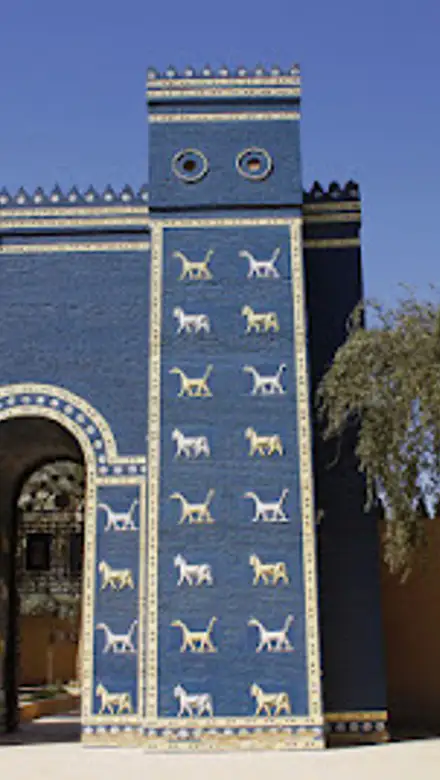
The Ishtar Gate, originally constructed in Babylon around 575 BC by order of King Nebuchadnezzar II, served as the grand entrance to the inner city. Adorned with glazed blue bricks and bas-reliefs of dragons, bulls, and lions, it symbolized the power and splendor of the Neo-Babylonian Empire. Today, a replica stands in Hillah, near the site of ancient Babylon, offering a glimpse into this civilization's rich history and architectural prowess.
Opening hours
- Mon8 am–11:30 pm
- Tue8 am–11:30 pm
- Wed8 am–11:30 pm
- Thu8 am–11:30 pm
- Fri8 am–11:30 pm
- Sat10 am–9 pm
- Sun9 am–7:30 pm
Opening hours as listed on the venue’s Google Business Profile. Hours can change for services and special events, so check with the venue before you go.
- Address
- GCVF+C2X, Hillah, Babylon Governorate
- Phone
Getting there
Public Transport
Car
Discover more about Ishtar Gate
Overview
The Ishtar Gate was the eighth gate to the inner city of Babylon and was constructed circa 575 BC during the reign of King Nebuchadnezzar II. Dedicated to the Babylonian goddess Ishtar, the gate was a key part of Nebuchadnezzar's plan to beautify his empire's capital. The gate served as the main entrance to the city and was the starting point of the Processional Way.The gate itself was a double gate, with a smaller frontal gate and a larger, more grandiose posterior section. The walls were made of glazed bricks, predominantly blue, and adorned with alternating rows of bas-reliefs depicting mušḫuššu (dragons), aurochs (bulls), and lions, symbolizing the gods Marduk, Adad, and Ishtar respectively. The roof and doors of the gate were constructed from cedar.Excavated by German archaeologist Robert Koldewey between 1902 and 1914, the Ishtar Gate was transported to Berlin, where a reconstruction was completed in the Pergamon Museum in 1930. The reconstructed gate stands 14 meters (46 feet) high and 30 meters (100 feet) wide. While the original gate was a double gate, the Pergamon Museum only displays the smaller, frontal part. Other panels and fragments from the gate's facade are located in museums around the world. A replica of the Ishtar Gate has been erected in Babylon, near Hillah, allowing visitors to experience the grandeur of the original structure in its historical setting.Visiting the Ishtar Gate offers a unique opportunity to connect with the art, architecture, and religious symbolism of ancient Mesopotamia.
Evendo Review Centre
 Google
Guest reviews
Explore Ishtar Gate on the map
A handpicked selection of must-see spots near Ishtar Gate, mapped for you.
Get your free copy of our complete guide to Ishtar Gate, delivered straight to you.
Everything on this page, from opening hours and how to get there to Eve’s tips and the best time to go, in one PDF you can read offline, print or share.
Already have an account? Sign in
Your Ishtar Gate guide is ready.
We'll send it to · Not you? Sign out

Getting your guide ready…
We are putting together a fresh copy of the Ishtar Gate guide. This can take up to a minute.
This can take a few moments. If your browser asks, choose Allow so the download can start. You'll find the guide in your Downloads folder.
Nothing happened? Download it again
Sorry, the guide is taking longer than usual. Please try again in a minute, or get it by email instead.
Other nearby places you may find interesting
The closest places of the same kind, if this one is not quite what you had in mind.
-
-
-
-
-


Swipe for more places
More to explore near Ishtar Gate

 Best experiences near Ishtar Gate
 Best hotels near Ishtar Gate
 Best landmarks near Ishtar Gate
 Best attractions near Ishtar Gate
 Best shops near Ishtar Gate
 Best restaurants near Ishtar Gate
 Best bars near Ishtar Gate
Do you manage this location?
Take control to get all the benefits, like improved information, better appearance, and stronger visibility across AI-powered discovery.
Explore more

Explore more of Muthanna
Explore Muthanna, Iraq: A blend of ancient history and natural beauty. Discover the ruins of Uruk, the Ziggurat of Ur, and the serene landscapes of the Euphrates River.
Explore Muthanna
Explore more of Iraq
Explore the cradle of civilization in Iraq, where ancient history, rich culture, and diverse landscapes create an unforgettable travel experience.
Explore Iraq