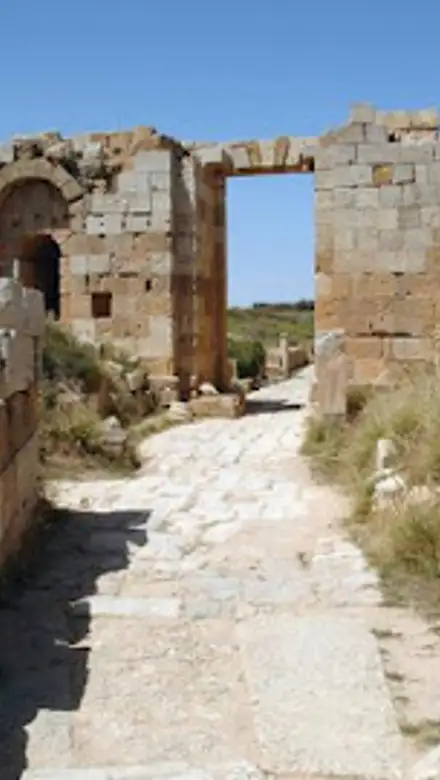
Byzantine Gate, Leptis Magna Travel Guide
Free Guide: Explore the Byzantine Gate in Leptis Magna, a testament to the city's enduring history and architectural transformations under Byzantine rule.


A brief summary of Byzantine Gate
Explore the Byzantine Gate in Leptis Magna, a testament to the city's enduring history and architectural transformations under Byzantine rule.
The Byzantine Gate in Leptis Magna is a historical landmark offering a glimpse into the city's later transformations under Byzantine rule. Built in the 6th century AD, it stands as a testament to the city's resilience after centuries of Roman prominence and subsequent Vandal conquest. The gate marks a transition in Leptis Magna's history, representing a shift in power and architectural style.
- Address
- J7QV+CMW, Leptis Magna
Getting there
Walking
Discover more about Byzantine Gate
Overview
The Byzantine Gate at Leptis Magna marks a significant chapter in the city's long and storied past. Constructed in the 6th century AD, during the Byzantine re-occupation of the city, the gate represents a period of rebuilding and fortification following earlier destruction. It stands not as an original Roman structure, but as a modification and reuse of existing elements, reflecting the changing fortunes of Leptis Magna.Originally, the gate was built to replace a prior arch over the Cardo, which was erected nearly five centuries prior. The initial arch was an honorific monument dedicated to Emperor Vespasian and his son Titus in 77 or 78 AD. The Byzantine gate was erected during the reign of Emperor Justinian when the Byzantine general Belisarius reconquered Carthage. Leptis, Oea, and Sabratha were then reintegrated into the Roman Empire.As you approach the gate, you'll notice the architectural adaptations, incorporating elements from earlier Roman structures. This reflects a practical approach to construction during a time of reduced resources, as well as a shift in the city's strategic needs. While it may not possess the same level of ornamentation as the grander Roman monuments, the Byzantine Gate offers a unique insight into the city's evolving identity.Today, the Byzantine Gate serves as a starting point for exploring the extensive ruins of Leptis Magna. It provides a tangible connection to the late antique period of the city, bridging the gap between its Roman heyday and its eventual decline. Exploring the gate allows visitors to appreciate the layers of history embedded within this remarkable UNESCO World Heritage Site.
Evendo Review Centre
 Google
Guest reviews
Explore Byzantine Gate on the map
A handpicked selection of must-see spots near Byzantine Gate, mapped for you.
Get your free copy of our complete guide to Byzantine Gate, delivered straight to you.
Everything on this page, from opening hours and how to get there to Eve’s tips and the best time to go, in one PDF you can read offline, print or share.
Already have an account? Sign in
Your Byzantine Gate guide is ready.
We'll send it to · Not you? Sign out

Getting your guide ready…
We are putting together a fresh copy of the Byzantine Gate guide. This can take up to a minute.
This can take a few moments. If your browser asks, choose Allow so the download can start. You'll find the guide in your Downloads folder.
Nothing happened? Download it again
Sorry, the guide is taking longer than usual. Please try again in a minute, or get it by email instead.
Other nearby places you may find interesting
The closest places of the same kind, if this one is not quite what you had in mind.
-
-

-
-
-


Swipe for more places
More to explore near Byzantine Gate

 Best experiences near Byzantine Gate
 Best hotels near Byzantine Gate
 Best landmarks near Byzantine Gate
 Best attractions near Byzantine Gate
 Best shops near Byzantine Gate
 Best restaurants near Byzantine Gate
 Best bars near Byzantine Gate
Do you manage this location?
Take control to get all the benefits, like improved information, better appearance, and stronger visibility across AI-powered discovery.
Explore more

Explore more of Leptis Magna
Discover Leptis Magna, Libya's hidden gem and one of the best-preserved Roman cities in the Mediterranean, offering an unparalleled glimpse into ancient history.
Explore Leptis Magna
Explore more of Libya
Discover Libya: Ancient ruins, vast deserts, and Mediterranean charm await in this North African gem.
Explore Libya