

Mold Castle Travel Guide
Free Guide: Explore the historic Norman earthworks of Mold Castle, a serene memorial garden blending medieval heritage with community spirit in Flintshire.


A brief summary of Mold Castle
Explore the historic Norman earthworks of Mold Castle, a serene memorial garden blending medieval heritage with community spirit in Flintshire.
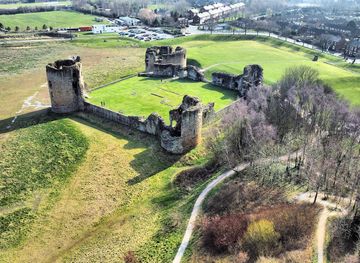
Mold Castle, also known as Bailey Hill, is a historic motte-and-bailey castle mound in Mold, Flintshire, Wales. Erected around 1072 by Norman forces, the site offers a glimpse into medieval military architecture and local history. Today, it serves as a peaceful memorial garden honoring Mold's World War I soldiers, featuring green spaces, a bowling green, and tennis courts, blending heritage with community recreation.
On-site amenities
 Restrooms
 Seating areas
 Information boards
 Picnic areas
 Trash bins
Opening hours
- Every dayOpen 24 hours
Opening hours as listed on the venue’s Google Business Profile. Hours can change for services and special events, so check with the venue before you go.
- Address
- Pwll Glas, Mold CH7 1BL
- Website
Getting there
Bus
Train and Taxi
Car
Discover more about Mold Castle
Origins and Norman Foundations
Mold Castle, locally called Castell yr Wyddgrug and often referred to as Bailey Hill, stands as a significant Norman motte-and-bailey fortress constructed circa 1072. It is believed to have been established by Robert de Montalt under the directive of Hugh d'Avranches, Earl of Chester. The castle was built atop an existing earthwork, a strategic high mound that likely influenced the town's name, derived from a corruption of 'mont haut' meaning 'high hill.' This early fortification played a pivotal role in Norman control over the region during the turbulent post-Conquest era.
Medieval Conflict and Shifting Control
Throughout the 12th and 13th centuries, Mold Castle was a focal point of military conflict, changing hands multiple times between Norman and Welsh forces. It was captured by the Welsh prince Owain Gwynedd in 1146 after several failed sieges, illustrating the fierce resistance against Norman expansion. The castle later came under the control of Llywelyn ab Iorwerth and was refortified before being seized by Dafydd ap Llywelyn in 1245. Its strategic importance is underscored by records of royal expenditure and supply, indicating its sustained use as a defensive stronghold amid ongoing regional power struggles.
Transformation into a Memorial and Public Space
By the late 18th century, the castle site passed to the Mostyn family, who enhanced it by erecting a stone wall and planting trees, converting the former fortress into a landscaped garden. In 1890, Mold Council acquired the land, and by 1920 it was designated as a memorial garden dedicated to local soldiers who fell in World War I. The grounds now encompass the original motte mound, surrounded by the rectangular bailey, with recreational features such as a bowling green and tennis courts. Recent restoration efforts have revitalized the park, including archaeological excavations revealing masonry remnants, and the addition of ramps and a performance space, blending heritage preservation with community use.
Architectural and Archaeological Features
Today, the visible remains of Mold Castle consist primarily of the conical motte mound and the enclosing bailey earthworks. Excavations have uncovered a large masonry wall on the inner bailey's edge, suggesting that the original castle may have had timber structures supported by stone fortifications. While no stone castle was fully developed on the site, the earthworks remain exceptionally well-preserved, offering valuable insight into Norman military architecture and medieval defensive strategies in Wales.
Local Significance and Visitor Experience
Mold Castle holds cultural and historical significance as a symbol of Norman influence and Welsh resistance. Its location near the 15th-century St Mary's Church situates it within the heart of Mold town, making it accessible for visitors interested in history and heritage. The memorial garden setting provides a tranquil environment for reflection and recreation, with mature trees and open green spaces inviting leisurely walks and community gatherings. The site’s restoration and interpretation efforts enhance visitor understanding of its layered past.
Preservation and Future Prospects
Managed as a scheduled ancient monument and town park, Mold Castle benefits from ongoing conservation initiatives aimed at protecting its archaeological integrity while accommodating public use. The addition of interpretive signage and performance areas fosters educational and cultural engagement. As a heritage landmark, it continues to link the community with its medieval roots and commemorates local contributions to national history, ensuring its relevance for future generations.
Evendo Review Centre
 Google
Guest reviews
Best time to go
Quietest: Jan, Feb & Dec · before 6am or at 9pm
Busy times are Evendo estimates for a typical year, to help you plan. Actual crowds vary with events, school holidays and the weather.
Explore Mold Castle on the map
A handpicked selection of must-see spots near Mold Castle, mapped for you.
Get your free copy of our complete guide to Mold Castle, delivered straight to you.
Everything on this page, from opening hours and how to get there to Eve’s tips and the best time to go, in one PDF you can read offline, print or share.
Already have an account? Sign in
Your Mold Castle guide is ready.
We'll send it to · Not you? Sign out

Getting your guide ready…
We are putting together a fresh copy of the Mold Castle guide. This can take up to a minute.
This can take a few moments. If your browser asks, choose Allow so the download can start. You'll find the guide in your Downloads folder.
Nothing happened? Download it again
Sorry, the guide is taking longer than usual. Please try again in a minute, or get it by email instead.
Other nearby places you may find interesting
The closest places of the same kind, if this one is not quite what you had in mind.
-
-
-
-
-


Swipe for more places
More to explore near Mold Castle

 Best experiences near Mold Castle
 Best hotels near Mold Castle
 Best landmarks near Mold Castle
 Best attractions near Mold Castle
 Best shops near Mold Castle
 Best restaurants near Mold Castle
 Best bars near Mold Castle
Do you manage this location?
Take control to get all the benefits, like improved information, better appearance, and stronger visibility across AI-powered discovery.
Explore more
Explore more of Flintshire
Discover Flintshire: A blend of historic charm, captivating castles, and natural beauty in the heart of North East Wales.
Explore Flintshire
Explore more of United Kingdom
Discover the United Kingdom: A blend of rich history, stunning landscapes, and vibrant cities, offering a unique travel experience for every visitor.
Explore United Kingdom
