Background

The Samuels Clock: A Market Street Icon

Discover the historic Samuels Clock on Market Street, a timeless landmark witnessing San Francisco's evolution since 1915, blending Art Deco design with a touch of local lore.

3.7

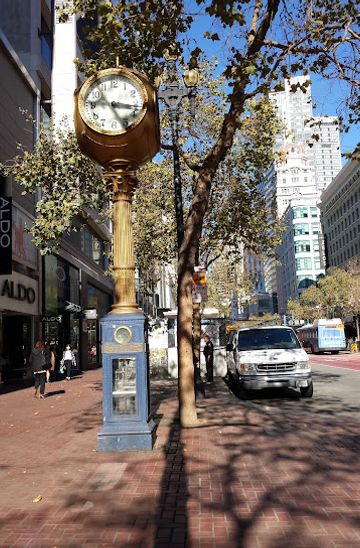
The Samuels Clock, a San Francisco landmark since 1915, stands proudly on Market Street near Union Square. Commissioned by Albert S. Samuels for his jewelry store, this ornate, eight-faced clock has witnessed over a century of San Francisco history, from the Panama-Pacific International Exposition to modern-day city life. Designed in an Art Deco style with Austrian craftsmanship, the clock features intricate details and a glimpse into its inner workings through glass panels. Though it has faced periods of disrepair and vandalism, dedicated volunteers and local benefactors have ensured its restoration and continued presence as a beloved symbol of the city. The clock serves as a reminder of San Francisco's resilience and enduring charm, making it a worthwhile stop for visitors exploring the downtown area.

A brief summary to The Samuels Clock

  • Market St, San Francisco, Union Square, California, 94102, US

Local tips

  • Check the clock's condition before visiting, as it is sometimes boarded up due to vandalism.
  • Visit during the day for better visibility and photo opportunities.
  • Explore nearby Union Square and the surrounding shops and restaurants.
widget icon

Getting There

  • Public Transport

    The Samuels Clock is easily accessible via public transportation. Several MUNI lines stop near the intersection of Market Street and 4th Street, including bus lines 5, 6, 7, 9, 14, and 31, as well as the F streetcar. The Powell Street BART and MUNI Metro station is also just a short walk away. A single MUNI fare is $3.00 for adults paying with cash or $2.75 when using a Clipper card or the MuniMobile app, which allows for unlimited transfers within 120 minutes. Cable car fare is $8 per trip.

  • Walking

    If you are already in the Union Square area, the Samuels Clock is within easy walking distance. Head southwest on Market Street towards 4th Street. The clock is located on the north side of Market Street, near the Flood Building. Be aware of pedestrian traffic and street conditions.

  • Taxi/Ride-Share

    Taxis and ride-sharing services like Uber and Lyft are readily available in San Francisco. A short ride from Union Square to the Samuels Clock will likely cost between $10 and $15, depending on traffic and demand. Be sure to confirm the fare before starting your trip.

  • Driving

    Driving to the Samuels Clock can be challenging due to traffic and limited parking. Several parking garages are located near Market Street and 4th Street, including the 5th and Mission Parking Garage and the Union Square Garage. Parking rates typically range from $4 to $8 per hour, with daily maximums ranging from $30 to $50. Be aware of street parking restrictions and meter fees, which typically cost $2-$4 per hour. Consider using a parking app like SpotHero or ParkWhiz to find and reserve parking in advance.

Unlock the Best of The Samuels Clock

Buy tickets

    No tickets available

Book tours with entry

    No tours available

Book tours without entry

    No tours available

Discover more about The Samuels Clock

The Samuels Clock, a San Francisco landmark, has been a fixture on Market Street since 1915. Originally commissioned by Albert S. Samuels, an Austrian immigrant and watchmaker, for his jewelry store, the clock was intended to coincide with the Panama-Pacific International Exposition, a celebration of the city's recovery from the devastating 1906 earthquake and fire. Samuels, who arrived in San Francisco in 1893, opened his own watchmaking business in 1909 and later commissioned Joseph Mayer of Seattle to construct the now-famous street clock. The clock's original location was in front of Samuels' Jewelry Store at 5th & Market Streets. In 1943, when Samuels moved his store to 856 Market Street, the clock followed, becoming a familiar sight next to the Flood Building. The clock's design blends Art Deco elements with Austrian craftsmanship, featuring a rectangular base with glass windows that offer a peek into the timepiece's intricate mechanisms. Above the base, the clock boasts eight faces, each displaying the time, and medallions bearing the slogan "Lucky," a nod to Samuels' jewelry store's branding as "The House of Lucky Wedding Rings." Over the decades, the Samuels Clock has witnessed significant events in San Francisco's history, including the general strike of 1934, labor leader Tom Mooney's parade after his pardon in 1939, V-J Day celebrations, and numerous 49ers' Super Bowl victory parades. It became an official San Francisco landmark in 1975, solidifying its place in the city's cultural heritage. However, the clock has not been without its challenges. It stopped working in 1990 and remained in disrepair for several years. Thanks to the efforts of the Market Street Timekeepers, a group of dedicated volunteers, and the financial support of James Flood, owner of the nearby Flood Building, the clock was restored to its original glory and rededicated on October 20, 2000. Despite its restoration, the Samuels Clock has faced ongoing issues with vandalism and neglect. The clock has been a frequent target of graffiti artists, and its maintenance has often been left to the owner of the property on which it stands. James Flood has consistently stepped in to fund repairs, but the clock's vulnerability remains a concern. The clock is often damaged and boarded up. The Samuels Clock also has a literary connection. Dashiell Hammett, the famous mystery writer, once worked for Samuels Jewelers as an advertising copywriter. Hammett incorporated the clock into his ads and even referenced it in at least one of his stories, adding another layer to its historical significance. Today, the Samuels Clock stands as a testament to San Francisco's past and its enduring spirit. While it may not always be in perfect working order, its presence on Market Street serves as a reminder of the city's resilience, its commitment to preserving its landmarks, and the individuals who have worked tirelessly to keep its history alive. The clock is a reminder of San Francisco's resilience and enduring charm, making it a worthwhile stop for visitors exploring the downtown area. It is a beautiful and intricate work of art, with a rectangular base featuring two little windows on either side, which show the inner workings of the timepiece. The clock was given landmark status in December of 1975, and the entire work of art is insured by Lloyds of London. Visiting the Samuels Clock offers a glimpse into San Francisco's rich history and its ongoing efforts to preserve its unique character. While exploring the bustling streets of Union Square, take a moment to appreciate this timeless landmark and the stories it holds within its ornate frame. The clock was temporarily placed in storage until October 1970, during the construction of BART. The Samuels Company bore the expense of removal, storage and replacement of the clock. In addition, to protect the subsurface vault area housing the mechanism and the clock during the construction period, the company expended in excess of $3,000 for reinforcing. Following construction, during which time the City had decided to plant trees in conjunction with Market Street beautification, it became apparent that one of the several hundred trees would be located very near the site of the clock. For some time, it appeared that the clock might not be reinstalled, however, after negotiations with the City -- and because of expressed public opinion favoring its return it was decided to allow the clock to be returned to its exact prior location despite the proximity of that nearby tree whose branches may interfere with the clock's operation. Samuels attended the Lincoln Grammar School (southeast corner of Fifth and Market Streets) and in 1897, was apprenticed to Albert Kuhlman, a watchmaker, where he served four years without pay to learn the trade. Following apprenticeship, he was employed by William Glindemann, a downtown firm which moved to 1532 Fillmore Street following the earthquake and fire. In 1908, Mr. Samuels bought out his employer and remained at the Fillmore Street location for one more year until the Lincoln Building on the site of his grammar school was completed. While clocks and watches were a significant part of the Samuels trade, the firm was best known for its sale of diamonds. In this connection, Mr. Samuels invented several instruments to aid prospective purchasers in the determination of the quality of the stones.

Popular Experiences near The Samuels Clock

Popular Hotels near The Samuels Clock

Select Currency