Iron Age Settlement, Esbjerg Travel Guide
Free Guide: Subtle traces of three Iron Age longhouses and ancient fields in Marbæk’s quiet forest, revealing 2,000 years of coastal farming history just north of Esbjerg.


A brief summary of Iron Age Settlement
Subtle traces of three Iron Age longhouses and ancient fields in Marbæk’s quiet forest, revealing 2,000 years of coastal farming history just north of Esbjerg.
Tucked into the wooded Marbæk area north of Esbjerg, the Iron Age Settlement near Nordre Skelvej preserves three house plots from the early Iron Age, around the time of Christ. Low earth banks trace the longhouse walls, while stone-paved hearths, stables and paths hint at daily life nearly 2,000 years ago. Surrounded by plantation forest and old field systems, it is a quiet, atmospheric spot that combines archaeology, landscape and imagination in a compact open-air site, free to wander at your own pace.
On-site amenities
 Information boards
 Trash bins
 Seating areas
Opening hours
- Every dayOpen 24 hours
Opening hours as listed on the venue’s Google Business Profile. Hours can change for services and special events, so check with the venue before you go.
- Address
- Nordre Skelvej, 6710 Esbjerg
Getting there
Car from central Esbjerg
Local bus plus short walk
Bicycle from Esbjerg
Discover more about Iron Age Settlement
Ancient farmsteads in a West Jutland forest
The Iron Age Settlement near Nordre Skelvej sits in the Marbæk plantation just north of Esbjerg, where the sandy coastal landscape hides traces of farms nearly 2,000 years old. Here, three protected house plots from the early Iron Age have been left visible in the terrain. Low, grassed-over banks mark where long timber buildings once stood, while sunken areas show former interiors and working spaces. It is a modest site at first glance, but one that rewards a slower look and a bit of imagination.These farms belonged to a broader cluster of settlements that once filled this part of the Wadden Sea coast. Archaeologists from Esbjerg Museum excavated the remains in the 1950s, uncovering a dense pattern of houses, barns and fields from the older Roman Iron Age, roughly around the birth of Christ. Only a fraction is on display today; the rest lies in fields and forest around you, a reminder that most of Denmark has been cultivated and inhabited since deep prehistory.
Reading the traces of longhouses and stables
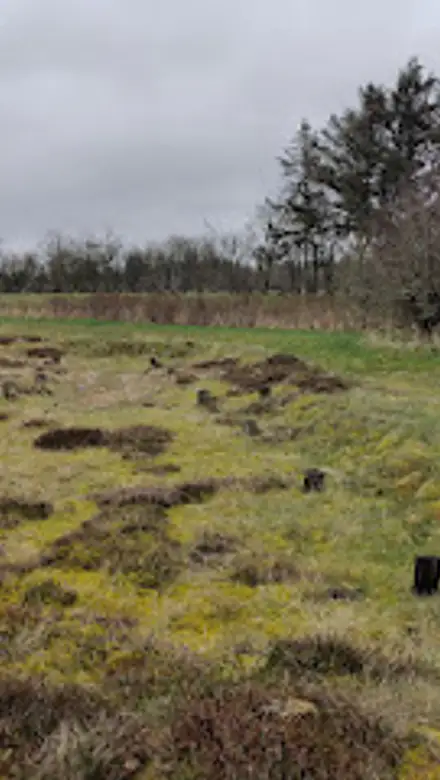
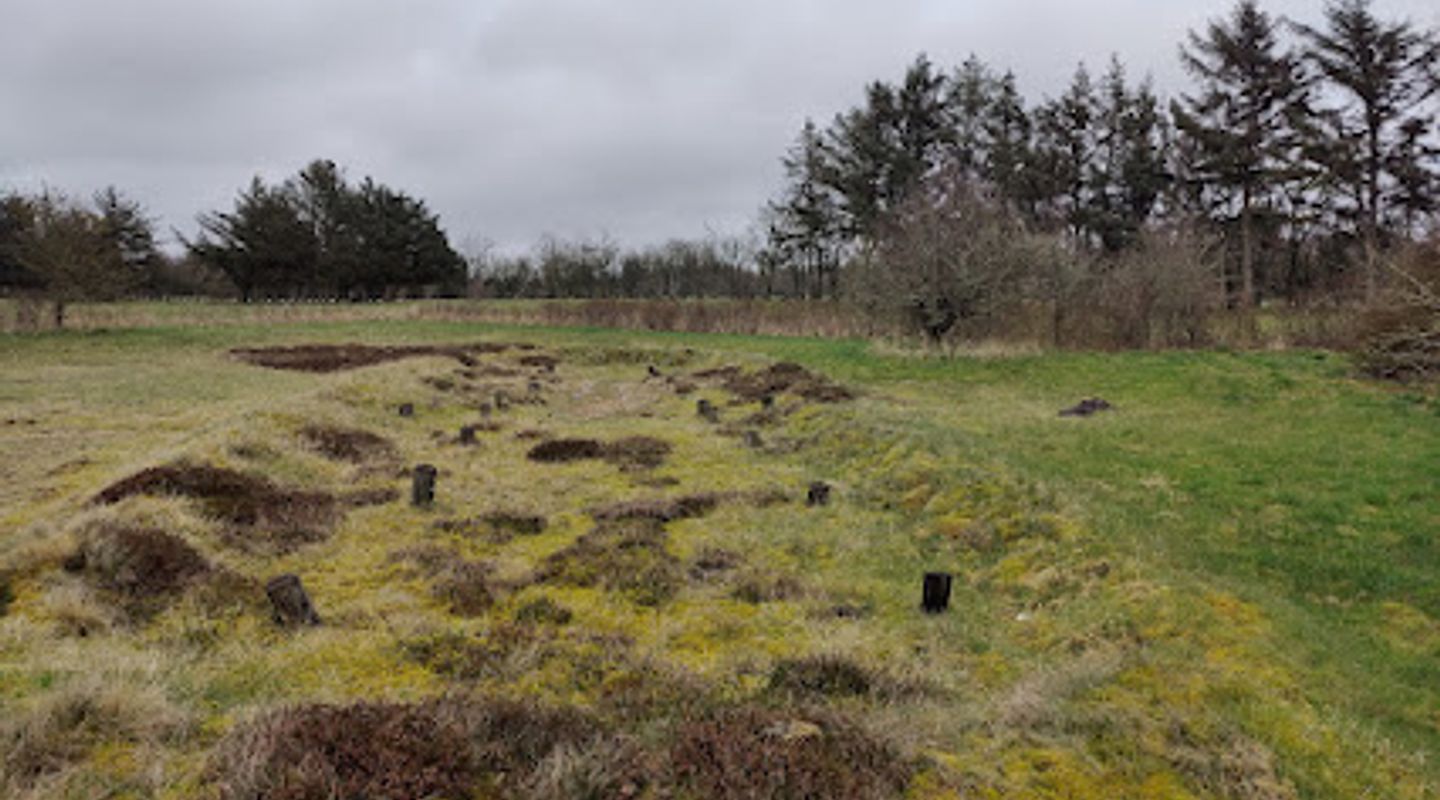
Within the small fenced area, you can distinguish three longhouses aligned broadly along the slope. Each was both dwelling and stable under one roof, with people at one end and cattle at the other. Their outlines appear as oval or rectangular ridges, the ghostly footprint of walls long since removed. In places, the stone paving of stable floors is still visible, its rough cobbles once trampled by hooves and boots.Look for the hearths, where darker patches and stones indicate former fireplaces that warmed the family and served for cooking and craft work. Between the buildings, narrow paved paths run like frozen tracks across the ground. These simple details tell much about daily life: the need to keep mud at bay during wet winters, to move animals and wagons between house and fields, and to organise space in a small farming community.
Fields, dykes and a once-busy countryside
Beyond the house plots, Marbæk Plantation preserves one of the region’s best examples of Iron Age field systems. Low earthen banks, sometimes only a few hand spans high, criss-cross the forest floor. These are the remnants of ancient field boundaries, dividing the land into small plots that were gradually rotated, manured and exhausted over generations. Walking among the trees, you are effectively crossing a patchwork of two-millennia-old agriculture.In the centuries around year 0, this coast was far from empty. Several Iron Age settlements and graves have been found along the nearby shoreline as well as further inland. The people who lived here fished the Wadden Sea shallows, grazed cattle on coastal meadows and cultivated cereals on the higher, lighter soils. Today’s plantation forest and recreational paths overlay a long history of careful land use, adaptation and occasional abandonment.
Atmosphere, seasons and a contemplative stop
The site itself is unfussy: there are no reconstructed buildings, only information boards and the shaped land. That simplicity is part of its appeal. In spring and summer, birdsong and the scent of pine frame the low earthworks, making it easy to picture smoke rising from thatched roofs and animals penned for the night. In autumn, fallen leaves accentuate the ridges and banks, turning the settlement into a subtle relief map underfoot.Because the Iron Age Settlement is compact, it fits easily into a broader day in the Marbæk area, whether combined with coastal walks, a picnic or a visit to other ancient monuments around Esbjerg. It especially suits travellers who enjoy piecing together stories from fragmentary remains rather than grand monuments. A short visit here adds historical depth to the wider Wadden Sea landscape, connecting modern Esbjerg to a much older rural past.
Practical visit notes and what to expect on site
Access is free, and the settlement is open at all hours, as it forms part of the public plantation. A simple path leads through the trees to the fenced area, with mostly flat ground and short grass around the house plots. After rain, some sections can be soft or muddy, so sturdy footwear is useful. There is no staffed visitor centre at the site; information comes from signs explaining the excavations, the house plans and the surrounding field systems.Facilities are minimal, so it is wise to bring water and snacks, and to plan restroom stops elsewhere in the Marbæk area or back in Esbjerg. Mobile reception is generally good, making it easy to use digital maps or audio guides while you explore. Allow around 30–60 minutes for a focused visit to the settlement itself, and longer if you intend to continue into the wider forest or down towards the Wadden Sea shore.
Evendo Review Centre
 Google
Guest reviews
Best time to go
Quietest: Jan, Feb & Dec · before 8am or at 8pm
Busy times are Evendo estimates for a typical year, to help you plan. Actual crowds vary with events, school holidays and the weather.
Explore Iron Age Settlement on the map
A handpicked selection of must-see spots near Iron Age Settlement, mapped for you.
Get your free copy of our complete guide to Iron Age Settlement, delivered straight to you.
Everything on this page, from opening hours and how to get there to Eve’s tips and the best time to go, in one PDF you can read offline, print or share.
Already have an account? Sign in
Your Iron Age Settlement guide is ready.
We'll send it to · Not you? Sign out

Getting your guide ready…
We are putting together a fresh copy of the Iron Age Settlement guide. This can take up to a minute.
This can take a few moments. If your browser asks, choose Allow so the download can start. You'll find the guide in your Downloads folder.
Nothing happened? Download it again
Sorry, the guide is taking longer than usual. Please try again in a minute, or get it by email instead.
Other nearby places you may find interesting
The closest places of the same kind, if this one is not quite what you had in mind.
-
-
-
-
-


Swipe for more places
More to explore near Iron Age Settlement

 Best experiences near Iron Age Settlement
 Best hotels near Iron Age Settlement
 Best landmarks near Iron Age Settlement
 Best attractions near Iron Age Settlement
 Best shops near Iron Age Settlement
 Best restaurants near Iron Age Settlement
 Best bars near Iron Age Settlement
Do you manage this location?
Take control to get all the benefits, like improved information, better appearance, and stronger visibility across AI-powered discovery.
Explore more

Explore more of Esbjerg
Discover Esbjerg: A coastal city in Denmark known for its maritime heritage, stunning sculptures, and vibrant downtown, offering something for every traveler.
Explore Esbjerg
Explore more of Denmark
Discover Denmark: A perfect blend of history, modern design, and the cozy concept of hygge. Explore vibrant cities, serene landscapes, and world-class cuisine.
Explore Denmark