Gravhøj Travel Guide
Free Guide: A 3000-year-old Bronze Age burial mound turned beacon hill, St. Bavnehøj’s Gravhøj above Rønde pairs deep prehistory with wide, wind-swept views over Kalø and Mols.


A brief summary of Gravhøj
A 3000-year-old Bronze Age burial mound turned beacon hill, St. Bavnehøj’s Gravhøj above Rønde pairs deep prehistory with wide, wind-swept views over Kalø and Mols.
Set just east of Rønde, the Gravhøj at St. Bavnehøj is an imposing Bronze Age burial mound crowning a steep, wooded hill. More than 3000 years old and never fully excavated, this ancient barrow offers a powerful sense of prehistory and a sweeping panorama over Kalø Vig, Mols Bjerge and the flat Midtdjurs landscape. A short but sharp walk brings you from the town’s edge into open sky, wind and wide horizons, where ancient ritual, signal fires and Ice Age geology quietly converge above modern Djursland.
On-site amenities
 Trash bins
 Information boards
 Seating areas
Opening hours
- Every dayOpen 24 hours
Opening hours as listed on the venue’s Google Business Profile. Hours can change for services and special events, so check with the venue before you go.
- Address
- St. Bavnehøj, 8410, 8410 Rønde
Getting there
Local bus from Aarhus to Rønde and walk
Car from Aarhus via Djursland
Cycling from Rønde town centre
Discover more about Gravhøj
An ancient mound above modern Rønde
St. Bavnehøj’s Gravhøj rises from the ridge just outside Rønde, a rounded grass-topped barrow that at first glance could be mistaken for a natural hill. Step closer and you are standing on a carefully constructed Bronze Age burial mound, raised more than 3000 years ago by communities who chose this prominent spur to honour their dead. The mound has never been fully excavated, and only traces of attempted grave robbery hint at what may lie inside.From the crown of the hill, the present-day town feels pleasantly distant. The barrow’s smooth curves, ringed by old field boundaries and scattered trees, create a simple, striking silhouette against the sky. It is a modest monument by modern standards, yet its survival through millennia gives the site a quiet gravity that is hard to miss.
Bronze Age power, belief and landscape
Throughout Djursland, Bronze Age mounds cluster on high ground, forming long lines along ridges and isolated beacons on hilltops. St. Bavnehøj is one of these strategic points, paired with the now overgrown Lille Bavnehøj behind it. Together they mark a landscape once shaped by organized communities who invested immense labour in building turf-and-soil barrows for their elite.These mounds were more than burial places. Their visibility from far away turned them into symbols of power, guiding markers in an open landscape and focal points for ritual gatherings. Standing here, it is easy to picture processions climbing the slope, carrying offerings of bronze, amber and finely worked textiles to be sealed away with the dead beneath the mound’s earthen skin.
Signal fires on the beacon hills
Centuries after the last Bronze Age burials, St. Bavnehøj gained a second life as part of a chain of signal hills. The Danish word “bavn” refers to the beacon fires once lit here, sending warnings or important news from one height to the next. From this mound the line of sight runs southwards to Agri Bavnehøj and Ellemandsbjerg, and further on across the sea towards Samsø.On clear evenings you can imagine flames flaring up along the horizon, messages rippling across the region long before telegraphs or mobile phones. The burial mound became infrastructure, woven into the communication systems of medieval kingdoms and local defence. The hill’s double identity – tomb and alarm post – adds an extra layer to its already dense history.
Panoramas carved by ice and sea
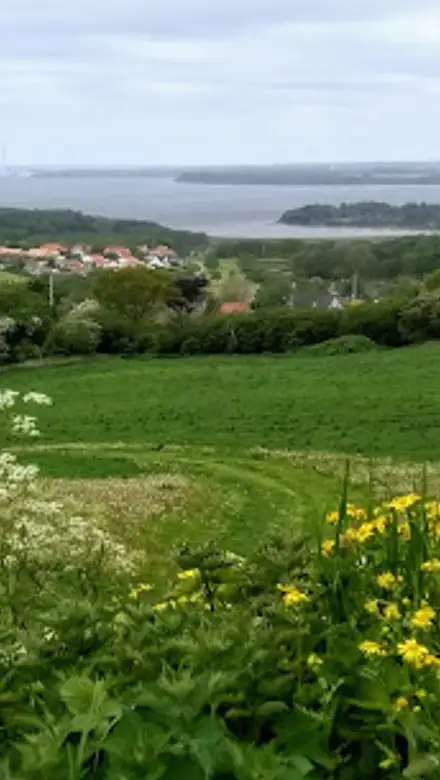
One of St. Bavnehøj’s greatest rewards is the view. To the north, the land drops away into the flatter Midtdjurs plains, scoured almost level by meltwater from the retreating Ice Age glaciers. Fields, hedgerows and farmsteads spread out in a patchwork that emphasises just how high you are standing.Turn south and the scene shifts dramatically. Kalø Vig curves in a broad arc, with Kalø Hovedgård, Kalø Slotsruin and the undulating forms of Mols Bjerge rising behind. The long moraines and dead-ice hills show exactly where the ice front once stalled. On days with crisp air, the folds of the landscape stand out in sharp relief, a natural textbook in glacial geology laid open beneath your feet.
A short, steep climb into quiet
Reaching the mound involves only a brief walk from the eastern edge of Rønde, but the path is notably steep. The ascent quickly leaves behind the noise of traffic, replacing it with birdsong from nearby trees and the rustle of wind in the grass. At the top, the open exposure means it can feel refreshingly breezy in summer and strikingly raw in winter.The simplicity of the site is part of its charm. There are no grand structures or indoor exhibits, just the hill, the mound and the view. Visitors linger on the summit, tracing distant landmarks, following the curve of the coast and watching shifting light over fields and water. It is an easy place to pause, breathe and feel the weight of time in the landscape.
Everyday life at the edge of deep time
Today St. Bavnehøj sits between past and present: a prehistoric monument on the doorstep of a modern town, a green knoll above supermarkets, schools and houses. Locals use the hill for quick sunset walks or brisk exercise; history-minded travellers come for the Bronze Age story and the panorama.In many ways, that mix encapsulates Djursland itself. Ancient barrows share space with contemporary roads, and Ice Age landforms frame everyday routines. Standing on the Gravhøj, you can look out over Kalø and Mols Bjerge, imagine beacon fires and Bronze Age ceremonies, then walk back down to buy groceries within minutes. Few places compress so much time, space and quiet drama into such a small, accessible hill.
Evendo Review Centre
 Google
Guest reviews
Best time to go
Quietest: Jan, Feb & Dec · before 8am or at 10pm
Busy times are Evendo estimates for a typical year, to help you plan. Actual crowds vary with events, school holidays and the weather.
Explore Gravhøj on the map
A handpicked selection of must-see spots near Gravhøj, mapped for you.
Get your free copy of our complete guide to Gravhøj, delivered straight to you.
Everything on this page, from opening hours and how to get there to Eve’s tips and the best time to go, in one PDF you can read offline, print or share.
Already have an account? Sign in
Your Gravhøj guide is ready.
We'll send it to · Not you? Sign out

Getting your guide ready…
We are putting together a fresh copy of the Gravhøj guide. This can take up to a minute.
This can take a few moments. If your browser asks, choose Allow so the download can start. You'll find the guide in your Downloads folder.
Nothing happened? Download it again
Sorry, the guide is taking longer than usual. Please try again in a minute, or get it by email instead.
Other nearby places you may find interesting
The closest places of the same kind, if this one is not quite what you had in mind.
-
-
-
-
-


Swipe for more places
More to explore near Gravhøj

 Best experiences near Gravhøj
 Best hotels near Gravhøj
 Best landmarks near Gravhøj
 Best attractions near Gravhøj
 Best shops near Gravhøj
 Best restaurants near Gravhøj
 Best bars near Gravhøj
Do you manage this location?
Take control to get all the benefits, like improved information, better appearance, and stronger visibility across AI-powered discovery.
Explore more

Explore more of Mols Bjerge National Park
Discover the natural beauty and historical charm of Mols Bjerge National Park, where rolling hills, ancient woodlands, and serene lakes create a perfect outdoor escape.
Explore Mols Bjerge National Park
Explore more of Denmark
Discover Denmark: A perfect blend of history, modern design, and the cozy concept of hygge. Explore vibrant cities, serene landscapes, and world-class cuisine.
Explore Denmark