St. Bavnehøj Travel Guide
Free Guide: Ancient beacon hill and Bronze Age burial mound above Rønde, offering big views over Kalø and Mols Bjerge after a short, steep climb through wind‑swept landscape.


A brief summary of St. Bavnehøj
Ancient beacon hill and Bronze Age burial mound above Rønde, offering big views over Kalø and Mols Bjerge after a short, steep climb through wind‑swept landscape.
St. Bavnehøj rises just east of the small town of Rønde, a more than 3000‑year‑old Bronze Age burial mound that doubles as one of Djursland’s finest viewpoints. A short but steep forest path leads from the roadside up to the rounded hilltop, where low stone walls frame wide views over Kalø, Mols Bjerge and the flat Midtdjurs landscape. The mound has never been excavated, preserving its mysterious interior, while later history layered on beacon fires and signal chains that once linked these high points across the region.
On-site amenities
 Trash bins
Opening hours
- Every dayOpen 24 hours
Opening hours as listed on the venue’s Google Business Profile. Hours can change for services and special events, so check with the venue before you go.
- Address
- 8410, Rønde
Getting there
Car from Aarhus
Bus from Aarhus to Rønde and walk
Cycling from Rønde
Discover more about St. Bavnehøj
Ancient hilltop resting place above Rønde
St. Bavnehøj sits on the eastern edge of Rønde as a large, grass‑clad Bronze Age burial mound, raised more than 3000 years ago on a naturally high ridge above the surrounding farmland. The people who built it chose the site carefully: from here, the dead would rest on a vantage point with an unbroken horizon, visible from far across Djursland. The mound itself is smoothly rounded, its proportions softened by time and grazing, but its size still makes it one of the most striking prehistoric monuments in the Kalø area.Unlike many barrows that have been opened, this one has never been scientifically excavated. Its interior remains unknown, though traces of attempted looting are visible in small disturbances in the surface. The lack of excavation adds to the sense of enigma; visitors stand on a hill that still conceals whatever gifts, weapons or bones were set here in the Bronze Age, untouched beneath layers of turf and roots.
From sacred mound to coastal signal beacon
Centuries after its original role as a grave, St. Bavnehøj found a second life as part of a regional warning system. The word “bavn” refers to a beacon fire, and many high Bronze Age barrows were reused as platforms for signal bonfires. On dark nights, watchers could light stacked wood here, with the blaze seen from other high points like Agri Bavnehøj and Ellemandsbjerget, forming a chain of messages across southern Djursland.This history as a beacon is easy to imagine on a windy day, when the summit feels exposed to the elements. The open crest, stripped of trees by centuries of use, recalls a time when ships in Kalø Vig or strangers on the move might trigger a flare of light to warn inland farms and manors. Today only the name survives, but the hill’s dual identity as both burial place and lookout adds depth to the simple act of climbing it.
Views over Kalø, Mols Bjerge and Midtdjurs
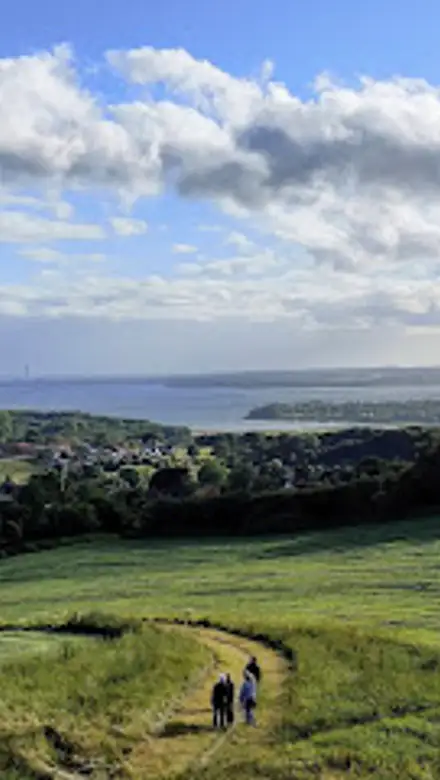
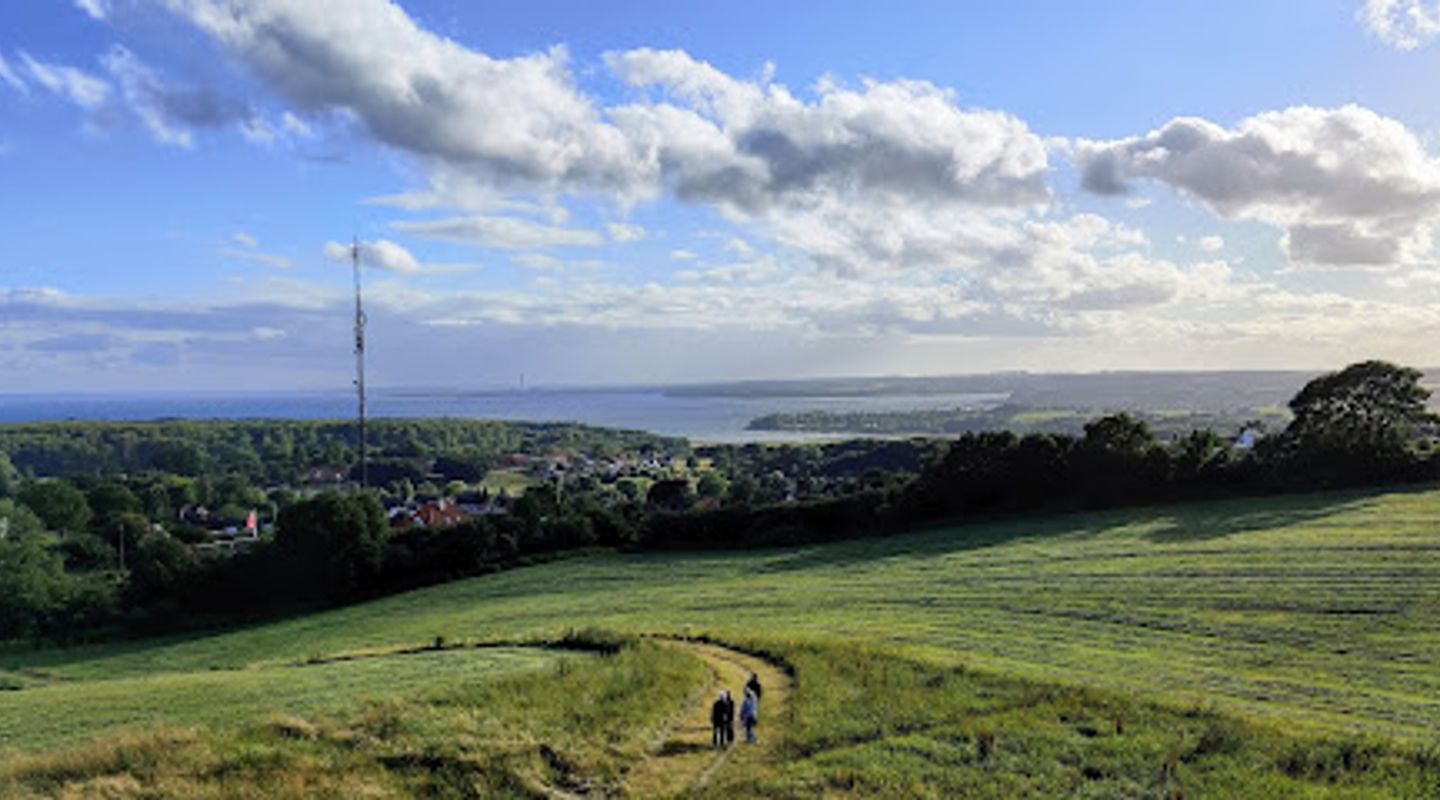
From the top of St. Bavnehøj, the landscape of eastern Jutland reads like a relief map. To the north, the land falls away into the flatter Midtdjurs countryside, a low, even plain shaped by meltwater that spilled off the Mols glaciers at the end of the last Ice Age. Fields, hedgerows and scattered farms stretch out in a patchwork that contrasts with the more dramatic terrain to the south.Turning that way, you look over the Kalø peninsula, the main farm complex of Kalø Hovedgård and the dark blocks of Hestehave and Ringelmose forests. Beyond lies the broken skyline of Mols Bjerge, with its heather‑covered ridges and scattered burial mounds, and the shimmering water of Kalø Vig. On clear days the light plays across sea and fields, and the low stone walls near the summit offer a place to sit and trace the contours of this protected landscape.
A short, steep path into prehistory
Reaching St. Bavnehøj involves only a brief effort: a roughly 150‑metre path climbing sharply from the roadside east of Rønde. The ascent is over quickly, but the gradient and sometimes uneven ground demand steady footwear and may feel demanding for those with limited mobility. The route threads between trees and low undergrowth before emerging onto the open top, where wind and weather are immediately more intense than in town below.Because the path is so short, it is easy to include the hill as a pause on a longer walk through the Kalø forests or as a quick detour from Rønde. Nearby, the smaller and now overgrown Lille Bavnehøj hides in the vegetation, a reminder that these mounds were often raised in groups on the best viewpoints. Together they form a small prehistoric landscape, squeezed between modern roads yet still surprisingly atmospheric once you leave the traffic behind.
Stone walls, old drove roads and living landscape
Around St. Bavnehøj, low stone dykes and field boundaries hint at later layers of rural history. To the south, similar walls line the route of Molsvej towards Kalø, marking what was once the village’s old drove road to the coastal meadows. Cattle would have been walked this way between the pastures and the farms on higher ground, using the same natural corridors that prehistory had already marked with mounds and monuments.Today the area blends this cultural heritage with everyday use. The hillside is kept open by grazing and occasional clearing, preserving the views that make the mound such a compelling stop. Birds circle on the thermals above Kalø Vig, tractors work the fields below, and the town of Rønde spreads along the ridge. Standing on the summit, you feel how people across millennia have used the same high ground for ceremony, warning, farming and, now, quiet contemplation.
Evendo Review Centre
 Google
Guest reviews
Best time to go
Quietest: Jan, Feb & Dec · before 7am or from 8pm
Busy times are Evendo estimates for a typical year, to help you plan. Actual crowds vary with events, school holidays and the weather.
Explore St. Bavnehøj on the map
A handpicked selection of must-see spots near St. Bavnehøj, mapped for you.
Get your free copy of our complete guide to St. Bavnehøj, delivered straight to you.
Everything on this page, from opening hours and how to get there to Eve’s tips and the best time to go, in one PDF you can read offline, print or share.
Already have an account? Sign in
Your St. Bavnehøj guide is ready.
We'll send it to · Not you? Sign out

Getting your guide ready…
We are putting together a fresh copy of the St. Bavnehøj guide. This can take up to a minute.
This can take a few moments. If your browser asks, choose Allow so the download can start. You'll find the guide in your Downloads folder.
Nothing happened? Download it again
Sorry, the guide is taking longer than usual. Please try again in a minute, or get it by email instead.
Other nearby places you may find interesting
The closest places of the same kind, if this one is not quite what you had in mind.
-
-
-
-
-


Swipe for more places
More to explore near St. Bavnehøj

 Best experiences near St. Bavnehøj
 Best hotels near St. Bavnehøj
 Best landmarks near St. Bavnehøj
 Best attractions near St. Bavnehøj
 Best shops near St. Bavnehøj
 Best restaurants near St. Bavnehøj
 Best bars near St. Bavnehøj
Do you manage this location?
Take control to get all the benefits, like improved information, better appearance, and stronger visibility across AI-powered discovery.
Explore more

Explore more of Mols Bjerge National Park
Discover the natural beauty and historical charm of Mols Bjerge National Park, where rolling hills, ancient woodlands, and serene lakes create a perfect outdoor escape.
Explore Mols Bjerge National Park
Explore more of Denmark
Discover Denmark: A perfect blend of history, modern design, and the cozy concept of hygge. Explore vibrant cities, serene landscapes, and world-class cuisine.
Explore Denmark