

Dybbøl Mill Travel Guide
Free Guide: A battle-scarred windmill on Dybbøl Banke, Dybbøl Mill combines working machinery, battlefield history and national symbolism above the fjord at Sønderborg.


A brief summary of Dybbøl Mill
A battle-scarred windmill on Dybbøl Banke, Dybbøl Mill combines working machinery, battlefield history and national symbolism above the fjord at Sønderborg.
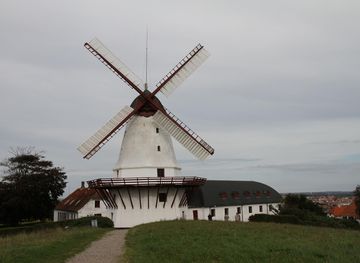
Perched on the windswept ridge of Dybbøl Banke overlooking Sønderborg and the Als Sound, Dybbøl Mill is one of Denmark’s most powerful national symbols. The white Dutch-style windmill has been destroyed and rebuilt several times since 1744, scarred by lightning, fire and, most famously, the Schleswig Wars of 1848–49 and 1864. Today it functions as an evocative museum: inside, exhibitions trace the millers’ lives, the battles fought around the hill and how Dybbøl became a focal point of Danish identity, while the gallery offers sweeping views across fields and coastline.
On-site amenities
 Restrooms
 Drink options
 Food options
 Seating areas
 Trash bins
 Information boards
 Visitor centre
Opening hours
- Every day10 am–4 pm
Opening hours as listed on the venue’s Google Business Profile. Hours can change for services and special events, so check with the venue before you go.
- Address
- Dybbøl Banke 7, 6400 Sønderborg
- Phone
- Website
Getting there
Local bus from Sønderborg centre
Bicycle from Sønderborg and surroundings
Taxi within the Sønderborg area
Discover more about Dybbøl Mill
Windmill on a Historic Ridge
Dybbøl Mill rises from the crest of Dybbøl Banke, a low, windswept ridge west of Sønderborg with commanding views over the fjord, the town and the bay of Vemmingbund. The current whitewashed Dutch-style mill with its dark cap and long sails dates from the mid‑20th century, but it stands on a site where a mill has turned in the wind since 1744. From the gallery that encircles the tower, you can look out across gently rolling fields that once formed the front line between two armies.The setting feels deceptively peaceful. Sheep graze on nearby slopes, paths weave through grassland and the sound of the sails creaking in the breeze mixes with birdsong. Yet information panels and the silhouettes of redoubts in the surrounding landscape hint at a past in which this pleasant hilltop was a strategic military position and a place of intense bombardment.
From Working Mill to Repeated Ruin
The story of Dybbøl Mill is one of persistence in the face of misfortune. The first mill here was a wooden structure that served local farmers before being destroyed by lightning. Its successors, built in brick in the classic Dutch style, fared no better: one burned during the First Schleswig War in 1849, another was shattered by artillery in 1864, and a later structure was lost again to fire in 1935. Each time, local owners and supporters chose to rebuild on the same exposed hilltop instead of moving to an easier site.Inside the grain warehouse beside the mill, exhibitions explain this cycle of destruction and reconstruction. Displays trace the families who ran the mill, their precarious finances, and the constant need to modernise machinery while also recovering from war damage. Old photographs, millstones, tools and charred relics tell a story in which the mill is both ordinary workplace and stubborn landmark continually brought back from the brink.
Front Line in the Schleswig Wars
Dybbøl Banke became a fortified line in the mid‑19th century when Danish engineers dug a crescent of redoubts between the Als Sound and Vemmingbund. The mill, perched near the centre of this line, was first used as an observation post and later as a symbolically charged target. During the Second Schleswig War in 1864, Prussian batteries pounded the hill for weeks. The mill’s tower was hit repeatedly, its top collapsing in a tangle of broken beams and sails while the surrounding trenches were overrun.Exhibition rooms in the warehouse and within the tower place the mill in this broader military context. Maps, models and uniforms show how the ridge functioned as a defensive system, while concise texts outline the political stakes of the wars and the territorial losses that reshaped Denmark. Rather than focusing only on tactics, the displays also highlight everyday life for soldiers and civilians, including the miller’s family, who were forced to flee as shells fell around their home.
Symbol of Danish Identity and Memory
After 1864, the mill took on a meaning far beyond its practical role. For Danes, its battered silhouette came to represent bravery and endurance in defeat; for the German Empire, monuments on the same hill commemorated victory. The exhibitions upstairs explore how Dybbøl evolved into a national symbol, appearing in poetry, paintings, ceremonies and political speeches throughout the late 19th and early 20th centuries.Panels examine how each rebuilding of the mill was infused with symbolism, turning it into a tangible reminder of cultural resilience. Photographs of commemorations, flags and wreaths illustrate how the hill became a stage for both Danish and German memory cultures until shifting borders and later conflicts changed the narrative again. Today the mill forms part of a broader landscape of remembrance that includes the nearby History Centre Dybbøl Banke and preserved fieldworks.
The Museum Experience Today
As a visitor, you move between working machinery and interpretation. In the mill tower, wooden gears, shafts and the great spur wheel rise through several levels. Even when the sails are at rest, you can visualise how grain once travelled from sack to stone to flour. The smell of timber and oil, the worn steps and the close, echoing space all contribute to a sense of physical connection with past millers.Across the yard, the warehouse’s modern exhibitions are clearly structured, guiding you from the origins of the mill through successive wars to its role as a symbol. Texts are generally concise, supplemented by objects, models and short films. Outside, benches and open ground invite quiet contemplation of the landscape that shaped — and was shaped by — events here. With its mixture of technical heritage, battlefield history and national storytelling, Dybbøl Mill offers a layered insight into Denmark’s past in a compact, easily explored setting.
Evendo Review Centre
 Google
Guest reviews
Best time to go
Quietest: Jan, Feb & Mar · before 8am or at 8pm
Busy times are Evendo estimates for a typical year, to help you plan. Actual crowds vary with events, school holidays and the weather.
Explore Dybbøl Mill on the map
A handpicked selection of must-see spots near Dybbøl Mill, mapped for you.
Get your free copy of our complete guide to Dybbøl Mill, delivered straight to you.
Everything on this page, from opening hours and how to get there to Eve’s tips and the best time to go, in one PDF you can read offline, print or share.
Already have an account? Sign in
Your Dybbøl Mill guide is ready.
We'll send it to · Not you? Sign out

Getting your guide ready…
We are putting together a fresh copy of the Dybbøl Mill guide. This can take up to a minute.
This can take a few moments. If your browser asks, choose Allow so the download can start. You'll find the guide in your Downloads folder.
Nothing happened? Download it again
Sorry, the guide is taking longer than usual. Please try again in a minute, or get it by email instead.
Other nearby places you may find interesting
The closest places of the same kind, if this one is not quite what you had in mind.
-
-
-
-
-


Swipe for more places
More to explore near Dybbøl Mill

 Best experiences near Dybbøl Mill
 Best hotels near Dybbøl Mill
 Best landmarks near Dybbøl Mill
 Best attractions near Dybbøl Mill
 Best shops near Dybbøl Mill
 Best restaurants near Dybbøl Mill
 Best bars near Dybbøl Mill
Do you manage this location?
Take control to get all the benefits, like improved information, better appearance, and stronger visibility across AI-powered discovery.
Explore more
Explore more of Sønderjylland
Sønderjylland: A Journey Through Denmark's Scenic Landscapes, Rich History, and Vibrant Traditions.
Explore Sønderjylland
Explore more of Denmark
Discover Denmark: A perfect blend of history, modern design, and the cozy concept of hygge. Explore vibrant cities, serene landscapes, and world-class cuisine.
Explore Denmark
