
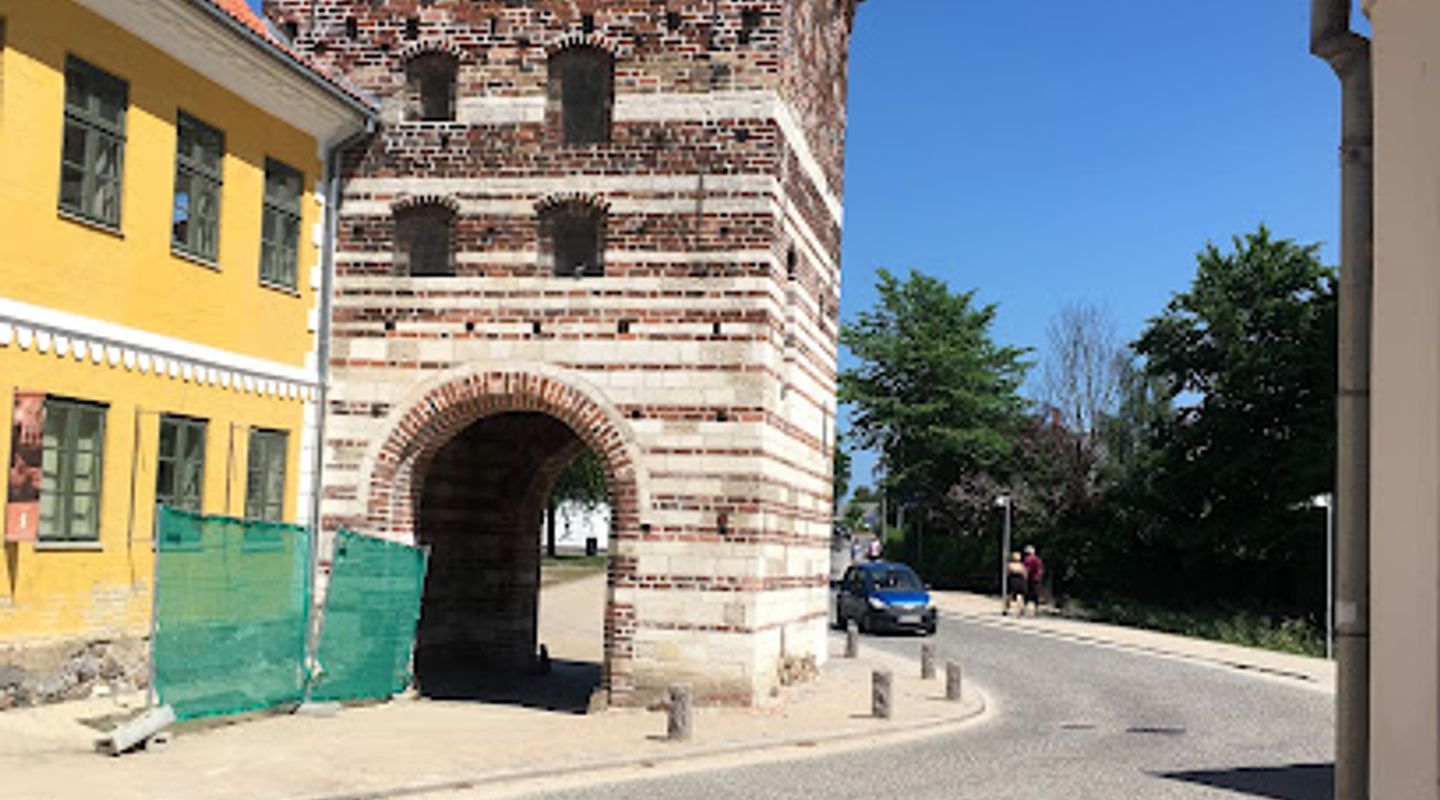
Mølleporten, South Zealand Travel Guide
One of Denmark’s last medieval town gates, Mølleporten opens a striped brick doorway into Stege’s fortified past and offers intimate views over ramparts and rooftops.
Mølleporten is the striking medieval town gate of Stege on the island of Møn, one of only two surviving town gates from the Middle Ages in all of Denmark. Built in the 1400s as part of Stege’s fortifications, the four-storey brick-and-limestone tower once controlled access to the city and later served as a prison. Today, after a meticulous recent restoration, you can step inside, climb through its atmospheric interior and enjoy views over the historic ramparts and red-roofed town.
A brief summary to Mølleporten
- Mølleport, Storegade 75, Stege, 4780, DK
- Click to display
- Duration: 0.5 to 1.5 hours
- Budget
-
 Mixed
Mixed
- Mobile reception: 4 out of 5

Know before you go
Hi, I'm Eve. Here are a few practical things to know before exploring Mølleporten.
- Combine a visit inside Mølleporten with a walk along the adjacent town rampart to appreciate how the gate once connected to Stege’s full defensive ring.
- Visit in the morning or late afternoon for softer light on the striped brickwork and clearer views from the upper floor windows.
- Mind the uneven cobblestones in the gateway and the relatively steep internal stairs; flat shoes with good grip make the visit more comfortable.
Do you manage this location?
Take control to get all the benefits, like improved information, better appearance, and stronger visibility across AI-powered discovery. Learn more about listing your business on Evendo
Activate your presenceOther nearby places you may find interesting
The closest places of the same kind, if this one is not quite what you had in mind.
Explore Mølleporten on the Map
A handpicked selection of must-see spots near Mølleporten, mapped for you.
Getting There
-
Car from Vordingborg
From Vordingborg town centre, driving to Stege and Mølleporten typically takes 30–40 minutes via the main regional road across the bridge to Møn. The route is straightforward, with regular traffic but few delays outside peak summer weekends. Parking options are available within walking distance in central Stege; most are short-stay and free or low-cost, though blue-disc time limits and local signage should be checked on arrival.
-
Regional bus from Vordingborg
Regional buses connect Vordingborg and Stege in about 35–50 minutes, running several times a day on most weekdays with reduced frequency in the evenings and on Sundays. A one-way adult ticket typically costs the equivalent of around 40–70 DKK depending on the specific regional fare system and any discounts. From Stege’s central bus stops it is an easy 10–15 minute walk through the historic streets to reach Mølleporten, along level pavements suitable for most visitors.
-
Cycling on Møn
For visitors already on Møn, cycling to Stege is a pleasant option in mild weather. Distances from nearby villages such as Koster or Lendemarke are in the range of 3–10 kilometres and usually take 15–40 minutes by bike along relatively quiet roads or signposted cycle routes. The terrain is gently rolling rather than steep, but strong winds can make the ride more challenging. Bicycles can be brought on many regional trains and buses for an extra fee when space permits, and there are railings and informal spots near the gate where bikes can be locked.
For the on-the-go comforts that matter to you
-
 Restrooms
-
 Drink Options
-
 Drinking Water
-
 Food Options
-
 Seating Areas
-
 Trash Bins
-
 Information Boards
-
 Visitor Center
Discover more about Mølleporten
A rare medieval gateway into Stege’s past
Mølleporten rises at the eastern edge of Stege, a compact four-storey gate tower built in the late 1400s when the town was encircled by ramparts, walls and moat. Its name, “The Mill Gate”, recalls the windmills that once turned outside the town on Møllemarken, where farmers arrived with grain and goods. Passing beneath the arch today, you step into the same line of approach that merchants, soldiers and traders used more than five centuries ago.Only two medieval town gates survive in Denmark, and Mølleporten is the eastern counterpart to Faaborg’s Vesterport. That rarity gives this modest structure national significance. It was the checkpoint where goods were inspected, taxes collected and nighttime entry controlled, part of a defensive system that once made Stege one of the best-fortified market towns in the kingdom.Brick stripes, stout walls and a storytelling tower
Architecturally, Mølleporten is a study in late medieval craft. The façade is built in alternating bands of deep red monk brick and pale limestone, echoing the pattern of nearby Stege Church. The lower courses carry broader, closer-set white stripes that make the base feel extra solid, while the upper levels appear lighter and more decorative. Granitic guard stones flank the gateway, reminders of wagon wheels and hooves that once scraped past.Above, a steep pyramidal tiled roof crowns the tower, likely a later addition that replaced an open gallery with pinnacles. Circular blindings and iron wall anchors add texture to the east and west faces, while small openings puncture the thick walls. Inside, timber beams and wooden floors divide the four levels, creating a sequence of rooms that once served very different purposes.From prison cells to carefully saved monument
By the 17th century, the military importance of the fortifications had declined, but the tower found a darker use. An inscription with the year 1674 marks a renovation when the upper floor was converted into a small prison, part of what local history calls “the evil time,” when hardship and conflict marked daily life. Later centuries brought neglect more than drama, and by the 1800s the structure had deteriorated so badly that demolition was seriously planned.In 1870s debates the gate narrowly escaped being torn down, and at the end of the 19th century it was finally protected as a historic monument. That decision ensured its survival into the modern era, but for a long time the interior remained closed and unused. The building stood as a symbolic gateway and town emblem rather than a lived experience of the Middle Ages.Meticulous restoration and new life inside the tower
A major restoration project completed in the mid-2020s transformed Mølleporten from closed relic to accessible monument. Specialists stabilised the masonry, reworked the roof and carefully reset damaged stones. The surrounding street level was lowered to reveal the original base and give the gate a more authentic stance on the rampart line. New internal stairs and landings thread up through the tower, allowing visitors to explore safely without hiding the historic structure.The renovation also reconnected the gate to the broader story of Stege’s defences. Interpretive panels and simple exhibition elements introduce the ramparts, moat and former town walls, turning the tower into a compact museum of urban fortification. From the upper level you can look out over the remains of the earthwork, the water and the red roofs of Stege, reading the landscape as medieval defenders would once have done.A walkable link between town, rampart and countryside
Mølleporten is not just an isolated monument but part of a longer green thread that encircles the town. The adjacent rampart and former moat now form a pleasant walking route where the defensive earthwork doubles as a raised path in a band of trees and grass. As you move along it, the gate appears and disappears between branches, its striped façade a constant point of orientation.For visitors, the experience is as much about atmosphere as about facts: cobblestones underfoot in the passage, cool air in the shadowed interior, the sudden openness of views from the windows. It is an easy stop to combine with a stroll through Stege’s historic streets and harbourfront, yet it quietly delivers one of Denmark’s most tangible encounters with a fortified medieval town.












Your all‑in‑one travel companion app
Explore expert travel guides, compare and book tours, experiences, hotels, and more—all from the palm of your hand. Download now for seamless trip planning wherever your wanderlust takes you.


Explore More of South Zealand
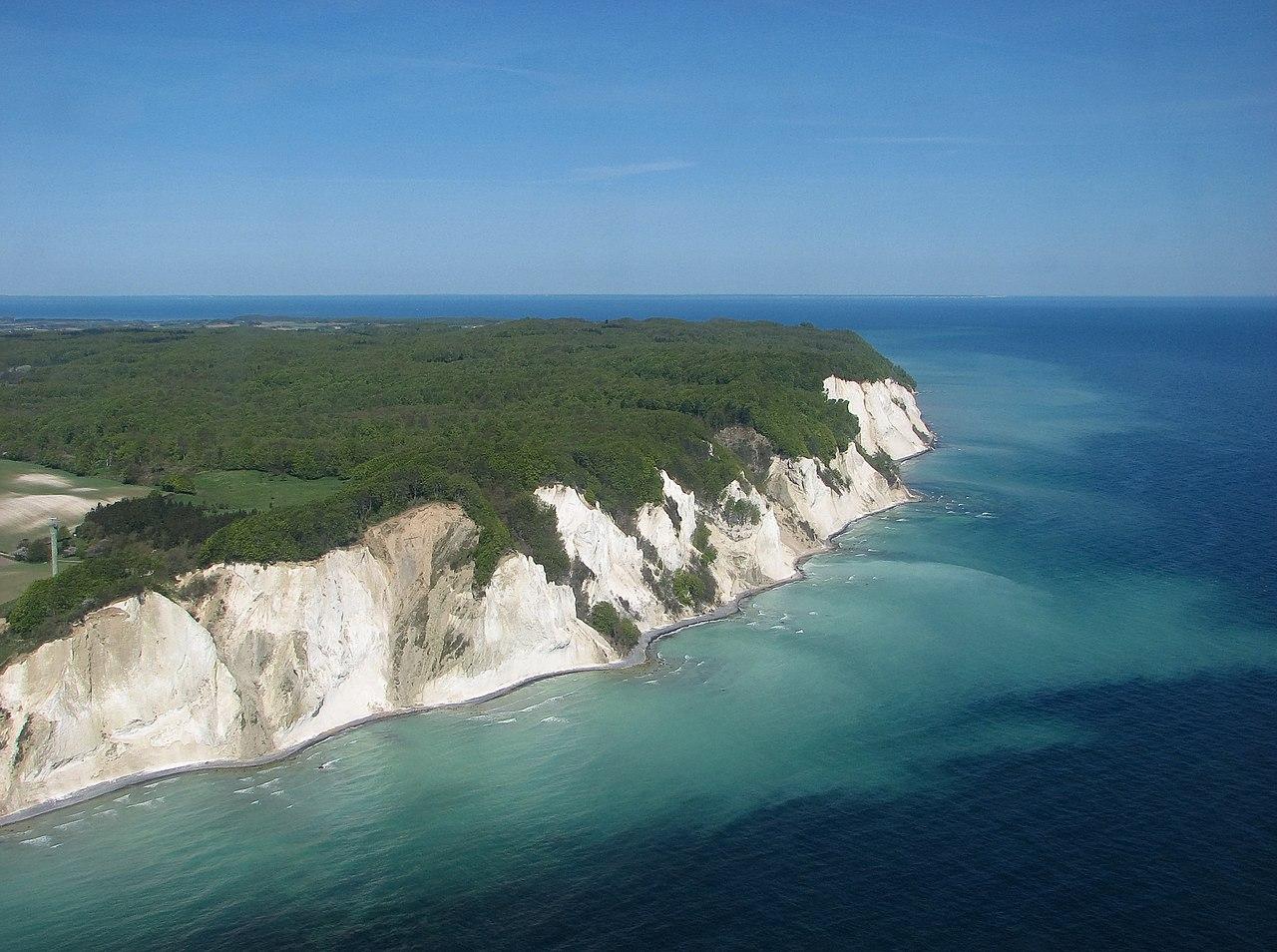
Looking beyond Mølleporten? Discover South Zealand for broader travel guides, local hot-spots, and regional highlights.
Explore South Zealand
A working Baltic fishing port turned relaxed marina village, Klintholm Harbor blends seaside cafés, child-friendly sands, history and boat access to dramatic Møns Klint.
Local history, island geology and merchant-town charm meet inside this atmospheric museum in a historic merchant’s house on Stege’s main street.
