

Old Synagogue, Erfurt Travel Guide
Explore one of Europe's best-preserved medieval synagogues, now a museum showcasing Erfurt's rich Jewish history and the remarkable Erfurt Treasure, a UNESCO World Heritage site.
The Old Synagogue in Erfurt stands as one of the best-preserved medieval synagogues in Europe, offering a captivating glimpse into Jewish life during the Middle Ages. Dating back to the 11th century, with significant expansions in the 13th and 14th centuries, it now functions as a museum showcasing the rich history of Erfurt's Jewish community. Visitors can explore the synagogue's original architecture, including its Romanesque gemel window and Gothic rose window, and delve into exhibits featuring the Erfurt Treasure, a remarkable hoard of medieval coins, jewelry, and artifacts discovered nearby. The Old Synagogue, along with the nearby Mikveh and Stone House, forms part of Erfurt's UNESCO World Heritage site, recognized for its exceptional preservation and historical significance.
A brief summary to Old Synagogue
- Waagegasse 8, Erfurt, Altstadt, 99084, DE
- Click to display
- Click to display
- Tuesday 10 am-6 pm
- Wednesday 10 am-6 pm
- Thursday 10 am-6 pm
- Friday 10 am-6 pm
- Saturday 10 am-6 pm
- Sunday 10 am-6 pm

Know before you go
Hi, I'm Eve. Here are a few practical things to know before exploring Old Synagogue.
- Visit on a weekday morning to avoid crowds and have a more intimate experience with the exhibits.
- Take advantage of the free video guide offered in multiple languages for a comprehensive tour of the synagogue and its history.
- Combine your visit with a tour of the nearby Mikveh (ritual bath) and the Small Synagogue to gain a deeper understanding of Jewish life in Erfurt.
- Check the museum's website for special events, lectures, and temporary exhibitions that may enhance your visit.
- If you are visually impaired, book a touch-guided tour in advance through the museum's educational service for a more accessible experience.
Do you manage this location?
Take control to get all the benefits, like improved information, better appearance, and stronger visibility across AI-powered discovery. Learn more about listing your business on Evendo
Activate your presenceOther nearby places you may find interesting
The closest places of the same kind, if this one is not quite what you had in mind.

Explore Old Synagogue on the Map
A handpicked selection of must-see spots near Old Synagogue, mapped for you.
Unlock the Best of Old Synagogue
Buy tickets
-
No tickets available
Book tours with entry


Getting There
-
Walking
From Fischmarkt (Fish Market), a central square in Erfurt's Altstadt (Old Town), walk east along the street 'Langen Brücke'. Turn right onto 'Waagegasse'. The Old Synagogue will be on your left, set back from the street. The walk is approximately 5 minutes. Note that the path in front of the entrance is partly difficult to walk on due to historical cobblestones.
-
Public Transport
Take tram lines 3, 4, or 6 to the 'Rathaus/Fischmarkt' stop. From there, follow the walking directions above. A single tram fare within Erfurt is approximately €2.30. The walk from the tram stop is about 5 minutes.
-
Taxi/Ride-Share
A taxi or ride-share from Erfurt's Hauptbahnhof (main train station) to the Old Synagogue will take approximately 10 minutes, depending on traffic. Expect to pay around €10-€15. Ask the driver to drop you off at Waagegasse 8.
-
Parking
Parking near the Old Synagogue is limited. The closest public parking is available at Domplatz multi-storey car park, a 10-minute walk away. Rates are approximately €2.50 per hour. Note that the surface quality of the car park is not easy to walk on.
Discover more about Old Synagogue













Your all‑in‑one travel companion app
Explore expert travel guides, compare and book tours, experiences, hotels, and more—all from the palm of your hand. Download now for seamless trip planning wherever your wanderlust takes you.


Explore More of Erfurt
Looking beyond Old Synagogue? Discover Erfurt for broader travel guides, local hot-spots, and regional highlights.
Explore Erfurt
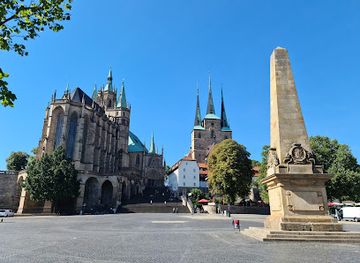
Explore Domplatz in Erfurt, a stunning historical square surrounded by iconic architecture and vibrant local culture.

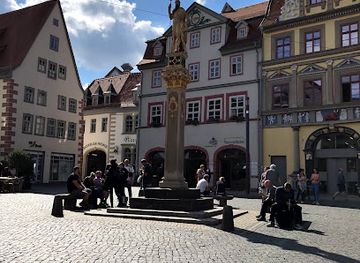
Discover the legacy of Adam Ries, a mathematical genius, at this monument in Erfurt's historic Altstadt, where his contributions to arithmetic come to life.
