Background

Nagelsäule: A Symbol of Mainz's Resilience

A unique WWI memorial in Mainz's heart, the Nagelsäule embodies unity and resilience. A poignant reminder of history on vibrant Liebfrauenplatz.

4.4

The Nagelsäule (Nail Pillar), standing proudly on Liebfrauenplatz in Mainz, is more than just a monument; it's a powerful symbol of the city's history and the resilience of its people. Erected in 1916 during World War I, this unique pillar served as a focal point for a fundraising campaign, where citizens hammered nails into its wooden structure in exchange for donations to support war relief efforts. Today, carefully restored and preserved, the Nagelsäule offers a poignant glimpse into a turbulent period of German history, inviting visitors to reflect on themes of unity, sacrifice, and remembrance. Its location on Liebfrauenplatz, near the iconic Mainz Cathedral, makes it an easily accessible and compelling stop for anyone exploring the heart of this historic city. The square itself is a vibrant hub, surrounded by charming shops and cafes, perfect for soaking in the atmosphere after contemplating the pillar's historical significance.

A brief summary to Nagelsäule

Local tips

  • Visit during the Mainz Christmas Market for a festive atmosphere and to see the Nagelsäule illuminated with holiday lights.
  • Take a guided walking tour of Mainz to learn more about the history of the Nagelsäule and its significance to the city.
  • Combine your visit with a stop at the Mainz Cathedral, located just steps away on Liebfrauenplatz.
widget icon

Getting There

  • Walking

    From Mainz Hauptbahnhof (main train station), Liebfrauenplatz is approximately a 15-20 minute walk. Exit the station and follow the signs towards the city center (Innenstadt). Walk along Bahnhofstrasse, then turn right onto Ludwigstrasse. Continue straight until you reach Domplatz, where you'll see the Mainz Cathedral. Liebfrauenplatz is located on the eastern side of the cathedral. Alternatively, from the 'Höfchen/Listmann' bus or tram stop, walk towards the cathedral; Liebfrauenplatz is directly in front of the cathedral's east entrance. No costs are associated with walking.

  • Public Transport

    From Mainz Hauptbahnhof, several bus and tram lines will take you to stops near Liebfrauenplatz. Take bus lines 60, 63, 80, 81, 90, 54, 55, 56, 57, or 58 to the 'Fischtor' or 'Höfchen/Listmann' stop. From either stop, it's a short walk to Liebfrauenplatz. A single ticket (Einzelfahrkarte) for a short trip (Kurzstrecke) costs around €2.00. A single ticket for the city zone costs around €3.20.

  • Taxi/Ride-Share

    A taxi or ride-share from Mainz Hauptbahnhof to Liebfrauenplatz will take approximately 5-10 minutes, depending on traffic. Expect to pay around €8-€12 for the ride.

  • Driving

    If driving, be aware that parking near Liebfrauenplatz is limited and can be expensive. The nearest parking garages are 'Parkhaus am Brand' and 'Parkhaus Theater'. Hourly rates typically range from €2.50 to €4.00, with daily maximums around €20-€25. Consider parking further out and taking public transport or walking to avoid parking hassles and costs. Follow signs towards 'Dom/Innenstadt' and then look for parking garage signs.

Unlock the Best of Nagelsäule

Buy tickets

    No tickets available

Book tours with entry

    No tours available

Book tours without entry

    No tours available

Discover more about Nagelsäule

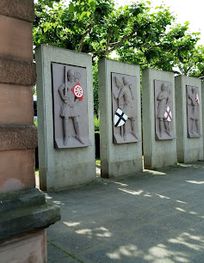
The Nagelsäule, prominently located on Liebfrauenplatz in Mainz, stands as a unique and poignant memorial, a testament to the city's spirit during the First World War. This unusual monument, also known as the Nail Pillar, is not just an artistic creation but a historical document, embodying the collective effort and sacrifices of the Mainz citizenry during a time of immense hardship. In the autumn of 1915, as the Allied blockade tightened its grip on the German Empire, the then Mayor of Mainz, Dr. Karl Emil Göttelmann, conceived a fundraising initiative to alleviate the growing distress among the population. Inspired by similar campaigns in other German cities, Göttelmann called upon the citizens of Mainz to demonstrate their solidarity and contribute financially to war relief efforts. The idea was simple yet powerful: for a donation, citizens could hammer a nail into a specially constructed wooden pillar. The design for the Nagelsäule was selected through a public competition, with the winning entry submitted by city master builder Adolf Gelius and sculptor Ludwig Lipp. Inaugurated on July 1, 1916, the seven-meter-high structure consisted of oak trunks encircled by three limestone pillars. These pillars represented the allegories of charity, bravery, and unity – core values that the campaign sought to promote. Crowning the pillar was an Iron Cross and the inscription "In Kriegsnot helf uns Gott" ("God help us in times of war"), further emphasizing the monument's patriotic and religious undertones. The fundraising campaign was a resounding success. Nails were sold at varying prices, ranging from a modest 50 Reichspfennig for a simple iron nail to a more substantial 20 Marks for a gold-plated one. Prominent figures, including the Hessian Grand Duke Ernst Ludwig and his family, participated in the inaugural ceremony, driving in the first nails and lending their prestige to the cause. By the time the campaign concluded on August 20, 1916, a total of 170,000 Marks had been collected – a sum equivalent to approximately 800,000 Euros today. These funds were then channeled to support war-related charities, including organizations providing assistance to soldiers' families and offering vacations for children from disadvantaged backgrounds. The Nagelsäule quickly became a focal point for patriotic expression and communal identity in Mainz. Plaques bearing the names of local institutions, associations, and businesses adorned the structure, further solidifying its connection to the city's social fabric. Even after the conclusion of the nailing campaign, the pillar continued to serve as a backdrop for public events, such as the Mainz Hindenburg celebration in 1917. Over the years, the Nagelsäule endured the ravages of time and war. It stood witness to the bombing of Mainz during World War II, which destroyed some of the surrounding buildings and further enlarged Liebfrauenplatz. By the late 20th century, the pillar's structural integrity had deteriorated, prompting concerns about its stability. In February 2006, the Nagelsäule was carefully dismantled and transported to a restoration workshop. A comprehensive restoration project was undertaken, involving experts from the Landesamt für Denkmalpflege Rheinland-Pfalz (State Office for Monument Preservation Rhineland-Palatinate) and the Römisch-Germanisches Zentralmuseum (Roman-Germanic Central Museum), as well as other specialists. The oak trunks were meticulously cleaned and reinforced, while the limestone pillars were repaired and stabilized. A new stainless-steel structure was designed to support the pillar, ensuring its long-term preservation. On July 21, 2011, the restored Nagelsäule was unveiled to the public, once again gracing Liebfrauenplatz with its presence. The restored Nagelsäule stands as a powerful reminder of Mainz's past, a symbol of the city's resilience and the enduring spirit of its people. It invites visitors to reflect on the themes of war, sacrifice, and remembrance, while also celebrating the communal efforts that helped Mainz overcome a period of profound crisis. Today, the Nagelsäule is an integral part of the Liebfrauenplatz experience. The square itself is a vibrant hub of activity, hosting a variety of events throughout the year, including the Mainz Christmas Market and the Johannisnacht festival. Visitors can stroll through the square, admire the architecture of the surrounding buildings, and soak in the atmosphere of this historic part of Mainz. The Nagelsäule serves as a compelling reminder of the city's rich history and its enduring spirit of community.

Popular Experiences near Nagelsäule

Popular Hotels near Nagelsäule

Select Currency