

Heinrichsbrunnen Travel Guide
Free Guide: Discover the Heinrichsbrunnen in Meissen, a historical fountain honoring King Henry I, the founder of the city, and a key landmark in the heart of the old town.


A brief summary of Heinrichsbrunnen
Discover the Heinrichsbrunnen in Meissen, a historical fountain honoring King Henry I, the founder of the city, and a key landmark in the heart of the old town.
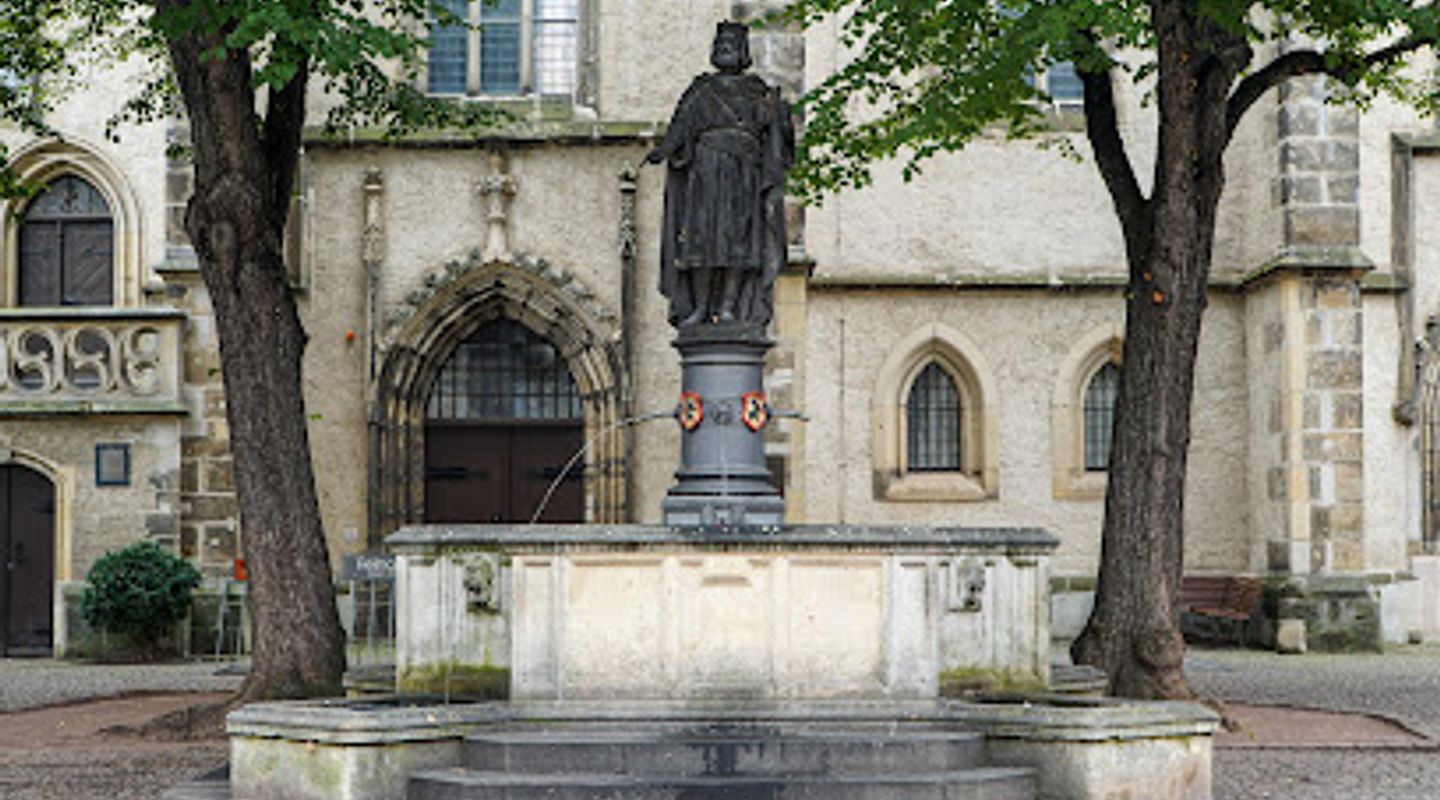
The Heinrichsbrunnen, located on Heinrichsplatz in Meissen's pedestrian zone, is more than just a fountain; it's a historical marker commemorating King Henry I, the founder of Meissen. Erected in 1863, the fountain replicates a medieval market fountain and features a statue of King Henry I holding a model of a castle, symbolizing his establishment of a border fortification in 929 that evolved into the Burg Misni (Meissen). The square itself, named in honor of the king, adds to the area's historical ambiance, making it a focal point for visitors exploring Meissen's rich past. The fountain's intricate details and central location near the Stadtmuseum and Franziskanerkirche make it a must-see landmark, offering a glimpse into the city's origins and its enduring connection to its royal founder. A stroll around the fountain allows visitors to soak in the atmosphere of Meissen's old town and appreciate the blend of history and art that defines this charming Saxon city. The Heinrichsbrunnen is a testament to Meissen's historical roots and a beautiful addition to the city's landscape.
Opening hours
- Every dayOpen 24 hours
Opening hours as listed on the venue’s Google Business Profile. Hours can change for services and special events, so check with the venue before you go.
- Address
- Heinrichspl., 01662 Meißen
- Website
Getting there
Walking
Public Transport
Taxi/Ride-Share
Discover more about Heinrichsbrunnen
Overview
The Heinrichsbrunnen, prominently situated on Heinrichsplatz in the heart of Meissen, serves as a captivating tribute to King Henry I, the German monarch credited with establishing the town's foundations. This elaborate fountain, inaugurated on April 23, 1863, is not merely a decorative element but a significant historical marker that encapsulates Meissen's rich heritage and its connection to its royal founder. The fountain's design is a deliberate homage to medieval market fountains, evoking a sense of historical continuity and tradition. At its center stands a bronze statue of King Henry I (919-936), also known as Henry the Fowler, sculpted by Robert Henze, a renowned artist from Dresden. The statue depicts the king holding a miniature model of a castle in his arm, symbolizing his pivotal role in establishing a fortified settlement on the Burgberg (castle hill) in 929. This fortification, initially intended as a defense against Slavic tribes, laid the groundwork for the development of the Reichsburg Misni, which eventually evolved into the town of Meissen. Heinrichsplatz, the square on which the fountain stands, was named in honor of King Henry I on April 20, 1863, further solidifying the area's association with the king and his legacy. The square itself has a rich history, having served as a fish market for many years. Before the construction of the Heinrichsbrunnen, the square featured a simple stone water trough, which was removed in 1862 to make way for the new monument. The Heinrichsbrunnen has undergone several renovations and repairs throughout its history. Just a few decades after its inauguration, in 1892, major repairs were necessary, including the replacement of all the lion's head spouts. In 1988 and 1989, the fountain basin was completely renewed and handed over on October 4, 1989. Despite these efforts, the basin continued to leak, necessitating a lead lining. The work was finally completed in May 1993. Today, the fountain operates with a recirculating water system. In 1995, further enhancements were made to the area surrounding the fountain. High-relief bronzes depicting a fanciful portrait of King Henry I and a circular inscription were embedded into the pavement, adding another layer of artistic and historical significance to the site. The inscription recounts the story of King Henry I's successful campaign around 929 and the founding of a castle high above the Elbe River, at the foot of which the town of Meissen, named after the small Misni River, would develop. During the winter months, the Heinrichsbrunnen is enclosed to protect it from the elements. However, the statue of King Henry I remains visible, secured behind Plexiglas panels, allowing visitors to appreciate the monument year-round. The entire fountain complex is listed as a cultural monument in the Free State of Saxony, under object number 09266307, underscoring its importance to the region's cultural heritage. Until 1962, the fountain was supplied with water via the Röhrfahrt, a system of wooden pipes used for medieval water supply. During renovation work in Meissen, parts of this ancient system were rediscovered and cleverly integrated into the redesign of public spaces, including the area around the Heinrichsbrunnen. The Heinrichsbrunnen is strategically located near other notable landmarks in Meissen. It stands in front of the Stadtmuseum Meißen (City Museum), housed in a former Franciscan monastery, and is adjacent to the Franziskanerkirche (Franciscan Church). This proximity to other cultural and historical sites enhances the area's appeal and makes it a natural focal point for tourists exploring Meissen's old town. Visiting the Heinrichsbrunnen offers a unique opportunity to connect with Meissen's past and appreciate the artistic and historical elements that define this charming Saxon city. Whether admiring the intricate details of the fountain, reflecting on the legacy of King Henry I, or simply soaking in the atmosphere of Heinrichsplatz, visitors are sure to find the Heinrichsbrunnen a memorable and enriching experience. The fountain serves as a reminder of Meissen's enduring connection to its royal founder and its rich cultural heritage.
Evendo Review Centre
 Google
Guest reviews
Explore Heinrichsbrunnen on the map
A handpicked selection of must-see spots near Heinrichsbrunnen, mapped for you.
Get your free copy of our complete guide to Heinrichsbrunnen, delivered straight to you.
Everything on this page, from opening hours and how to get there to Eve’s tips and the best time to go, in one PDF you can read offline, print or share.
Already have an account? Sign in
Your Heinrichsbrunnen guide is ready.
We'll send it to · Not you? Sign out

Getting your guide ready…
We are putting together a fresh copy of the Heinrichsbrunnen guide. This can take up to a minute.
This can take a few moments. If your browser asks, choose Allow so the download can start. You'll find the guide in your Downloads folder.
Nothing happened? Download it again
Sorry, the guide is taking longer than usual. Please try again in a minute, or get it by email instead.
Other nearby places you may find interesting
The closest places of the same kind, if this one is not quite what you had in mind.
-
-
-
-
-


Swipe for more places
More to explore near Heinrichsbrunnen

 Best experiences near Heinrichsbrunnen
 Best hotels near Heinrichsbrunnen
 Best landmarks near Heinrichsbrunnen
 Best attractions near Heinrichsbrunnen
 Best shops near Heinrichsbrunnen
 Best restaurants near Heinrichsbrunnen
 Best bars near Heinrichsbrunnen
Do you manage this location?
Take control to get all the benefits, like improved information, better appearance, and stronger visibility across AI-powered discovery.
Explore more

Explore more of Saxony
Discover Saxony: A blend of baroque beauty, musical heritage, and natural splendor in Germany's historic heartland.
Explore Saxony
Explore more of Germany
Experience Germany: where history meets innovation, and urban energy blends with natural beauty. Discover diverse cultures, delicious cuisine, and stunning landscapes.
Explore Germany
