

Free South Aegean Travel Guide & Mobile App
Explore South Aegean with free travel guides. Discover regional history, expert tips, proposed trips, and audio guides on web or mobile app.


Explore Greece’s South Aegean through Cycladic villages, Dodecanese fortresses, volcanic landscapes, beaches, archaeology and island cuisine.
Read more about South Aegean
When is the best time to visit South Aegean?
Best: May–June, September · 24–29°C| Month | High (°C) | Rainfall (mm) |
|---|---|---|
| January | 14 | 73 |
| February | 15 | 63 |
| March | 16 | 53 |
| April | 20 | 33 |
| May (best) | 24 | 22 |
| June (best) | 29 | 12 |
| July | 32 | 7 |
| August | 32 | 8 |
| September (best) | 28 | 17 |
| October | 23 | 42 |
| November | 19 | 63 |
| December | 16 | 73 |
Getting to and around South Aegean
How to get there
Transportation
Top city travel guides in South Aegean
The cities of South Aegean, and the easiest places to base yourself.

Swipe for more cities
Best attractions in South Aegean
The South Aegean offers an unusually broad range of attractions spread across two island groups. In the Cyclades, visitors can explore the buried Bronze Age settlement of Akrotiri on Santorini, the sacred island of Delos, the archaeological museum and Portara monument on Naxos, and the marble villages and religious heritage of Tinos. Santorini’s caldera, Milos’s varied volcanic coastline and the beaches of Paros and Naxos provide contrasting landscapes, while islands such as Amorgos, Folegandros and Sifnos are well suited to walking, village visits and quieter coastal excursions. The Dodecanese adds the medieval city of Rhodes, the ancient and Roman remains of Kos, the Cave of the Apocalypse and monastery complex on Patmos, and volcanic scenery on Nisyros. Sea kayaking, sailing, diving, windsurfing and swimming are widely available, though exposure to wind and strong currents varies. Museums, Byzantine churches, castles and traditional settlements give depth to beach-focused itineraries, while protected landscapes and rural paths reward visitors who travel beyond the main resort areas.
-
Historical landmark
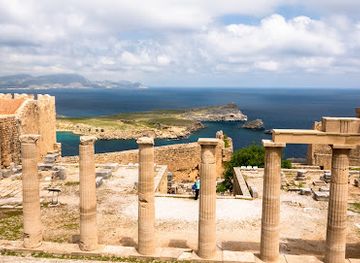
Lindos Acropolis
Discover the ancient wonders of the Acropolis of Lindos, a breathtaking historical landmark overlooking the Aegean Sea.
-
Park
Butterflies Valley
Explore the serene beauty of Butterflies Valley in Rhodes, Greece, where nature and vibrant butterflies create a breathtaking outdoor experience.
-
 Historical landmark
Kallithea Springs
Experience the serene beauty and historical charm of Kallithea Springs in Rhodes, Greece, a perfect blend of nature and cultural heritage.
-
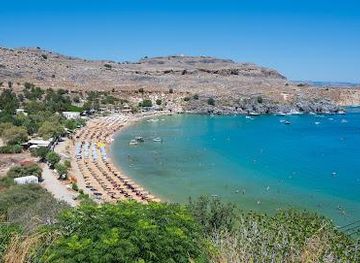
Beach
Lindos Beach
Discover the beauty of Lindos Beach in Rhodes, Greece; a perfect blend of relaxation, adventure, and rich cultural experiences await you.


Best landmarks in South Aegean
The South Aegean’s landmarks express its geological, religious, maritime and military history. Santorini’s caldera is the region’s defining natural feature, created by a major volcanic eruption and now lined with settlements such as Fira and Oia. The Portara, a monumental marble gateway on Naxos, marks the unfinished Temple of Apollo and has become a powerful symbol of the Cyclades. Delos is an exceptional archaeological landscape of sanctuaries, houses and public buildings, while the medieval walls and Street of the Knights in Rhodes preserve the scale of a former Hospitaller stronghold. Patmos is marked by the fortified Monastery of Saint John the Theologian and the Cave of the Apocalypse, both central to Orthodox pilgrimage. Symi’s harbour is framed by neoclassical houses rising up the hillsides, and the volcanic summit and caldera of Nisyros provide a distinctive natural counterpart. Across the islands, windmills, Byzantine churches, Venetian castles and dry-stone terraces reveal how communities adapted to limited land and exposed conditions.
-
Historical landmark
Acropolis of Athens
Explore the Acropolis of Athens, a symbol of ancient Greek civilization and architectural marvel, offering breathtaking views and historical insights.
-
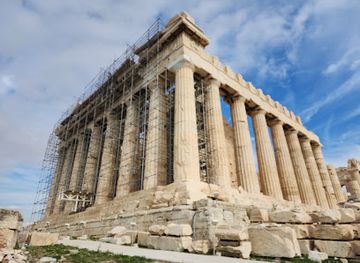
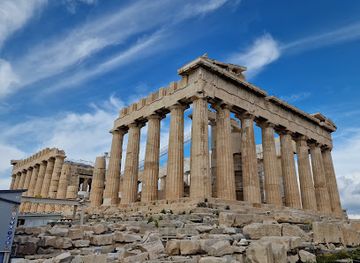
Historical landmark
Parthenon
Explore the Parthenon, an enduring symbol of ancient Greece and Athenian democracy, offering breathtaking views and a glimpse into a glorious past.
-
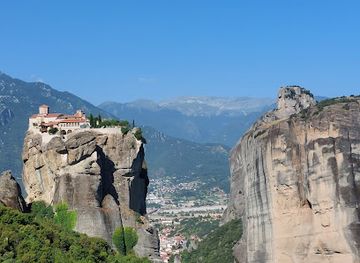
Monastery
Meteora
Discover Meteora's breathtaking monasteries, a UNESCO World Heritage Site where faith and nature converge in a stunning landscape of towering rock formations.
-
Historical landmark
Lindos Acropolis
Explore the ancient Acropolis of Lindos, a stunning historical site with breathtaking views of the Aegean Sea and a rich, layered past.
Explore South Aegean on the map
Plan your trip on one map. See where the top cities, national parks and sights are, and book hotels and experiences in a few clicks.
Best hotels in South Aegean
Best restaurants in South Aegean
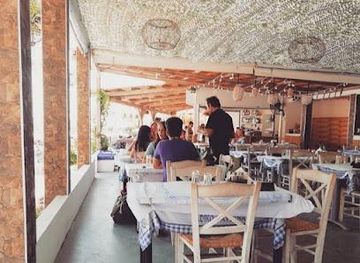
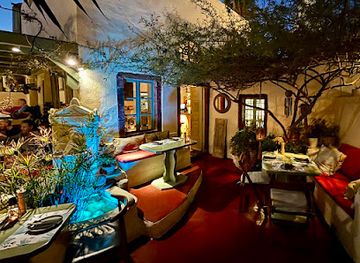
South Aegean cooking varies from island to island but is grounded in seasonal vegetables, pulses, grains, herbs, seafood and products that travel well in a dry maritime climate. Cycladic specialities include Santorini’s fava, capers and small tomatoes, Naxos cheeses and potatoes, Tinos cheeses and sausages, and the chickpea-based cooking associated with Sifnos. The Dodecanese brings dishes influenced by the wider eastern Mediterranean, including filled vegetables, fresh fish, octopus, local cheeses, honey and syrup-based sweets. Tavernas remain central to dining, from harbour tables and village squares to family-run restaurants inland, while bakeries, cafés and farmers’ stalls provide practical daytime food. Local wines are particularly prominent on Santorini and other wine-producing islands, and raki or souma may be offered after a meal. Menus can be seasonal and catches variable, so asking about the day’s fish and local produce is often more useful than expecting every dish to be available year-round.
-
Mediterranean
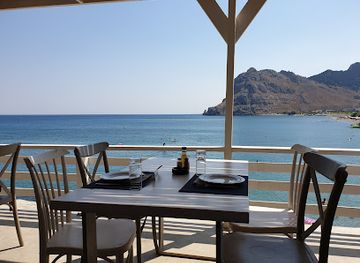
Ladiko Restaurant Beach Bar
Serene cove beach bar in Rhodes serving authentic Greek tavern fare with stunning sea views and sun-kissed relaxation.
-
Greek
Karma Greek Restaurant
Savor authentic Greek cuisine at Karma Restaurant in Oia—where every meal is accompanied by breathtaking views.
-
Restaurant
Seafood Limanaki Restaurant
Experience exquisite seafood dining at Seafood Limanaki Restaurant in Kolympia - where fresh flavors meet stunning views.
-
Restaurant
Agora Riviera Restaurant
Discover authentic Mediterranean flavors at Agora Riviera Restaurant in Vouliagmeni with breathtaking sea views and warm hospitality.

Best bars in South Aegean
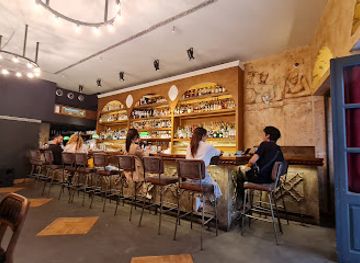
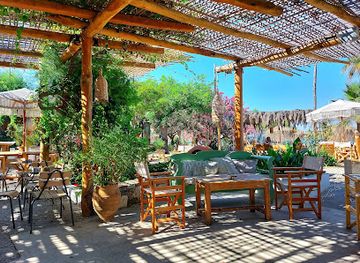
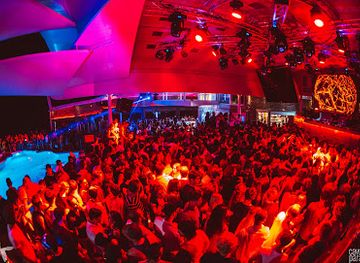
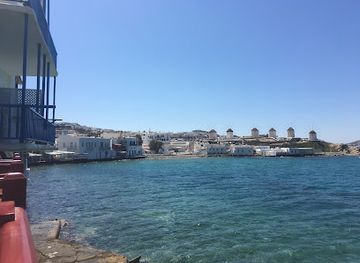
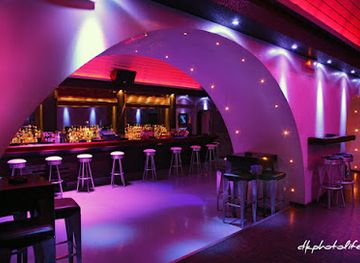
Evening life differs sharply across the South Aegean. Mykonos and parts of Santorini have internationally known bars and clubs, while Rhodes, Kos and Ios offer concentrated summer nightlife in resort and harbour areas. On most other islands, evenings centre on waterfront tavernas, traditional cafés, wine bars, small music venues and late meals rather than a large club scene. Ermoupoli on Syros has a more urban cultural rhythm, with restaurants, bars and performance spaces, while island villages generally become social gathering places around their central squares. Beach bars and seasonal venues can be important in summer, but their opening patterns change from year to year. In smaller Dodecanese communities, nightlife is often quieter and closely linked to local dining, festivals or live Greek music. Visitors should be considerate in residential lanes, where accommodation may stand directly beside bars and late-night gathering places.
-
Bar
The Clumsies
Discover the vibrant cocktail scene at The Clumsies, Athens' premier bar, where innovative drinks meet a stylish atmosphere.
-
Cocktail bar
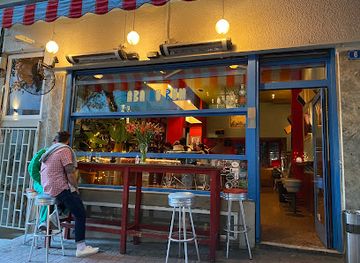
Baba au Rum
Experience the vibrant cocktail culture of Athens at Baba au Rum, renowned for its inventive drinks and lively atmosphere.
-
Bar
Mylos Beach Bar Kos
Discover the enchanting Mylos Beach Bar in Kos, where breathtaking views meet delicious cuisine and refreshing drinks in a vibrant atmosphere.
-
Grill
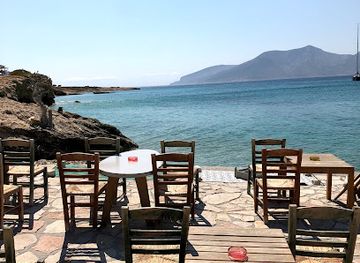
Sorokos
Experience the flavors of Greece at Sorokos, a top-rated grill bar in Koufonisia known for its fresh ingredients and inviting ambiance.
Best nightclubs in South Aegean
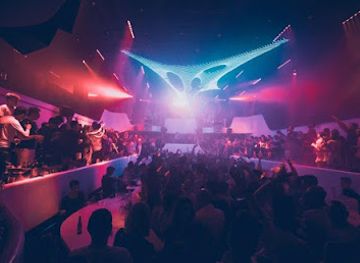
Evening life differs sharply across the South Aegean. Mykonos and parts of Santorini have internationally known bars and clubs, while Rhodes, Kos and Ios offer concentrated summer nightlife in resort and harbour areas. On most other islands, evenings centre on waterfront tavernas, traditional cafés, wine bars, small music venues and late meals rather than a large club scene. Ermoupoli on Syros has a more urban cultural rhythm, with restaurants, bars and performance spaces, while island villages generally become social gathering places around their central squares. Beach bars and seasonal venues can be important in summer, but their opening patterns change from year to year. In smaller Dodecanese communities, nightlife is often quieter and closely linked to local dining, festivals or live Greek music. Visitors should be considerate in residential lanes, where accommodation may stand directly beside bars and late-night gathering places.
-
Night club
Cavo Paradiso Club Mykonos
Discover the electrifying nightlife of Cavo Paradiso, Mykonos' premier club with breathtaking views and top DJs.
-
Bar
Paradise Beach Club Mykonos
Experience the vibrant nightlife of Mykonos at Paradise Beach Club, where sun, fun, and music unite for an unforgettable party.
-
Night club
Koo Club
Unleash your inner party spirit at Koo Club, Santorini's dynamic nightlife hub featuring top DJs and an electrifying atmosphere.
-
Night club
VOID mykonos
Discover the pulsating energy of VOID Mykonos, where unforgettable nights filled with music, dance, and vibrant nightlife await.
Best shops in South Aegean
Shopping in the South Aegean ranges from busy resort retail to small village workshops and food producers. Mykonos, Santorini, Rhodes and Kos have the broadest selection of fashion, jewellery, art, cosmetics and tourist goods, while Ermoupoli, Naxos Town and Parikia offer independent shops alongside everyday Greek retail. Traditional products make more meaningful souvenirs: Santorini capers and wine, Naxos cheeses and spirits, Tinos craftwork, Sifnos pottery, local honey, herbs, olive oil and Dodecanese sweets. Rhodes has a long association with decorative arts and leather goods, although quality and provenance vary between shops. Markets are generally modest rather than vast, with seasonal produce and local foods often found through bakeries, delicatessens, village shops and occasional farmers’ stalls. When buying antiquities, shells or natural materials, use reputable sellers and check that the item is legally traded; removing archaeological objects or unlicensed finds is prohibited.
-
Shopping mall
The Mall Athens
Explore The Mall Athens: A premier shopping and dining destination in Greece, offering a wide selection of stores and delicious cuisine.
-
Outlet mall
Designer Outlet Athens
Discover unbeatable deals on luxury brands at Designer Outlet Athens, your ultimate shopping destination near Athens, Greece.
-
Shopping mall
Shopping Street
Discover the vibrant shopping scene of Ermou Street in Athens, blending modern retail with rich cultural heritage.
-
Store
Cava Stafylos
Explore the rich flavors of Greece at Cava Stafylos in Embonas, where local wines and gourmet products await.


Get your free copy of our complete guide to South Aegean, delivered straight to you.
Everything on this page, from attractions and restaurants to essentials and local phrases, in one PDF you can read offline, print or share.
Already have an account? Sign in
Your South Aegean guide is ready.
We'll send it to · Not you? Sign out

Getting your guide ready…
We are putting together a fresh copy of the South Aegean guide. This can take up to a minute.
This can take a few moments. If your browser asks, choose Allow so the download can start. You'll find the guide in your Downloads folder.
Nothing happened? Download it again
Sorry, the guide is taking longer than usual. Please try again in a minute, or get it by email instead.
South Aegean essentials
Currency and Payment
Safety
Emergency Situations
Do's and Don'ts
Local Tips
From Eve
Local phrases worth knowing
You don't need to get them perfect. A few words go a long way, and locals appreciate the effort.
Basics
| English | Local | Say it |
|---|---|---|
| Hello | Γειά σου | [Yia sou] |
| Goodbye | Αντίο | [Adío] |
| Yes | Ναι | [Ne] |
| No | Όχι | [Óchi] |
| Please/You're welcome | Παρακαλώ | [Parakaló] |
| Thank you | Ευχαριστώ | [Efcharistó] |
| Excuse me/Sorry | Συγγνώμη | [Signómi] |
| How are you? | Τι κάνεις; | [Ti káneis?] |
| Fine. And you? | Καλά. Εσύ; | [Kalá. Esý?] |
| Do you speak English? | Μιλάς Αγγλικά; | [Milás Angliká?] |
| I don't understand | Δεν καταλαβαίνω | [Den katalavaino] |
Eating & Drinking
| English | Local | Say it |
|---|---|---|
| I'd like to see the menu, please | Θα ήθελα να δω το μενού, παρακαλώ | [Tha íthela na do to menou, parakaló] |
| I don't eat meat | Δεν τρώω κρέας | [Den tróo kréas] |
| Cheers! | Στην υγειά σας! | [Stin ygeiá sas!] |
| I would like to pay, please | Θα ήθελα να πληρώσω, παρακαλώ | [Tha íthela na pliróso, parakaló] |
Emergencies
| English | Local | Say it |
|---|---|---|
| Help! | Βοήθεια! | [Voítheia!] |
| Go away! | Φύγε! | [Fýge!] |
| Call the Police! | Καλέστε την Αστυνομία! | [Kaléste tin Astynomía!] |
| Call a doctor! | Καλέστε έναν γιατρό! | [Kaléste énan giatró!] |
| I'm lost | Είμαι χαμένος | [Eímai chaménos] |
| I'm ill | Είμαι άρρωστος | [Eímai árrhostos] |
Shopping
| English | Local | Say it |
|---|---|---|
| I'd like to buy... | Θα ήθελα να αγοράσω... | [Tha íthela na agoráso...] |
| I'm just looking | Απλά κοιτάζω | [Ap lákitázo] |
| How much is it? | Πόσο κοστίζει; | [Póso kostízei?] |
| That's too expensive | Είναι πολύ ακριβό | [Eínai polý akrivó] |
| Can you lower the price? | Μπορείς να ρίξεις την τιμή; | [Borís na ríkis tin timí?] |
Time & Numbers
| English | Local | Say it |
|---|---|---|
| What time is it? | Τι ώρα είναι; | [Ti óra eínai?] |
| It's one o'clock | Είναι μία η ώρα | [Eínai mía i óra] |
| Half past (10) | Δέκα και μισή | [Déka kai misí] |
| Morning | Πρωί | [Proï] |
| Afternoon | Απόγευμα | [Apógevma] |
| Evening | Βράδυ | [Vrády] |
| Yesterday | Χθες | [Chthes] |
| Today | Σήμερα | [Símera] |
| Tomorrow | Αύριο | [Ávrio] |
| 1 | 1 | [1] |
| 2 | 2 | [2] |
| 3 | 3 | [3] |
| 4 | 4 | [4] |
| 5 | 5 | [5] |
| 6 | 6 | [6] |
| 7 | 7 | [7] |
| 8 | 8 | [8] |
| 9 | 9 | [9] |
| 10 | 10 | [10] |
Transport & Directions
| English | Local | Say it |
|---|---|---|
| Where's a/the...? | Πού είναι το...; | [Poú eínai to...?] |
| What's the address? | Ποια είναι η διεύθυνση; | [Poia eínai i diéfthynsi?] |
| Can you show me (on the map)? | Μπορείς να μου δείξεις (στο χάρτη); | [Borís na mou deíxeis (sto chárti)?] |
| When's the next (bus)? | Πότε είναι το επόμενο (λεωφορείο); | [Póte eínai to epómeno (leoforeío)?] |
| A ticket (to ....) | Ένα εισιτήριο (για ....) | [Éna eisitírio (gia ....)] |
History of South Aegean
Cycladic Civilisations and Bronze Age Seafaring
The Cyclades were an important maritime zone during the Early Bronze Age, when communities exchanged obsidian, metals, ceramics and other goods across the Aegean. The marble figurines associated with the Cycladic civilisation are among the region’s best-known archaeological objects, although many were removed from their original contexts through illicit excavation and trade. Later Bronze Age connections linked the islands with Minoan Crete and Mycenaean Greece. Excavations at Akrotiri on Santorini preserve a sophisticated settlement buried by the great volcanic eruption of the second millennium BCE, offering evidence of architecture, commerce and seafaring before the disaster.
Classical Island States and Sanctuaries
During the classical period, the islands belonged to a network of independent communities, alliances and maritime powers rather than forming a single political unit. Delos became a major religious centre dedicated to Apollo and later an important commercial port, while Rhodes developed as a powerful city-state after the synoecism of its principal settlements in 408 BCE. Kos was associated with the medical tradition of Hippocrates and the sanctuary of Asklepios. Temples, theatres, inscriptions and harbour remains across the region reflect the islands’ participation in the political and economic life of the wider Greek world.
Hellenistic and Roman Aegean
After the campaigns of Alexander the Great, the South Aegean became part of the Hellenistic world, with shifting alliances and strong commercial links to Asia Minor, Egypt and the Levant. Rhodes was a major naval and trading power, while Delos flourished as a free port under Roman rule and attracted merchants from across the Mediterranean. Roman administration brought new roads, public buildings, baths and villas, many of whose remains can still be seen at sites including Kos, Rhodes, Delos and Nisyros. Christianity gradually transformed the religious landscape in late antiquity.
Byzantine Rule and Island Monasticism
Following the division of the Roman Empire, the islands became part of the eastern Roman, or Byzantine, world. Their strategic position exposed them to raids and changing military pressures, encouraging the construction of fortified settlements and the use of defensible hilltop locations. Orthodox Christianity became central to island life, and monasteries developed as religious, cultural and economic institutions. The Monastery of Saint John the Theologian on Patmos, founded in the late eleventh century, remains one of the clearest expressions of this heritage, alongside numerous rural chapels, painted churches and ecclesiastical collections.
Venetians, Knights and Ottoman Administration
From the thirteenth century, parts of the Cyclades were controlled by Latin and Venetian powers, while the Knights of Saint John established a powerful base on Rhodes and governed several Dodecanese islands until the Ottoman conquest in 1522. Fortifications, harbour walls and castle settlements record these rival regimes. Ottoman authority then shaped the islands for several centuries, with local communities retaining religious and commercial institutions within the imperial system. The period also saw continued movement of sailors, merchants and agricultural products across the Aegean and nearby Anatolian coast.
The Modern Greek State and Island Economies
The Cyclades became part of the independent Greek state in the nineteenth century, whereas the Dodecanese followed a different political path. Italy occupied the Dodecanese from 1912, leaving a visible architectural legacy in places such as Rhodes and Kos, before the islands were transferred to Greece in 1947 after the Second World War. Traditional livelihoods included farming, fishing, shipping, quarrying, pottery and sponge diving, with emigration and maritime work influencing many communities. From the mid-twentieth century, tourism became increasingly important and reshaped ports, housing, transport and employment.
Tourism, Conservation and Contemporary Island Life
The South Aegean’s international profile expanded rapidly after the Second World War, first through archaeological and cultural tourism and later through beaches, sailing, nightlife and resort development. Santorini, Mykonos, Rhodes and other islands now receive visitors on a scale that brings substantial economic benefits as well as pressure on water supplies, housing, waste systems, heritage sites and fragile landscapes. Contemporary island policy increasingly involves balancing tourism with conservation, agricultural production, local access and the protection of historic settlements, archaeological remains and marine environments.
South Aegean in Photos
Browse through our photo collection highlighting the charm and character of the destination.
Neighbouring regions of South Aegean
The closest regions to South Aegean, if you have time for more than one.
-

-
-

-

-


Swipe for more regions
Explore more
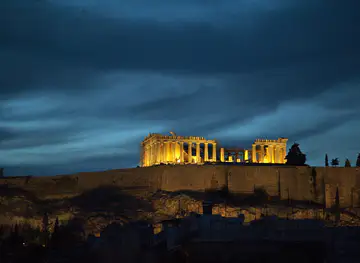
Explore more of Greece
Discover Greece: A land where ancient history meets modern vibrancy, offering stunning islands, crystal-clear seas, and unforgettable cultural experiences.
Explore Greece