

Free Grand Anse Travel Guide & Mobile App
Plan your Grand Anse trip with Evendo. Get free guides to top attractions, restaurants, hotels, and bars. Web access or download the mobile app.


Grand Anse, Seychelles offers Praslin beaches, coco de mer forests, Creole culture and island sightseeing beside the Indian Ocean.
A Coastal Settlement on Praslin
Grand Anse is a relaxed coastal district on the south-western side of Praslin, Seychelles’ second-largest inhabited island. Its broad beach curves beside the island’s only airport, while low-rise guesthouses, self-catering villas, local shops and restaurants line the roads behind the shore. The setting is distinctly Seychellois: granite hills rise inland, coconut palms lean towards the Indian Ocean and daily life moves at an unhurried island pace. Grand Anse is less a conventional town than a practical seaside base, offering easy access to beaches, nature reserves and the island’s modest transport network.Read more about Grand Anse
Island Nature and Heritage
Everyday Island Life
When is the best time to visit Grand Anse?
Best: June–July, September · 30–31°C| Month | High (°C) | Rainfall (mm) |
|---|---|---|
| January | 30 | 379 |
| February | 30 | 238 |
| March | 31 | 210 |
| April | 31 | 188 |
| May | 31 | 146 |
| June (best) | 31 | 94 |
| July (best) | 30 | 102 |
| August | 30 | 107 |
| September (best) | 30 | 99 |
| October | 30 | 135 |
| November | 30 | 168 |
| December | 30 | 275 |
Getting to and around Grand Anse
How to get there
Transportation
Best attractions in Grand Anse
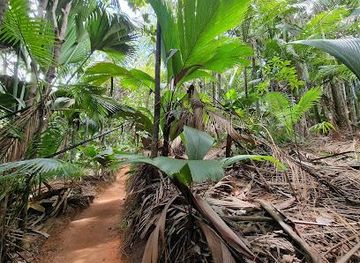
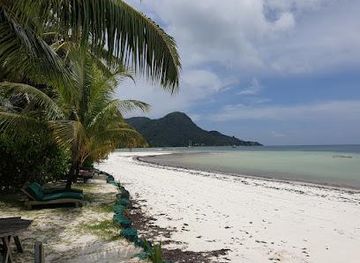
Grand Anse Beach is the district’s defining attraction, a broad west-coast shoreline where visitors can watch aircraft approach Praslin Airport and enjoy changing Indian Ocean light. The beach is best appreciated with local advice about swimming conditions, as seaweed and currents vary seasonally. Inland, the Vallée de Mai Nature Reserve offers a very different landscape of ancient palm forest, famous for the coco de mer and protected endemic species; it lies elsewhere on Praslin rather than within Grand Anse. Fond Ferdinand Nature Reserve provides another organised way to experience native palms and elevated island scenery. Around the wider island, Anse Lazio and Anse Georgette are celebrated beaches, while boat trips reveal smaller coves and neighbouring islands. Grand Anse itself remains less about a concentration of formal attractions than about combining a practical coastal base with Praslin’s forests, beaches and marine environment.
-
National park
Vallée de Mai, Praslin, Seychelles
Explore Vallée de Mai, a UNESCO World Heritage Site in Seychelles, featuring unparalleled biodiversity in a tropical paradise.
6 min drive · 2.0 km from city centre
-
Beach
Grand Anse beach
Discover the idyllic Grand Anse Beach in Seychelles, a tropical paradise with stunning scenery, vibrant marine life, and endless relaxation.
5 min walk · 0.4 km from city centre
Explore Grand Anse on the map
Plan your Grand Anse trip on one map. See where the top attractions, landmarks, restaurants, bars and hotels are, find what's near where you're staying, and book hotels and experiences in a few clicks.
Best hotels in Grand Anse
Get your free copy of our complete guide to Grand Anse, delivered straight to you.
Everything on this page, from attractions and restaurants to essentials and local phrases, in one PDF you can read offline, print or share.
Already have an account? Sign in
Your Grand Anse guide is ready.
We'll send it to · Not you? Sign out

Getting your guide ready…
We are putting together a fresh copy of the Grand Anse guide. This can take up to a minute.
This can take a few moments. If your browser asks, choose Allow so the download can start. You'll find the guide in your Downloads folder.
Nothing happened? Download it again
Sorry, the guide is taking longer than usual. Please try again in a minute, or get it by email instead.
Grand Anse essentials
Currency and Payment
Safety
Emergency Situations
Do's and Don'ts
Local Tips
From Eve
Local phrases worth knowing
You don't need to get them perfect. A few words go a long way, and locals appreciate the effort.
Basics
| English | Local | Say it |
|---|---|---|
| Hello | Bonzour | [bon-zoor] |
| Goodbye | Orevwar | [oh-reh-vwar] |
| Yes | Wi | [wee] |
| No | Non | [non] |
| Please/You're welcome | Silvouple/Mersi | [seel-voo-play/mehr-see] |
| Thank you | Mersi | [mehr-see] |
| Excuse me/Sorry | Pardon/Desole | [pahr-dohn/deh-zoh-leh] |
| How are you? | Ki ou fer? | [kee oo fehr] |
| Fine. And you? | Byen. E ou? | [byen. eh oo] |
| Do you speak English? | Ou pale Anglais? | [oo pahl ahn-gleh] |
| I don't understand | Mon pa konpran | [mohn pah kohn-prahn] |
Eating & Drinking
| English | Local | Say it |
|---|---|---|
| I'd like to see the menu, please | Monn oule ganny meni, si ou ple | [mohn oo-l gehn-nee meh-nee, see oo pleh] |
| I don't eat meat | Monn pa manz karn | [mohn pah mahnz kahrn] |
| Cheers! | Sente! | [sehn-teh] |
| I would like to pay, please | Monn oule peye, si ou ple | [mohn oo-l peh-yeh, see oo pleh] |
Emergencies
| English | Local | Say it |
|---|---|---|
| Help! | Sekour! | [seh-koor] |
| Go away! | Al lway! | [ahl lwai] |
| Call the Police! | Sime laser! | [see-meh lah-sehr] |
| Call a doctor! | Sime dokter! | [see-meh dohk-tehr] |
| I'm lost | Monn perdi | [mohn pehr-dee] |
| I'm ill | Monn malad | [mohn mah-lahd] |
Shopping
| English | Local | Say it |
|---|---|---|
| I'd like to buy... | Monn oule aste... | [mohn oo-l ah-steh] |
| I'm just looking | Monn jis regar | [mohn zhees reh-gahr] |
| How much is it? | Kombien sa koute? | [kohm-byehn sah koo-teh] |
| That's too expensive | Sa tro kher | [sah troh khehr] |
| Can you lower the price? | Ou kapab redwi pri? | [oo kah-pahb rehd-wee pree] |
Time & Numbers
| English | Local | Say it |
|---|---|---|
| What time is it? | Ki ler i ler? | [kee lehr ee lehr] |
| It's one o'clock | I ler | [ee lehr] |
| Half past (10) | Demi ler (10) | [deh-mee lehr (diz)] |
| Morning | Maten | [mah-tehn] |
| Afternoon | Apremidi | [ah-preh-mee-dee] |
| Evening | Swar | [swahr] |
| Yesterday | Yer | [yehr] |
| Today | Ozordi | [oh-zohr-dee] |
| Tomorrow | Demenn | [deh-mehn] |
| 1 | En | [ehn] |
| 2 | De | [deh] |
| 3 | Troa | [troh-ah] |
| 4 | Kat | [kaht] |
| 5 | Sis | [sees] |
| 6 | Ses | [sehs] |
| 7 | Set | [seht] |
| 8 | Wit | [weet] |
| 9 | Nef | [neff] |
| 10 | Dis | [dees] |
Transport & Directions
| English | Local | Say it |
|---|---|---|
| Where's a/the...? | Ki kote i...? | [kee koh-teh ee] |
| What's the address? | Ki lokasyon? | [kee loh-kah-zyohn] |
| Can you show me (on the map)? | Ou kapab montrer mwa (sou kat)? | [oo kah-pahb mohn-treh mwah (soo kaht)] |
| When's the next (bus)? | Ki lere le prochen (bis)? | [kee lehr leh proh-shen (bees)] |
| A ticket (to ....) | Un biye (ale...) | [oon byeh (ah-leh)] |
History of Grand Anse
Praslin Before Permanent Settlement
Praslin was uninhabited when French navigators charted the Seychelles archipelago, although sailors, traders and explorers knew the islands before permanent colonial settlement. The island’s dense forests, granite terrain and sheltered coastal waters later attracted attention for their timber, palms and agricultural potential. Its earlier European name, Isle de Palme, reflected the abundance of palms that distinguished it from many other islands. This natural environment remains central to Grand Anse’s identity, particularly through the coco de mer forests preserved in the interior. The apparent isolation of Praslin should not be mistaken for cultural emptiness: its later society developed through movement across the Indian Ocean, bringing together African, European and Asian influences that became characteristic of Seychellois Creole culture.
French Colonial Development
French control of the Seychelles became established in the eighteenth century, and Praslin was named after César Gabriel de Choiseul, duc de Praslin, during the period of French administration. Permanent settlement expanded through plantations producing coconuts and other tropical crops, with the labour system relying heavily on enslaved Africans and people brought through Indian Ocean networks. Small coastal settlements developed around practical needs such as landing places, cultivation and trade. Grand Anse’s position on the western side of Praslin made it part of this wider island economy, although it did not become a large colonial town. The surviving landscape of palms, cultivated plots and scattered settlements reflects this plantation history as well as the island’s natural ecology.
British Rule and Emancipation
Britain took control of the Seychelles during the Napoleonic period, and the transfer was confirmed by the Treaty of Paris in 1814. Plantation society continued under British rule, with coconuts, vanilla, cinnamon and other products supporting local commerce. The abolition of slavery in the British Empire in 1834, followed by emancipation in the Seychelles in 1835, transformed labour and social relations, though economic inequality did not disappear. Freed communities and later migrants contributed to the Creole society that emerged across Praslin. Coastal districts such as Grand Anse remained connected to agriculture, fishing and inter-island movement rather than developing as dense urban centres.
From Plantation Island to Tourist Destination
During the twentieth century, Praslin gradually moved from a predominantly plantation-based economy towards one shaped by conservation and tourism. Better maritime links and road improvements made the island more accessible, while Praslin Airport, opened in 1971, placed its western coastal districts within easier reach of Mahé. Grand Anse grew around the airport and the beach, with guesthouses, shops and services replacing some of the isolation associated with earlier island life. The expansion of tourism also made the protection of Praslin’s native forests increasingly important, particularly as the coco de mer became a symbol of the island’s environmental heritage.
Contemporary Grand Anse
Since Seychelles became independent in 1976, Grand Anse has developed as a small service and accommodation district within an island economy balancing tourism, conservation and local life. The airport remains an important practical landmark, while the beach and surrounding roads serve residents and visitors alike. Praslin’s identity is now closely connected with protected landscapes, including the Vallée de Mai and Fond Ferdinand, as well as with beaches that attract visitors from across the archipelago. Grand Anse retains a low-rise, dispersed character rather than a formal city centre, and its present-day atmosphere reflects the wider Seychellois blend of maritime livelihoods, Creole traditions and carefully managed natural resources.
Grand Anse in Photos
Browse through our photo collection highlighting the charm and character of the destination.
Cities near Grand Anse
The closest cities to Grand Anse, if you have time for more than one stop.
-

-

-

-

-


Swipe for more cities
Explore more
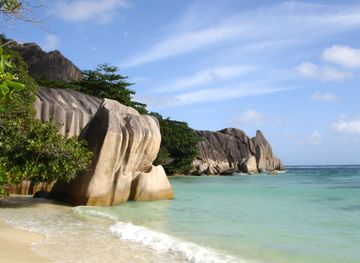
Explore more of Seychelles
Discover the enchanting islands of Seychelles, where stunning beaches, vibrant wildlife, and rich Creole culture come together for an unforgettable tropical escape.
Explore Seychelles