

Free Praslin Travel Guide & Mobile App
Plan your Praslin trip with Evendo. Get free guides to top attractions, restaurants, hotels, and bars. Web access or download the mobile app.


Praslin, Seychelles, pairs UNESCO-listed Vallée de Mai, coco de mer palms, powdery beaches and island-hopping adventures with clear waters and Creole ease.
An Island Shaped by Forest and Sea
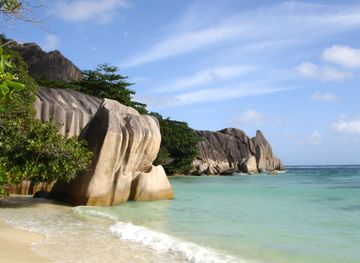
Praslin lies in the central Seychelles, about 44 kilometres north-east of Mahé, and is the archipelago’s second-largest inhabited island. Its granite interior rises into forested hills, while the coast curves into broad bays, sheltered coves and pale beaches framed by warm Indian Ocean water. Roads connect the principal settlements of Baie Sainte Anne and Grand Anse, passing through plantations, wooded slopes and viewpoints over neighbouring islands. The atmosphere is unhurried, with daily life centred on small shops, local buses, fishing, tourism and the movement of ferries between the islands.Read more about Praslin
Forests of Global Significance
Beaches, Boats and Creole Island Life
When is the best time to visit Praslin?
Best: June–July, October · 31°C| Month | High (°C) | Rainfall (mm) |
|---|---|---|
| January | 30 | 300 |
| February | 30 | 300 |
| March | 30 | 300 |
| April | 30 | 300 |
| May | 31 | 300 |
| June (best) | 31 | 100 |
| July (best) | 31 | 100 |
| August | 31 | 100 |
| September | 31 | 100 |
| October (best) | 31 | 100 |
| November | 30 | 300 |
| December | 30 | 300 |
Getting to and around Praslin
How to get there
Transportation
Explore Praslin on the map
Plan your Praslin trip on one map. See where the top attractions, landmarks, restaurants, bars and hotels are, find what's near where you're staying, and book hotels and experiences in a few clicks.
Best hotels in Praslin
Get your free copy of our complete guide to Praslin, delivered straight to you.
Everything on this page, from attractions and restaurants to essentials and local phrases, in one PDF you can read offline, print or share.
Already have an account? Sign in
Your Praslin guide is ready.
We'll send it to · Not you? Sign out

Getting your guide ready…
We are putting together a fresh copy of the Praslin guide. This can take up to a minute.
This can take a few moments. If your browser asks, choose Allow so the download can start. You'll find the guide in your Downloads folder.
Nothing happened? Download it again
Sorry, the guide is taking longer than usual. Please try again in a minute, or get it by email instead.
Praslin essentials
Currency and Payment
Safety
Emergency Situations
Do's and Don'ts
Local Tips
From Eve
Local phrases worth knowing
You don't need to get them perfect. A few words go a long way, and locals appreciate the effort.
Basics
| English | Local | Say it |
|---|---|---|
| Hello | Bonzour | [bon-zoh] |
| Goodbye | Orevwar | [oh-rev-wah] |
| Yes | Wi | [wee] |
| No | Non | [nohn] |
| Please/You're welcome | Silvouple | [seel-voo-play] |
| Thank you | Mersi | [mehr-see] |
| Excuse me/Sorry | Eskize mwa | [es-kee-zay mwah] |
| How are you? | Ki manyer? | [kee man-yeh] |
| Fine. And you? | Byen. E ou? | [bee-en. eh oo?] |
| Do you speak English? | Ou pale Angle? | [oo pah-lay ahn-glay] |
| I don't understand | Mwan pa konpran | [mwahn pah kohn-prahn] |
Eating & Drinking
| English | Local | Say it |
|---|---|---|
| I'd like to see the menu, please | Montr mwa meni, silvouple | [mohn-truh mwah meh-nee, seel-voo-play] |
| I don't eat meat | Mwan manze karn | [mwahn mahn-zeh kahrn] |
| Cheers! | Sente | [sen-teh] |
| I would like to pay, please | Monn peye, silvouple | [mohn pay-yeh, seel-voo-play] |
Emergencies
| English | Local | Say it |
|---|---|---|
| Help! | Aid | [ayd] |
| Go away! | Al lew | [ahl loo] |
| Call the Police! | Sey lapolis! | [say lah-poh-leece] |
| Call a doctor! | Sey dokter! | [say dohk-tehr] |
| I'm lost | Mwan perdi | [mwahn peh-dee] |
| I'm ill | Mwan malad | [mwahn mah-lahd] |
Shopping
| English | Local | Say it |
|---|---|---|
| I'd like to buy... | Monn anvi achte... | [mohn ahn-vee ahkt] |
| I'm just looking | Mwan pe sime | [mwahn pay see-meh] |
| How much is it? | Konbyen li koute? | [kohn-byen lee koot] |
| That's too expensive | Sa tro dispendye | [sah troh dees-pen-dyeh] |
| Can you lower the price? | Ou kapab redwi pri? | [oo kah-pahb reh-dwee pree] |
Time & Numbers
| English | Local | Say it |
|---|---|---|
| What time is it? | Ki ler li ye? | [kee lair lee yeh] |
| It's one o'clock | Li enn ler | [lee enn lair] |
| Half past (10) | Demi-diz | [deh-mee deez] |
| Morning | Maten | [mah-tehn] |
| Afternoon | Apremidi | [ah-preh-mee-dee] |
| Evening | Aswar | [ah-swah] |
| Yesterday | Zouryerdizour | [zoo-ree-yehr-dee-zoor] |
| Today | Zordi | [zor-dee] |
| Tomorrow | Demenn | [deh-mehn] |
| 1 | Enn | [enn] |
| 2 | De | [day] |
| 3 | Troa | [twa] |
| 4 | Kat | [kaht] |
| 5 | Sank | [sahnk] |
| 6 | Sis | [sees] |
| 7 | Set | [seht] |
| 8 | Uit | [weet] |
| 9 | Nef | [nef] |
| 10 | Dis | [dees] |
Transport & Directions
| English | Local | Say it |
|---|---|---|
| Where's a/the...? | Ki kote...? | [kee koh-teh] |
| What's the address? | Ki adres? | [kee ah-drehs] |
| Can you show me (on the map)? | Ou kapab montre mwa (sou lap) | [oo kah-pahb mohn-truh mwah (soo lah-puh)] |
| When's the next (bus)? | Kan prochen (bis)? | [kahn proh-shen (bees)] |
| A ticket (to ....) | En billet (vers ....) | [enn bee-yay (vehr)] |
History of Praslin
Before Permanent Settlement
Praslin formed part of an archipelago with no known permanent Indigenous population before European exploration and later settlement. European navigators charted the Seychelles in the early modern period, while the islands remained distant from the major population centres of the Indian Ocean. Praslin’s dense forests, steep interior and isolated location limited early development, although sailors and visiting vessels knew the islands’ sheltered anchorages. Its natural resources, particularly timber and the unusual palm later called coco de mer, gradually attracted greater attention. The island’s later history was shaped less by ancient urban development than by colonial landholding, maritime connections and the gradual establishment of plantation communities.
French Colonial Foundations
France claimed the Seychelles in the eighteenth century, and Praslin was named in 1768 after César Gabriel de Choiseul, Duke of Praslin, who was then associated with the French administration. French settlers established plantations and small coastal communities, cultivating food crops and commercially useful plants in the island’s fertile valleys. Enslaved Africans and people with connections to Madagascar and the wider western Indian Ocean were brought to the Seychelles to work on plantations, creating social and cultural foundations that remain visible in Seychellois Creole society. Baie Sainte Anne developed as an important harbour and administrative centre, while the interior remained heavily forested.
British Rule and Plantation Society
Britain took control of the Seychelles during the Napoleonic period, and the islands were formally ceded to Britain in 1814. On Praslin, plantation agriculture continued under a colonial economy that relied first on enslaved labour and, after emancipation in the British Empire in 1835, on contracted labour and local workers. Coconut, vanilla, cinnamon and other crops became important, while fishing and small-scale farming supported coastal communities. The island’s remoteness preserved extensive areas of native forest, even as plantations and paths altered parts of the lowlands. French cultural influence endured through language, family traditions and the developing Creole identity.
The Coco de Mer and Scientific Interest
Praslin became increasingly known for the coco de mer, a palm found naturally on Praslin and nearby Curieuse. Its extraordinarily large seed was once surrounded by legends because it was often discovered floating far from its source, and the palm became a prized object in international trade. Scientific study gradually replaced many of the old myths with a clearer understanding of its restricted habitat and slow reproduction. Protection of the palm forests became central to the island’s modern identity. Vallée de Mai, safeguarded as a nature reserve and later recognised as a UNESCO World Heritage Site, preserves a landscape closely associated with Praslin’s natural and cultural history.
Tourism and Conservation in Modern Praslin
After the Seychelles became independent from Britain in 1976, improved transport and investment in visitor infrastructure connected Praslin more closely with Mahé and the wider world. Tourism grew around beaches, marine excursions, forest reserves and small-scale accommodation, while fishing and local services remained important to everyday life. Conservation became an essential part of development, particularly in protecting coco de mer forests, endemic birds, coral reefs and nesting beaches. Today, Praslin’s settlements retain a relatively low-rise, island-scale character. Its history is experienced through plantation landscapes, Creole communities, protected forests and the continuing relationship between residents, the sea and the surrounding islands.
Praslin in Photos
Browse through our photo collection highlighting the charm and character of the destination.
Cities near Praslin
The closest cities to Praslin, if you have time for more than one stop.
-

-

-

-

-


Swipe for more cities
Explore more
Explore more of Seychelles
Discover the enchanting islands of Seychelles, where stunning beaches, vibrant wildlife, and rich Creole culture come together for an unforgettable tropical escape.
Explore Seychelles