

Friedrich Engels Statue, Manchester Travel Guide
Free Guide: A bold Soviet-era statue honoring Friedrich Engels stands proudly in Manchester, bridging industrial history with modern radical spirit.


A brief summary of Friedrich Engels Statue
A bold Soviet-era statue honoring Friedrich Engels stands proudly in Manchester, bridging industrial history with modern radical spirit.
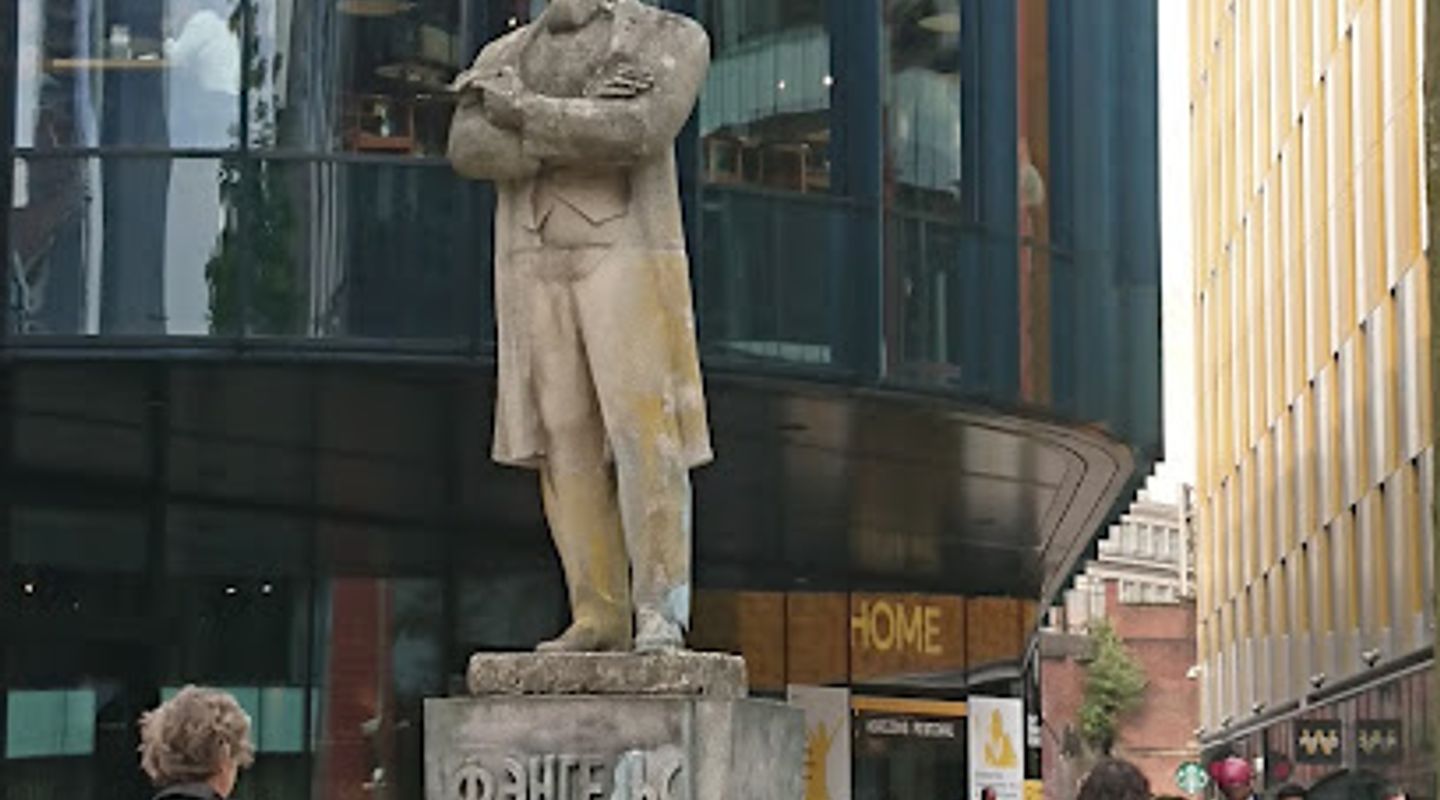
The Friedrich Engels Statue stands at Tony Wilson Place, Manchester, commemorating the German philosopher's deep ties to the city where he lived and worked for over 20 years. Originally erected in 1970 in Soviet Ukraine, the 12-foot concrete statue was rescued from abandonment and brought to Manchester in 2017 by artist Phil Collins. It symbolizes Engels’ legacy in social thought and Manchester’s radical history, positioned prominently outside the HOME arts centre in a modern urban setting.
On-site amenities
 Restrooms
 Drink options
 Food options
 Seating areas
 Trash bins
 Information boards
Opening hours
- Every dayOpen 24 hours
Opening hours as listed on the venue’s Google Business Profile. Hours can change for services and special events, so check with the venue before you go.
- Address
- First St, Manchester M15 4GU
Getting there
Tram
Train
Bus
Walking
Discover more about Friedrich Engels Statue
A Journey from Soviet Ukraine to Manchester’s Urban Core
The Friedrich Engels Statue is a striking 12-foot concrete sculpture originally created in the 1970s during the Soviet era and first installed in Mala Pereschepyna, a village in the Poltava Oblast of Ukraine. Following Ukraine’s 2015 laws banning Soviet symbols, the statue was removed, cut in half, and abandoned in a field. After years of searching, artist Phil Collins located the statue in this neglected state and secured permission to transport it to Manchester, the city where Engels spent much of his adult life. The statue’s journey across Europe became part of an artistic project culminating in its unveiling in 2017 outside the HOME arts centre on Tony Wilson Place, a vibrant public square in Manchester’s city centre.
Engels’ Enduring Connection to Manchester’s Industrial Heritage
Friedrich Engels, born in Germany in 1820, was sent to Manchester in 1842 to work in his family’s textile business. His experiences in the city’s industrial environment profoundly shaped his views on capitalism and social inequality. Guided by his partner Mary Burns, Engels witnessed firsthand the harsh living and working conditions of the city’s working class, inspiring his seminal work, The Condition of the Working Class in England. Manchester served as a base for his collaboration with Karl Marx and remains a key location in the history of socialist thought. The statue’s placement in Manchester acknowledges this deep historical and intellectual link.
Artistic and Symbolic Significance of the Statue
The statue depicts Engels standing with arms crossed, embodying dignity and resolve. Despite its Soviet origins, the monument has been recontextualized as a symbol of Manchester’s radical past and ongoing social discourse. Traces of blue and yellow paint, the colors of the Ukrainian flag, remain visible on the statue, reflecting its complex history. Positioned amidst the contemporary glass and steel architecture of Tony Wilson Place, the statue creates a powerful dialogue between Manchester’s industrial heritage and its modern identity.
Controversy and Community Perspectives
The statue’s Soviet provenance has sparked debate, particularly within Manchester’s Ukrainian community, some of whom view it as a reminder of oppressive regimes. Nonetheless, many locals and activists embrace the statue as a tribute to Engels’ contributions and a focal point for discussions about poverty, inequality, and workers’ rights. The monument has become a gathering place for political events and commemorations, reinforcing its role as a living part of Manchester’s cultural landscape.
Location and Visitor Experience
Situated outside the HOME arts centre on First Street, the statue occupies a prominent corner in Manchester’s city centre. The surrounding area combines modern urban development with cultural venues, offering visitors a chance to reflect on the city’s industrial past while enjoying contemporary arts and entertainment. The statue’s presence enriches the public space, inviting contemplation on social history and the ongoing relevance of Engels’ ideas.
Legacy and Continuing Relevance
More than a historical monument, the Friedrich Engels Statue in Manchester serves as a reminder of the city’s role in shaping social and economic thought. It highlights the enduring challenges of social justice and the importance of remembering radical histories. Through its evocative presence, the statue encourages visitors to engage with the complexities of industrialization, capitalism, and activism that continue to influence Manchester and beyond.
Evendo Review Centre
 Google
Guest reviews
Best time to go
Quietest: Jan, Feb & Dec · before 3am
Busy times are Evendo estimates for a typical year, to help you plan. Actual crowds vary with events, school holidays and the weather.
Explore Friedrich Engels Statue on the map
A handpicked selection of must-see spots near Friedrich Engels Statue, mapped for you.
Get your free copy of our complete guide to Friedrich Engels Statue, delivered straight to you.
Everything on this page, from opening hours and how to get there to Eve’s tips and the best time to go, in one PDF you can read offline, print or share.
Already have an account? Sign in
Your Friedrich Engels Statue guide is ready.
We'll send it to · Not you? Sign out

Getting your guide ready…
We are putting together a fresh copy of the Friedrich Engels Statue guide. This can take up to a minute.
This can take a few moments. If your browser asks, choose Allow so the download can start. You'll find the guide in your Downloads folder.
Nothing happened? Download it again
Sorry, the guide is taking longer than usual. Please try again in a minute, or get it by email instead.
Unlock the best of Friedrich Engels Statue
Skip-the-line tickets, guided tours with entry, and walking tours of the area, booked in a few clicks.

Other nearby places you may find interesting
The closest places of the same kind, if this one is not quite what you had in mind.
-
-
-
-
-


Swipe for more places
More to explore near Friedrich Engels Statue
-
 Best experiences near Friedrich Engels Statue
-
 Best hotels near Friedrich Engels Statue
-
 Best landmarks near Friedrich Engels Statue
-
 Best attractions near Friedrich Engels Statue
-
 Best shops near Friedrich Engels Statue
-
 Best restaurants near Friedrich Engels Statue
-
 Best bars near Friedrich Engels Statue


Do you manage this location?
Take control to get all the benefits, like improved information, better appearance, and stronger visibility across AI-powered discovery.
Explore more

Explore more of Manchester
Discover Manchester, the dynamic city where industrial heritage meets modern culture, offering a unique blend of history, sports, music, and gastronomy in Northern England.
Explore Manchester
Explore more of United Kingdom
Discover the United Kingdom: A blend of rich history, stunning landscapes, and vibrant cities, offering a unique travel experience for every visitor.
Explore United Kingdom
