

The Jurors Travel Guide
Free Guide: A powerful circle of ten bronze chairs at Runnymede, commemorating Magna Carta and inviting reflection on justice, freedom and the voices that shape them.


A brief summary of The Jurors
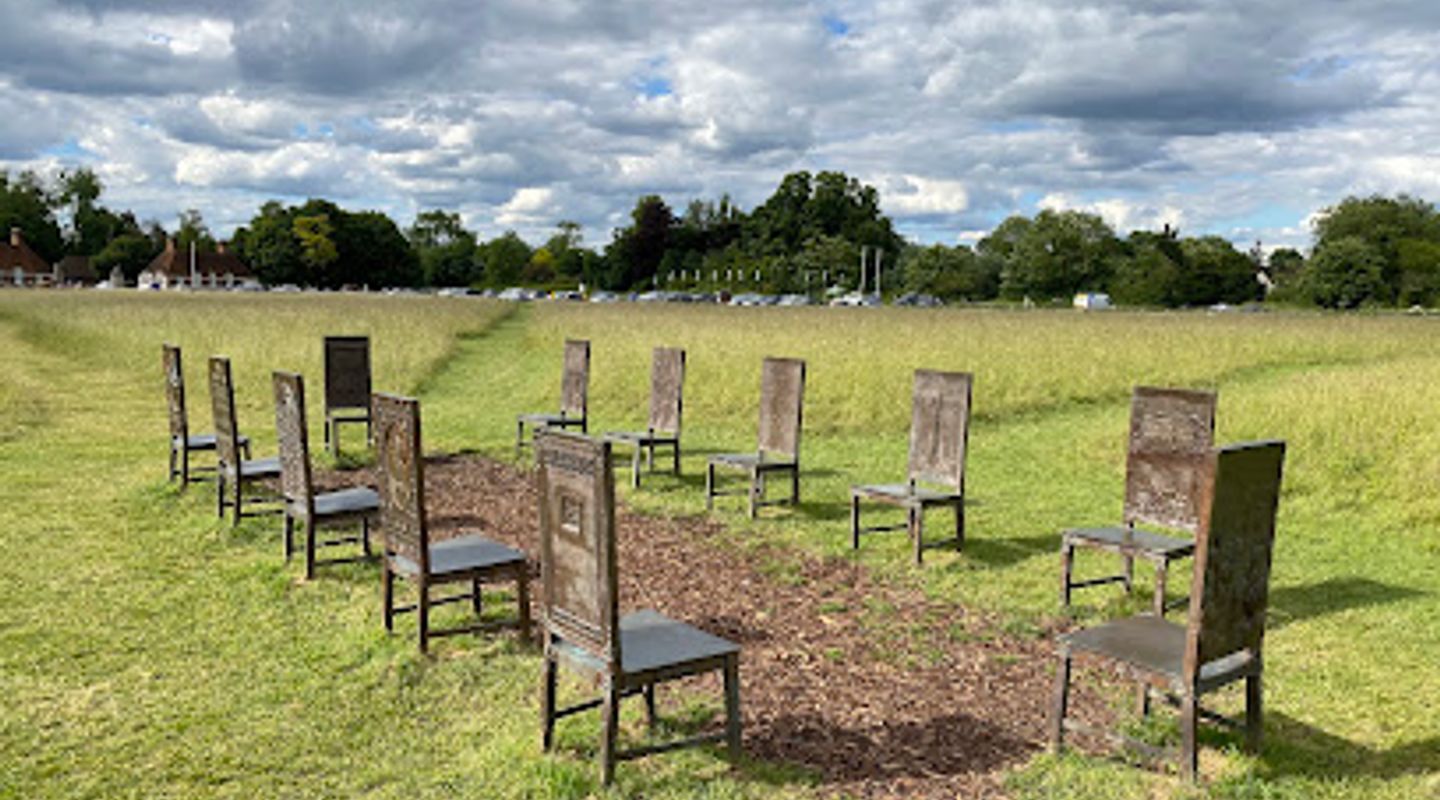
A powerful circle of ten bronze chairs at Runnymede, commemorating Magna Carta and inviting reflection on justice, freedom and the voices that shape them.
Standing on the historic Runnymede meadow, Hew Locke’s powerful public sculpture 'The Jurors' commemorates 800 years since the sealing of Magna Carta. Ten life-size bronze chairs, each adorned with intricate carvings and symbols, form a circle around an empty seat, inviting reflection on justice, freedom, and the ongoing struggle for rights. The work draws on Caribbean, British and global references, transforming a political landmark into a living space for dialogue and remembrance. It’s a thought-provoking, visually rich artwork that rewards close looking and quiet contemplation.
On-site amenities
 Restrooms
 Drink options
 Drinking water
 Food options
 Seating areas
 Sheltered areas
 Picnic areas
 Trash bins
 Information boards
 Visitor centre
Opening hours
- Every dayOpen 24 hours
Opening hours as listed on the venue’s Google Business Profile. Hours can change for services and special events, so check with the venue before you go.
- Address
- Englefield Green, Staines TW20 0YU
- Website
Getting there
Public transport
Car
Walking
Discover more about The Jurors
A Circle of Justice at Runnymede
On the open meadow of Runnymede, where Magna Carta was sealed in 1215, Hew Locke’s 'The Jurors' stands as a bold, contemporary response to that foundational moment. Commissioned for the 800th anniversary, the work consists of ten life-size bronze chairs arranged in a circle, their backs turned outward, surrounding a single empty seat at the centre. This deliberate emptiness is central to the piece: it represents the ongoing, unfinished nature of justice, and the space that each of us must step into to uphold rights and fairness. The chairs are not static monuments; they are places to sit, to think, to speak, making the artwork both a memorial and an invitation to participation.
Symbolism Woven into Bronze
Each chair is richly decorated with carvings, patterns and objects that speak to histories of power, resistance, trade and identity. You’ll find references to the Caribbean, Britain and beyond: sugar canes, chains, ships, crowns, flags, maps, musical instruments, and motifs drawn from African, Indigenous and colonial visual cultures. These layered symbols reflect Locke’s long-standing interest in how nations construct their identities through imagery, and how those same images can be reclaimed or reinterpreted. The work doesn’t offer a single narrative; instead, it presents a complex, sometimes contradictory, tapestry of histories that continue to shape ideas of law and liberty today.
Art, History and the Public Realm
'The Jurors' is more than a sculpture; it’s a site of public discourse. By placing it on Runnymede, Locke connects the medieval charter with modern struggles for equality, human rights and social justice. The circular arrangement echoes both a jury and a gathering of elders, suggesting that justice is not the domain of a single authority but a collective responsibility. The work encourages visitors to walk among the chairs, to sit in them, to notice the details up close, and to consider what justice means in their own lives and communities. It’s a rare example of public art that is both monumental and intimate, intellectually rigorous and emotionally resonant.
Experiencing the Work Today
The sculpture is sited in a peaceful, open landscape, with views across the Thames and the surrounding parkland. This setting amplifies its contemplative quality: the rustle of grass, the flight of birds, the changing light across the bronze surfaces all become part of the experience. There are no barriers or fences; the chairs are accessible and meant to be engaged with. Whether you come for a brief visit or spend time sitting and reflecting, 'The Jurors' offers a powerful encounter with history, art and the enduring questions of fairness and freedom. It’s a place that feels both timeless and urgently relevant, where the past and present meet in a circle of bronze.
Evendo Review Centre
 Google
Guest reviews
Best time to go
Quietest: Jan, Feb & Dec · before 8am or from 8pm
Busy times are Evendo estimates for a typical year, to help you plan. Actual crowds vary with events, school holidays and the weather.
Explore The Jurors on the map
A handpicked selection of must-see spots near The Jurors, mapped for you.
Get your free copy of our complete guide to The Jurors, delivered straight to you.
Everything on this page, from opening hours and how to get there to Eve’s tips and the best time to go, in one PDF you can read offline, print or share.
Already have an account? Sign in
Your The Jurors guide is ready.
We'll send it to · Not you? Sign out

Getting your guide ready…
We are putting together a fresh copy of the The Jurors guide. This can take up to a minute.
This can take a few moments. If your browser asks, choose Allow so the download can start. You'll find the guide in your Downloads folder.
Nothing happened? Download it again
Sorry, the guide is taking longer than usual. Please try again in a minute, or get it by email instead.
Unlock the best of The Jurors
Skip-the-line tickets, guided tours with entry, and walking tours of the area, booked in a few clicks.

Other nearby places you may find interesting
The closest places of the same kind, if this one is not quite what you had in mind.
-
-
-
-
-


Swipe for more places
More to explore near The Jurors

 Best experiences near The Jurors
 Best hotels near The Jurors
 Best landmarks near The Jurors
 Best attractions near The Jurors
 Best shops near The Jurors
 Best restaurants near The Jurors
 Best bars near The Jurors
Do you manage this location?
Take control to get all the benefits, like improved information, better appearance, and stronger visibility across AI-powered discovery.
Explore more
Explore more of Surrey
Explore the picturesque landscapes, historic landmarks, and charming villages of Surrey, a quintessential English countryside retreat just a stone's throw from London.
Explore Surrey
Explore more of United Kingdom
Discover the United Kingdom: A blend of rich history, stunning landscapes, and vibrant cities, offering a unique travel experience for every visitor.
Explore United Kingdom
