

Hire a fluent English speaking and professional Machu Picchu guide
 Aguas Calientes, PE
 100% of travellers recommend this
Non-refundable - Your booking can not be cancelled, modified or refunded.
Guaranteed Lowest Prices - Find a lower price? We'll match it!
Highlights
- "Undivided attention from your private guide"
- "Customize your Machu Picchu itinerary"
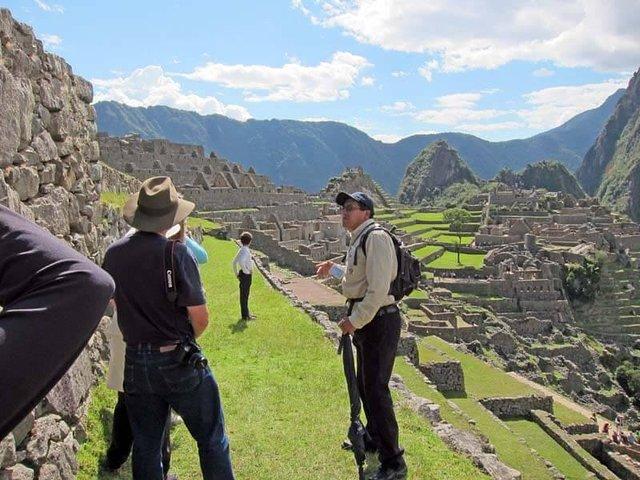
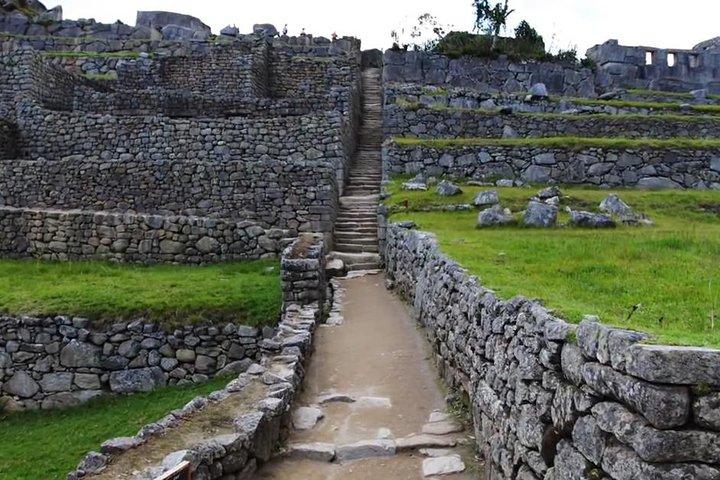
- "See the top attractions and learn their history"
- "Capture amazing photographs in beautiful locations"
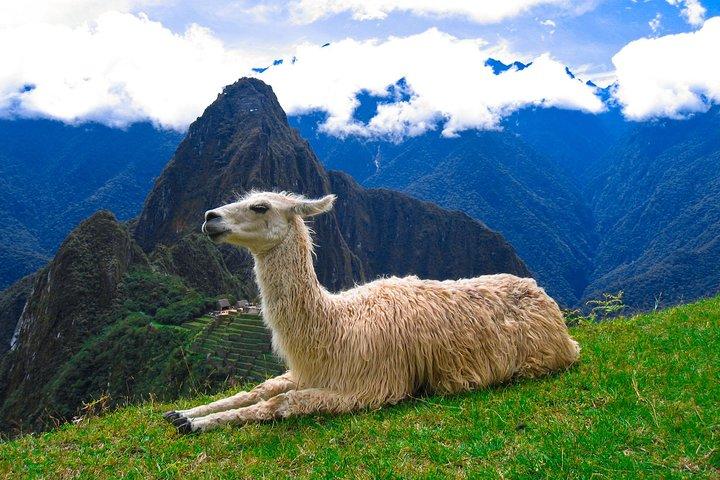
- "Get up close with resident llamas"
-
2.5hr Guided private tour
-
Fluent English-speaking guide
-
Customized itinerary options
-
Professional licensed guide
-
Briefing at hotel or station
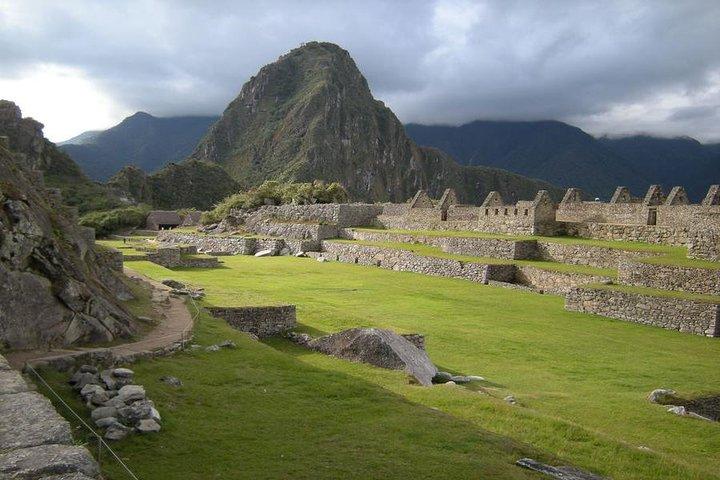
Experience the wonder of Machu Picchu like never before with a fluent English speaking and professional guide. This private tour gives you the opportunity to customize your itinerary according to your interests, ensuring you see the attractions that captivate you the most. Your guide will take you to the top attractions inside Machu Picchu, explaining the history and significance of the ancient temples, terraced hills, and sacrificial sites. They will also show you the best locations to capture stunning photographs and encounter resident llamas. With undivided attention from your guide, you'll have the chance to ask questions and truly immerse yourself in the rich culture and history of this incredible destination. Don't miss out on this unforgettable experience - book your private Machu Picchu guide today!
At a Glance
-
 2 hours 30 minutes
-
 Instant Confirmation
-
 Available in English, Spanish; Castilian
-
 Mobile voucher
-
 Private Tour
-
 Guided
-
 Family friendly

Featured Reviews

Explore the wonders of Machu Picchu with a private, fluent English-speaking guide for a personalized 2.5-hour experience.
Included
-
 Fluent English-speaking or Spanish-speaking guide
 -
2.5hr Guided tour of Machu Picchu
-
Briefing at your hotel in Machu Picchu the night before at 7pm
-
Professional and licensed Machu Picchu guide
-
Briefing at the train station if you arrive the same day
Excluded
-
 Entrance ticket to machu picchu is not included. please ask us, we are experts at getting you in.
Meeting Point
If you arrive the same day as your tour, guide will meet you at the train station EXIT (green fence) with a sign with your name.

Aguas Calientes 08681 , Peru

End Point
The tour will end inside the Machu Picchu Sanctuary, you can continue visiting Machu Picchu after the guided tour.

Muro de la Ciudad, 08680 , Peru
What to expect
Meeting Point
Briefing and introduction with your guide will be the day before at 7pm at your hotel in Machu Picchu Pueblo (also known as Aguas Calientes) prior to your guided tour. Please provide your hotel information.

If you are staying at the Belmond Santuary Lodge, choose this option and your guide will meet you 15 minutes prior to the start of your tour at this hotel.
Historic Sanctuary of Machu Picchu
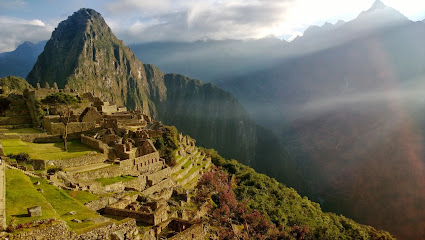
You will have a professional Machu Picchu guide take you to the top attractions inside Machu Picchu and explain the history and significance of the ancient temples, terraced hills and sacrificial sites. The guide will also take you to the best locations to capture photographs and come face-to-face with resident llamas.
150 minutes
 Admission Not Included
You will have a professional Machu Picchu guide take you to the top attractions inside Machu Picchu and explain the history and significance of the ancient temples, terraced hills and sacrificial sites. The guide will also take you to the best locations to capture photographs and come face-to-face with resident llamas.
240 minutes
Admission Not Included
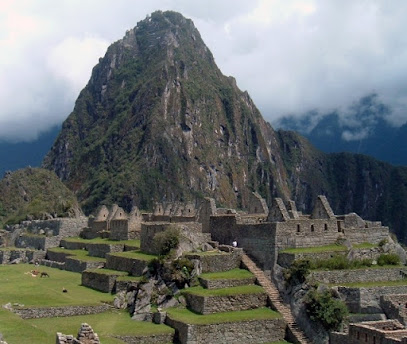
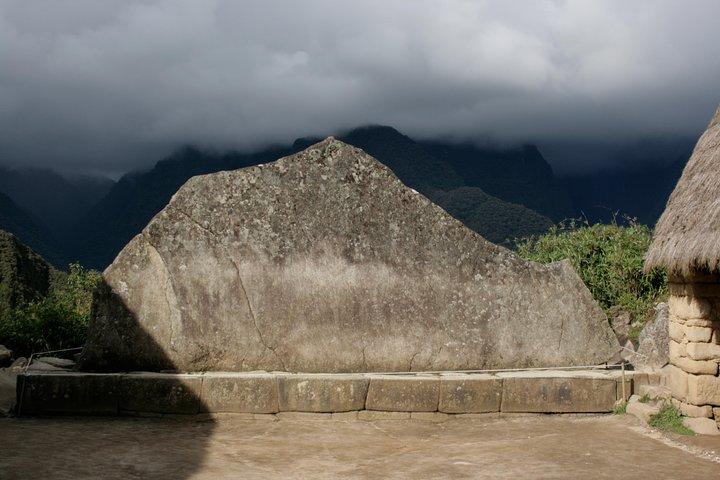
Located in the lower part of the Urban Sector of Machu Picchu, the Sacred Rock (also ominously called a Wank’a in Quechua), is a large stone, surrounded by a small low wall. In front of the rock is a large open flat area flanked by 2 open sided shelters. The lithic shelters have been restored by Peru’s Ministry of Culture and now include thatched roofs. The rock, which some say resembles the shape of the top of the mountains behind it (most noticeably Yanantin Mountain) is a shrine where the Incas carried out special rituals and pachamamas (offerings to the earth). The two shelters were used by the people carrying out the rituals. The Sacred Rock is a powerful symbol in Machu Picchu, and is recognised as being a spiritual area for meditation and absorbing positive energies. Rocks similar to this one can be found throughout the region of Cusco, often in agricultural fields. These are also called Wank’a and are considered to be guardians of the land and crops. When the Spanish arrived in Peru, many of these Wank’a were used to create Catholic churches or sanctuaries, such as the one at Qoyllority.
5 minutes
Admission Not Included
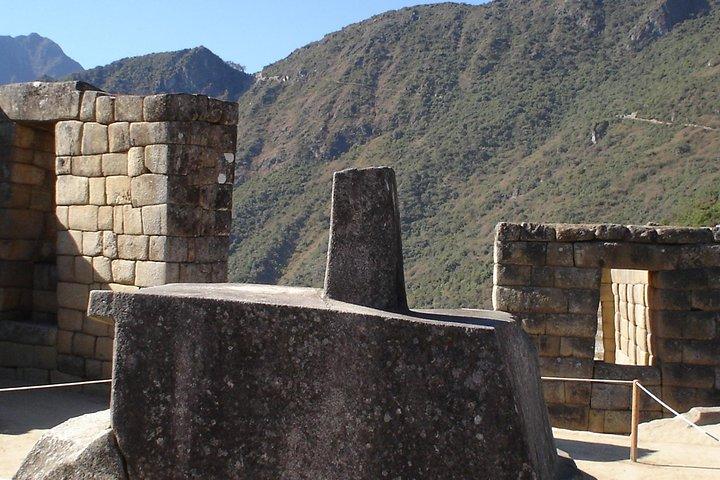
Intihuatana Stone
Located in the western side of Machu Picchu’s Urban Sector, the Intihuatana stone (also spelt Intiwatana) is a beautifully carved rock that the Incas may have used for astronomical purposes as well as spiritual and religious ceremonies. In Quechua the word Intihuatana translates as “hitching post of the sun,” but it is unknown where the origin of the term originates. Sat at the top of a large terraced pyramid, the Intihuatana Rock, carved insitu from one solid piece of granite is situated close to the Royal Plaza and is an iconic feature of Machu Picchu. Part of the base of the Intihuatana rock is formed with a stepped recess which would have been used as an altar for offerings and sacrifices. On the opposite side to the altar there is a mysterious protruding tab which points to magnetic north. The top of the rock is carved into a square with each of its corners marking the 4 cardinal points: north, east, south and west. The flat side of the square from north to east marks the winter solstice (June 21) and the side from east – south marks the summer solstice (December 22). At sunrise during winter solstice the sun light projects though the Intihuatana to produce a triangle of light which illuminates 2 strange concentric circles on the floor No one really knows for sure what the Intihuatana Stone was used for, some historians believe it was used as a sun dial, whilst others theorised its use as an astronomical observatory. Another theory was that the stone was a rock full of energy; a focal point of the positive energy at Machu Picchu and from the surrounding energy currents flowing into the rock. In the past, visitors to Machu Picchu would place there hands upon the stone to absorb the positive energy of the stone, but nowadays the stone is partitioned off from passing visitors with a permanent security guard watching over it.
5 minutes
Admission Not Included
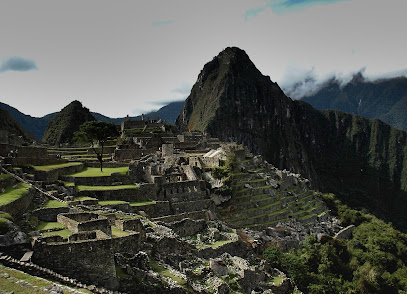
One of the most magical times in one of the most magical places in the world is winter solstice in Machu Picchu. In the Southern Hemisphere, winter solstice is the 21st of June and is the shortest day of the year, marking the start of winter. In Inca times, winter solstice was known as Inti Raymi or the Festival of the Sun. In Machu Picchu at dawn, when the very first light rises over the distant mountains, it shines through one of the two windows of the Temple of the Sun and illuminates the ceremonial stone within. The second window was for the sun’s rays on summer solstice. The Temple of the Sun was used to honor the Inca deity, known as “Inti.” The Inca’s would sacrifice animals, such as llamas, on the stone altar in order to ensure good agricultural production for the coming months of planting and harvesting. In modern times, Inti Raymi is celebrated on the 24th of June with celebrations and festivals dominating the Cusco streets from the 16th to 24th of June. This is one of the best and busiest times to visit Cusco. In the center of the Temple of the Sun is a large altar carved from rock, where the ceremonies and sacrifices could be performed. Underneath the temple is a cave, accessible only from the temple itself, which was believed to have been the burial site of Pachacutec. Along the back wall of the temple was a 'window' of small holes, believed to have originally held small gemstones, often called the 'window of the serpent' by modern scholars.
5 minutes
Admission Not Included
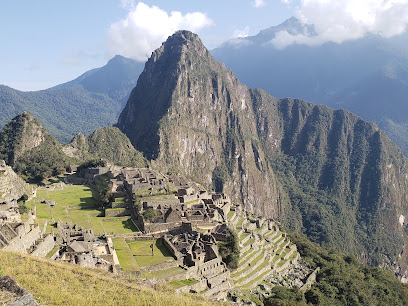
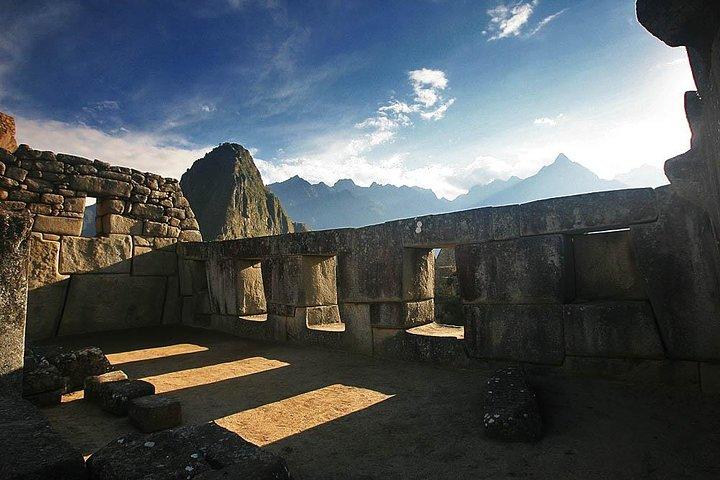
Located on the Sacred Plaza in then main Urban Section of Machu Picchu, the Temple of the Three Windows is a large lithic structure constructed of three walls. The long main wall features three large windows which are orientated east, and the two shorter lateral walls were used to support the main roof beam. There are many theories as to why this building has three windows, most of which come from ancient chronicles written by Spanish conquistadores and prominent natives nobles; all of which seem to contract each other. Hiram Bingham believed that the three windows symbolized the place where the Incas originated. His theory was based on the written words of the chronicler Pachakuti Yanki Salqamayhua who says that after the great success of Manco Cápac (the legendary first Inca ruler) in creating the Inca Empire, he himself ordered the construction of the temple. The three windows were supposed to represent the three windows of his parents’ house. Interestingly according to Inca mythology Manco Cápac and his sister Mama Ocllo were sent from heaven, not from their parents’ house!
10 minutes
Admission Not Included
Temple of the Three Windows
Situated on the Sacred Plaza in the Urban Sector of Machu Picchu, the Main Temple is an impressive rectangular shaped building consisting of 2 lateral walls and 1 rear wall. The base of the temple is made up of large lithic stones which support more regular sized and precisely carved stones. The Main Temple features a total of 17 trapezoidal shaped niches which were most likely used for ceremonial offerings. The rear wall of the temple also has 6 large stone pegs, which were probably used to hang decorations or aid in some way the rituals carried out at the temple. During Inca times it was said that the Temple was adorned with colourful mantles, emblems and mummies of the most important Inca leaders. The temple supposedly housed an effigy of P’unchao, a divine sacred symbol made of solid gold representing the Inca God Wiraqocha. When the Incas abandoned Machu Picchu at the time of the Spanish conquest, they took with them all the most important artefacts leaving behind just the stone structure which we see today. Various earthquakes over the years have undermined the structure of the Main Temple causing damage. It is most notable in the rear right hand corner of the building, where the stones have separated and moved downwards.
5 minutes
Admission Not Included
Sacred Plaza
The Sacred Plaza is located in the far western side of the Urban Sector in a naturally elevated position. The plaza is home to three important buildings: The Main Temple, The Three Windowed Temple and the Priest’s House. Within the plaza there are also three mysterious stones: the first a large low lying flat stone thought to have been used as an altar; the second a much smaller and taller quadrangular block thought to have also been used as an altar; and the third stone in the shape of a rhombus, of which its corners point to the four cardinal points. The view from the rear of the Sacred Plaza takes in the Vilcantoa Valley and mountain range. To the far right close to the river you can just see the start of the modern hydroelectric plant.
5 minutes
Admission Not Included
The experience can be subject to change due to bad weather or unforseen circumstances. We always endeavour to give you the best possible experience.
Additional Information
-
 Not recommended for travelers with poor cardiovascular health
 -
Public transportation options are available nearby
-
Suitable for all physical fitness levels
What our experts say
-
 Wear comfortable shoes for walking.
 -
Bring a water bottle to stay hydrated.
-
Check sunset times for great photos.
-
Visit the nearby hot springs after.

More About this Experience
Introduction
Experience the wonders of Machu Picchu like never before with a private and professional English-speaking guide. This exclusive tour offers you the opportunity to explore this magnificent ancient citadel at your own pace, while receiving personalized attention and gaining in-depth knowledge about the history and significance of each attraction. With a duration of 150 minutes, this tour ensures that you make the most of your time in Machu Picchu, allowing you to discover its top attractions and capture stunning photographs.What to expect?
During this tour, your knowledgeable guide will take you to the must-see spots within Machu Picchu, providing detailed explanations about the ancient temples, terraced hills, and sacrificial sites. You'll also have the chance to interact with resident llamas and learn about their significance in Inca culture. With the expertise of your guide, you can customize the itinerary according to your interests, making this experience truly unique and tailored to your preferences.Who is this for?
This private tour is designed for individuals and small groups who seek a more immersive and personalized experience in Machu Picchu. Whether you're a history enthusiast, a nature lover, or simply someone who appreciates breathtaking landscapes, this tour is suitable for all ages and fitness levels.Why book this?
Booking this private guided tour ensures that you get the most out of your visit to Machu Picchu. With a knowledgeable guide by your side, you'll gain a deeper understanding of the historical and cultural significance of this ancient site. The personalized attention allows you to ask questions and delve into specific areas of interest. Additionally, your guide will capture memorable photos of you and your group, so you can relive the experience for years to come.Good to know
It is important to note that Machu Picchu is vast and cannot be fully explored in just one day. However, with a private guide, you'll have the advantage of seeing more attractions and focusing on the ones that interest you most within the given 2.5-hour tour. Remember to wear comfortable shoes, bring sunscreen and water, and be prepared for varying weather conditions. After the guided tour, you have the freedom to continue exploring Machu Picchu at your own pace.Reviews
Customers who have booked this private guided tour of Machu Picchu have expressed their satisfaction and appreciation for the knowledge and professionalism of their guides. They were impressed by the personalized attention, allowing them to truly immerse themselves in the history and beauty of this mystical place. Many visitors have also praised the organized itinerary, which covers the top attractions and ensures a comprehensive experience. Overall, these reviews highlight the value of booking a private guide to enhance the visit to Machu Picchu and make it a truly memorable adventure.Journals from our explorers at this location










This is a popular product and the date you are looking for just sold out. Next available date is
