

Innenstadt (Linz) Travel Guide - Free
Explore Innenstadt in Linz with Evendo's free guide. Find the best shops, historic streets, restaurants, and gems on web or mobile.


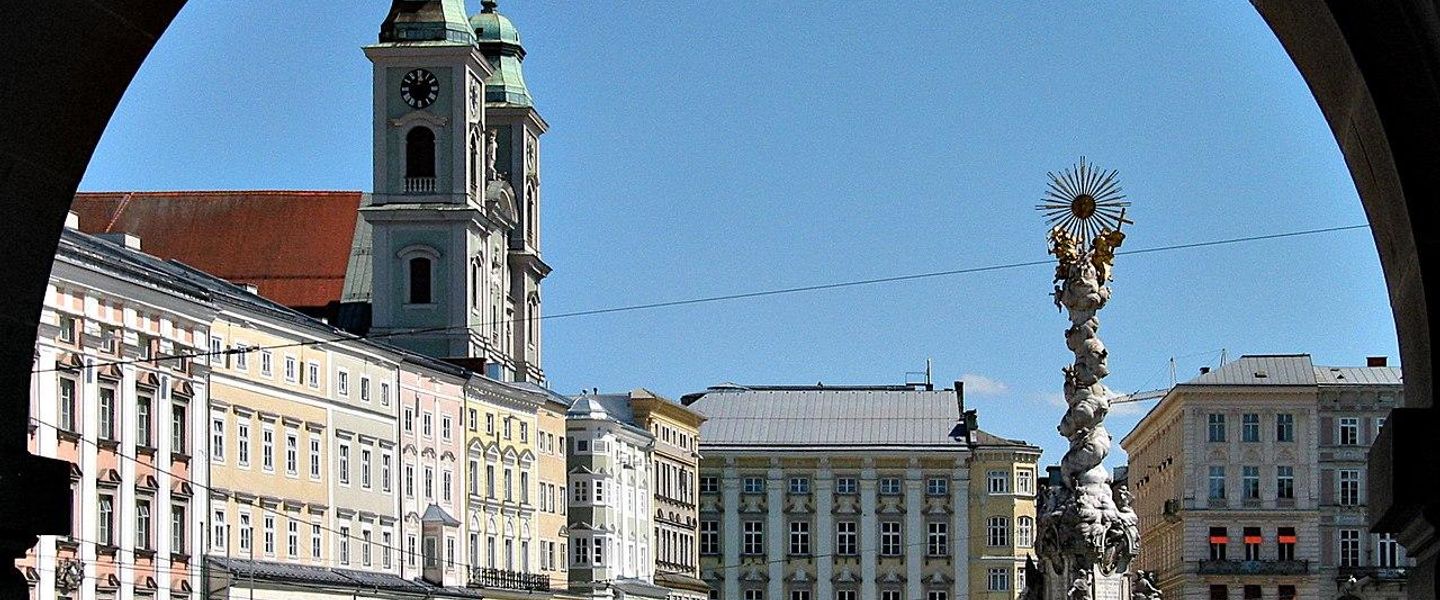


Innenstadt Linz brings together Baroque squares, Danube views, historic churches, cafés, shopping streets and the cultural heart of Upper Austria.
Historic Centre and Urban Rhythm
Innenstadt is the civic and commercial core of Linz, spreading from the Danube and Hauptplatz through the Altstadt lanes towards Landstraße, the city's principal shopping avenue. The district brings together medieval traces, Baroque façades, nineteenth-century civic buildings, modern department stores and the everyday movement of a regional capital. Its scale is comfortable for walking: a few minutes can take visitors from tram-lined streets and busy cafés to quiet courtyards, church interiors and viewpoints above the old town.Read more about Innenstadt
Squares, Churches and the Danube
Culture, Food and Shopping
Explore Innenstadt on the map
A handpicked selection of must-see spots in Innenstadt, mapped for you.
Best hotels in Innenstadt
Innenstadt essentials
Getting There
Getting Around
Safety
Emergency Situations
Do's and Don'ts
Local Tips

From Eve
Local phrases worth knowing
You don't need to get them perfect. A few words go a long way, and locals appreciate the effort.
Basics
| English | Local | Say it |
|---|---|---|
| Hello | Servus | [ser-voos] |
| Goodbye | Auf Wiedersehen | [owf vee-der-zay-en] |
| Yes | Ja | [yah] |
| No | Nein | [nine] |
| Please/You're welcome | Bitte | [bee-teh] |
| Thank you | Danke | [dahn-keh] |
| Excuse me/Sorry | Entschuldigung | [ent-shool-di-goong] |
| How are you? | Wie geht es dir? | [vee gayt es deer?] |
| Fine. And you? | Gut. Und dir? | [goot oont deer?] |
| Do you speak English? | Sprechen Sie Englisch? | [shpre-khen zee eng-leesh?] |
| I don't understand | Ich verstehe nicht | [eech fair-shtay-eh neekt] |
Eating & Drinking
| English | Local | Say it |
|---|---|---|
| I'd like to see the menu, please | Ich hätte gerne die Speisekarte, bitte | [eech hah-teh gehr-neh dee shpy-zeh-kahr-teh, bee-teh] |
| I don't eat meat | Ich esse kein Fleisch | [eech ess-eh kine fly-sh] |
| Cheers! | Prost! | [prohst] |
| I would like to pay, please | Ich möchte bitte zahlen | [eech merkh-teh bee-teh tsah-len] |
Emergencies
| English | Local | Say it |
|---|---|---|
| Help! | Hilfe! | [hill-feh] |
| Go away! | Geh weg! | [geh vehg] |
| Call the Police! | Rufen Sie die Polizei! | [roo-fen zee dee poh-lee-tsai] |
| Call a doctor! | Rufen Sie einen Arzt! | [roo-fen zee i-nen ahr-tst] |
| I'm lost | Ich habe mich verirrt | [eech hah-beh meesh fair-eert] |
| I'm ill | Mir ist schlecht | [meer ist sh-lekht] |
Shopping
| English | Local | Say it |
|---|---|---|
| I'd like to buy... | Ich möchte ... kaufen | [eech merkh-teh ... kow-fen] |
| I'm just looking | Ich schaue nur | [eech sh-ow-eh noor] |
| How much is it? | Wie viel kostet das? | [vee feel koh-stet dahs] |
| That's too expensive | Das ist zu teuer | [dahs eest tsoo toy-er] |
| Can you lower the price? | Könnten Sie den Preis senken? | [kern-ten zee den prees zehn-ken] |
Time & Numbers
| English | Local | Say it |
|---|---|---|
| What time is it? | Wie spät ist es? | [vee shpeht eest ehs] |
| It's one o'clock | Es ist ein Uhr | [es eest iyn oor] |
| Half past (10) | Halb zehn | [halb tsayn] |
| Morning | Morgen | [mohr-gen] |
| Afternoon | Nachmittag | [nahk-mee-tahk] |
| Evening | Abend | [ah-bend] |
| Yesterday | Gestern | [gehs-tern] |
| Today | Heute | [hoy-teh] |
| Tomorrow | Morgen | [mohr-gen] |
| 1 | Eins | [iyns] |
| 2 | Zwei | [tsvai] |
| 3 | Drei | [dry] |
| 4 | Vier | [feer] |
| 5 | Fünf | [foontf] |
| 6 | Sechs | [zeks] |
| 7 | Sieben | [zee-ben] |
| 8 | Acht | [ahkt] |
| 9 | Neun | [noyn] |
| 10 | Zehn | [tsayn] |
Transport & Directions
| English | Local | Say it |
|---|---|---|
| Where's a/the...? | Wo ist ein/der...? | [voh eest iyn/dehr] |
| What's the address? | Wie lautet die Adresse? | [vee lowt-et dee ah-dreh-sai] |
| Can you show me (on the map)? | Können Sie mir zeigen (auf der Karte)? | [kern-en zee meer tsay-gen (ouf dehr kahr-teh)] |
| When's the next (bus)? | Wann kommt der nächste (Bus)? | [vahn kohmt dehr n-ehk-steh (boos)] |
| A ticket (to ....) | Eine Fahrkarte (nach ....) | [iyn-eh fahr-kahr-teh (nahkh ....)] |
History of Innenstadt
A Danube Settlement Takes Shape
The area now understood as Linz's Innenstadt developed beside an important Danube crossing and along routes linking the river with the hinterland. Roman Lentia stood in the wider central area, establishing the strategic importance of the site, while the medieval settlement grew around the parish church, market spaces and the fortified Schlossberg. The river supported movement and commerce, and the elevated ground above the centre offered both protection and control of the route. Although modern streets have altered the medieval plan, the relationship between Hauptplatz, the old town lanes, the castle hill and the Danube remains legible in the central district.
Market Town and Provincial Centre
During the late Middle Ages and early modern period, Linz's central square became a focus for markets, civic administration and trade. Hauptplatz was reshaped over time by the houses of merchants and officials, while churches and religious institutions gave the surrounding streets their enduring architectural presence. The Baroque Trinity Column, erected between 1717 and 1723, reflects the period's devotional culture and remains the square's defining monument. Linz also gained importance as a residence of the Habsburg court on several occasions, strengthening the central district's political and commercial role without turning it into a permanent imperial capital.
Railways, Industry and Expansion
The nineteenth century changed Innenstadt's relationship with the rest of Linz. Rail connections and industrial growth expanded the city beyond its historic core, while new civic and commercial buildings appeared along routes leading from the old town towards the railway station and Landstraße. The centre became a place of administration, retail and public transport as well as a residential quarter. Historic streets survived, but their role shifted as Linz developed into an industrial city and regional capital. This mixture of older masonry, nineteenth-century façades and later commercial development still defines much of the district's visual character.
A Modern Cultural Capital
The twentieth and early twenty-first centuries brought war damage, reconstruction and a renewed effort to connect Linz's historic centre with contemporary urban life. Streets and commercial buildings were modernised, while the old town, churches and castle remained important markers of local identity. Linz's selection as European Capital of Culture in 2009 accelerated its cultural profile and encouraged attention to public space, contemporary art and the Danube setting across the city. Within Innenstadt, the result is not a single redevelopment style but a layered centre where medieval and Baroque buildings stand alongside post-war shops, offices, cafés and cultural venues.
Innenstadt in Photos
Browse through our photo collection highlighting the charm and character of the destination.
Neighbourhoods near Innenstadt
The closest neighbourhoods to Innenstadt, if you have time for more than one stop.

Swipe for more neighbourhoods
Explore more

Explore more of Linz
Linz combines Danube views, Ars Electronica, industrial heritage, contemporary art and historic streets with thoughtful Austrian culture and regional cuisine.
Explore Linz